
Blog / Insights
InsightsA Guide to Tax Credit Financing and Lending Options
October 14, 2026 · 13 min read · By the SFG Capital team
How Tax Credit Financing Turns Future Credits Into Working Capital
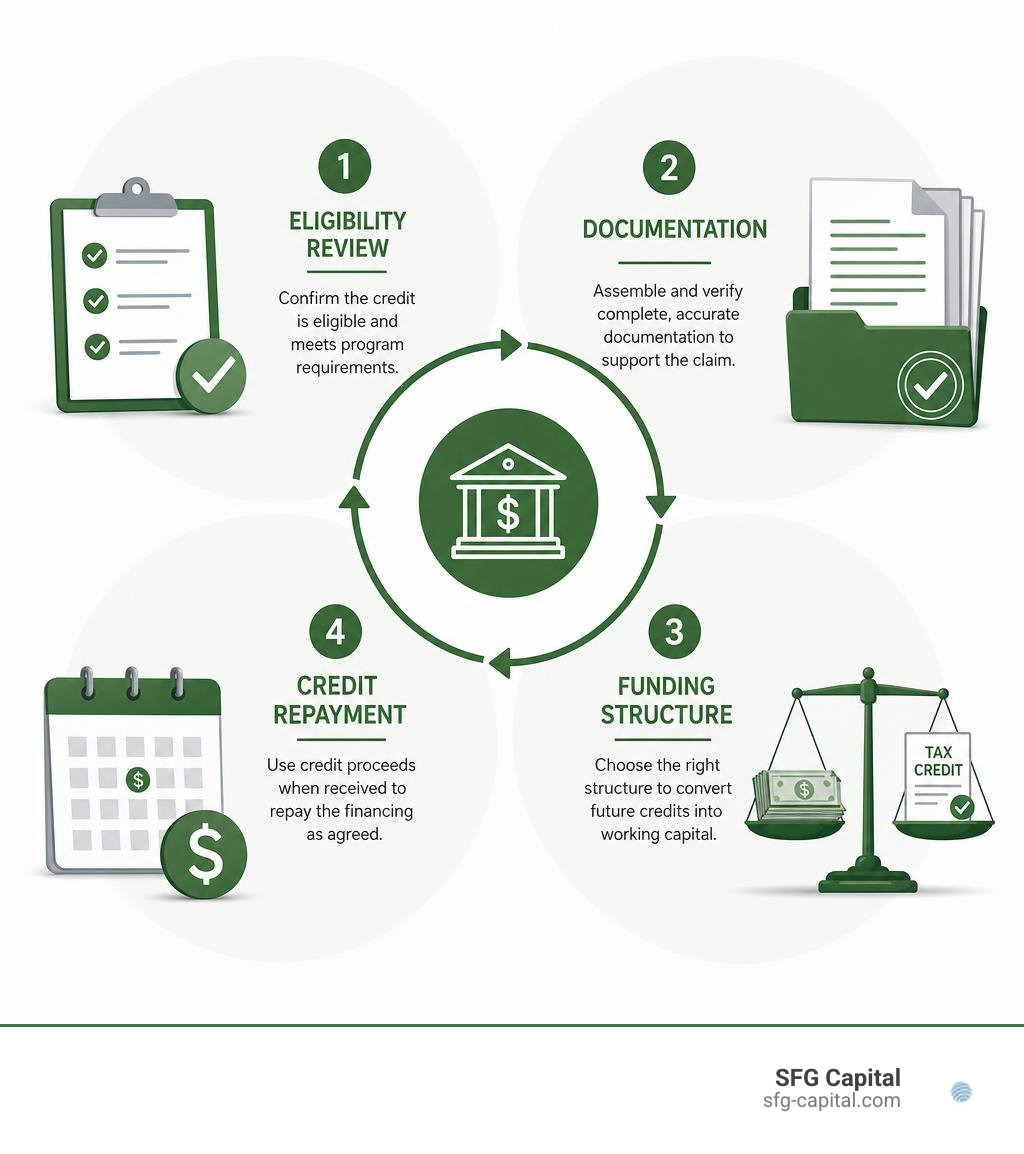
Tax credit financing helps a business or project access cash now based on tax credits it expects to receive later. To secure funding, first confirm that the credit claim is eligible and well documented. Then compare the right structure for your situation:
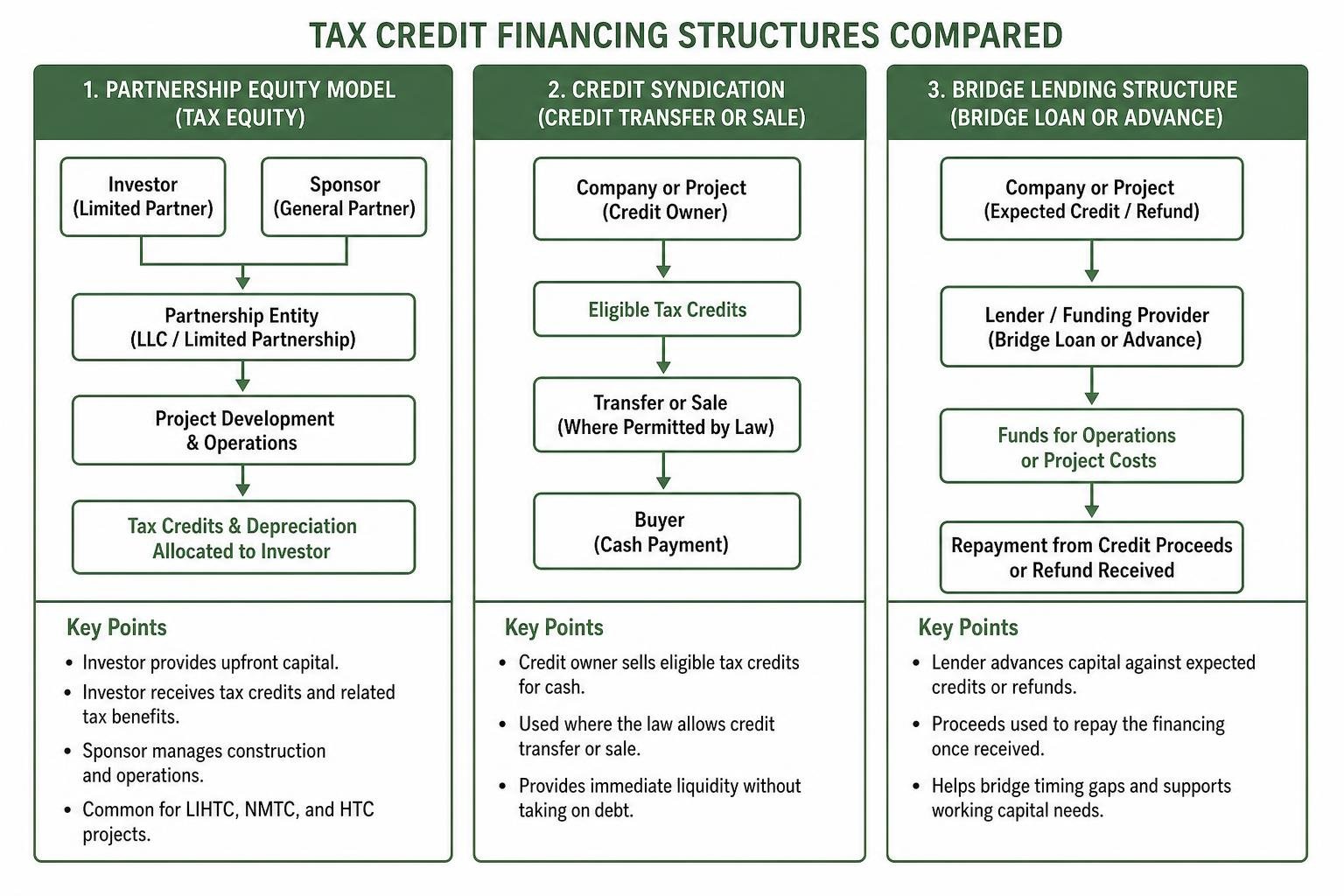
- Tax equity or syndication: An investor contributes capital in exchange for tax credits and related tax benefits.
- Credit transfer or sale: Where the law allows it, a taxpayer sells eligible credits to a buyer for cash.
- Bridge loan or advance: A lender or funding provider advances capital against an expected refund or credit proceeds, which are used to repay the financing later.
For business owners waiting on an ERC refund, the practical goal is simple: turn a properly supported claim into dependable working capital without assuming that the IRS will move on your preferred timeline.
Tax credit financing is also used for larger projects, including affordable housing, community development, historic rehabilitation, and clean energy. These transactions can combine credits with bank debt, grants, and sponsor equity to close a funding gap. The structure matters because credits may be delayed, discounted, subject to audits, or recaptured if program rules are not met.
I am Santino battaglieri, a financial-services professional focused on compliant ERC advisory and structured funding solutions. Through SFG Capital’s experience funding and purchasing more than $500 million in ERC claims, I have seen how careful documentation and disciplined Tax credit financing can help businesses pursue liquidity while managing claim and repayment risk.
Understanding Tax Credit Financing and Tax Equity Structures
Government agencies use statutory tax incentives to direct private capital toward public policy goals, such as revitalizing underserved areas, building affordable housing, and preserving landmark buildings. However, developers and operating companies frequently face a common problem: they hold valuable future tax benefits but lack the corporate income tax liability to absorb them immediately.
To turn illiquid incentives into upfront cash equity, developers use specialized partnership structures. According to a CRS report on tax equity financing, the U.S. tax equity market was estimated at roughly $20 billion in 2017. These structures allow third-party institutional investors to supply upfront capital in exchange for the stream of tax credits and depreciation deductions generated by the underlying project.
In a standard tax equity transaction, the sponsor and investor establish a pass-through entity (such as a limited liability company or limited partnership). The sponsor typically serves as the managing member or general partner handling construction and daily operations, while the investor enters as a passive limited partner.
| Program Name | Typical Credit Value | Compliance Period | Primary Capital Focus |
|---|---|---|---|
| Low-Income Housing Tax Credit (LIHTC) | 4% (bond-financed) or 9% (competitive) annually over 10 years | 15 years (30+ year extended use) | Affordable multifamily rental housing development |
| New Markets Tax Credit (NMTC) | 39% of Qualified Equity Investment (QEI) over 7 years | 7 years | Commercial and community projects in distressed tracts |
| Federal Historic Tax Credit (HTC) | 20% of Qualified Rehabilitation Expenses (QRE) | 5 years | Substantial rehabilitation of certified historic structures |
| Clean Energy Credits (ITC / PTC) | 30%+ investment credit or production-based rate | 5-year vesting (ITC) or 10-year generation (PTC) | Renewable energy installations and clean power generation |
How the Tax Equity Investment Model Works
Tax equity models depend on aligning tax allocations with statutory IRS safe harbors, such as Revenue Procedure 2007-65. Because federal tax law prohibits the naked sale of tax credits without an underlying ownership interest in the asset, the partnership structure distributes tax attributes based on equity ownership percentages.
In structures like the “partnership flip,” the tax equity investor is initially allocated up to 99% of the project’s taxable income, losses, depreciation, and tax credits until achieving a targeted internal rate of return (IRR). Once that hurdle rate is satisfied, the allocation flips—often down to 5%—returning operating control and residual cash flows to the developer.
Institutional investors—predominantly large financial institutions and corporations with substantial, predictable tax obligations—participate in these structures for two reasons:
- Financial yield: Purchasing future credits at a discount offers an attractive after-tax return that often exceeds standard fixed-income debt yields.
- Regulatory incentives: Commercial banks actively deploy capital into tax equity funds to meet statutory Community Reinvestment Act (CRA) lending and investment requirements in their assessment areas.
Monetizing Credits: Syndication, Direct Transfers, and Investor Returns
Project developers who do not have existing relationships with institutional investors often work with specialized syndication funds. Syndicators aggregate equity from multiple institutional investors, bundle pipeline developments, and handle ongoing compliance oversight in exchange for asset management fees.
When negotiating tax credit equity pricing, credits are sold at a discount to reflect the time value of money, underwriting expenses, and project risks. For example, Low-Income Housing Tax Credits historically trade in the mid-$0.80s to mid-$0.90s per $1.00 of credit. The difference between the discounted purchase price and the full dollar-for-dollar offset represents the investor’s return.
Accounting for these investments requires strict adherence to U.S. GAAP standards. As detailed in the PwC accounting guide for tax credit investments, qualifying reporting entities can utilize the Proportional Amortization Method (PAM) under ASC 323-740. This allows the investor to amortize the initial cost basis of the investment directly to income tax expense in proportion to the tax credits and benefits received, rather than recognizing it through operating income.
Recent tax legislation, notably Section 6418 of the Internal Revenue Code, has simplified clean energy monetization by allowing the direct transfer (sale) of eligible credits to unrelated corporate buyers for cash, creating an active secondary transfer market without requiring complex equity partnership entities.
Major Federal Programs: LIHTC, NMTC, and Historic Tax Credits
Federal community development programs are built around specific public policy objectives. By understanding program guidelines, developers can tailor their capital stacks to include the right credit mix.
Low-Income Housing Tax Credits (LIHTC)
Established under the Tax Reform Act of 1986, LIHTC serves as the primary federal mechanism for creating and preserving affordable rental housing. The Joint Committee on Taxation estimated that LIHTC costs roughly $13.2 billion in 2023, rising to $15.2 billion by 2025. Across its history, the program has supported the construction or rehabilitation of more than 3.5 million units nationwide.
LIHTC delivers capital through two distinct credit mechanisms:
- 9% Competitive Credits: Awarded annually by state housing finance agencies through a competitive application process governed by each state’s Qualified Allocation Plan (QAP). These credits are generally used for new construction projects that require substantial equity subsidies.
- 4% Non-Competitive Credits: Typically paired with tax-exempt private activity bonds. Under financing parameters like Freddie Mac 4% LIHTC guidelines, projects can leverage bond credit enhancement structures, achieving debt coverage ratios as low as 1.15x for fixed-rate debt with loan terms up to 35 years.
To qualify, properties must meet statutory income and rent limits:
- 20-50 Rule: At least 20% of units must be rent-restricted and occupied by tenants earning 50% or less of Area Median Income (AMI).
- 40-60 Rule: At least 40% of units must be rent-restricted and occupied by tenants earning 60% or less of AMI.
- Average Income Test: At least 40% of units must be occupied by households with an average income not exceeding 60% AMI, with no individual unit exceeding 80% AMI.
LIHTC properties are subject to a mandatory 15-year initial compliance period, backed by a minimum 30-year extended-use affordability commitment.
New Markets Tax Credits and the Role of CDEs
Administered by the U.S. Treasury’s Community Development Financial Institutions (CDFI) Fund, the CDFI Fund NMTC Program attracts private investment into economically distressed communities. As of the end of FY 2023, the NMTC Program has generated $8 of private investment for every $1 of federal funding and supported more than 888,200 jobs.
The NMTC provides a 39% federal tax credit calculated against the Qualified Equity Investment (QEI) amount, claimed over a seven-year compliance schedule (5% per year for the first three years, and 6% per year for the remaining four years).
The program relies on specialized financial intermediaries known as Community Development Entities (CDEs). CDEs compete for annual allocation authority from the CDFI Fund and direct capital to Qualified Active Low-Income Community Businesses (QALICBs).
NMTC funding is deployed within Qualifying Census Tracts that meet core distress thresholds:
- Poverty rates exceeding 20% (or 30% for high-distress classifications).
- Median family income below 80% of statewide or metropolitan benchmarks.
- Unemployment rates at least 1.5 times the national average.
NMTC capital is commonly structured as a pair of loans (an “A Note” representing leveraged senior debt and a “B Note” representing subsidized equity proceeds). Combined, this provides 20% to 25% of a project’s total cost in the form of low-cost, interest-only financing that can be forgiven or restructured at the end of the seven-year compliance period.
Historic Tax Credits and the Power of Twinning Strategies
The Federal Historic Rehabilitation Tax Credit (HTC) provides a 20% credit on Qualified Rehabilitation Expenses (QREs) for certified historic structures undergoing substantial rehabilitation. Administered by the National Park Service (NPS) alongside the IRS, the project must preserve the historical character of the building and be held for income-producing purposes (such as commercial, industrial, or residential rental use; owner-occupied housing is ineligible).
Nearly 40 states offer companion state Historic Tax Credits, often adding another 20% to 25% of qualified costs.
Developers can also pair these incentives through “credit twinning.” Combining federal HTCs, state HTCs, and New Markets Tax Credits on a single historic renovation within a qualifying low-income census tract allows developers to cover more than 50% of total project costs through tax equity subsidies alone. In these projects, developers often utilize master lease agreements to pass tax credit attributes to investors while keeping daily operations and developer fees clean and tax-efficient.
Debt Structures and Borrowing Against Tax Credits

While tax equity provides long-term capital, it does not always solve short-term cash flow needs during construction and stabilization. This timing gap creates a need for specialized bridge financing.
Bridge Loans and Debt Structuring in Tax Credit Financing
In many tax credit structures, equity investors do not disburse all of their capital on day one. Instead, tax equity is contributed in stages tied to specific construction and performance milestones, such as completing the foundation, reaching dry-in, certificate of occupancy, or final lease-up.
To pay contractors and keep work moving before tax equity arrives, project sponsors utilize Tax Credit Bridge Loans. As outlined in legal analyses of transfer bridge loan considerations, sizing these bridge facilities requires reviewing developer obligations, investor creditworthiness, and statutory credit transfer requirements.
Lenders evaluate several factors when structuring these loans:
- Advance Rates: Sized between 80% and 95% of committed tax equity capital contributions. If a buyer has not yet signed a purchase contract for transferable clean energy credits, uncommitted advance rates drop to 50% to 75%.
- Collateralization: Secured via Uniform Commercial Code (UCC) financing statements filed against the developer’s partnership interests, capital call receivables, and escrow accounts.
- Intercreditor Agreements: Coordinate priority rights between senior construction debt lenders, mezzanine lenders, and tax equity investors to establish clear notice and cure rights in the event of default.
Managing Risks: Recapture, Discounting, and Timing Gaps
Borrowing against future tax credits carries structural risks that require careful underwriting:
- Recapture Risk: Under statutory guidelines (such as IRC Section 50 for energy credits or LIHTC compliance rules), if a property changes ownership, falls out of compliance, or suffers a foreclosure within the compliance window, the IRS can reclaim previously awarded credits. To protect against this, lenders often require completion bonds, sponsor indemnifications, or specific affiliate joint venture entities that keep tax credits isolated from term-loan foreclosure actions.
- Timing Gaps and Interest Accrual: Tax credit certifications require rigorous cost accounting and third-party CPA audits before state agencies or the IRS issue final determination letters. Delays in completing these audits or submitting state filings extend the bridge loan term, increasing interest expenses and reducing overall project returns.
- Collateral Discounting: Tax credits are rarely converted at full face value. Changes in statutory corporate tax rates or shifting corporate appetite can cause pricing discounts to widen, leaving an unexpected funding gap that the sponsor must bridge with subordinated debt or equity.
Business Tax Credit Advances and Payroll Refund Liquidity
Tax credit financing is not limited to real estate and utility-scale energy projects. Operating companies can also borrow against or monetize refundable payroll tax credits to address working capital needs.
Small Business Liquidity and Tax Credit Financing Options
During periods of economic volatility, programs like the Employee Retention Credit (ERC) provided payroll tax relief to help businesses maintain staff. However, backlogs at the Internal Revenue Service have often left business owners waiting many months for processing and check delivery.
For businesses that cannot afford to leave capital tied up in processing queues, specialized liquidity options can accelerate access to cash:
- ERC Bridge Loans: Short-term credit facilities secured by the business’s anticipated Form 941-X payroll refund. The business borrows a portion of its expected refund, using the IRS check to pay off the balance upon receipt.
- Non-Recourse ERC Advances and Buyouts: Business owners can sell your ERC claim through a direct factoring or purchase agreement. The funding provider purchases the rights to the pending refund at a discounted rate, delivering immediate capital and assuming the processing timeline.
At SFG Capital, we provide tailored ERC funding solutions, including non-recourse ERC bridge loans and structured ERC refund advance options. By conducting detailed eligibility reviews and claim analyses up front, we help local business owners bypass agency backlogs and access immediate cash flow for expansion, payroll, and daily operations.
Evaluating Policy Alternatives: Direct Pay, Refundable Credits, and Grants
The historic reliance on private tax equity partnerships has sparked policy debate among economists and lawmakers. In traditional tax equity syndication, transaction friction—such as syndicator fees, legal structuring, and discounted credit pricing—diverts an estimated 10 to 25 cents of every federal subsidy dollar away from the underlying project.
To improve efficiency, policy alternatives have emerged across federal initiatives:
- Direct Pay (IRC Section 6417): Allows tax-exempt entities, state and local governments, and tribal organizations to treat clean energy tax credits as direct overpayments of tax, triggering a direct cash refund from the IRS without needing a private tax equity partner.
- Statutory Refundability: Designing credits so that any benefit exceeding a taxpayer’s liability is paid directly as a cash refund, eliminating the need for secondary monetization partners.
- Direct Federal Grants: Models like the Section 1603 program under the American Recovery and Reinvestment Act temporarily replaced renewable tax credits with direct cash construction grants during the 2008–2009 financial crisis.
While direct grants and refundable credits offer higher dollar-for-dollar financial efficiency, traditional tax equity models continue to hold support because third-party investors provide rigorous underwriting, project vetting, and ongoing compliance oversight.
Frequently Asked Questions About Tax Credit Lending and Equity
How much capital can New Markets Tax Credits provide for a project?
New Markets Tax Credit funding typically generates 20% to 25% of a project’s total capital costs in the form of net equity proceeds. The investment is delivered as an interest-only, low-interest loan (the “B Note”) that can be forgiven or restructured after completing the mandatory seven-year compliance period. Due to legal, audit, and structuring costs, NMTC transactions generally require a minimum project size of around $4 million to be economically viable.
What is tax credit twinning and how does it benefit developers?
Tax credit twinning involves pairing multiple credit programs—such as combining federal Historic Tax Credits (HTC), state HTCs, and New Markets Tax Credits (NMTC)—within the financing structure of a single project. By layering these incentives, developers can cover more than 50% of their total project costs with tax equity, reducing the need for conventional bank debt and closing large capital gaps on complex redevelopments.
What is the difference between tax credit syndication and tax credit bridge loans?
Tax credit syndication is an equity transaction where a developer sells partnership interests and tax benefits to an investor (or pool of investors) at a discount in exchange for permanent project equity. A tax credit bridge loan is a debt product that provides short-term construction financing to fund project costs until the investor’s equity installments or credit sale proceeds are distributed to pay off the loan.
Conclusion
Tax credit financing is a powerful mechanism that transforms statutory incentives into working capital for commercial real estate, affordable housing, community revitalization, and operating businesses. Whether you are structuring complex multi-tiered partnerships under LIHTC, NMTC, and HTC frameworks or accelerating a pending payroll refund claim, success depends on proper documentation, clear underwriting, and disciplined risk management.
At SFG Capital, we understand the operational challenges of delayed tax incentives. We work directly with business owners to provide clear guidance, thorough eligibility reviews, and liquidity through compliant advance and buyout structures. If your enterprise is waiting on a filed tax credit claim, contact our team today to explore how structured financing can unlock the capital you need to keep your business moving forward.
See what your business may qualify for.
60 seconds. No documents. No upfront cost.
General information only, not legal or tax advice. Eligibility and estimates are fact-specific and subject to review.