
Blog / Insights
InsightsAmending Your 941 for ERC Without Losing Your Mind
October 14, 2026 · 11 min read · By the SFG Capital team
How to File an Amended 941 for the Employee Retention Credit
To claim a missed Employee Retention Credit (ERC), file Form 941-X for each qualifying 2020 or 2021 quarter. First confirm eligibility, recalculate qualified wages without double-counting PPP forgiveness wages, complete the ERC lines and explanation, and coordinate the required wage-deduction adjustment on your income tax return.
The ERC claim deadlines have passed: April 15, 2024, for 2020 quarters and April 15, 2025, for 2021 quarters. If you already filed an amended 941 employee retention credit claim, the focus now is accuracy, IRS correspondence, documentation, and avoiding a costly disallowance.
IRS processing has been slow, but a clean claim is still your best protection. Keep records that show your gross-receipts decline or government-ordered suspension, payroll data by employee, health-plan costs, and how you kept ERC wages separate from PPP wages.
I am Santino battaglieri, founder of SFG Capital, with more than nine years in financial services and experience supporting ERC transactions at scale. Our work with amended 941 employee retention credit claims centers on careful documentation, practical risk review, and helping businesses understand their options while they wait for the IRS.
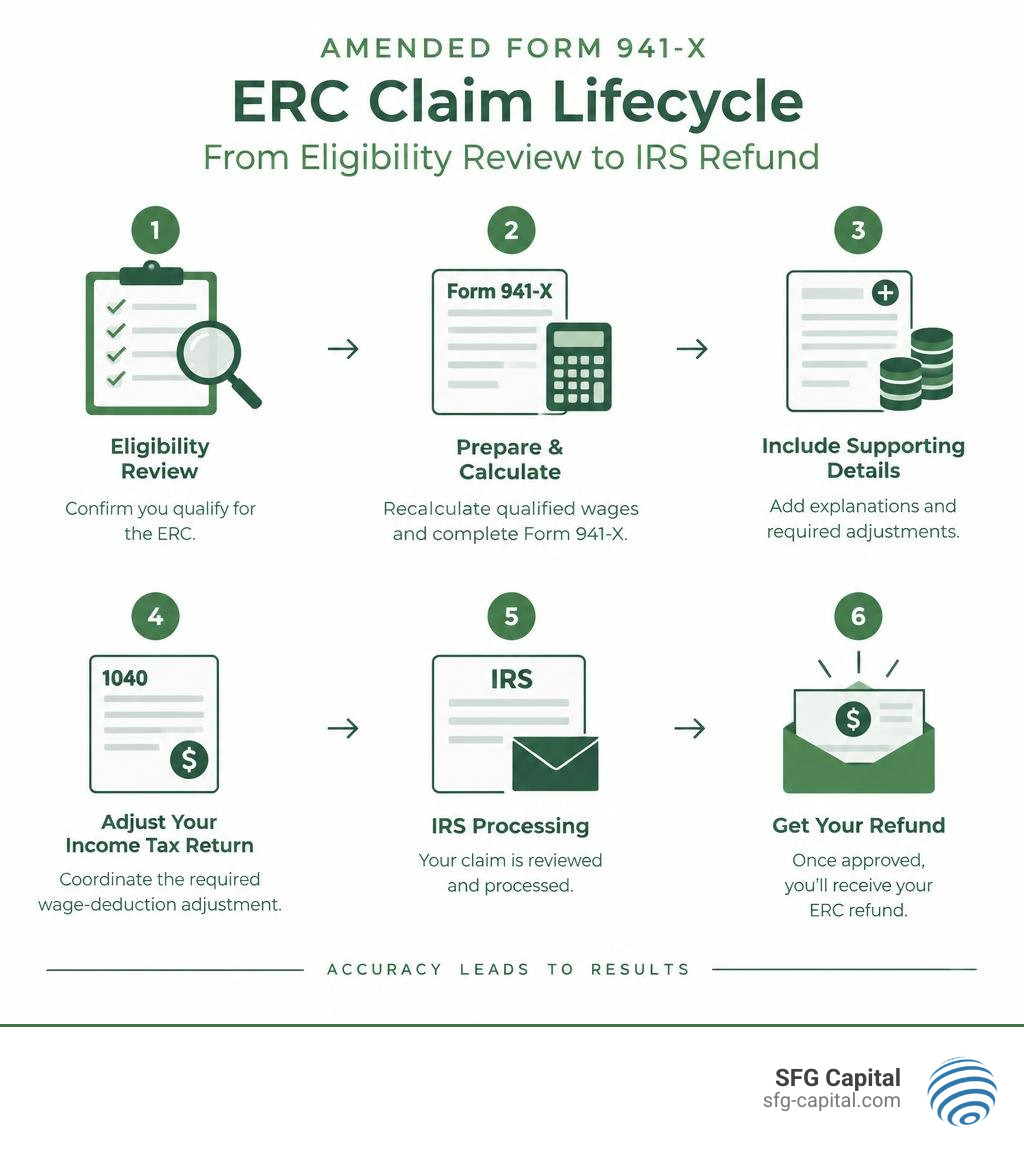
Simple amended 941 employee retention credit word guide:
Understanding Form 941-X and Employee Retention Credit Eligibility
When the federal government introduced the Coronavirus Aid, Relief, and Economic Security (CARES) Act in 2020, it established the Employee Retention Credit to encourage businesses to keep staff on payroll during widespread economic disruption. While some employers claimed the credit on their original quarterly payroll tax returns, thousands discovered their eligibility well after the fact.
To correct a prior return and retroactively claim relief, employers must use Form 941-X (Adjusted Employer’s QUARTERLY Federal Tax Return or Claim for Refund). Form 941-X is the only official document the IRS recognizes for adjusting federal employment taxes and claiming refundable payroll credits across individual calendar quarters. Understanding the mechanics of the ERC begins with recognizing that it operates entirely through your payroll tax filings, rather than standard corporate income tax forms.
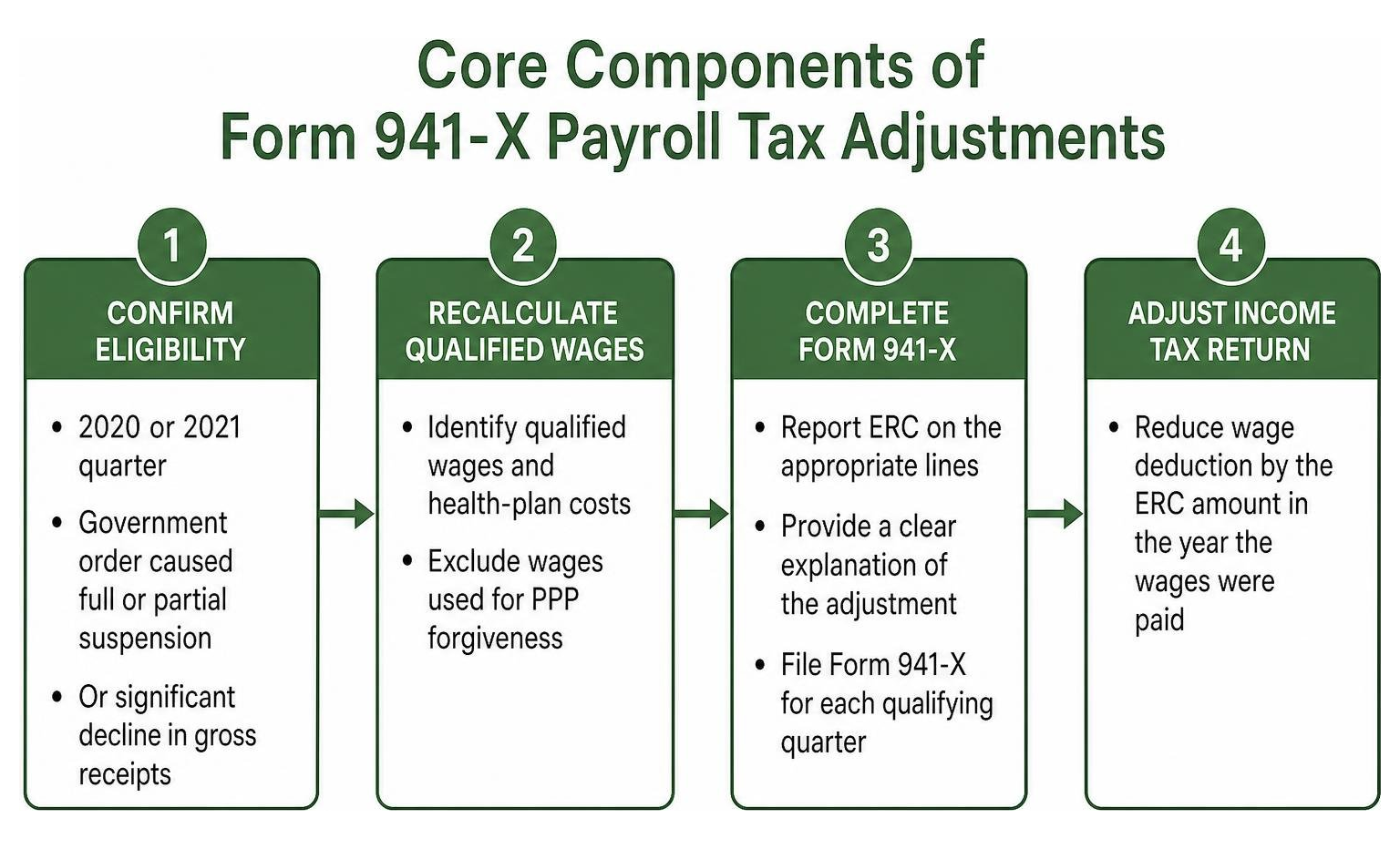
Qualifying Rules and Filing Deadlines for Past Quarters
To establish eligibility for any amended return, an employer must satisfy clear qualifying criteria. Under IRS rules, a business qualified during 2020 or 2021 if it experienced either:
- A full or partial suspension of operations due to government orders limiting commerce, travel, or group meetings because of COVID-19.
- A significant decline in gross receipts:
- For 2020: Gross receipts for a calendar quarter fell below 50% of gross receipts for the same calendar quarter in 2019.
- For 2021: Gross receipts for a calendar quarter fell below 80% of gross receipts for the same calendar quarter in 2019 (or the immediately preceding quarter).
- Status as a Recovery Startup Business: For the third and fourth quarters of 2021, businesses that began operations after February 15, 2020, and had average annual gross receipts under $1 million could qualify without meeting the standard gross receipts or suspension tests (subject to a $50,000 quarterly cap).
The statutory deadlines to file Form 941-X are governed by Internal Revenue Code rules: within three years from the date the original Form 941 was filed (or deemed filed on April 15 of the following year) or two years from the date the tax was paid, whichever is later. As a result, the statutory filing window closed on April 15, 2024, for 2020 payroll quarters and on April 15, 2025, for 2021 payroll quarters.
| Attribute | 2020 ERC Parameters | 2021 ERC Parameters (Q1–Q3) |
|---|---|---|
| Credit Calculation Rate | 50% of qualified wages | 70% of qualified wages |
| Wage Limit per Employee | $10,000 per calendar year | $10,000 per calendar quarter |
| Maximum Credit per Employee | $5,000 per year ($10,000 × 50%) | $21,000 per year ($7,000 per quarter × 3) |
| Gross Receipts Decline Test | > 50% reduction vs. 2019 | > 20% reduction vs. 2019 |
| Large Employer Threshold | More than 100 full-time employees | More than 500 full-time employees |
| Statutory Filing Deadline | April 15, 2024 | April 15, 2025 |
For full historical parameters and legislative updates, review the IRS 2020 vs 2021 Comparison Chart.
Step-by-Step Guide to Filing an Amended 941 Employee Retention Credit Return
Amending quarterly returns requires careful preparation. You must prepare a separate Form 941-X for every calendar quarter you intend to adjust. Never combine multiple quarters onto a single form.

Before filling out the form, review the Instructions for Form 941-X and collect your original Form 941 filings, detailed payroll summaries, qualified health plan expense schedules, and Paycheck Protection Program (PPP) loan forgiveness reports. Wages allocated to PPP forgiveness cannot be counted toward the ERC. Employers can submit Form 941-X via paper mail or utilize electronic filing capabilities supported by approved IRS Modernized e-File providers.
Completing Parts 1, 2, and Key Line Items on Form 941-X
To prepare Form 941-X accurately, proceed through each section sequentially:
- Header Details: Fill in your Employer Identification Number (EIN), business name, and address. Check the box for the specific calendar quarter and enter the calendar year being corrected.
- Part 1 (Process Selection): Check Box 2 (“Claim”) if you are requesting a refund or abatement of overreported employment taxes.
- Part 2 (Certifications): Check Box 5d to certify that your claim consists entirely of adjustments to refundable and nonrefundable employment tax credits.
- Part 3 (Adjustments to Wages and Credits):
- Line 18a (Nonrefundable portion): Enter the nonrefundable portion of the credit as a negative amount in Column 4. This offsets your employer tax share on the return.
- Line 26a (Refundable portion): Enter the refundable portion of the credit as a negative number in Column 4.
- Line 27 (Total adjustments): Combine lines 18a and 26a to reflect your total net credit claim.
- Line 30 (Qualified wages for ERC): Enter the total qualified wages paid during the quarter (excluding wages used for PPP forgiveness).
- Line 31a (Qualified health plan expenses): Report allocable group health plan costs associated with the qualified wages.
- Part 4 (Explanation of Corrections): On Line 43, provide a detailed explanation of why the return is being amended. State that you are correcting the return to claim the Employee Retention Credit, list the qualifying criteria (such as suspension by local health order or gross receipts drop), and provide the math behind the qualified wage calculations.
Calculating Your Amended 941 Employee Retention Credit with Worksheets 2 and 4
The IRS provides dedicated calculation worksheets within the Form 941-X instructions. Using the correct worksheet depends on the calendar period of the claim:
- Worksheet 2: Used for qualified wages paid between March 13, 2020, and June 30, 2021. For these quarters, the nonrefundable portion of the credit offsets the employer’s share of Social Security tax (6.2%).
- Worksheet 4: Used for qualified wages paid between July 1, 2021, and December 31, 2021 (Q3 and Q4 2021). Under the American Rescue Plan Act, the nonrefundable portion shifts to offset the employer’s share of Medicare tax (1.45%).
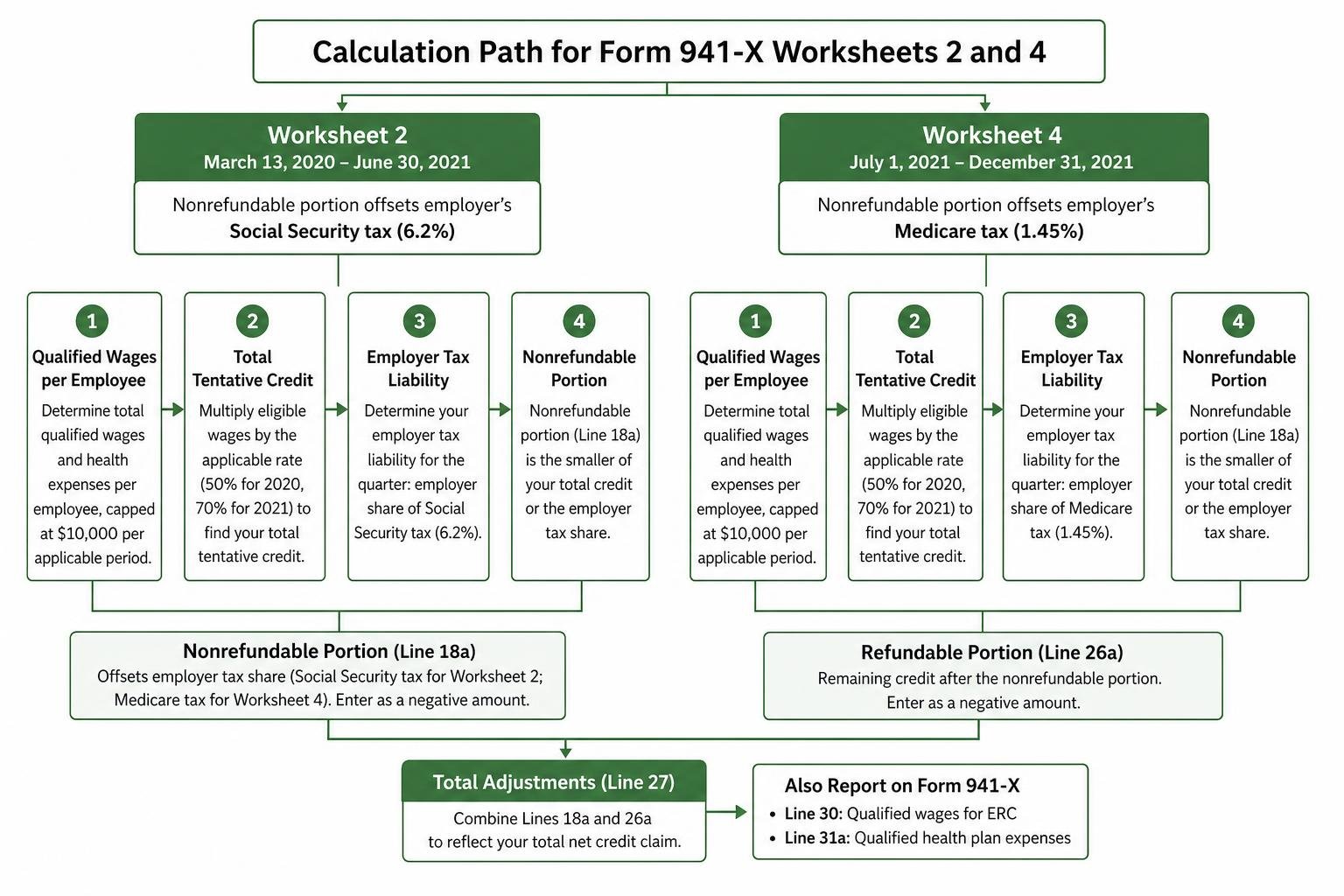
To calculate the split:
- Determine total qualified wages and health expenses per employee, capped at $10,000 per applicable period.
- Multiply eligible wages by the applicable rate (50% for 2020, 70% for 2021) to find your total tentative credit.
- Determine your employer tax liability for the quarter (Social Security tax for Worksheet 2; Medicare tax for Worksheet 4).
- The nonrefundable portion (reported on Line 18a) is the smaller of your total credit or the employer tax share.
- The refundable portion (reported on Line 26a) is the remaining credit balance. Both portions are ultimately paid out as a direct refund if your taxes were previously deposited in full.
Income Tax Deductions and IRS Penalty Relief for ERC Amendments
Claiming an employment tax credit affects your income tax obligations. The IRS treats the ERC as an expense offset rather than tax-free grant income.

Wage Deduction Adjustments and Amending Income Tax Returns
Under Internal Revenue Code (IRC) Section 280C(a), employers cannot take a double benefit for the same wage dollars. You must reduce your deductible wage expense on your federal income tax return by the exact dollar amount of the ERC claimed.
This wage reduction applies to the tax year in which the qualified wages were paid or accrued, not the year the refund check arrives. Consequently, claiming the ERC requires adjusting prior-year income tax filings:
- C-Corporations: File Form 1120-X to lower deductible wages, which increases taxable income and generates an additional corporate tax liability.
- Sole Proprietorships: File Form 1040-X with an adjusted Schedule C, which can increase both income tax and self-employment tax.
- S-Corporations: File Form 1120-S, issue amended Schedules K-1 to shareholders, and require shareholders to amend their personal returns.
- Partnerships: Partnerships subject to the Bipartisan Budget Act (BBA) must file an Administrative Adjustment Request (AAR) using Form 8082 alongside Form 1065 rather than a standard Form 1065-X.
For businesses dealing with long processing backlogs, IRS guidance provides limited alternative procedures to account for adjustments in the year of receipt, though standard practice continues to rely on amending the wage deduction year.
Reasonable Cause Penalty Abatement and Relief Options
Because amending an income tax return to reduce wage deductions increases prior-year tax liabilities, business owners often face underpayment penalties and interest charges before their ERC refund checks have even been issued.
The IRS recognized this issue in Notice 2021-65 and related administrative guidance. If you owe additional income tax because your wage deduction was reduced by a retroactive ERC claim, you can request Reasonable Cause Penalty Abatement. To qualify:
- Submit a written explanation establishing that the underpayment resulted directly from retroactive ERC wage reduction adjustments.
- Demonstrate that you acted in good faith and exercised ordinary business care.
- Request reasonable cause relief rather than using your one-time First-Time Penalty Abatement, preserving your first-time waiver for unexpected future issues.
While statutory interest cannot always be abated under general reasonable cause standards, penalty mitigation prevents compounding delinquency fees.
IRS Processing Timelines, Backlogs, and Risk Mitigation in 2026
Filing an amended payroll tax return requires patience and careful recordkeeping. The influx of retroactive filings led the IRS to implement enhanced scrutiny, creating an inventory backlog that agency staff continues to process.
Current IRS Backlog Status and Claim Tracking
Processing speeds for amended returns remain deliberate. As of May 2026, the IRS inventory reflects roughly 20,600 ERC claims progressing through various administrative stages:
- 3,500 claims under active preliminary compliance review.
- 4,000 claims pending final payment approval or formal disallowance notice.
- 5,500 claims assigned to field or correspondence audit teams.
- 6,000 claims awaiting IRS evaluation of taxpayer disallowance responses.
- 1,600 claims currently handled by the IRS Independent Office of Appeals.
To track a pending claim, employers or their authorized representatives (using Form 2848 Power of Attorney) can contact the IRS Practitioner Priority Service. While the Taxpayer Advocate Service historically assisted with hardship cases, agency resources remain focused on resolving remaining legacy submissions. You can monitor overall trends through our 2026 processing timelines and backlog updates.
Avoiding Audits and Disallowance on an Amended 941 Employee Retention Credit Claim
The IRS maintains aggressive audit enforcement targeting improper ERC filings promoted by predatory third-party mills. Proposed legislative measures, including the “One, Big, Beautiful Bill,” include provisions to extend the IRS assessment statute of limitations on ERC claims to six years across all calendar quarters.
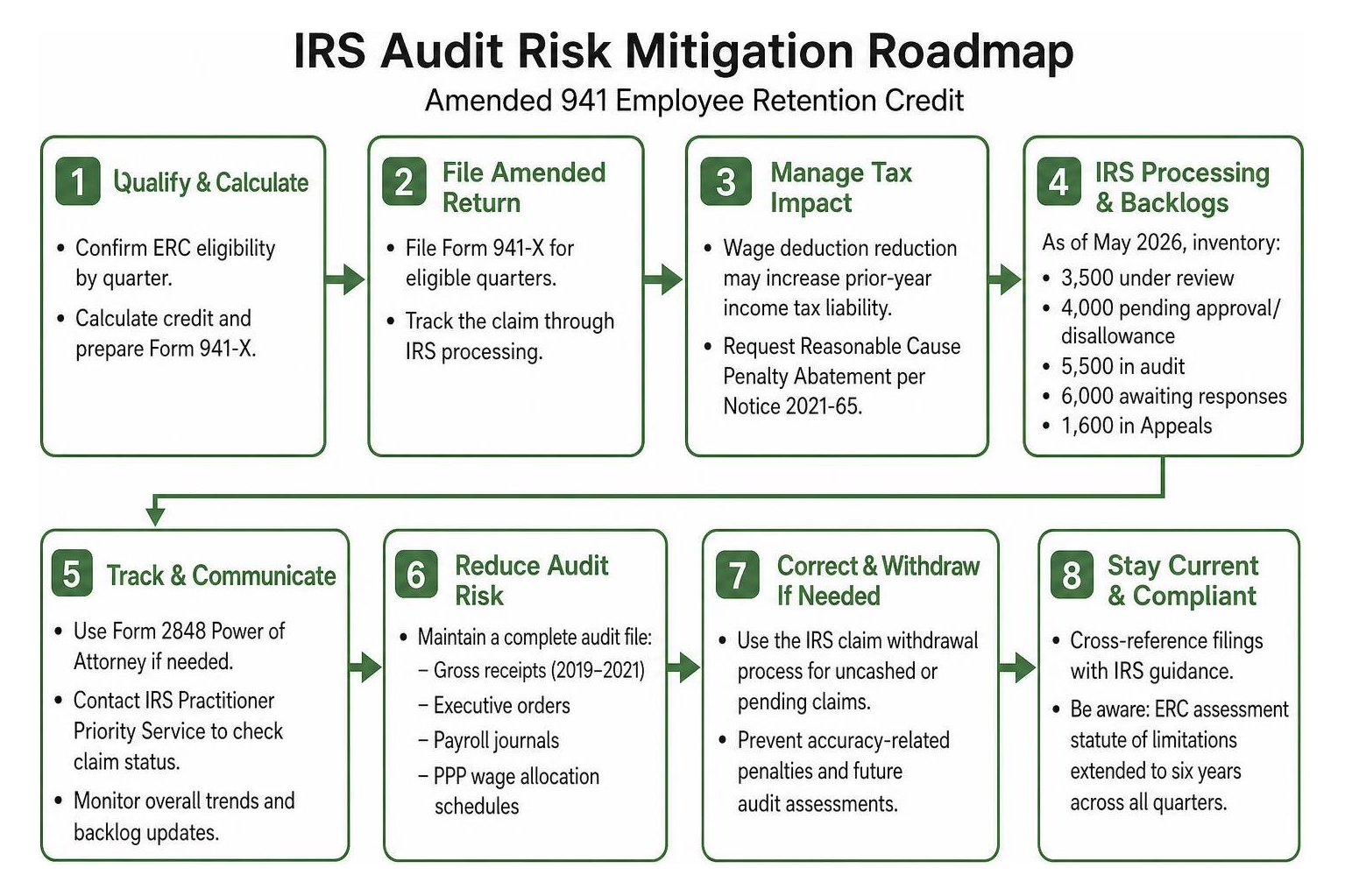
To protect your business against audits and disallowance:
- Maintain a Complete Audit File: Retain contemporaneous records of gross receipts ledgers from 2019, 2020, and 2021, exact copies of executive emergency orders that impacted operations, detailed payroll journals, and PPP wage allocation schedules.
- Utilize the IRS Claim Withdrawal Process: If you discover that an uncashed or pending claim was calculated incorrectly or submitted by an aggressive promoter without meeting qualifying criteria, submit a formal withdrawal request. Withdrawing an unprocessed claim prevents future accuracy-related penalties and audit assessments.
- Review Official Updates: Cross-reference your filings against standard guidance on the IRS Employee Retention Credit Overview.
Frequently Asked Questions About Amending Form 941 for ERC
How long does the IRS take to process Form 941-X for ERC refunds?
IRS processing of Form 941-X claims typically takes between 6 to 12 months, though complex claims or returns flagged for secondary compliance reviews can extend past a year. The IRS pays statutory interest on legitimate refund claims that experience processing delays. For employers needing immediate capital for operations, advance funding options provide liquidity while the agency processes the underlying paperwork.
Is the Employee Retention Credit considered taxable income on federal returns?
The ERC refund is not considered gross income for federal tax purposes. However, under IRC Section 280C, you must reduce your deductible wage expenses on your federal income tax return by the amount of the credit. This increases your net taxable business income, creating an indirect tax effect roughly equivalent to the credit amount multiplied by your marginal income tax rate.
Can I withdraw an amended Form 941 claim if I suspect an error?
Yes. If you submitted a Form 941-X claim that has not yet been paid—or if you received a refund check but have not yet cashed or deposited it—you can utilize the IRS ERC claim withdrawal process. Withdrawing the claim treats it as though it was never filed, eliminating potential failure-to-pay penalties, accuracy penalties, and related audit investigations.
Conclusion
Amending payroll tax returns to secure the Employee Retention Credit requires exact calculations, thorough substantiation, and synchronized updates to your federal income tax returns. While statutory filing windows for 2020 and 2021 payroll quarters have closed, navigating ongoing IRS correspondence, potential audits, and processing queues remains a top priority for business owners.
At SFG Capital, we work with businesses throughout Austin and Travis County, Texas, to manage complex payroll credit documentation, protect against audit risks, and bypass lengthy IRS processing delays. Explore our specialized ERC refund advance services to turn your pending payroll tax claims into reliable working capital today.
See what your business may qualify for.
60 seconds. No documents. No upfront cost.
General information only, not legal or tax advice. Eligibility and estimates are fact-specific and subject to review.