
Blog / Insights
InsightsBefore You Dial, Know That Wait-Time Estimates Depend on Review and Call Volume
November 25, 2026 · 8 min read · By the SFG Capital team
Call the IRS to Speak to Someone About a Tax Refund
To speak with an IRS representative about an individual tax return, call 1-800-829-1040 Monday through Friday, 7 a.m. to 7 p.m. local time, except federal holidays. For a business return, call 1-800-829-4933. Have your return and any IRS notice ready, then follow the prompts for your issue.
Phone wait times change with call volume. A call may help you understand a delayed refund, but it cannot guarantee a payment date. If you need cash while an eligible ERC refund is pending, SFG Capital offers ERC advances and buyouts. Funding estimates depend on claim review and eligibility.
I’m Santino Battaglieri, founder of SFG Capital. With more than nine years in financial services and experience with pending ERC claims, I know why business owners search for “call irs speak to someone” when they need a clear answer about a delayed refund.
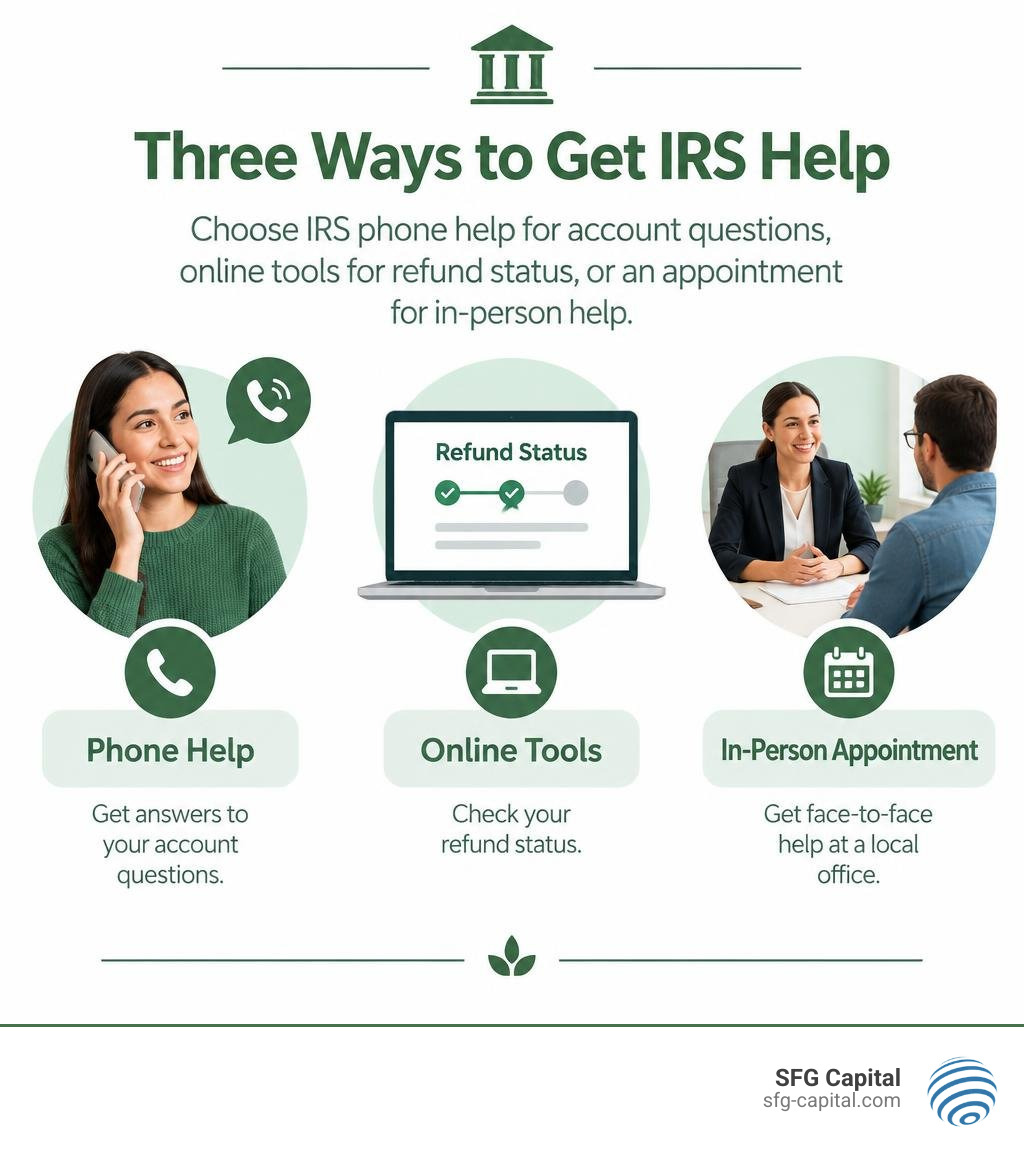
How to call the IRS to speak to someone: number, hours, and timing
The main line for individual taxpayers is 1-800-829-1040. It is open Monday through Friday, 7 a.m. to 7 p.m. local time. The IRS closes its phone lines on federal holidays. Callers in Alaska and Hawaii follow Pacific time, and Puerto Rico’s lines run 8 a.m. to 8 p.m. local time.
Timing matters almost as much as the number. The IRS says waits are usually longer on Mondays and Tuesdays, over Presidents Day weekend, and close to the April filing deadline. Wednesday through Friday tends to be calmer. Calling early in the day is also a popular tip, since queues often build as the day goes on.
Please treat every wait-time figure as an estimate. Actual waits depend on call volume and on what your account needs reviewed. Nobody can promise you a time.
Here is a quick example of why we say this. A business owner waiting on a pending ERC claim might call on a Monday in April and sit through a long queue. The same owner calling on a Thursday in the fall could get through much faster. Same question, very different day.
See if you qualify for cash against a pending refund while you wait. It takes a short form, you need no documents to start, and there is no upfront cost.
When are IRS phone lines open, and what are typical wait times?
- Hours: 7 a.m. to 7 p.m. local time, Monday through Friday, excluding federal holidays.
- Filing season (January to April): the IRS says waits can average roughly 8 to 9 minutes, depending on the source page.
- May to December: waits can average about 15 minutes.
- Variable queues: averages hide long stretches on busy days, and some lines run longer than others.
- Callback option: when waits pass about 15 minutes or call volume is high, you may be offered a return call during regular business hours instead of holding. If it is offered, it is often worth taking.
How to get through and prepare before you call

A little prep turns a frustrating call into a short one. Charge your phone, or plug it in, because holds can run long. Find a quiet spot, since the automated system can misread background noise. Write your questions down before you dial.
During the call, note the representative’s name and badge number, and jot down what they tell you in detail. If action is promised, ask for a timeframe and follow up if it does not happen. Stay polite. It really does help.
Calling for someone else? The IRS needs authorization first. That means the taxpayer is on the line with you or you have a signed Form 8821 or Form 2848 on file. Representatives must verify identity before discussing personal account details.
How to call the IRS to speak to someone through the automated system
The IRS phone menu can feel like a maze, and menus may change, so there is no guaranteed shortcut. These habits tend to help:
- Listen to the full prompt before answering.
- Describe your specific issue instead of a vague “I want a representative.” Something like “I need help with a notice about my return” or naming a form works better.
- Mention the exact form or notice number when you have one.
- Skip self-service offers, such as refund status or transcripts, if your issue is more complex.
- If you land in the wrong department, hang up and try again with different wording.
- Accept a callback if one is offered.
- Ask the representative to clarify anything confusing, and keep notes.
Also know that phone assistors will not prepare your forms line by line.
What to prepare before you call the IRS to speak to someone
Have these ready:
- Social Security number or ITIN
- Date of birth
- Filing status
- The tax return you are calling about, plus last year’s return
- Any IRS notice or letter you received
- Payment records
- Relevant W-2 or 1099 forms
- Authorization documents if you are calling for another person
Choose the right IRS number or online option for your issue

The IRS uses different lines for different needs. Here is a handy list:
- Individual returns: 1-800-829-1040
- Business returns: 1-800-829-4933
- Nonprofits: 1-877-829-5500 (8 a.m. to 5 p.m.)
- Missing refund tracing (automated): 1-800-829-1954
- Taxpayer Assistance Center appointments: 1-844-545-5640
- Spanish: 1-800-829-1040
- Other languages (interpreter): 833-553-9895
- TTY/TDD: 1-800-829-4059
- International callers: 1-267-941-1000 (not toll-free)
The IRS does not accept tax questions by email, so phone, online tools, or an appointment are your routes. The IRS contact tools and phone options page is a good starting hub. The IRS Online Account also covers refund status, transcripts, payments, and payment plans, often without any hold music.
If your issue is a pending ERC claim, our ERC claim support page explains how we help. You can also see if you qualify with a short form, no documents to start, and no upfront cost.
When should I call about a refund or amended return?
Patience saves calls. The IRS issues most refunds in less than 21 days, though that is not a promise for every return.
- E-filed return: call only after 3 weeks, unless Where’s My Refund tells you to call sooner.
- Paper return: wait 6 weeks.
- Amended return: check Where’s My Amended Return after 3 weeks, and call only if more than 16 weeks have passed since you mailed it.
- Do not file a duplicate return while you wait. It can slow things down.
Slow refunds have many causes, and our advance funding options for eligible claims can help while the IRS finishes its review. All timelines depend on IRS review.
What can the IRS help with, and what is better handled online?
Phone representatives can help with notices, account questions, balances, payment plans, and refund referrals when the online tool tells you to call. When a letter lists a phone number, use that number.
Online is usually better for transcripts, tax forms, payments, and general tax-law information. Representatives will not handle early refund status checks or complaints that taxes are too high.
If waiting is hurting your cash flow, advance funding options for eligible claims can provide funds while the IRS finishes its review. Amounts and timing depend on claim review and eligibility.
When to seek TAS or local help, and how to spot an IRS scam
Sometimes the normal phone line just does not solve it. That is when escalation or in-person help makes sense. Just as important, make sure whoever contacts you is the real IRS.
When should I contact the Taxpayer Advocate Service?
The Taxpayer Advocate Service (TAS) is a free, independent organization within the IRS. Consider it when:
- You tried regular IRS channels and could not fix the problem.
- You face financial hardship, such as trouble paying for housing, food, or utilities.
- An IRS process failed, or you have waited more than 30 days past normal processing time.
TAS offers an eligibility tool, and you can call 1-877-777-4778 or submit Form 911. TAS is very busy, and replies can take up to two weeks. Case resolution can take anywhere from a couple of weeks to a couple of months, and no timeline is guaranteed. Contact the Taxpayer Advocate Service to start. Low Income Taxpayer Clinics are another option, representing eligible taxpayers for free or a small fee.
How do I arrange in-person IRS help?
Taxpayer Assistance Centers work by appointment only and cover specific topics. Find a local IRS office, including in Austin and Travis County, then call 1-844-545-5640 to book and confirm the services offered.
Bring two original forms of ID, including a current government-issued photo ID, plus your SSN or ITIN and supporting tax records. Arrive on time, since you may lose your slot if you are over 15 minutes late without checking in. Leave food, drinks, cameras, and weapons at home.
How to spot an IRS scam
The IRS usually makes first contact by U.S. mail, not by phone, email, or text. Be suspicious of contact that is unexpected, rushed, threatening, or demands immediate payment or personal information. A social media message is never from the IRS. Do not click suspicious links. If someone visits you in person, ask to see credentials. How to know it’s the IRS explains the details and how to report suspicious contact.
Conclusion
To reach a person, match your issue to the right IRS number, check online tools first, and have your identity and tax records ready. Wait out the published refund-processing window before calling, and use only verified channels for calls, visits, and appointments. If you need to call the IRS to speak to someone, a little prep goes a long way.
If your pending ERC, tariff (IEEPA) refund, payroll tax credit, or other government refund is taking longer than your budget can handle, SFG Capital can help you get cash now instead of waiting. Funding estimates depend on claim review and eligibility, and we cannot guarantee any funding amount or timeline.
See if you qualify. It takes a short form, you need no documents to start, and there is no upfront cost. Prefer to talk it through? Contact a specialist.
See what your business may qualify for.
60 seconds. No documents. No upfront cost.
General information only, not legal or tax advice. Eligibility and estimates are fact-specific and subject to review.