
Blog / Insights
InsightsDirect Deposit and Delays: The 2026 IRS Survival Guide
October 14, 2026 · 9 min read · By the SFG Capital team
Why IRS Refund Delays 2026 Require Early Action
IRS refund delays 2026 are hitting taxpayers most often when returns are suspended for review, banking details are missing or wrong, or a refund must move through the slower paper-check process. File electronically, verify routing and account numbers before filing, and respond to any IRS notice right away.
For taxpayers who receive a CP53E notice, the deadline matters. You generally have 30 days to add or correct direct-deposit information through your IRS Individual Online Account. Missing that window can mean waiting about six more weeks for a paper check, pushing the total delay close to two and a half months.
The problem is broader than one notice. More than 14 million individual returns were suspended during the 2026 filing season, while paper returns and paper refunds slowed amid staffing cuts and technology problems. For businesses waiting on payroll tax refunds or ERC-related processing, those delays can turn into a real working-capital issue.
I am Santino Battaglieri, founder of SFG Capital, with more than nine years in financial services and experience supporting compliant ERC transactions and structured funding. This guide explains the practical steps businesses and taxpayers can take to navigate IRS refund delays 2026 while protecting cash flow.
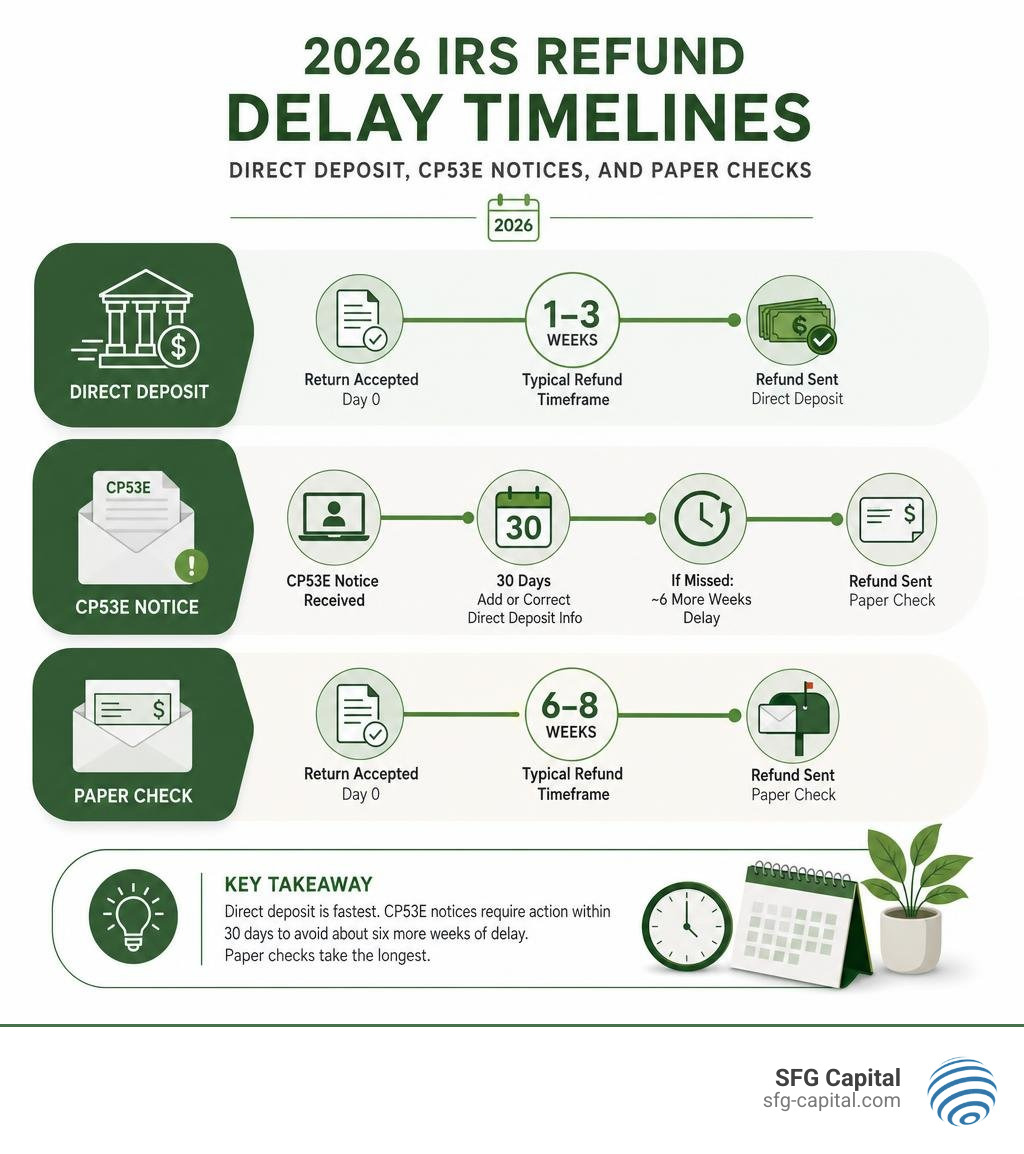
Irs refund delays 2026 basics:
Understanding IRS Refund Delays 2026: Key Causes and Timelines
The 2026 tax season has brought major shifts in how the federal government disburses money to individuals and businesses alike. While the vast majority of filers expect their funds within the standard 21-day processing window, millions have found their money caught in bureaucratic holding patterns. Understanding why these logjams occur is the first step in determining what to do when your tax refund is stuck in processing limbo.
During the 2026 filing cycle, the IRS processed approximately 139 million individual income tax returns and distributed over 90 million refunds. The average refund amount climbed to roughly $3,275. However, while electronic filers with accurate direct deposit details generally saw prompt disbursements, an unprecedented number of returns triggered automated security filters, document verification requests, and structural holds.
Key Operational Drivers of IRS Refund Delays 2026
At the root of the processing slowdowns lies a confluence of workforce contraction and technological bottlenecks. The IRS submission processing division concluded the filing season with approximately 8,100 personnel, representing an 18% workforce reduction compared to the previous year. Furthermore, nationwide in-person Taxpayer Assistance Centers experienced widespread cutbacks, with fully staffed offices dropping from 102 down to 42 locations.
These staffing constraints were compounded by severe hardware and software outages. During the opening six weeks of the filing season, the agency’s primary individual paper scanning system went completely offline. The situation was even more challenging for commercial filings: the business paper return scanning architecture remained non-functional throughout the entire filing season. As a result, the agency was forced to outsource 3.7 million paper business returns to private contractors—a 725% surge over prior volumes.
As detailed when the National Taxpayer Advocate issues 2026 mid-year report to Congress, administrative friction, procurement bottlenecks, and phone assistance limitations placed severe burdens on filers seeking live account resolutions.
Suspended Returns and the 14 Million Taxpayer Backlog
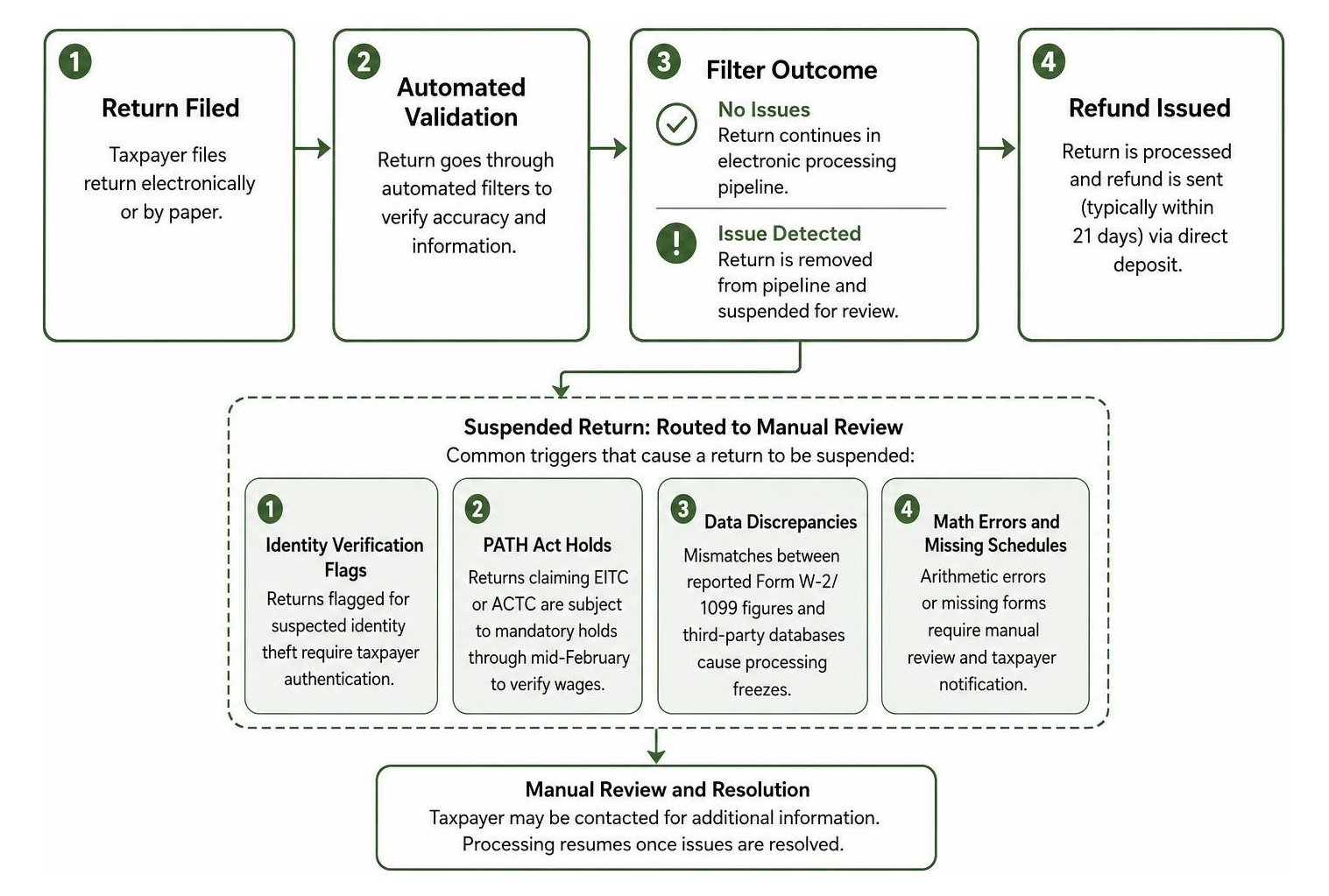
More than 14 million individual returns were suspended by automated validation filters during the 2026 filing season. When an automated filter catches an anomaly, the return is removed from the regular electronic processing pipeline and routed into manual inventory.
Over one million taxpayers whose returns were suspended experienced an average wait time of 5.5 weeks beyond standard delivery schedules. These suspensions stem from several primary triggers:
- Identity Verification Flags: Returns flagged for suspected identity theft require taxpayers to authenticate their identity using online tools or direct mail correspondence.
- PATH Act Holds: Returns claiming the Earned Income Tax Credit (EITC) or Additional Child Tax Credit (ACTC) are subject to mandatory statutory holds through mid-February to verify wage reporting.
- Data Discrepancies: Mismatches between reported Form W-2/1099 figures and third-party payer databases cause automated processing freezes.
- Math Errors and Missing Schedules: Simple arithmetic adjustments or omitted forms require manual review and taxpayer notification.
The 2026 Direct Deposit Mandate and the CP53E Notice Trap

One of the largest contributors to refund hold-ups in 2026 involves banking details. In an effort to curb check fraud and modernize federal disbursements, the IRS has implemented strict electronic direct deposit verification rules. When a return contains invalid, missing, or rejected routing details, the refund is immediately frozen, triggering an official CP53E notice.
Through late April, the IRS issued roughly 4 million CP53E notices. This notice alerts the recipient that their money cannot be disbursed until valid direct deposit information is provided.
Executive Order 14247 and the Paper Check Phase-Out
Under Executive Order 14247, the federal government initiated an aggressive phase-out of traditional paper checks. This policy directive resulted in an 80% decrease in the total volume of paper refund checks issued during the early months of 2026 compared to historical numbers.
For taxpayers requesting paper instruments or failing to provide verified banking data, the timeline has stretched considerably. The average time required to issue a paper refund jumped to 36 days in 2026, up from 13 days in 2025. When combined with the statutory 30-day notice response window, taxpayers trapped in this cycle face total wait periods extending past two and a half months.
How to Resolve a CP53E Notice and Unfreeze Funds
Receiving a CP53E letter requires immediate action. To resolve the freeze and speed up the release of funds:
- Log in to your IRS Individual Online Account via IRS.gov.
- Navigate to the Profile section and select Banking Information.
- Choose Add Bank Account and carefully enter your financial institution’s 9-digit routing number and your account number.
- Verify all digits against a formal bank statement rather than a debit card number.
- Submit the update to initiate direct electronic disbursement.
Taxpayers who update their banking credentials online often receive their electronic deposit within seven days. Taking proactive measures will consistently speed up your tax refund compared to letting the system default to manual checks.
Small Business Payroll Backlogs and Form 941 Processing Bottlenecks

While individual taxpayers struggle with direct deposit verifications, employers and commercial enterprises face substantial hurdles within the agency’s commercial accounts divisions. Paper-filed quarterly payroll returns and amended business filings have encountered unprecedented delays.
Impact of IRS Refund Delays 2026 on Business Payroll and ERC Claims
The agency’s commercial processing pipeline has experienced acute backlogs. The average processing time for paper Form 941 (Employer’s Quarterly Federal Tax Return) climbed to 72 days in 2026—a significant jump from 45 days in 2025 and 25 days in 2024.
This extended processing lag directly impacts businesses awaiting payroll tax adjustments and Employee Retention Credit disbursements. For company leadership, understanding and overcoming ERC refund delays is essential for maintaining liquidity. When millions of dollars in credits remain immobilized in government processing queues, everyday operations face strain.
To bridge this gap, many companies evaluate structured financial tools, including options for an ERC refund advance to secure capital without waiting for IRS manual processing.
Managing Cash Flow During Extended IRS Backlogs
Uncertainty surrounding government payouts forces businesses to adopt strategic cash management protocols. Delayed tax credits can disrupt payroll funding, inventory acquisition, and supplier contracts.
At SFG Capital, we work with business owners across Travis County, Austin, TX, and throughout the United States to resolve liquidity bottlenecks caused by federal processing queues. Through tailored ERC refund buyouts and advances, businesses can convert pending claims into immediate working capital. Our performance-based model delivers clear financing solutions while our specialists assist with claim documentation, insulating your balance sheet from administrative holdups.
How to Track Your Refund Status and Avoid IRS Processing Delays
Minimizing processing delays begins with choosing the right filing methods and monitoring systems. The table below outlines how filing format and delivery selection influence overall refund delivery schedules in 2026.
| Filing Method | Delivery Selection | Typical 2026 Processing Schedule | Potential Delay Factors |
|---|---|---|---|
| Electronic (E-File) | Direct Deposit | Up to 21 Days | PATH Act holds, automated anti-fraud review |
| Electronic (E-File) | No Bank Info (CP53E) | 21 Days + 6 to 10 Weeks | Failure to submit bank details within 30 days |
| Paper Return | Direct Deposit | 30 to 45 Days | Manual data entry, physical mail transit |
| Paper Return | Paper Check | 8 to 12+ Weeks | Scanning system outages, check phase-out rules |
| Form 941 / 941-X | Treasury Check / Direct | 72+ Days | Third-party contractor scanning backlogs |
Utilizing IRS Online Account and Where’s My Refund Tools
Taxpayers can track their returns using digital self-service utilities:
- Where’s My Refund?: Available on IRS.gov and via the IRS2Go mobile application. It reflects updates once daily, usually overnight. Access requires your Social Security Number or ITIN, filing status, and exact expected refund dollar amount.
- IRS Individual Online Account: Provides an in-depth view of tax transcripts, received notices, wage records, and banking settings.
- Refund Status Stages: The trackers move across three sequential phases: Return Received, Refund Approved, and Refund Sent.
To check the official progress of an individual return, consult the official IRS refund tracking tool.
Practical Alternatives for Unbanked Taxpayers
The elimination of automatic paper checks under Executive Order 14247 presents unique challenges for unbanked filers. Fortunately, several compliant pathways exist to receive electronic payments without a traditional brick-and-mortar checking account:
- FDIC-Insured Prepaid Debit Cards: Many reloadable prepaid cards feature dedicated routing and account numbers capable of receiving direct deposits from the U.S. Treasury.
- Digital Wallets and Fintech Accounts: Verified mobile payment applications often provide routing credentials tailored for payroll and tax disbursements.
- Paper Check Exception Waivers: Individuals unable to establish electronic accounts can request an official paper check waiver through their IRS Online Account or by contacting telephone assistance at 800-829-1040.
Frequently Asked Questions About 2026 Tax Refunds
What is a CP53E notice and what happens if I ignore it?
A CP53E notice is an official IRS communication indicating that your tax refund has been approved but cannot be released because your direct deposit banking details are missing, invalid, or rejected by your financial institution.
If you ignore the CP53E notice and do not supply valid banking information within 30 days, the IRS will place your refund into a manual check conversion queue. This triggers a mandatory waiting period of roughly six additional weeks before a paper check is mailed, resulting in total processing delays of up to two and a half months.
How long does the IRS take to process paper returns in 2026?
Paper tax returns face substantial processing backlogs. The average processing time for an individual paper return increased to 30 days in 2026, compared to 16 days in 2025.
For business paper filings, such as Form 941, processing times average 72 days due to the ongoing shutdown of internal scanning hardware and the transition to outside data-entry contractors. E-filing remains the most reliable method to ensure prompt return processing.
Does the IRS pay interest on delayed refunds in 2026?
Yes. Under internal revenue statutes, if the IRS takes longer than 45 days past the official April filing deadline (or the date you filed, whichever is later) to issue your refund, the agency is legally obligated to pay overpayment interest.
Interest rates are adjusted quarterly based on the federal short-term rate plus three percentage points. Any refund interest paid by the U.S. Treasury is considered taxable income and will be reported on Form 1099-INT for the subsequent tax year.
Conclusion
The 2026 filing environment requires proactive tax management. With more than 14 million returns suspended, strict electronic deposit mandates, and extensive paper processing queues, relying on automatic paper checks is no longer viable. Ensuring your direct deposit information is accurate before filing—and responding promptly to any CP53E correspondence—is the most effective way to protect your timeline.
For commercial enterprises in Travis County and nationwide managing extended federal delays on payroll adjustments, SFG Capital delivers practical cash-flow relief. Our specialized funding solutions help bypass administrative backlogs so you can keep your business moving forward. If your company is waiting on federal credits, contact our team today for specialized employee retention credit help and tailored advance funding options.
See what your business may qualify for.
60 seconds. No documents. No upfront cost.
General information only, not legal or tax advice. Eligibility and estimates are fact-specific and subject to review.