
Blog / Insights
InsightsDon’t Leave Money on the Table with ERC for Small Business
October 31, 2026 · 10 min read · By the SFG Capital team
The ERC for Small Business: What You Need to Know Before the Deadline
ERC for small business is a refundable tax credit created under the CARES Act that rewards eligible employers for keeping workers on payroll during the COVID-19 pandemic. It is not a loan — it does not need to be paid back.
Here’s a quick snapshot of what’s available:
| 2020 | 2021 (Q1–Q3) | |
|---|---|---|
| Credit rate | 50% of qualified wages | 70% of qualified wages |
| Wage cap per employee | $10,000 total | $10,000 per quarter |
| Max credit per employee | $5,000 | $7,000/quarter ($21,000 total) |
| Combined max per employee | Up to $26,000 | |
| Eligibility threshold | 50% gross receipts decline | 20% gross receipts decline |
To qualify, your business generally needs to meet one of these tests for any eligible quarter:
- Gross receipts declined significantly compared to 2019
- Operations were fully or partially suspended due to a government order
The credit is available for wages paid between March 13, 2020 and September 30, 2021 (with special rules for recovery startup businesses extending to December 31, 2021).
Despite the program’s size, many small business owners have never claimed it — or haven’t claimed the full amount they’re owed. The IRS currently has a backlog of approximately 1.2 million unprocessed ERC claims, and businesses have been waiting over a year for refunds they’re already entitled to.
I’m Santino Battaglieri, founder of SFG Capital, a financial services firm that has purchased and funded over $500 million in ERC claims and helped businesses navigate the full spectrum of ERC for small business advisory, compliance, and funding. In this guide, I’ll walk you through everything you need to know — eligibility, calculations, deadlines, scam protection, and how to access your funds faster.
Understanding the ERC for Small Business: Eligibility and Rules
Navigating the rules for the erc for small business can feel like trying to read a map in a thunderstorm. However, once you strip away the dense tax jargon, the eligibility boils down to two main avenues. You don’t need to meet both; qualifying under either the “Suspension Test” or the “Gross Receipts Test” opens the door to these funds.

The first way to qualify is through a government suspension. If your business was forced to fully or partially shut down due to orders from a federal, state, or local government authority, you likely qualify for the period the order was in effect. This isn’t just about being “closed.” It includes “disruptions of typical business operations” such as capacity limits, enforced social distancing that reduced your seating, or restricted hours of operation. If you are a restaurant in Austin that had to limit indoor dining to 50% capacity, that is a partial suspension.
The second way is the gross receipts decline. This is a purely mathematical test compared against your 2019 numbers. For many, this is the most “business-friendly” test because once you qualify for a quarter based on revenue loss, you often automatically qualify for the subsequent quarter. To dig deeper into these specifics, we recommend reviewing The Essential Guide to ERC Eligibility Requirements.
The rules shifted significantly between years. The IRS Comparison Chart: 2020 vs 2021 highlights that while 2020 was a great start, 2021 made the credit much more accessible and valuable for small employers.
| Eligibility Factor | 2020 Rules | 2021 Rules (Q1-Q3) |
|---|---|---|
| Gross Receipts Decline | > 50% vs 2019 | > 20% vs 2019 (or prior quarter) |
| Max Credit Percentage | 50% of wages | 70% of wages |
| Employee Limit | 100 or fewer (for all wages) | 500 or fewer (for all wages) |
Qualifying via Gross Receipts for ERC for Small Business
The gross receipts test is the “bread and butter” of erc for small business claims because it is objective. For 2020, you qualify starting in the quarter where your gross receipts were less than 50% of the same quarter in 2019. You stay qualified until the quarter after your receipts return to 80% of 2019 levels.
In 2021, the bar was lowered significantly. You only need a 20% decline compared to the same quarter in 2019. Even better, there is a “look-back” rule: you can use the immediately preceding quarter to qualify for the current one. If your Q1 2021 receipts were down 20% vs Q1 2019, you qualify for Q1. If they weren’t, but your Q4 2020 receipts were down 20% vs Q4 2019, you still qualify for Q1 2021! To make sure you aren’t missing a window of eligibility, check out The ERC Eligibility Checklist.
Special Rules for Recovery Startup Businesses
What if you started your business during the pandemic? Most tax credits ignore new players, but the ERC has a special category called the Recovery Startup Business. If you began your trade or business after February 15, 2020, and your average annual gross receipts do not exceed $1 million, you may be eligible for the credit in Q3 and Q4 of 2021.
This is a unique lifeline because Recovery Startups don’t necessarily have to prove a revenue decline or a government suspension to qualify. They can claim a credit of up to $50,000 per quarter. Understanding these ERC Qualifications is vital for newer entrepreneurs in Travis County who thought they were excluded from pandemic relief.
Calculating Your Potential Refund: The $26,000 Opportunity
The headline number—$26,000 per employee—sounds like a marketing gimmick, but it is real federal law. The calculation is based on “qualified wages.” For most small businesses, this includes the gross wages paid to the employee plus the employer’s share of qualified health plan expenses.
As discussed in the Employee Retention Tax Credit Essential with Jamie Trull [Webinar], the key is knowing what to include and what to leave out. In 2020, the credit is 50% of up to $10,000 in wages for the entire year (Max $5,000). In 2021, it’s 70% of up to $10,000 in wages per quarter for the first three quarters (Max $21,000). Total them up, and you hit that $26,000 mark.
But what can you actually do with that money? Since it’s a refundable tax credit and not a restricted loan, the flexibility is immense. You can read more about What Can ERTC Funds Be Used For? to see how other businesses are using these funds to stabilize their operations.
Maximizing the ERC for Small Business with PPP Loans
Early on, the government said you couldn’t have both PPP and ERC. Thankfully, Congress changed their minds. You can now claim both, but you cannot “double-dip” by using the same dollar of wages for both programs.
This is where “wage allocation” becomes an art form. You want to use the minimum amount of payroll necessary to get your PPP loan forgiven, then “allocate” the remaining eligible wages toward your erc for small business claim. As tax lawyers explain in the PPP and ERC: A Tax Lawyer Explains How to Maximize Both Programs Together [Webinar], proper sequencing can net you thousands of dollars more than a “standard” filing. For a deeper dive into this interplay, visit our ERC Help: Everything You Need to Know.
Navigating the IRS Backlog and Claiming Your Credit
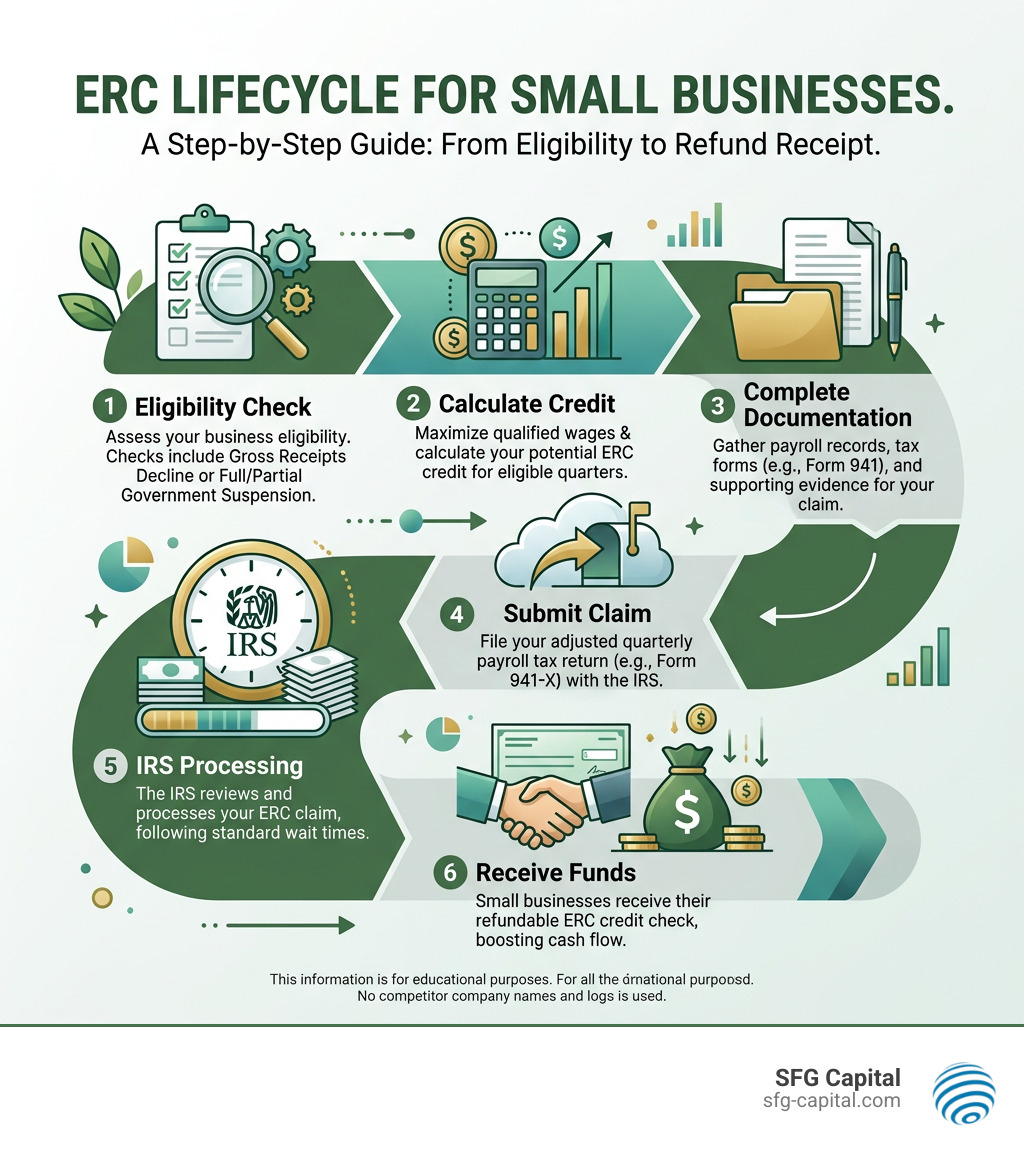
If you haven’t claimed your credit yet, you’ll be filing an “adjusted” return using Form 941-X. This form tells the IRS, “Hey, we overpaid our payroll taxes back in 2020/2021 because we didn’t realize we had these credits coming.”
However, there is a massive elephant in the room: the IRS backlog. As of late 2024, there are roughly 1.2 million claims waiting in line. The IRS is currently processing about 400,000 claims worth $10 billion, but many small businesses have been waiting for more than a year for their checks. The Official IRS ERC Guidance confirms that while they are working through the pile, fraud prevention measures have slowed things down for everyone—even the legitimate “good guys.”
The ERC Funding Process is no longer a “file and receive in 6 weeks” situation. It requires patience and meticulous documentation to ensure that when an agent finally sees your file, there are no reasons for them to kick it back.
How to Secure Your ERC for Small Business Refund Faster
Waiting 12 to 18 months for a refund is a luxury many Travis County businesses don’t have. If your business is struggling with cash flow today, an IOU from the IRS doesn’t pay the rent.
At SFG Capital, we specialize in helping businesses bypass these delays. We offer ERC Bridge Loans and claim buyouts. Essentially, we provide you with the capital you’re owed now, and we take on the wait time with the IRS. This turns a distant tax refund into immediate ERC and Working Capital that you can use to grow your business, hire new staff, or pay down high-interest debt.
Avoiding Scams and Handling Disallowed Claims
Because there is so much money on the table, the “ERC Mills” have come out in force. You’ve probably seen the ads: “Everyone qualifies! No documentation needed! We take 30%!”
These are massive red flags. The IRS has specifically warned against promoters who charge large upfront fees or percentage-based fees without doing a thorough eligibility analysis. A reputable Employee Retention Credit Specialist Guide will tell you that not every business qualifies, and claiming it when you don’t can lead to audits, penalties, and interest.
If you realize you’ve filed an improper claim, the IRS has a withdrawal program. This allows you to pull back an unpaid claim to avoid penalties. If your claim is disallowed (you’ll receive Letter 105-C), you have the right to appeal.
One technical note that catches many off guard: when you receive the ERC, you cannot count it as tax-free income. Instead, you must reduce your wage expense deduction on your income tax return for the year the wages were paid. If your claim is eventually disallowed after you already reduced your deductions, the IRS now allows you to increase your wage expense in the year the disallowance becomes final, which is a huge relief for businesses worried about amending old returns.
Frequently Asked Questions about ERC for Small Business
What is the deadline to file for 2021 ERC claims?
The clock is ticking. For 2020 claims, the deadline was April 15, 2024. For 2021 ERC claims, the deadline to file an amended return is April 15, 2025. If you haven’t started the process yet, you need to move quickly. Don’t wait until the final week; the complexity of the forms and the documentation required means you should start now. Don’t Miss Out: How to Secure Your ERC before the window closes forever.
How do small businesses differ from large businesses in claiming ERC?
The government defines “small” differently for this credit depending on the year. In 2020, a “small” employer had 100 or fewer full-time employees. In 2021, that limit jumped to 500.
This distinction is critical. Small employers can claim the credit for all wages paid to employees during the eligible period. Large employers can only claim the credit for wages paid to employees not to work (i.e., you kept them on payroll while the shop was closed). As noted by the NFIB, this makes the ERC exponentially more valuable for the true small business owner.
What documentation is needed to support an ERC claim?
You should treat your ERC file like it’s going to be audited tomorrow. You need:
- Payroll journals and quarterly tax filings (Form 941).
- Documentation of health insurance costs.
- A spreadsheet showing exactly how you calculated the credit while excluding PPP wages.
- Proof of eligibility: either gross receipts spreadsheets or the specific government orders that caused your suspension.
For a comprehensive list of what to gather, see our guide on What is ERC?.
Conclusion
The erc for small business is likely the last major piece of pandemic-era stimulus available, and for many, it’s the largest. With up to $26,000 per employee available, this isn’t just a “nice to have” tax break—it’s a significant capital injection that can provide long-term financial stability.
Whether you’re looking for 5 Ways to Use ERC Funds to Strengthen Your Business or you simply want to get your money out of the IRS backlog and into your bank account, we are here to help. At SFG Capital, we understand the unique challenges of businesses in Austin and Travis County. We’ve processed over 14,000 claims and secured over $2.5 billion for our clients.
Don’t let the complexity or the IRS delays stop you from claiming what is rightfully yours. Check out Our Services today to see how we can help you maximize your claim and secure your funding faster.
See what your business may qualify for.
60 seconds. No documents. No upfront cost.
General information only, not legal or tax advice. Eligibility and estimates are fact-specific and subject to review.