
Blog / Insights
InsightsDon’t Let Your Form 943 ERC Savings Go to Seed
October 14, 2026 · 10 min read · By the SFG Capital team
How Farm Employers Can Check a Form 943 ERC Claim
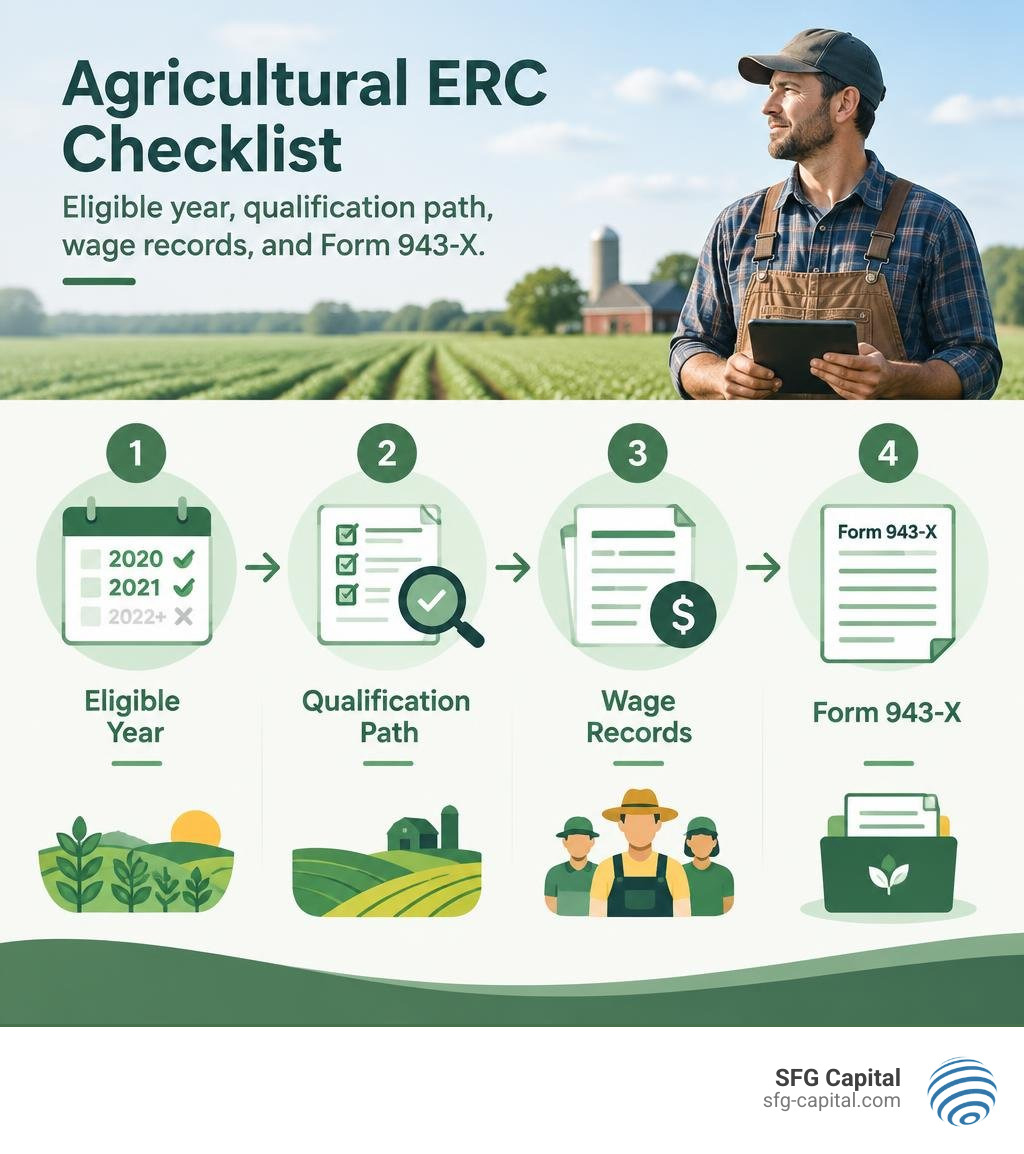
Start with the year the wages were paid. The Employee Retention Credit (ERC) does not cover wages paid in 2022 or later. If your farm paid eligible wages in 2020 or 2021, check whether you qualified through a drop in gross receipts, a qualifying government order, or the 2021 recovery startup rules. Then match payroll records to the credit claimed and make sure you have not used the same wages for sick or family leave credits or PPP loan forgiveness.
Agricultural employers correct a previously filed Form 943 with Form 943-X, not Form 941-X. As of October 2026, the usual deadlines for new 2020 and 2021 ERC refund claims have passed. If you filed on time and are still waiting, keep your records ready for IRS review rather than counting on a quick payment.
I’m Santino Battaglieri, founder of SFG Capital. I have more than nine years of financial services experience, and our work with ERC claims informs this guide to the form 943 employee retention credit and the risks of filing without solid documentation.
Relevant articles related to form 943 employee retention credit:
Understanding the Form 943 Employee Retention Credit for Agricultural Employers
Agricultural operations operate under a different tax framework than standard retail or corporate businesses. While mainstream companies report employment taxes quarterly using Form 941, farm employers file an annual return using Form 943 (Employer’s Annual Federal Tax Return for Agricultural Employees). Understanding how the Employee Retention Credit (ERC) applies within this framework is critical for compliance and verifying past filings.
The ERC was originally enacted under the Coronavirus Aid, Relief, and Economic Security (CARES) Act on March 27, 2020, to incentivize businesses to keep farmhands, packers, and operational crews on the payroll during pandemic disruptions. It was later expanded and amended under the Consolidated Appropriations Act and the American Rescue Plan Act, codified under Section 3134 of the Internal Revenue Code.
For agricultural employers, employment taxes are reported annually when wage thresholds are met:
- Paying an individual agricultural employee $150 or more in cash wages during the calendar year.
- Paying a total of $2,500 or more in aggregate cash and non-cash wages across all farmworkers.
Unlike standard quarterly filers, agricultural operations report their annual social security tax (6.2% employer share and 6.2% employee share, totaling 12.4%) and Medicare taxes (1.45% each) all at once on Form 943. Because the ERC functions as a refundable payroll tax credit against the employer’s share of social security tax (or Medicare tax for specific quarters in 2021), agricultural employers were required to calculate quarterly eligible wages but reconcile them on their annual Form 943 or through retroactive amendments. Reviewing the Official IRS Employee Retention Credit guidance helps verify how these statutory periods were structured across 2020 and 2021.
Eligibility Criteria for the Form 943 Employee Retention Credit
To sustain a valid claim, a farm operation must satisfy specific eligibility tests during the eligible calendar quarters of 2020 or 2021. You cannot simply claim the credit because your agribusiness experienced rising feed costs or general supply delays without meeting specific IRS benchmarks.
Agricultural employers qualified primarily through one of three pathways:
- Significant Decline in Gross Receipts: Comparing quarterly gross revenue to the corresponding calendar quarter in 2019.
- Full or Partial Suspension of Operations: Subject to a direct government order that suspended business activities.
- Recovery Startup Business Status: Available in the third and fourth quarters of 2021 for newer agricultural ventures.
Under IRS Notice 2021-20, to qualify via a partial suspension, the government order must have had a “more than nominal” effect on operations. The IRS defines a portion of business operations as more than nominal if it accounted for at least 10% of total gross receipts or 10% of total employee service hours in the identical calendar quarter of 2019. If your packing facility or processing shed had to shut down for mandatory sanitization or state-mandated capacity caps that reduced your service capacity by over 10%, that specific operational period qualifies.
Farm employers can double-check their qualifying periods using an ERC eligibility checklist to verify that gross receipt drops or operational restrictions meet strict statutory requirements.
| Qualification Criteria | 2020 Tax Year (Form 943) | 2021 Tax Year (Form 943) |
|---|---|---|
| Gross Receipts Decline Required | > 50% drop compared to 2019 quarter | > 20% drop compared to 2019 quarter |
| Alternative Quarter Election | Not applicable | Can use immediately preceding quarter |
| Maximum Qualified Wages | $10,000 per employee per year | $10,000 per employee per quarter (Q1-Q3) |
| Credit Percentage | 50% of qualified wages | 70% of qualified wages |
| Maximum Credit Per Worker | $5,000 total for 2020 | $7,000 per quarter (up to $21,000 total) |
| Large Employer Threshold | More than 100 full-time employees | More than 500 full-time employees |
| Eligible Periods | March 13, 2020 – Dec 31, 2020 | Jan 1, 2021 – Sep 30, 2021 (Dec 31 for RSB) |
Interaction with Sick Leave, PPP, and Recovery Startup Rules
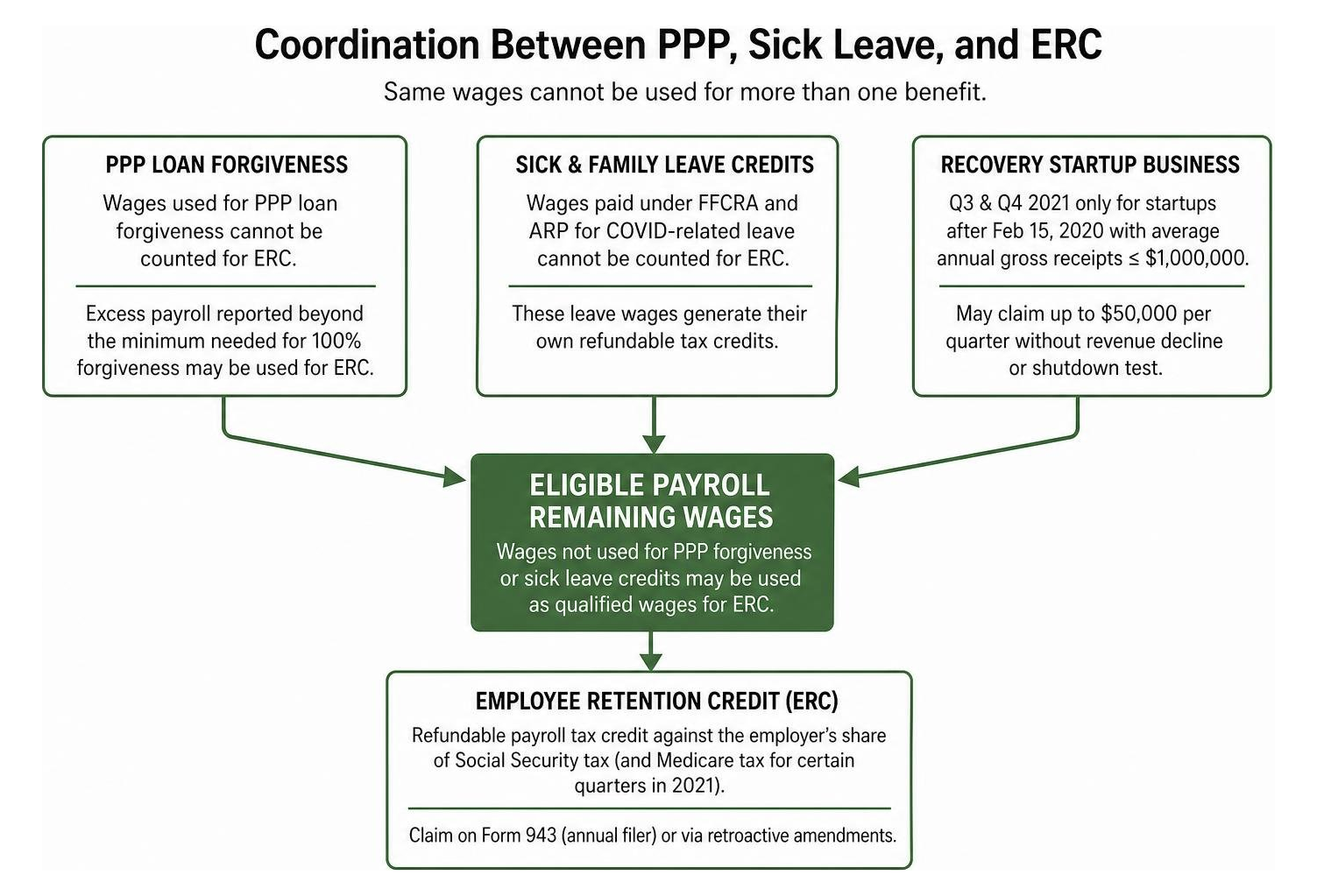
Agribusinesses frequently leveraged multiple pandemic relief programs simultaneously. However, federal law strictly prohibits double-dipping on the same dollar of payroll.
When reviewing your calculations, pay close attention to the following interactions:
- Paycheck Protection Program (PPP): Wages allocated toward PPP loan forgiveness cannot be counted as qualified wages for the ERC. However, under IRS Notice 2021-20, if your farm reported excess payroll on your PPP forgiveness application beyond the minimum amount needed for 100% forgiveness, those excess wages can be utilized for the ERC. Review how PPP loan forgiveness impacts your qualified payroll calculations.
- Qualified Sick and Family Leave: Wages paid under the Families First Coronavirus Response Act (FFCRA) and the American Rescue Plan Act for COVID-related leave generate their own refundable tax credits. These leave wages cannot be counted toward ERC qualified wages.
- Recovery Startup Businesses (RSB): Enacted for the second half of 2021, an agricultural startup that began operations after February 15, 2020, with average annual gross receipts not exceeding $1,000,000, could claim up to $50,000 per quarter for Q3 and Q4 2021 without demonstrating a revenue drop or government shutdown.
To handle these computations correctly, employers must follow the specific credit calculation frameworks detailed in the 2022 Instructions for Form 943, ensuring non-refundable and refundable credits are separated appropriately.
Step-by-Step Guide to Claiming Agricultural Payroll Credits

Claiming or verifying agricultural payroll credits requires a methodical approach that separates general farm labor from ineligible categories. If you are examining an existing claim or auditing your documentation, following a structured step-by-step ERC application walkthrough ensures every calculation aligns with current IRS compliance standards.
Here is the exact procedure agricultural employers use to substantiate and claim credits:
- Segregate Ineligible Farm Labor: Certain agricultural wages are statutorily excluded. For example, compensation paid to H-2A temporary agricultural guest workers is exempt from Social Security and Medicare taxes under IRC Section 3121(b)(1). Because no FICA taxes apply to H-2A compensation, these wages cannot generate an Employee Retention Credit.
- Isolate Owner and Family Wages: Wages paid to majority owners (owning more than 50% of the farm entity) and their direct family relatives (children, parents, siblings) are generally disallowed from ERC wage calculations under attribution rules.
- Determine Large vs. Small Employer Status: For 2020, if your farm had 100 or fewer average full-time employees in 2019, you could claim the credit on all wages paid to employees during eligible periods. For 2021, that threshold expanded to 500 or fewer full-time workers. If you exceeded those limits, you could only claim ERC on wages paid to employees who were not working (e.g., paid standby time).
- Identify Qualified Health Plan Expenses: You can include the employer-paid portion of pre-tax health insurance premiums allocated pro-rata across eligible agricultural workers.
- Reconcile Refundable vs. Non-Refundable Portions: The non-refundable portion offsets the employer’s statutory tax liability for that filing period, while the remaining balance is fully refundable as a direct Treasury disbursement.
Filing Form 943-X to Amend and Claim Your Form 943 Employee Retention Credit
When correcting agricultural payroll tax returns, farm employers must file Form 943-X (Adjusted Employer’s Annual Federal Tax Return for Agricultural Employees or Claim for Refund).
Key steps and fields on Form 943-X include:
- Worksheet Selection: Complete the corresponding IRS worksheet depending on whether you are correcting 2020 wages (Worksheet 2) or 2021 wages (Worksheet 4 for ARP credits).
- Line Adjustments: Input corrected figures for qualified wages, employer health expenses, and calculated credit amounts on the appropriate non-refundable and refundable lines.
- Detailed Explanation on Line 41: The IRS mandates a detailed, written explanation on Line 41 of Form 943-X. You must state the specific reason for the amendment, detail the qualification basis (gross receipts decline percentages or exact government shutdown orders), and demonstrate that no wages overlap with PPP loan forgiveness or FFCRA leave.
- Schedule R (Form 943) for Aggregate Filers: If your farm utilizes a Certified Professional Employer Organization (CPEO) or an aggregate payroll agent, the agent must file Form 943-X and attach Schedule R to allocate the credits to your specific Employer Identification Number (EIN).
Consult the official Instructions for Form 943-X to ensure that the correct version of the form and its corresponding worksheets are matched to the tax year being amended.
Calculating Qualified Wages and Credit Worksheets
Accurate arithmetic is vital. A minor calculation error can trigger extended IRS processing freezes or formal disallowances.
To audit or prepare agricultural ERC numbers, assemble the following required documentation:
- Detailed quarterly agricultural payroll summaries showing gross pay, hours, and worker classifications.
- Form W-2 and Form 943 copies for 2019, 2020, and 2021.
- Quarterly profit and loss statements or sales tax filings for 2019, 2020, and 2021 to substantiate gross receipts.
- PPP-1 and PPP-2 loan forgiveness applications (Form 3508/3508S/3508EZ) and formal forgiveness letters from the SBA.
- Documentation of health insurance invoices and proof of payment allocating costs across farmworkers.
- Copies of state, local, or federal emergency executive orders if qualifying under a partial operational suspension.
Current IRS Processing Realities, Moratoriums, and Promoter Red Flags

As of October 2026, the environment surrounding ERC processing is markedly different from the early days of pandemic relief. On September 14, 2023, the IRS established a formal moratorium on processing newly submitted ERC claims to protect honest business owners from predatory third-party promoters.
The IRS continues to scrutinize claims rigorously, prioritizing older submissions that demonstrate low risk while issuing formal disallowance letters (Letter 105-C) to claims lacking sufficient factual support. Reading current IRS ERC backlog updates shows that while lower-risk claims are being processed and released, review timelines remain substantially slower than typical tax refund schedules.
Agricultural employers must remain vigilant against predatory promoter warning signs:
- Broad Qualification Claims: Promoters claiming that “every farm qualifies” due to general supply chain disruptions or fertilizer price increases. (General inflation or supply chain hiccups do not qualify under IRS Notice 2021-20 unless directly tied to a specific government shutdown order affecting a critical supplier).
- Exorbitant Contingency Fees: Third parties charging 20% to 30% upfront or contingency fees without signing the return as a paid preparer.
- Refusal to Provide Supporting Computations: Promoters who calculate an inflated refund number but refuse to hand over line-by-line wage allocation sheets or PPP reconciliation files.
If you received an improper credit or worked with an aggressive promoter, the IRS provides administrative remedies such as formal claim withdrawals or the Voluntary Disclosure Program to resolve issues without steep civil penalties. For employers with legitimately filed, well-documented claims facing severe capital constraints, managing ERC refund delays often requires exploring external liquidity options while the IRS completes its review.
Frequently Asked Questions about Agricultural ERC
Has the Employee Retention Credit expired for Form 943 filers?
Yes. The statutory periods for paying qualified wages under the ERC expired in 2021. For the vast majority of agricultural employers, eligible wages had to be paid between March 13, 2020, and September 30, 2021 (or through December 31, 2021, for qualified Recovery Startup Businesses). Furthermore, the statutory deadlines for filing retroactive refund claims via Form 943-X for 2020 and 2021 tax periods have now closed as of 2026. The focus for farm employers today is tracking existing, pending claims and ensuring audit readiness.
Can agricultural employers claim ERC on Form 943 for wages paid in 2022?
No. You cannot claim the Employee Retention Credit for wages paid during the 2022 calendar year. The only credits that could be claimed on a 2022 Form 943 were certain retroactive adjustments for qualified sick and family leave wages paid in 2022 for leave taken in earlier periods (under FFCRA rules). Any promoter asserting that general agricultural wages paid in 2022 qualify for the ERC is misinformed.
What is the current IRS processing timeline for agricultural ERC refunds?
IRS processing speeds for ERC claims remain protracted. While the IRS continues to release payments for substantiated, lower-risk claims, thorough compliance filters mean reviews can take several months or longer. Employers awaiting payments should verify that their bank account details are up to date on their IRS Business Tax Account, as executive mandates prioritize direct deposit disbursements for federal tax refunds.
Conclusion
The Employee Retention Credit provided crucial relief to agricultural operations during unprecedented operational challenges. However, claiming the credit on Form 943 required navigating complex wage tests, strict gross receipts evaluations, PPP non-duplication rules, and the complete exclusion of H-2A workers.
With the IRS conducting in-depth audits and issuing formal reviews, maintaining pristine documentation of your calculations, shutdown orders, and payroll ledgers is essential. At SFG Capital, we help businesses across Austin, Travis County, and nationwide navigate complex tax credit processes. If your farm has a validated, pending ERC claim stuck in IRS backlog delays, explore how you can accelerate your ERC refund through advance funding to stabilize your working capital today.
See what your business may qualify for.
60 seconds. No documents. No upfront cost.
General information only, not legal or tax advice. Eligibility and estimates are fact-specific and subject to review.