
Blog / Insights
InsightsEmployee Retention Credit Qualified Wages 2026: Don’t Let the IRS Rain on Your Parade
October 14, 2026 · 11 min read · By the SFG Capital team
Employee Retention Credit Qualified Wages 2026: What Employers Must Do Now
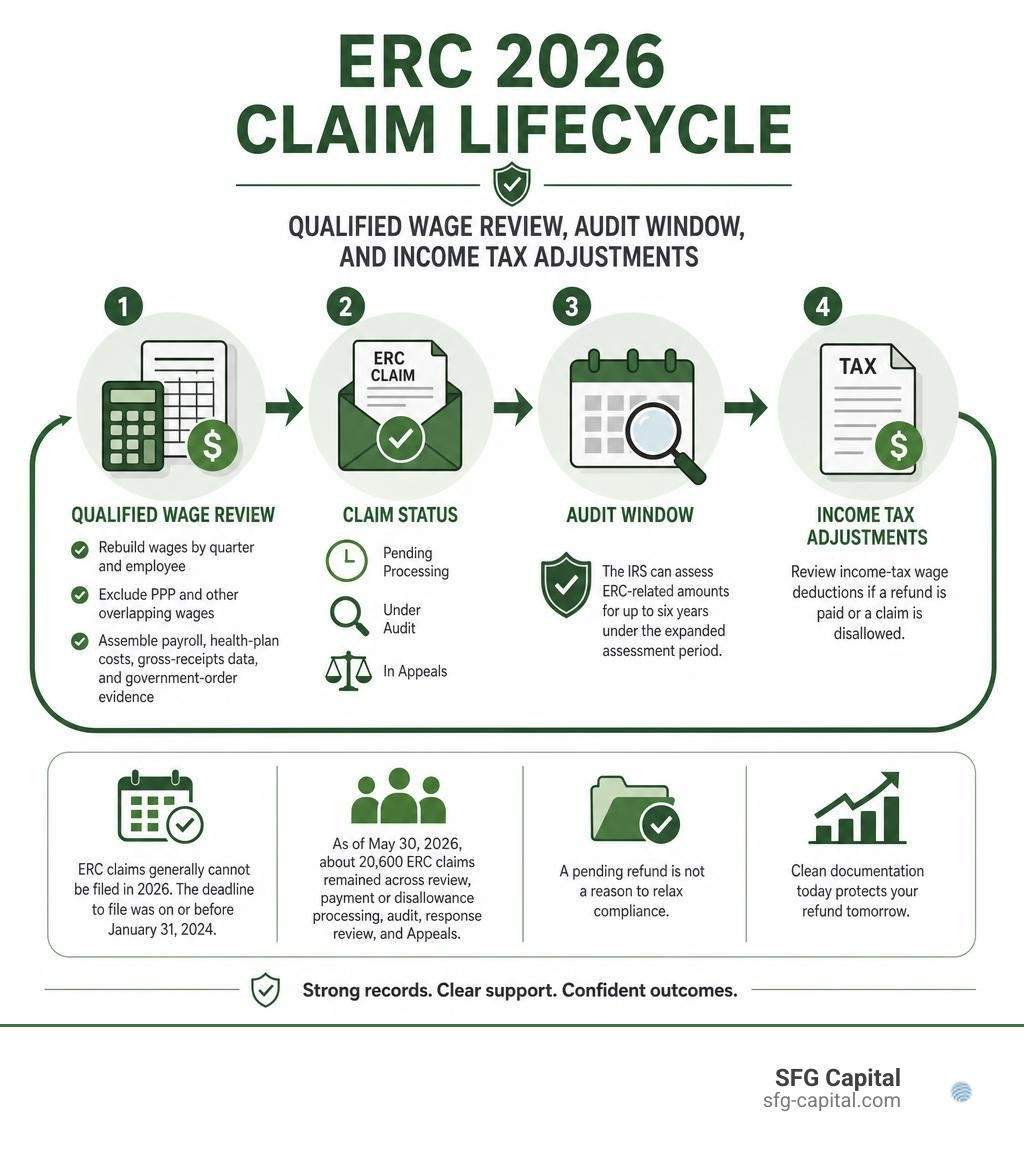
In 2026, employers generally cannot file a new ERC claim. The One Big Beautiful Bill Act limits credits and refunds to claims filed on or before January 31, 2024. If your claim was timely filed and is still pending, under audit, or in Appeals, your priority is to prove that the historic wages on the claim were truly qualified.
- Rebuild your wage calculation by quarter and employee.
- Remove wages used for PPP forgiveness or other overlapping credits.
- Keep payroll records, health-plan costs, gross-receipts data, and government-order evidence together.
- Review your income-tax wage deductions if a refund is paid or a claim is disallowed.
Qualified wages are determined under the rules in effect for the 2020 and 2021 credit periods, not by wages paid in 2026. The IRS can now assess ERC-related amounts for up to six years under the expanded assessment period, making clean documentation essential.
The backlog is smaller, but it is not gone: as of May 30, 2026, about 20,600 ERC claims remained across review, payment or disallowance processing, audit, response review, and Appeals. A pending refund is not a reason to relax compliance.
I am Santino Battaglieri, founder of SFG Capital, with more than nine years in financial services and structured funding. My work on employee retention credit qualified wages 2026 focuses on careful claim support, documentation integrity, and practical risk management for employers navigating delayed refunds and IRS scrutiny.
Explore more about employee retention credit qualified wages 2026:
The 2026 ERC Landscape: Filing Deadlines and Current IRS Backlog
The Employee Retention Credit landscape in September 2026 looks vastly different from the freewheeling early days of pandemic relief. When the One Big Beautiful Bill Act (OBBBA) was signed into law on July 4, 2025, it fundamentally altered the rules of engagement. Under the OBBBA, the IRS is barred from issuing credits or refunds for any new ERC claim filed after January 31, 2024. This statutory cutoff effectively closed the door on new filings, transforming the entire ERC ecosystem from a retroactive filing race into a strict audit and claim-substantiation environment.
Originally, the Joint Committee on Taxation projected the overall cost of the ERC at roughly $78 billion. However, analyses by the Penn Wharton Budget Model (PWBM) reveal that the program ballooned significantly, on track to cost more than $300 billion upon full processing. Before the IRS instituted a moratorium on processing new claims in September 2023, runaway filings had put the credit on pace to reach a staggering cumulative total of $567 billion. Enhanced enforcement, fraud filters, and legislative cutoffs curbed that trajectory, settling the projected final cumulative tab near $302 billion.
For businesses that filed before the statutory deadline, understanding A Comprehensive Guide to 2026 ERC and 941-X Processing Times remains vital. Although the initial wave of millions of Form 941-X returns has been worked through, thousands of legitimate business owners still find themselves stuck in administrative limbo, waiting for final determinations from the IRS. You can review the baseline standards on the Official IRS Employee Retention Credit guidance portal to track how the agency evaluates legacy filings.
IRS Backlog Breakdown in Late 2026
As of late May 2026, official IRS tracking indicates that approximately 20,600 unresolved ERC claims remain in the agency’s pipeline. Processing times have stretched far beyond initial estimates, with complex claims taking hundreds of days to navigate the heightened scrutiny layers.

The remaining inventory breaks down into specific operational categories:
- 3,500 claims under active review: Claims undergoing deep manual examination by specialized IRS compliance teams.
- 4,000 claims pending payment or disallowance: Files that have completed initial review and await formal check issuance or statutory notices of claim disallowance.
- 5,500 claims under audit: Filings flagged for comprehensive field or correspondence audits requiring exhaustive payroll and operational substantiation.
- 6,000 claims awaiting review of disallowance responses: Files where employers have submitted formal rebuttals or supplementary documentation following a preliminary denial.
- 1,600 claims with the Independent Office of Appeals: Disputed claims where taxpayers are actively challenging adverse determinations through administrative appeals.
If your business is among those still waiting on an outcome, checking How Long Until Your ERC Refund Arrives A 2026 Update will provide clarity on current IRS processing speeds and queue priorities.
Calculating Employee Retention Credit Qualified Wages 2026: Limits and Allocations

When the IRS evaluates an ERC claim in 2026, the central point of contention is whether the reported compensation meets the statutory definition of qualified wages. Qualified wages are the gross compensation subject to FICA taxes paid to eligible employees, including qualified health plan expenses allocable to those wages.
For 2021 tax quarters (Q1, Q2, and Q3, plus Q4 for qualifying startups), the credit rate is 70% of qualified wages, with wages capped at $10,000 per employee per quarter. This produces a maximum possible credit of $7,000 per employee per quarter ($21,000 total per worker across standard 2021 quarters). For 2020 claims, the credit was 50% of qualified wages up to $10,000 for the entire year ($5,000 maximum per employee).
A common mathematical pitfall involves double-dipping. Any dollar used to claim Paycheck Protection Program (PPP) loan forgiveness, the Families First Coronavirus Response Act (FFCRA) paid leave credit, the Work Opportunity Tax Credit (WOTC), or restaurant revitalization grants cannot be classified as qualified wages for the ERC. Mastering these nuances is essential; our guide on Mastering the Math Behind Your Employee Retention Credit Refund breaks down the exact formulas needed to avoid miscalculations.
Detailed requirements are codified in Statutory definitions under 26 U.S.C. § 3134, which establishes how employer size dictates wage eligibility:
| Category | Small Employer (≤500 FTEs in 2019) | Large Employer (>500 FTEs in 2019) |
|---|---|---|
| Eligible Wages | All wages paid to employees during eligible period | Wages paid ONLY to employees NOT providing services |
| Health Plan Expenses | Included (working and non-working) | Included (non-working hours only) |
| 2021 Wage Cap | $10,000 per employee per quarter | $10,000 per employee per quarter |
| 2021 Max Credit | 70% ($7,000 per employee per quarter) | 70% ($7,000 per employee per quarter) |
| Gross Receipts Test | <80% of corresponding 2019 quarter | <80% of corresponding 2019 quarter |
Small vs. Large Employer Thresholds and Aggregation Rules
The distinction between small and large employers relies on full-time employee (FTE) headcounts during 2019 (averaging 30+ hours per week or 130 hours per month). For 2021 eligibility, the threshold is 500 full-time employees (up from 100 FTEs for 2020).
If an employer had more than 500 FTEs in 2019, they cannot claim qualified wages paid to employees who actually performed work. They may only claim wages paid to employees who were paid to stay home and not provide services due to a full or partial government shutdown order.
Critically, employers cannot calculate headcounts or gross receipts in isolation if they share ownership structures. Under the aggregation rules of IRC Section 52(a)/(b) and Section 414(m)/(o), all entities under common control (such as a parent-subsidiary group, brother-sister controlled group, or affiliated service group) must be treated as a single employer.
Failing to apply aggregation rules properly is one of the leading triggers for IRS disallowances. If five related entities each have 120 employees, their combined headcount of 600 makes them a large employer across the board, disallowing working wages. Review our detailed breakdown on ERC Qualifications to verify your entity structuring.
Recovery Startup Business Caps and Special Rules
The American Rescue Plan Act introduced special provisions for Recovery Startup Businesses (RSBs) claiming credits for Q3 and Q4 of 2021. An RSB is defined as an entity that:
- Began operations after February 15, 2020; and
- Maintained average annual gross receipts of $1,000,000 or less for the three-year tax period preceding the credit quarter.
Unlike standard employers, RSBs do not need to prove a 20% decline in gross receipts or demonstrate a government-mandated suspension of operations. However, the total credit for an RSB is strictly capped at $50,000 per calendar quarter, for a maximum combined credit of $100,000 across Q3 and Q4 2021.
If an aggregated group operates multiple startup entities, the $50,000 quarterly limitation applies to the combined group as a whole. You can read more about these startup parameters in The Essential Guide to ERC Eligibility Requirements.
IRS Compliance, Audits, and Income Tax Adjustments

IRS enforcement in 2026 has reached peak intensity. Armed with fresh funding and automated data-matching tools, the agency is aggressively screening claims for signs of non-compliance, unallowable supply chain claims, and third-party promoter abuse.
Under the OBBBA, penalties for unregulated “COVID-ERTC promoters” are severe: the statute imposes an assessable penalty of $1,000 per failure for promoters who fail to meet strict due diligence requirements or who charged percentage-contingent fees on inflated claims.
When claims fail compliance checks, the IRS issues formal disallowance notices. Employers must be prepared to respond quickly with complete substantiation or face substantial clawbacks, failure-to-pay penalties, and compounding interest. To understand the IRS’s updated administrative stance, review how IRS releases new FAQs on employee retention credits.
Auditing Employee Retention Credit Qualified Wages 2026 Under the 6-Year Statute
The most impactful provision enacted under the OBBBA is the statutory extension of the assessment window. The statute of limitations for assessing any tax liability attributable to an ERC claim has been extended to 6 years from the latest of:
- The date the original employment tax return was filed;
- The date the return is treated as filed (e.g., April 15 of the following year); or
- The date the claim for credit or refund was made on Form 941-X.
This means claims filed in early 2024 remain exposed to IRS audit scrutiny through 2030. To withstand an audit, employers must maintain an organized substantiation binder containing:
- Detailed payroll journals mapping every employee’s gross wages, healthcare costs, and taxes per pay period;
- Documentation demonstrating the carve-out of PPP payroll costs and other overlapping credits;
- Specific federal, state, or local government executive orders causing full or partial business suspensions, paired with internal records showing direct operational impact;
- Quarterly gross receipts statements substantiating the required revenue drop compared to 2019.
For a timeline of these extended deadlines and lookback rules, consult The 2025 ERC Application Deadlines Survival Guide.
Reporting Employee Retention Credit Qualified Wages 2026 on Income Tax Returns
Under IRC Section 280C, employers who claim the ERC must reduce their deductible wage expenses on their federal income tax return by the amount of the credit claimed. This prevents businesses from taking a double benefit—claiming a tax credit on wages while simultaneously deducting those same wages from gross income.
Historically, this required filing an amended corporate or partnership tax return (Form 1120, 1120-S, or 1065) for 2020 or 2021. However, recent IRS guidance simplifies how taxpayers handle timing mismatches and disallowed claims:
- Handling Overstated Wages (Refund Received): If an employer receives an ERC refund in 2026 but did not reduce wage deductions on their original 2020/2021 return, the IRS allows them to include the credit amount in gross income in the tax year the refund is received, bypassing the need to amend prior-year income tax returns.
- Handling Disallowed Claims: If the IRS disallows an ERC claim for which the employer had preemptively reduced wage deductions, the taxpayer can restore that wage deduction on their current 2026 income tax return in the year the disallowance becomes final.
Frequently Asked Questions About 2026 ERC Claims
Can businesses submit a new ERC claim in 2026?
No. Under the One Big Beautiful Bill Act (OBBBA), no credit or refund can be claimed or allowed for any ERC filing submitted after January 31, 2024. The program is completely closed to new claims. Any solicitations claiming they can still “file fresh ERC paperwork” in 2026 are misleading and violate current federal tax laws. For historical context on this statutory closure, read our analysis on ERC Claim Deadline What You Need to Know Now.
What happens if the IRS disallows an ERC claim in 2026?
If the IRS issues a preliminary disallowance (Letter 105C or Letter 106C), taxpayers typically have 30 days to file a formal administrative appeal with the IRS Independent Office of Appeals. If appeals are exhausted or the deadline lapses, the taxpayer can challenge the disallowance by filing a refund suit in the U.S. District Court or the U.S. Court of Federal Claims within two years. When working through denials, choosing seasoned tax professionals is critical; explore From Compliance to Claims Your Guide to Top ERC Tax Credit Services for procedural strategies.
How do promoter penalties impact taxpayers using third-party preparers?
The OBBBA established severe civil penalties against predatory third-party ERC mills, specifically targeting promoters who took percentage-based fees or pushed non-compliant claims. If the IRS determines that your claim was prepared by a non-compliant promoter, your file faces elevated audit risk.
Taxpayers remain strictly liable for any improperly received funds, along with 20% accuracy-related penalties and mandatory statutory interest. If you used an aggressive third-party preparer, reviewing your filings with an independent CPA to ensure every dollar of qualified wages is defensible is essential.
Conclusion
Navigating the final stretch of the Employee Retention Credit in 2026 requires rigorous compliance, detailed payroll substantiation, and active management of your tax filings. With an extended six-year audit window and roughly 20,600 claims still moving through review, audit, and appeals, business owners cannot afford to take a passive approach to their qualified wage records.
At SFG Capital, we work with businesses in Austin, Travis County, and across the United States to bring clarity to complex tax credit situations. Whether you are dealing with IRS delays, responding to substantiation inquiries, or seeking to bridge cash flow gaps through tailored claim buyouts and advances with performance-based structures, our team provides the institutional support you need.
Do not let administrative backlogs or compliance hurdles derail your financial strategy. Visit our SFG Capital refund advance and funding solutions page to speak with our funding specialists and protect your business’s bottom line today.
See what your business may qualify for.
60 seconds. No documents. No upfront cost.
General information only, not legal or tax advice. Eligibility and estimates are fact-specific and subject to review.