
Blog / Insights
InsightsERC Eligibility Business Texas: How to Claim Your Credit
October 14, 2026 · 11 min read · By the SFG Capital team
How Texas Businesses Can Determine ERC Eligibility
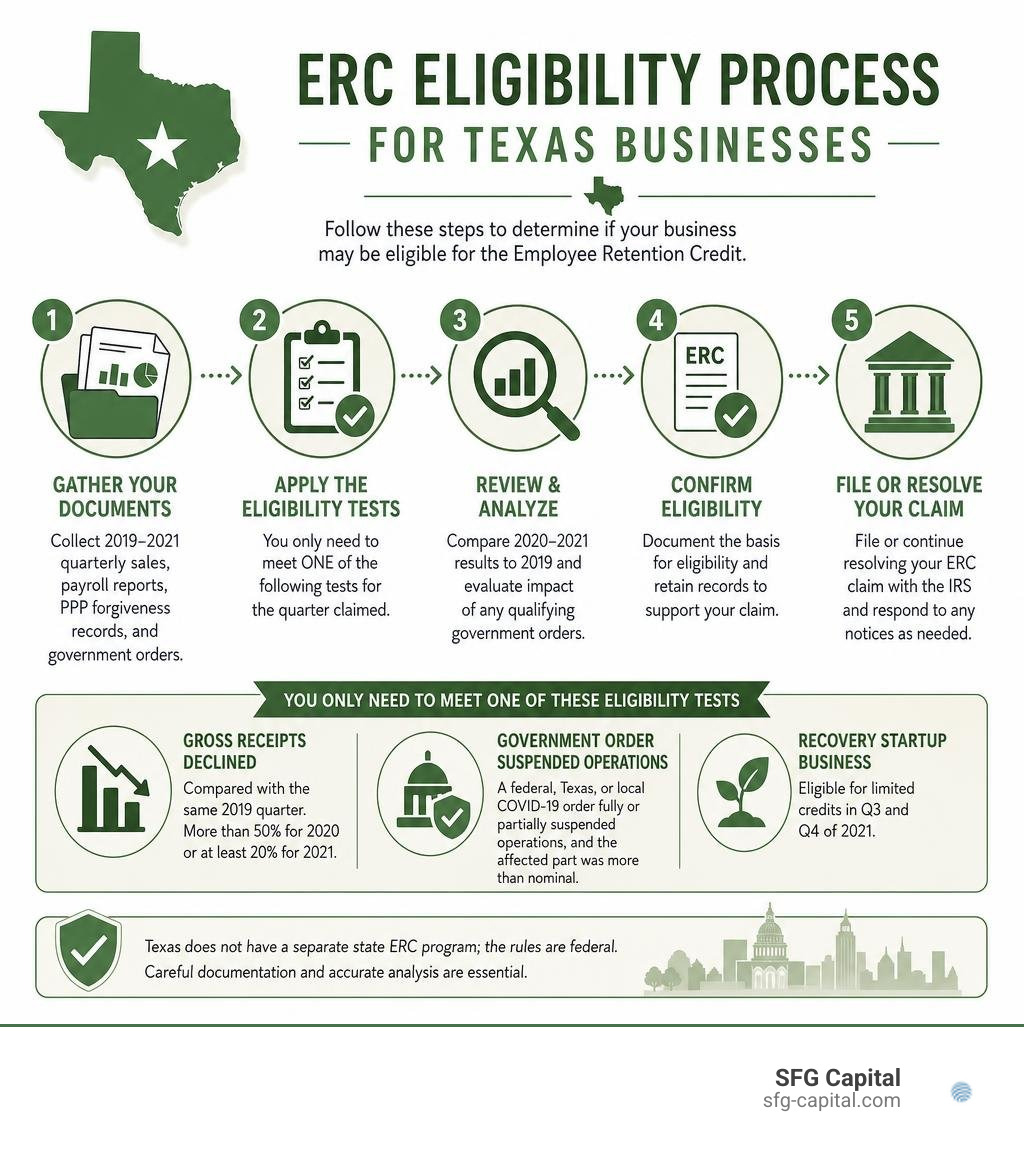
A Texas business may qualify for the federal Employee Retention Credit (ERC) if it paid employees during the COVID-19 period and meets at least one eligibility test for the quarter claimed:
- Gross receipts declined compared with the same 2019 quarter – more than 50% for 2020 or at least 20% for 2021.
- A binding federal, Texas, or local COVID-19 order fully or partially suspended operations, and the affected part of the business was more than nominal.
- The business is a recovery startup business eligible for limited credits in Q3 and Q4 of 2021.
For ERC eligibility business Texas employers should start by pulling 2019-2021 quarterly sales records, payroll reports, PPP forgiveness records, and copies of every government order that directly affected operations. Texas does not have a separate state ERC program; the rules are federal. Most employers can no longer file new ERC claims because amendment deadlines have passed, but businesses with pending claims, IRS notices, or valid claim-resolution issues still need careful documentation and tax guidance.
The potential credit was substantial: up to $5,000 per employee for 2020 and up to $7,000 per employee per qualifying quarter in 2021. But the IRS is closely reviewing claims, especially those based on broad supply-chain problems or weak partial-suspension arguments.
I am Santino Battaglieri, and through SFG Capital I have worked in ERC advisory, compliance support, and structured funding for claims at scale. My experience with ERC eligibility business Texas reviews centers on careful documentation, conservative risk analysis, and helping businesses understand their options while claims are pending.
Core Rules for ERC Eligibility Business Texas Employers Must Know
The Employee Retention Credit (ERC) was enacted under the Coronavirus Aid, Relief, and Economic Security (CARES) Act and expanded through subsequent relief legislation. Designed to encourage businesses to keep employees on their payroll during severe economic disruptions, the ERC provides a direct, refundable payroll tax credit rather than an income tax deduction.
Because the credit is uniform across the country, Texas employers follow federal statutory provisions rather than state-administered tax rules. For an authoritative breakdown of general federal guidelines, review the IRS Employee Retention Credit Overview.
| Feature / Metric | 2020 Eligibility Rules | 2021 Eligibility Rules (Q1–Q3) |
|---|---|---|
| Gross Receipts Decline Requirement | > 50% decline vs. 2019 baseline quarter | > 20% decline vs. 2019 baseline quarter |
| Credit Percentage of Qualified Wages | 50% | 70% |
| Qualifying Wage Cap | Up to $10,000 per employee per year | Up to $10,000 per employee per quarter |
| Maximum Credit per Employee | $5,000 for the entire calendar year | Up to $7,000 per quarter ($21,000 total) |
| Small Employer Definition | 100 or fewer average full-time employees in 2019 | 500 or fewer average full-time employees in 2019 |
| Eligible Wages for Small Employers | Wages paid to all employees during the qualifying period | Wages paid to all employees during the qualifying period |
| Eligible Wages for Large Employers | Only wages paid to employees not providing services | Only wages paid to employees not providing services |
| Special Provisions | None | Recovery Startup Businesses (Q3 & Q4) |
Federal Conformity and Qualifying Wage Caps for Texas Filers
When determining credits, businesses calculate qualified wages against the employer’s share of federal employment taxes—specifically Social Security taxes (and Medicare taxes for certain 2021 quarters) reported on Form 941. Qualified wages include both direct gross wages and qualified health plan expenses allocable to those employees.
For small employers (100 or fewer full-time employees in 2019 for 2020 claims, and 500 or fewer for 2021 claims), all wages paid to employees working or on stand-by during an eligible period qualify. Large employers face a strict statutory limit: they can only count wages paid to individuals who were paid not to work. For a broader overview of these baseline mandates, explore The Essential Guide to ERC Eligibility Requirements.
The Four Main Pillars of ERC Eligibility Business Texas Companies Can Claim
To establish eligibility, an employer must satisfy the legal criteria under one of four distinct pillars for each calendar quarter:
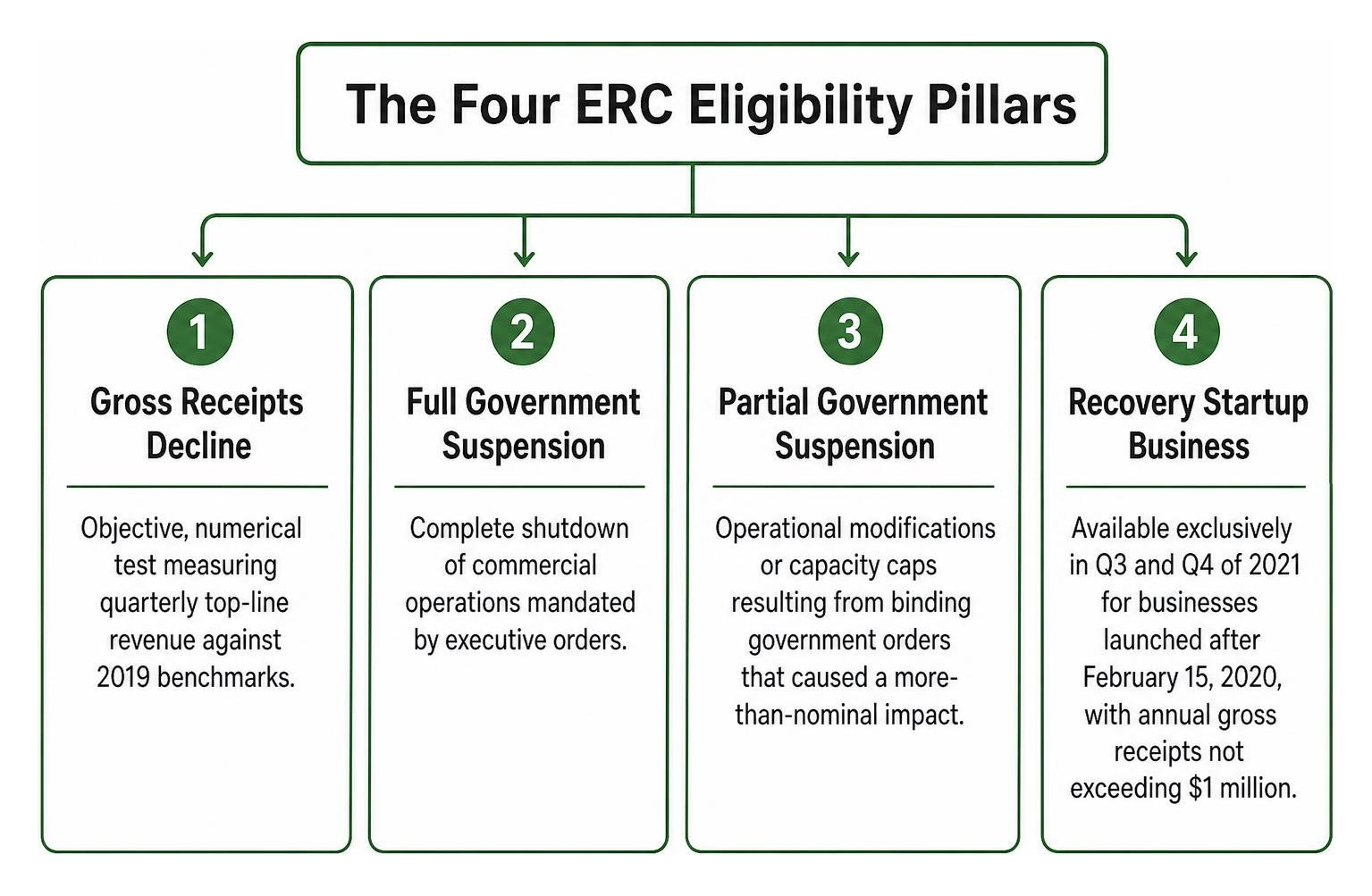
- Gross Receipts Decline: Objective, numerical test measuring quarterly top-line revenue against 2019 benchmarks.
- Full Government Suspension: Complete shutdown of commercial operations mandated by executive orders.
- Partial Government Suspension: Operational modifications or capacity caps resulting from binding government orders that caused a more-than-nominal impact.
- Recovery Startup Business: Available exclusively in Q3 and Q4 of 2021 for businesses launched after February 15, 2020, with annual gross receipts not exceeding $1 million.
To see how these pillars fit into broader compliance strategies, review our breakdown of ERC Qualifications.
Qualifying Under the Gross Receipts Test vs. Texas Government Suspension Orders
Establishing legitimate eligibility requires matching your company’s operational records against specific IRS criteria. You can cross-reference your specific operational timeline against the official IRS Employee Retention Credit Eligibility Checklist.
Navigating Revenue Declines: 2020 (50%) vs. 2021 (20%) Thresholds
The gross receipts test is the lowest-risk qualification method because it relies entirely on verifiable financial data. Under Internal Revenue Code (IRC) Section 448(c), gross receipts include total sales, net capital gains, investment income, and gross receipts from all trade or business activities without deducting cost of goods sold.
- 2020 Calculation: A Texas employer qualified starting in the calendar quarter where gross receipts were less than 50% of the gross receipts for the same calendar quarter in 2019. Eligibility continued through the end of the quarter in which gross receipts recovered to more than 80% of the corresponding 2019 quarter.
- 2021 Calculation: A business qualified in any of the first three calendar quarters of 2021 if gross receipts were less than 80% of gross receipts in the corresponding 2019 quarter (a 20% decline).
- Alternative Quarter Election: Under IRS Notice 2021-23, if a business did not meet the 20% decline in a current 2021 quarter, it could look back to the immediately preceding quarter. For example, if Q1 2021 experienced a 22% drop compared to Q1 2019, the employer could qualify for Q1 2021 and also elect to qualify for Q2 2021 based on Q1 numbers.
Per IRS Revenue Procedure 2021-33, forgiven Paycheck Protection Program (PPP) loan amounts are excluded from gross receipts calculations. For more on managing financial workflows around these refunds, see The Texas Business Guide to ERC Refunds and Cash Flow.
Evaluating Government Orders and the More-Than-Nominal Partial Suspension Test

Many Texas businesses that did not meet gross receipts thresholds sought eligibility under the suspension tests. Under IRS Notice 2021-20, an order must be a mandatory, binding directive issued by a federal, state, or municipal government entity with jurisdiction over the business.
In Texas, qualifying directives included statewide executive orders (such as Governor Greg Abbott’s executive orders GA-08 through GA-38) and local emergency orders (such as Austin-Travis County health authority orders). However, the partial suspension test carries strict standards:
- Binding Authority: Voluntary recommendations, CDC bulletins, or general industry guidance do not qualify.
- The 10% Safe Harbor: An order must have impacted a “more than nominal” portion of operations. Under IRS guidance, this is satisfied if the suspended portion accounted for at least 10% of total gross receipts or 10% of total employee service hours during the comparable 2019 calendar period.
- Operational Modifications: If mandatory modifications (such as 25% or 50% dining room capacity caps) reduced your operational capacity by 10% or more, that operational segment meets the threshold.
- Timeframe Limitations: Qualified wages can only be claimed for the exact days the government order was legally in effect—not for the entire calendar quarter.
To ensure your filing adheres to IRS guidelines, consult The ERC Eligibility Checklist What You Need to Know.
Supply Chain Disruptions and IRS Memo AM-2023-005 Standards
Many improper claims were filed under broad supply chain assertions. The IRS clarified its enforcement position in Generic Legal Advice Memorandum AM-2023-005 and IRS Publication 5887.
To claim ERC eligibility through a supply chain disruption:
- You must identify a specific, binding COVID-19 government shutdown order that legally halted your domestic direct supplier’s operations.
- The supplier’s shutdown must have directly caused their inability to deliver critical goods or raw materials.
- Your business must demonstrate that alternative suppliers were unavailable in the open market.
- The lack of components must have caused a more-than-nominal shutdown of your own operations.
General product shortages, shipping delays, container port congestion, and inflation-driven price hikes do not satisfy IRS standards.
Special Qualifications: Recovery Startups, PPP Coordination, and Wage Rules

Understanding how the credit interacts with other federal relief programs is critical for maintaining tax compliance. Review the official IRS Frequently Asked Questions about the ERC for additional technical guidance.
Establishing Recovery Startup Business Status in 2021
The American Rescue Plan Act introduced a lifeline for newer ventures under IRC § 3134: the Recovery Startup Business (RSB) provision. RSB status allowed qualifying employers to claim ERC in Q3 and Q4 of 2021 without having to show a decline in gross receipts or a government suspension order.
To qualify as an RSB, a Texas business had to satisfy three criteria:
- Launch Date: Began carrying on an active trade or business after February 15, 2020.
- Gross Receipts Cap: Maintained average annual gross receipts of $1,000,000 or less for the tax years preceding the claimed quarter (calculated under IRC § 448(c)(3)).
- Pillar Independence: Did not qualify under the gross receipts reduction test or the full/partial government suspension test for that quarter.
RSB claims are subject to a statutory credit cap of $50,000 per calendar quarter (up to $100,000 across Q3 and Q4 2021). You can review more details in Are You Eligible Decoding ERC Refund Requirements.
Avoiding Double-Dipping: PPP Loans, Tax Deductions, and Ineligible Family Wages
When calculating qualified wages, several statutory guardrails prevent duplicate benefits:
- PPP Loan Coordination: Under the Consolidated Appropriations Act, employers can claim both PPP forgiveness and the ERC, but cannot use the exact same payroll dollars for both programs. Payroll costs reported to justify PPP loan forgiveness cannot be included as ERC qualified wages.
- Section 280C Wage Deduction Disallowance: ERC is not considered taxable gross income for federal income tax purposes. However, under IRC Section 280C(a), an employer must reduce their deductible wage expenses on their federal income tax return by the amount of the ERC claimed. This adjustment increases taxable business profit for the year wages were paid.
- Related Individual Exclusions: Wages paid to majority owners (owning more than 50% of the entity directly or indirectly) and their family members (parents, siblings, children, spouses, and in-laws) are ineligible for the ERC under IRC § 51(i)(1) constructive ownership rules.
To evaluate how these calculations intersect with federal programs, read The ERC Explained Everything You Need to Know About This Tax Credit.
Audit Readiness and Defending an ERC Claim in Texas
The IRS continues to scrutinize ERC claims. The agency trained roughly 400 specialized audit agents and maintains a sharp enforcement focus on unsupported partial-suspension claims and promoter mills. For in-depth legal analysis, examine this Legal Analysis of Employee Retention Credit Compliance.
Documentation Checklist to Substantiate ERC Eligibility Business Texas Audits
Surviving an IRS examination requires an audit-ready defense file prepared before an audit notification arrives. Your file should include:
- [ ] Complete copies of originally filed Forms 941 and amended Forms 941-X for all claimed quarters.
- [ ] Detailed payroll journals mapping every employee, their gross wages, and allocable health insurance costs per pay period.
- [ ] PPP loan applications, forgiveness application forms (Form 3508/3508EZ/3508S), and SBA forgiveness approval letters documenting payroll allocations.
- [ ] Complete quarterly gross receipts schedules for 2019, 2020, and 2021 with corresponding federal tax returns.
- [ ] Contemporaneous copies of the specific federal, Texas, or Travis County executive orders relied upon for suspension claims.
- [ ] Numerical documentation proving the suspended operations met the 10% safe harbor threshold for gross receipts or employee service hours.
- [ ] Corporate ownership charts establishing that majority owner and related-party wages were properly excluded.
For further insights on identifying potential claim oversights, review Is Your Business Missing Out The ERC Refund Explained.
Responding to IRS Audits, Disallowance Letters (105-C), and Appeals
If the IRS reviews your ERC claim, administrative steps follow a clear legal path:
- Information Requests (Letter 6612): The IRS issues an Information Document Request asking for calculation workpapers, wage allocation spreadsheets, and government order citations.
- Disallowance Notices (Letter 105-C): If the IRS determines a claim is invalid, it issues formal Letter 105-C disallowing the refund. Employers have 30 days to request an administrative appeal with the IRS Independent Office of Appeals.
- Judicial Remedy: Receipt of Letter 105-C starts a strict two-year statute of limitations to file a tax refund lawsuit in U.S. District Court or the U.S. Court of Federal Claims.
- Voluntary Claim Withdrawal: If a Texas business submitted an improper claim that has not been paid, or if the refund check has not been deposited, the IRS allows claim withdrawal using Form 941-X or the portal at IRS.gov/withdrawmyerc. A valid withdrawal treats the claim as if it was never filed, mitigating civil penalties and interest.
For full guidance on responding to administrative inquiries, explore our ERC Credit Complete Guide.
Frequently Asked Questions About Texas ERC Eligibility
Can a Texas business claim the ERC if it already received PPP loan forgiveness?
Yes. Employers who received Paycheck Protection Program loans can claim the ERC. However, the same wages cannot be double-counted. Payroll expenses allocated toward PPP loan forgiveness must be excluded from ERC qualified wage calculations. Proper tax preparation involves allocating allowable non-payroll expenses (rent, utilities, covered operations expenses) to the PPP loan forgiveness application to maximize remaining qualified wages for the ERC.
Does Texas impose state income tax on ERC refunds?
Texas does not impose a personal state income tax or a traditional corporate income tax. However, Texas businesses are subject to the Texas Franchise Tax. Because federal law requires employers to reduce deductible wage expenses under IRC Section 280C, this can affect compensation-based deduction calculations on Texas Franchise Tax reports (specifically when electing the Cost of Goods Sold or Compensation deduction methods).
What should a Texas business do if it receives IRS Letter 105-C or audit notice?
Do not ignore the correspondence. Letter 105-C starts a binding 30-day window to file an administrative appeal with the IRS Independent Office of Appeals and triggers a two-year clock to preserve federal refund litigation rights. Work with experienced tax attorneys or credentialed CPAs to assemble contemporaneous records, government orders, and wage reconciliations, or evaluate whether administrative claim withdrawal is appropriate.
Conclusion
Determining ERC eligibility for a Texas business requires careful alignment with statutory requirements, precise wage segregation from PPP funds, and verifiable documentation of gross receipts declines or binding governmental orders.
As the IRS actively works through roughly 400,000 backlogged ERC claims worth approximately $10 billion, business owners in Austin and throughout Travis County often face severe processing delays while waiting on refunds.
SFG Capital helps businesses navigate IRS processing delays by providing funding solutions, claim advances, and buyout options. If your business has a pending ERC claim and needs immediate liquidity or compliance support, connect with SFG Capital Commercial Funding Services to review your funding options today.
See what your business may qualify for.
60 seconds. No documents. No upfront cost.
General information only, not legal or tax advice. Eligibility and estimates are fact-specific and subject to review.