
Blog / Insights
InsightsEverything You Need to Know About the 2026 ERC Program
October 14, 2026 · 9 min read · By the SFG Capital team
What the 2021 ERC Program Means for Businesses in 2026
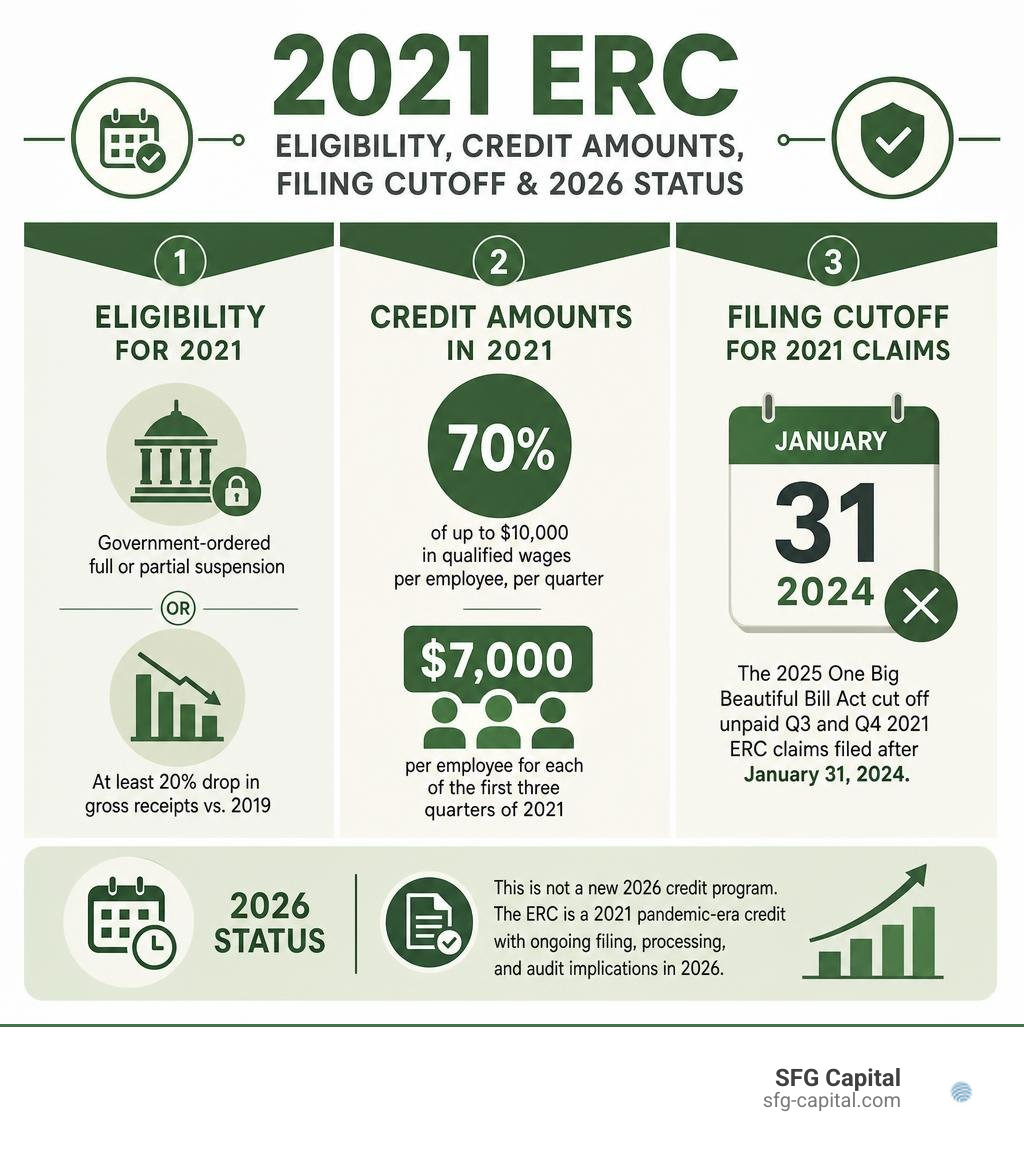
The Employee Retention Credit (ERC) was a refundable payroll tax credit for employers that kept workers on payroll during COVID-19 disruptions. Under the ERC program 2021 rules, eligible employers could generally claim 70% of up to $10,000 in qualified wages per employee, per quarter – as much as $7,000 per employee for each of the first three quarters of 2021.
To evaluate a 2021 claim today, focus on three questions:
- Did your business face a qualifying government-ordered full or partial suspension, or at least a 20% drop in gross receipts compared with 2019?
- Were the wages claimed kept separate from wages used for PPP loan forgiveness or other wage-based credits?
- When was the claim filed? The 2025 One Big Beautiful Bill Act cut off unpaid Q3 and Q4 2021 ERC claims filed after January 31, 2024.
This is not a new 2026 credit program. It is a 2021 pandemic-era credit with major filing, processing, and audit consequences that remain important in 2026.
I am Santino battaglieri, and I lead SFG Capital, a financial services firm with experience in ERC advisory, compliance review, and structured funding. Our work with more than $500 million in ERC claims has shown why careful documentation matters when navigating the ERC program 2021 rules and long IRS timelines.
Erc program 2021 further reading:
Comprehensive Guide to the ERC Program 2021 Rules and Qualification

Understanding what is erc requires looking at how the federal government structured refundable tax relief under the Internal Revenue Code. Unlike a non-refundable credit that merely reduces your tax liability to zero, a refundable payroll tax credit delivers a direct cash refund for any credit balance that exceeds your employment taxes.
Employers claimed the credit on qualified wages paid to W-2 staff, which included gross wages subject to FICA taxes along with qualified group health plan expenses allocated to those employees. To claim these amounts retroactively, businesses filed Form 941-X (Adjusted Employer’s Quarterly Federal Tax Return or Claim for Refund).
Qualifying Criteria Under the ERC Program 2021: Gross Receipts and Government Orders
To qualify for relief under the 2021 rules, an employer had to satisfy either of two core statutory tests:
- The Gross Receipts Decline Test: An employer experienced an eligible decline if gross receipts for a 2021 calendar quarter dropped by more than 20% compared to the corresponding calendar quarter in 2019. Lawmakers also created an alternative quarter election, enabling employers to establish eligibility for a quarter using the gross receipts of the immediately preceding quarter. If you qualified in Q1 2021, you could use that result to claim Q2 2021 as well.
- The Government Suspension Test: An employer qualified if commercial operations were fully or partially suspended due to orders from an appropriate governmental authority limiting commerce, travel, or group meetings due to COVID-19. To meet the nominal effect standard under IRS guidance, the government-mandated suspension had to affect more than a nominal portion of business operations (typically at least a 10% reduction in service capacity or gross receipts).
Properly evaluating erc qualifications requires concrete documentation of specific local health orders or clean accounting ledgers verifying gross revenue drops rather than vague references to general economic slowdowns or generalized supply chain disruptions.
Major Legislative Shifts: How the ERC Program 2021 Expanded Upon 2020 Provisions
The differences between the 2020 rules (originating in the CARES Act) and the 2021 provisions expanded under the Consolidated Appropriations Act and the American Rescue Plan Act (ARPA) are substantial. For a full breakdown, review our erc credit complete guide.
| Feature / Metric | 2020 ERC Program | 2021 ERC Program |
|---|---|---|
| Credit Percentage | 50% of qualified wages | 70% of qualified wages |
| Wage Cap per Employee | $10,000 per year | $10,000 per quarter |
| Maximum Credit per Employee | $5,000 annually | $7,000 per quarter ($21,000 for Q1–Q3) |
| Gross Receipts Decline Required | > 50% decline vs. 2019 baseline | > 20% decline vs. 2019 baseline |
| Small Employer Employee Limit | Up to 100 full-time W-2 employees | Up to 500 full-time W-2 employees |
| PPP Double-Dipping Restriction | Initially barred PPP borrowers entirely | Permitted with wage segregation |
Under the 2020 framework, companies with more than 100 full-time employees could only claim wages paid to employees not providing services (paid leave). For 2021, Congress raised that threshold to 500 employees, allowing businesses with up to 500 W-2 workers to claim credits on all qualified wages paid for working staff.
Recovery Startup Businesses and Severely Distressed Employers
The 2021 amendments introduced special categories for specific business conditions:
- Recovery Startup Businesses: Businesses formed after February 15, 2020, with average annualized gross receipts under $1,000,000 could claim the credit for Q3 and Q4 of 2021 even without showing a 20% revenue drop or a government shutdown. The maximum credit for a Recovery Startup Business was capped at $50,000 per quarter ($100,000 total).
- Severely Distressed Employers: Employers suffering a gross receipts reduction greater than 90% compared to the identical 2019 quarter were treated as small employers regardless of headcount, letting large companies claim credit on wages paid to all active workers during eligible quarters.
Coordinating the 2021 ERC with PPP Loans and Other Federal Relief Programs
A central rule of federal pandemic relief is the prohibition against double-dipping: you cannot claim payroll tax credits using the exact same wage dollars forgiven under other grant and loan initiatives.
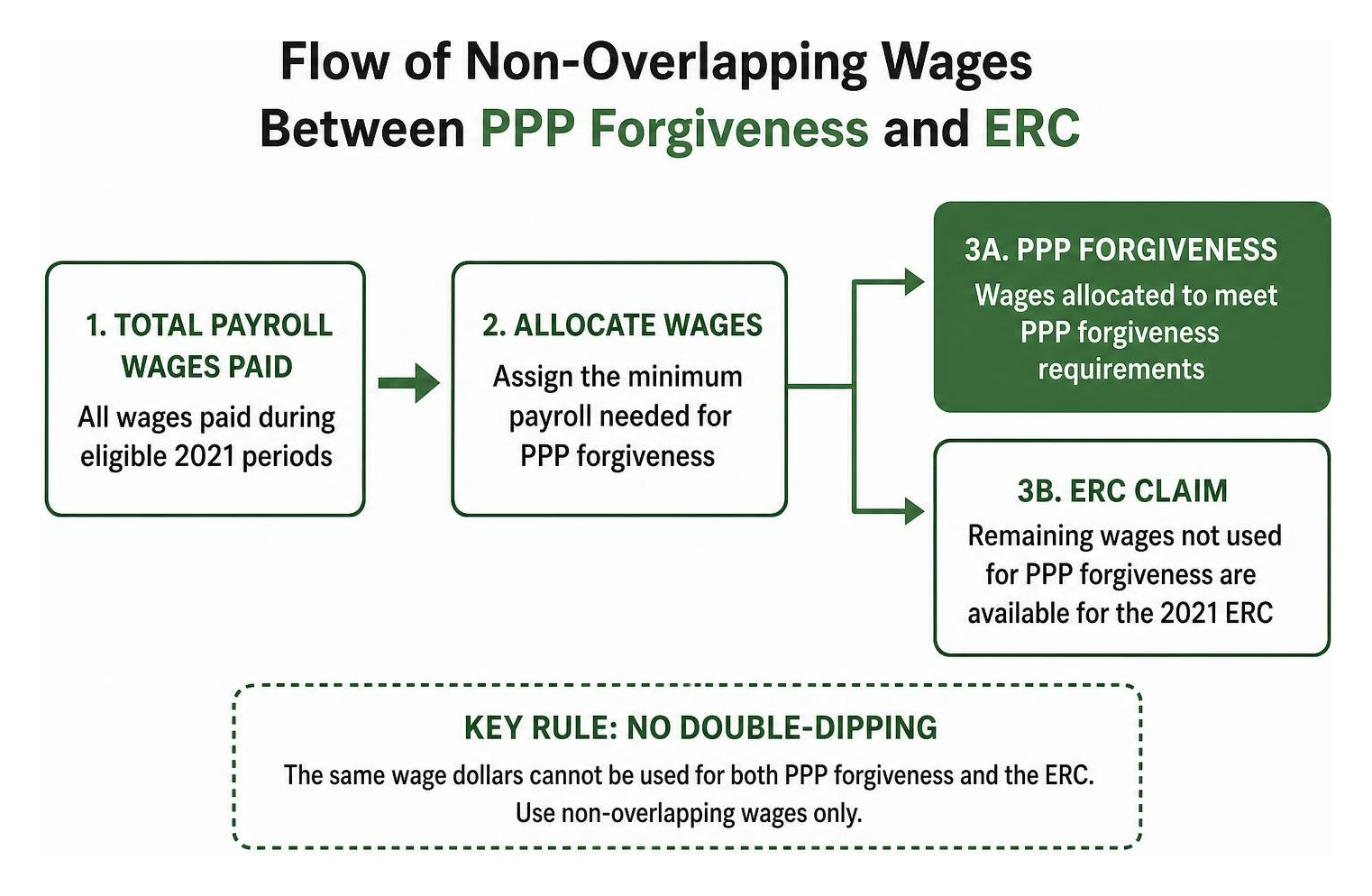
Understanding forgive and forget how ppp loan forgiveness impacts your employee retention credit is critical for audit defense. When applying for Paycheck Protection Program (PPP) loan forgiveness on SBA Form 3508, business owners who reported gross payroll exceeding their minimum forgiveness needs can safely allocate remaining payroll wages toward their 2021 ERC filings.
Interactions with EIDL, WOTC, and Restaurant Revitalization Grants
- Economic Injury Disaster Loans (EIDL): EIDL proceeds are standard working capital loans, not wage subsidies, meaning EIDL usage does not restrict ERC wage calculations.
- Work Opportunity Tax Credit (WOTC): Wages certified toward WOTC for targeted worker demographics cannot be counted toward ERC qualified wages.
- Restaurant Revitalization Fund (RRF) & Shuttered Venue Operators Grants (SVOG): Payroll expenses covered by non-taxable RRF or SVOG grant funds cannot overlap with wages claimed on Form 941-X.
Filing Timelines, IRS Moratoriums, and the One Big Beautiful Bill Act

The journey of ERC claims has seen massive administrative turbulence. On September 14, 2023, the IRS imposed a moratorium on processing new claims due to a severe surge in improper submissions driven by aggressive marketing mills. Processing turnaround times stretched from under 100 days to over 390 days as the agency instituted detailed manual reviews. Review our update on 2025 erc deadlines and how to beat the irs clock to understand the shifting administrative timeline.
The One Big Beautiful Bill Act and Retroactive Filing Cutoffs
On July 4, 2025, the One Big Beautiful Bill Act (OBBBA / P.L. 119-21) was signed into law. This legislation made permanent shifts to outstanding 2021 ERC claims:
- Retroactive Cutoff: It prevents the IRS from issuing refunds for unpaid Internal Revenue Code Section 3134 claims for the third and fourth quarters of 2021 if filed after January 31, 2024.
- Promoter Penalties: Imposed an immediate $1,000 non-compliance penalty per failure for third-party promoters who fail to meet strict statutory due diligence standards.
- Statute of Limitations: Established a 6-year assessment window for the IRS to audit and assess erroneous 2021 Q3 and Q4 claims.
Program Cost Growth and Budgetary Impact
The initial Joint Committee on Taxation (JCT) estimate scored the ERC at $78 billion. However, retroactive filings through Form 941-X and aggressive third-party marketing caused expenditures to surge.
By late September 2023, realized payments reached $230 billion with an active backlog of 600,000 claims. Before the IRS moratorium took effect, unchecked claim trajectories were on pace to reach $567 billion. Economic analyses by the Penn Wharton Budget Model (PWBM) project the finalized cost of the ERC will exceed $300 billion once remaining inventory is cleared.
Audits, Penalties, and Dispute Resolution in 2026
In 2026, the IRS continues active civil and criminal enforcement regarding ERC claims:
- 6-Year Audit Window: Revenue agents have up to 6 years from the date of filing or payment to audit 2021 claims.
- 20% Erroneous Refund Penalties: Assessed under Section 6676 on excessive or unsubstantiated refund claims unless a taxpayer proves reasonable cause.
- Criminal Enforcement: IRS Criminal Investigation (CI) has initiated hundreds of criminal investigations involving billions of dollars in fraudulent ERC filings.
IRS Voluntary Disclosure and Claim Withdrawal Procedures
To resolve improper filings before formal examination, the IRS created targeted remediation avenues:
- Claim Withdrawal Program: Allows employers who submitted a Form 941-X that has not yet been paid or processed to withdraw the submission completely, treating it as if it had never been filed to avoid civil fraud penalties.
- Voluntary Disclosure Programs (VDP): The second round of the IRS Voluntary Disclosure Program allowed employers that received questionable ERC refunds to repay 80% of the credit received, avoiding penalties and interest on the remaining 20%.
Administrative Appeals, Audit Defense, and Federal Court Litigation
If your legitimate 2021 ERC claim has been denied or delayed indefinitely by administrative backlogs, you have clear legal rights:
- IRS Office of Appeals: Challenge unagreed audit findings administratively by submitting a formal protest within 30 days of a 30-day letter.
- Federal District Court Lawsuits: If the IRS fails to act on a timely filed claim within six months of submission, taxpayers can file a tax refund suit in U.S. District Court to compel formal judicial resolution.
Working with an experienced team is critical when defending complex tax positions. If you need erc help find top employee retention credit advisors here to assess your substantiation files. Business owners can also monitor local municipal initiatives via the Small Business Programs | Travis County, Texas portal for additional regional guidance.
Frequently Asked Questions About the 2021 Employee Retention Credit
Can a business still receive a payout for an unprocessed 2021 ERC claim in 2026?
Yes, provided the claim was filed on or before January 31, 2024 (for Q3/Q4 2021 quarters subject to the OBBBA cutoff) and meets all IRS risk-scoring criteria. The IRS continues processing low-risk claims from its historical backlog through manual review queues.
How did PPP loan forgiveness impact 2021 ERC wage calculations?
Under the non-duplication rule, any payroll costs formally reported on SBA Form 3508 to achieve 100% PPP loan forgiveness cannot be included as qualified wages for ERC. Employers must maintain clear payroll ledger entries demonstrating that separate, non-overlapping wage dollars were used for the ERC credit.
Why did the total cost of the ERC program exceed initial government estimates?
The original JCT estimate of $78 billion was modeled under strict 2020 rules that prohibited PPP recipients from claiming ERC. In 2021, Congress lifted that restriction retroactively, raised the credit to $7,000 per worker per quarter, and expanded the eligible small employer size to 500 workers. These policy shifts, paired with aggressive third-party contingency fee promotions, caused total program costs to exceed $300 billion.
Conclusion: Securing Your Business Position in the 2026 ERC Environment
The 2021 Employee Retention Credit remains one of the largest corporate tax relief programs in federal history, but navigating its aftermath in 2026 requires careful compliance management and defensible audit records. If your claim was disallowed, remember you are legally entitled to claim refunds for any wage expense deductions that were reduced when the credit was originally filed.
For business owners in Travis County and Austin, TX who have legitimate, fully substantiated ERC claims stuck in IRS processing queues, SFG Capital offers structured ERC funding advances and claim buyouts. We provide access to capital on a performance-based fee structure, helping you access working capital without waiting on federal backlogs. Contact SFG Capital today to learn more about our structured funding solutions. Explore our full range of options on the SFG Capital services page.
See what your business may qualify for.
60 seconds. No documents. No upfront cost.
General information only, not legal or tax advice. Eligibility and estimates are fact-specific and subject to review.