
Blog / Insights
InsightsEverything You Ever Wanted to Know About ERTC Qualified Wages
October 14, 2026 · 9 min read · By the SFG Capital team
What Counts as ERTC Qualified Wages?
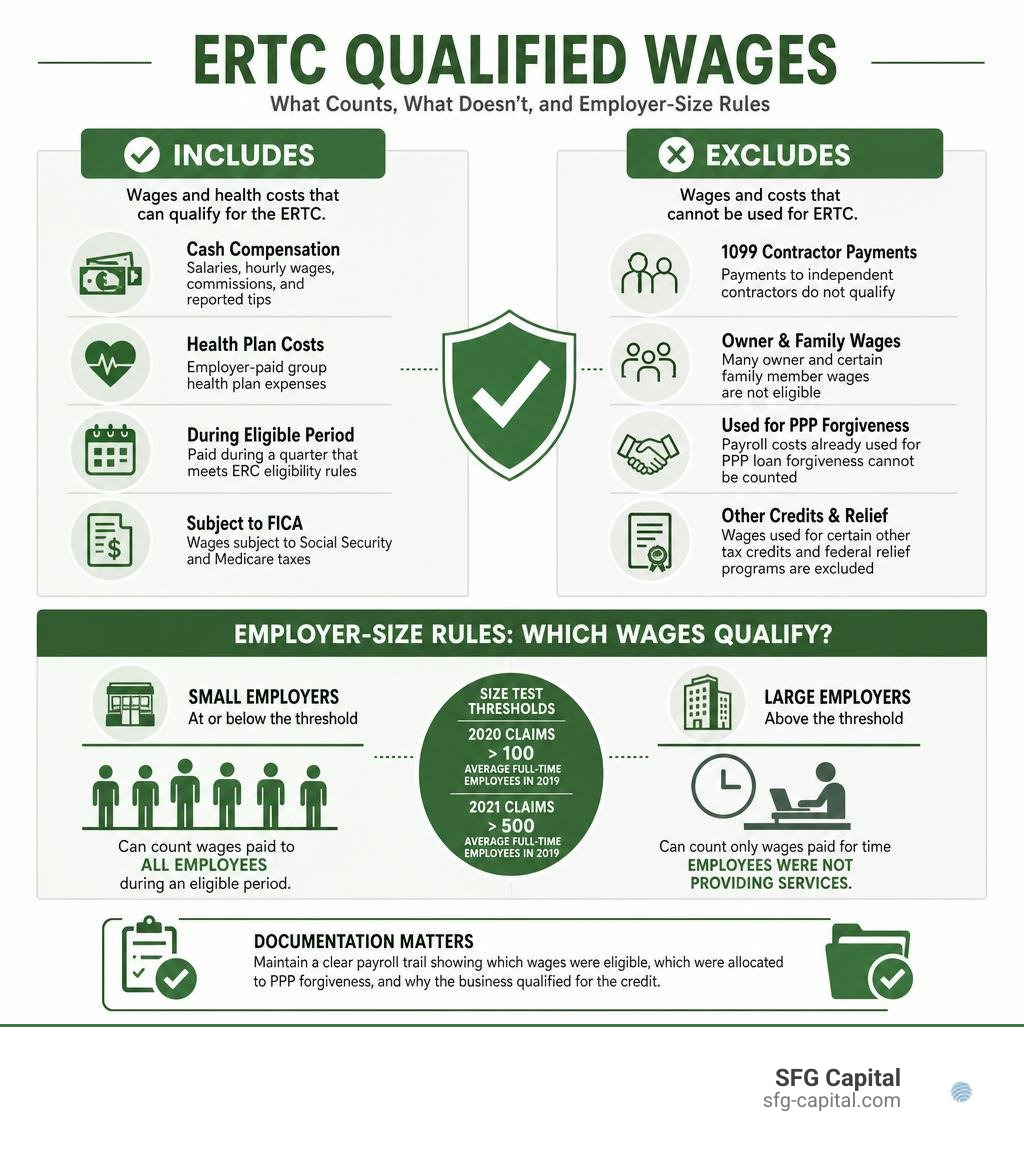
ERTC qualified wages are generally employee pay subject to Social Security and Medicare taxes, plus certain employer-paid group health plan costs. This can include salaries, hourly wages, commissions, and reported tips. But the wages must be paid during an ERC-eligible period and cannot overlap with payroll costs used for PPP loan forgiveness or certain other tax credits and federal relief programs.
The key rule depends on employer size:
- Small employers: Generally can count wages paid to all employees during an eligible period.
- Large employers: Generally can count only wages paid for time employees were not providing services.
- Everyone: Must exclude 1099 contractor payments, many owner-family wages, and payroll already used for PPP forgiveness.
The size test changed from more than 100 average full-time employees in 2019 for 2020 claims to more than 500 for 2021 claims. The credit also became more valuable in 2021: 70% of up to $10,000 in qualified wages per employee per quarter, compared with 50% of up to $10,000 per employee for all of 2020.
Getting the wage calculation right matters. A valid ERC claim needs a clear payroll trail that shows which wages were eligible, which were allocated to PPP forgiveness, and why the business qualified for the credit in the first place.
I am Santino Battaglieri of SFG Capital. Through ERC advisory, compliance support, and structured funding work involving more than $500 million in ERC claims, I have seen how careful documentation and conservative analysis help businesses evaluate ERTC qualified wages without taking avoidable claim risk.
Terms related to ertc qualified wages:
Defining ERTC Qualified Wages: What Compensation Counts?
To understand how to calculate your credit, you must first understand what is ERC at its statutory foundation. Under the Coronavirus Aid, Relief, and Economic Security (CARES) Act and subsequent guidance, qualified wages are defined primarily by Internal Revenue Code (IRC) Section 3121(a). In straightforward terms, this means compensation that is subject to Federal Insurance Contributions Act (FICA) taxes.
According to the Employee Retention Credit | Internal Revenue Service official guidelines, qualifying compensation covers:
- Standard gross salaries and hourly pay
- Overtime pay and shift differentials
- Cash tips (over $20 per month) reported to the employer
- Commissions and piece-rate compensation
- Qualified employee pre-tax salary reductions under IRC Section 401(k), Section 403(b), or Section 457(b) plans
- Allocable qualified health plan expenses paid by the employer
However, not every dollar distributed to a worker counts. Compensation that is not subject to FICA taxes or that falls outside statutory boundaries cannot be claimed.
| Compensation Component | Included in Qualified Wages? | Statutory Basis & Notes |
|---|---|---|
| Gross Wages & Salaries | Yes | Subject to FICA under IRC Section 3121(a) |
| Hourly Pay & Overtime | Yes | Standard FICA wages |
| Reported Cash Tips | Yes | Tips over $20/month reported under Section 6053(a) |
| Sales Commissions | Yes | Standard taxable wage compensation |
| Employer Group Health Plan Costs | Yes | Excludable under IRC Section 106(a), allocable to wages |
| Employee Pre-Tax 401(k) Deferrals | Yes | Treated as Section 3121(a) wages |
| Employer 401(k) Matching Contributions | No | Excluded from FICA wage definitions |
| Payments to 1099 Independent Contractors | No | Non-employee compensation |
| Severance & Post-Termination Pay | No | Paid for past services, not active retention |
| Wages Reimbursed by PPP Forgiveness | No | Double-dipping prohibited under CARES Act / CAA |
Small vs. Large Employer Rules for Qualifying Wages
One of the most heavily scrutinized areas during an IRS audit is employer size determination. The law creates distinct rules for small versus large employers, dictating which specific hours worked—or not worked—can generate credits. Knowing the essential guide to ERC eligibility requirements is critical here.
Under IRC Section 4980H, employer size is measured by calculating the average monthly number of full-time employees (averaging at least 30 hours per week or 130 hours per month) across 2019:
- 2020 Claims (100-Employee Threshold): If you averaged 100 or fewer full-time employees in 2019, you are a small employer and can claim all wages paid to employees during eligible periods. If you averaged more than 100 full-time employees, you are a large employer and can only claim wages paid to employees for time they were not providing services (idle or non-working time).
- 2021 Claims (500-Employee Threshold): Congress expanded this threshold under the Relief Act. Employers with 500 or fewer full-time employees in 2019 are treated as small employers and can claim all wages paid during eligible quarters. Those with more than 500 full-time employees remain restricted to non-working wages.

Furthermore, employers must apply controlled group aggregation rules under IRC Section 52(a), 52(b), and Section 414. If multiple business entities share more than 50% or 80% common ownership, their employee headcounts must be aggregated to determine whether they exceed the 100 or 500-employee limit.
Calculating ERTC Qualified Wages: 2020 vs. 2021 Rules
Understanding the timeline of legislative changes is vital for mastering the math behind your employee retention credit refund. The calculation rules differ sharply between calendar years 2020 and 2021, as detailed in the official Determining Qualified Wages FAQs – ERTC Employee Retention Tax Credit.
2020 Wage Calculation Mechanics
- Credit Rate: 50% of qualified wages.
- Wage Cap: $10,000 per employee across all eligible quarters in 2020 combined.
- Maximum Benefit: $5,000 per employee for the entire year ($10,000 × 50%).
- Eligibility Trigger: A full or partial government shutdown order or a 50% or greater decline in gross receipts compared to the same calendar quarter in 2019.
2021 Wage Calculation Mechanics
- Credit Rate: 70% of qualified wages.
- Wage Cap: $10,000 per employee per calendar quarter.
- Maximum Benefit: Up to $7,000 per employee per quarter. For Q1, Q2, and Q3, eligible employers could qualify for up to $21,000 per employee (or $14,000 across Q1 and Q2).
- Eligibility Trigger: A full or partial government shutdown order or a 20% or greater decline in gross receipts compared to the same calendar quarter in 2019 (or the immediately preceding quarter).
- Recovery Startup Businesses: Businesses launched after February 15, 2020, with average annual gross receipts under $1 million could claim credits in Q3 and Q4 of 2021, capped at $50,000 total per quarter, without needing to satisfy standard shutdown or revenue decline thresholds.
Statutory Exclusions and Double-Dipping Prohibitions
While the ERTC offers substantial relief, federal law strictly prohibits double-dipping across multiple pandemic assistance programs. When reviewing your payroll ledger, you must separate payroll dollars allocated to other relief mechanisms before calculating your credit base. For an in-depth breakdown of these interactions, read our guide on how PPP loan forgiveness impacts your Employee Retention Credit.
The Consolidated Appropriations Act (CAA) of 2021 retroactively repealed the restriction that barred Paycheck Protection Program (PPP) borrowers from claiming the ERTC. However, wages used to justify PPP loan forgiveness cannot be claimed as ERTC qualified wages.
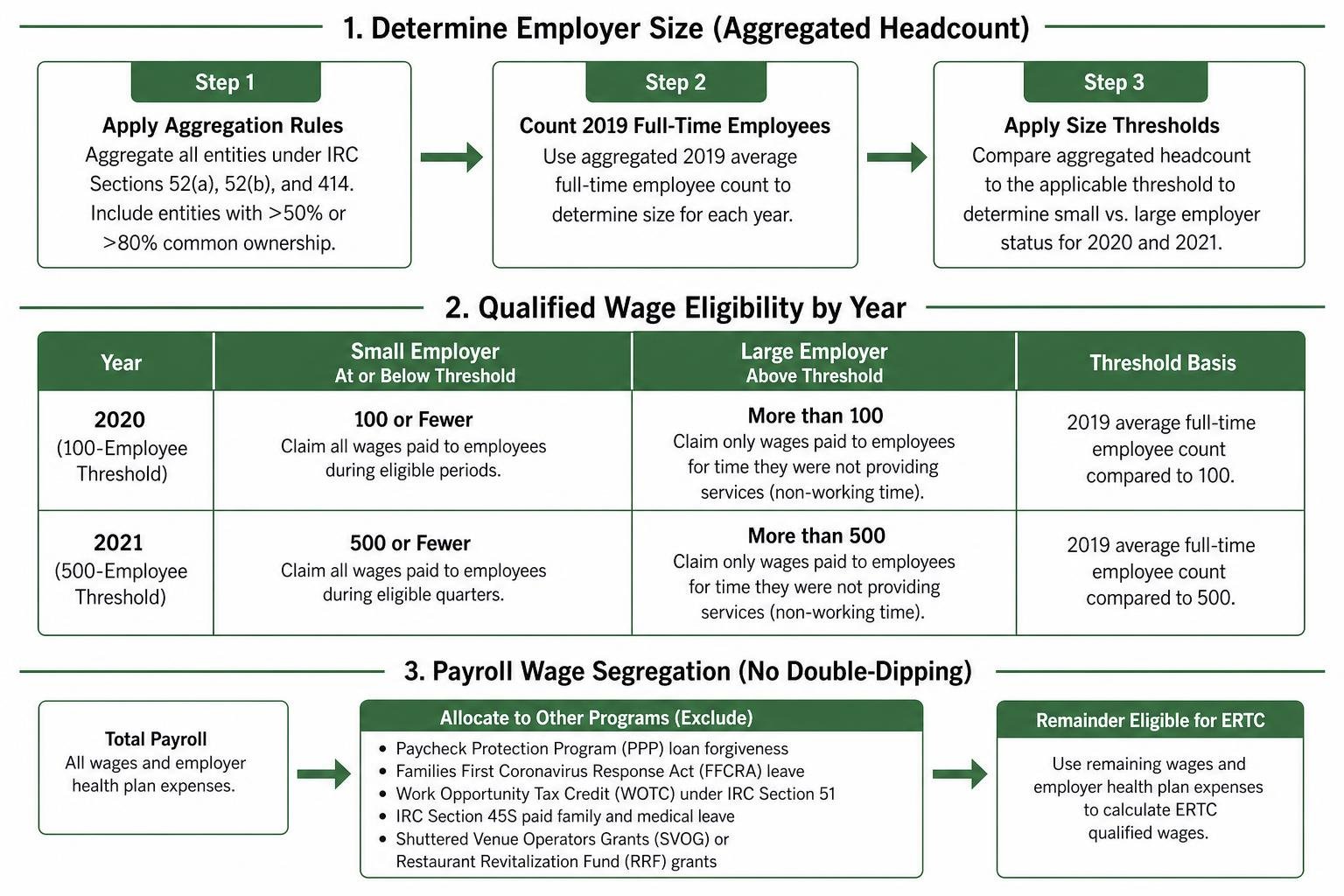
Other statutory credit exclusions include:
- Wages paid for Families First Coronavirus Response Act (FFCRA) emergency paid sick or family leave
- Wages used to claim the Work Opportunity Tax Credit (WOTC) under IRC Section 51
- Wages claimed under IRC Section 45S for employer-provided paid family and medical leave
- Payroll funded by Shuttered Venue Operators Grants (SVOG) or Restaurant Revitalization Fund (RRF) grants
Statutory Exclusions from ERTC Qualified Wages
Beyond federal grant interactions, specific categories of workers and compensation types are strictly barred from credit calculations to maintain proper ERC qualifications:
- Related Individuals and Constructive Ownership: Under IRC Section 267(c) and Section 152, wages paid to majority owners (holding over 50% value of the business directly or indirectly) and their family members are disallowed if the owner has living relatives. Disqualified relations include children, grandchildren, siblings, parents, grandparents, nieces, nephews, aunts, uncles, and in-laws.
- Form 1099 Independent Contractors: Independent contractors, gig workers, and statutory non-employees are not common-law employees and cannot generate qualified wages.
- Ministerial Wages: Compensation paid to ordained ministers or members of religious orders exempt from FICA under Section 3121(a) cannot be counted.
- Severance and Post-Termination Pay: Payments made after an employee’s separation do not represent active employment retention.
- Off-the-Books Cash Compensation: Any compensation not properly reported on Form 941 and Form W-2 is ineligible.
Income Tax Impact and Wage Deduction Reductions
Claiming the ERTC is not entirely tax-free on your corporate tax returns. Under IRC Section 280C(a), an employer must reduce its wage expense deduction by the amount of the credit claimed for the tax year in which the qualified wages were paid. For complete details on tax adjustments, review our payroll tax credit complete guide.
According to IRS Issues Q&A Guidance on Employee Retention Credit, employers historically needed to file amended income tax returns (such as Form 1120, 1120-S, or 1065) for 2020 or 2021 to reduce wage deductions.
However, updated IRS guidance issued in March 2025 clarified the application of the tax benefit rule. If a taxpayer receives an ERTC refund in a subsequent year without having amended their original return, they are permitted to include the overstated wage deduction as gross income on their current-year tax return in the year the payment is received, rather than opening an amended return past the standard three-year statute of limitations.
Essential Documentation and IRS Audit Defense
Because the IRS has extended scrutiny and established a five-year audit window for pandemic-era payroll claims, retaining complete documentation is essential. Navigating a step-by-step guide to the ERC application process requires compiling a comprehensive substantiation file.
Every claimant must maintain the following audit-ready records:
- Payroll Journals and Reports: Detailed individual employee pay records, showing gross pay, tax withholdings, and pay dates for all quarters in 2020 and 2021.
- Form 941 and Form 941-X Copies: Original filed employment tax returns and amended returns claiming the refund.
- Health Benefit Documentation: Invoices, summary plan descriptions, and allocation worksheets supporting qualified health plan expenses.
- PPP Loan Records: Forgiveness applications (Form 3508/3508EZ/3508S) and SBA forgiveness approval letters showing exact payroll cost allocations.
- Government Orders Substantiation: Copies of local executive orders, public health directives, and internal documentation proving full or partial operational suspension with a “more than nominal” impact (at least 10% effect on gross receipts or service capacity).
- Gross Receipts Worksheets: Quarterly revenue schedules comparing 2020/2021 financial statements directly against 2019 baselines.
Frequently Asked Questions About ERTC Qualified Wages
Can owner wages and family member pay be included in qualified wages?
Wages paid to majority owners who own more than 50% of the business directly or indirectly through constructive attribution rules under IRC Section 267(c) are generally excluded if the owner has living relatives. If an owner has any living family members (such as parents, siblings, or children), constructive ownership attributes 100% of the company to those relatives, which automatically disallows wages paid to both the owner and their relatives from being treated as qualified wages.
How do allocable qualified health plan expenses factor into calculations?
Allocable qualified health plan expenses represent the pre-tax amounts paid by the employer to maintain a group health plan under IRC Section 106(a). When businesses unlock their potential with the ERC payroll credit, these expenses can be added directly to gross wages to determine qualified compensation up to the per-employee caps ($10,000). Both employer-paid premiums and employee pre-tax contributions via a Section 125 cafeteria plan qualify, while post-tax employee contributions and health reimbursement arrangements (HRAs) funded outside group plans are excluded.
What happens if an ERC claim on qualified wages is disallowed?
If the IRS issues a Letter 105C formal notice of disallowance, the employer has 30 days to file an administrative appeal with the IRS Independent Office of Appeals. If a claim disallowance becomes final after you already reduced your wage expense deductions on an income tax return, official guidance from the Frequently asked questions about the Employee Retention Credit | Internal Revenue Service confirms you can restore and increase your deductible wage expenses on the tax return for the year in which the disallowance is finalized.
Conclusion: Overcoming IRS Delays on Your ERTC Refund
Accurately calculating ERTC qualified wages requires navigating complex statutory definitions, employer-size thresholds, health plan allocations, and double-dipping rules. While the credit offers vital capital, businesses across Austin and Travis County, TX continue to face extensive federal processing backlogs, with the IRS actively working through a backlog of approximately 400,000 pending claims valued at roughly $10 billion.
At SFG Capital, we help businesses in Travis County bypass IRS delays. We offer non-recourse refund advances and claim buyouts on a performance-based fee structure, giving you immediate access to working capital without waiting years for IRS check distribution. If your business has a pending or unfiled claim, explore our services to see how our structured funding solutions can unlock your ERTC funds today.
See what your business may qualify for.
60 seconds. No documents. No upfront cost.
General information only, not legal or tax advice. Eligibility and estimates are fact-specific and subject to review.