
Blog / Insights
InsightsEverything You Need to Know About Form 941 and ERC
October 14, 2026 · 11 min read · By the SFG Capital team
How Form 941 and the Employee Retention Credit Work
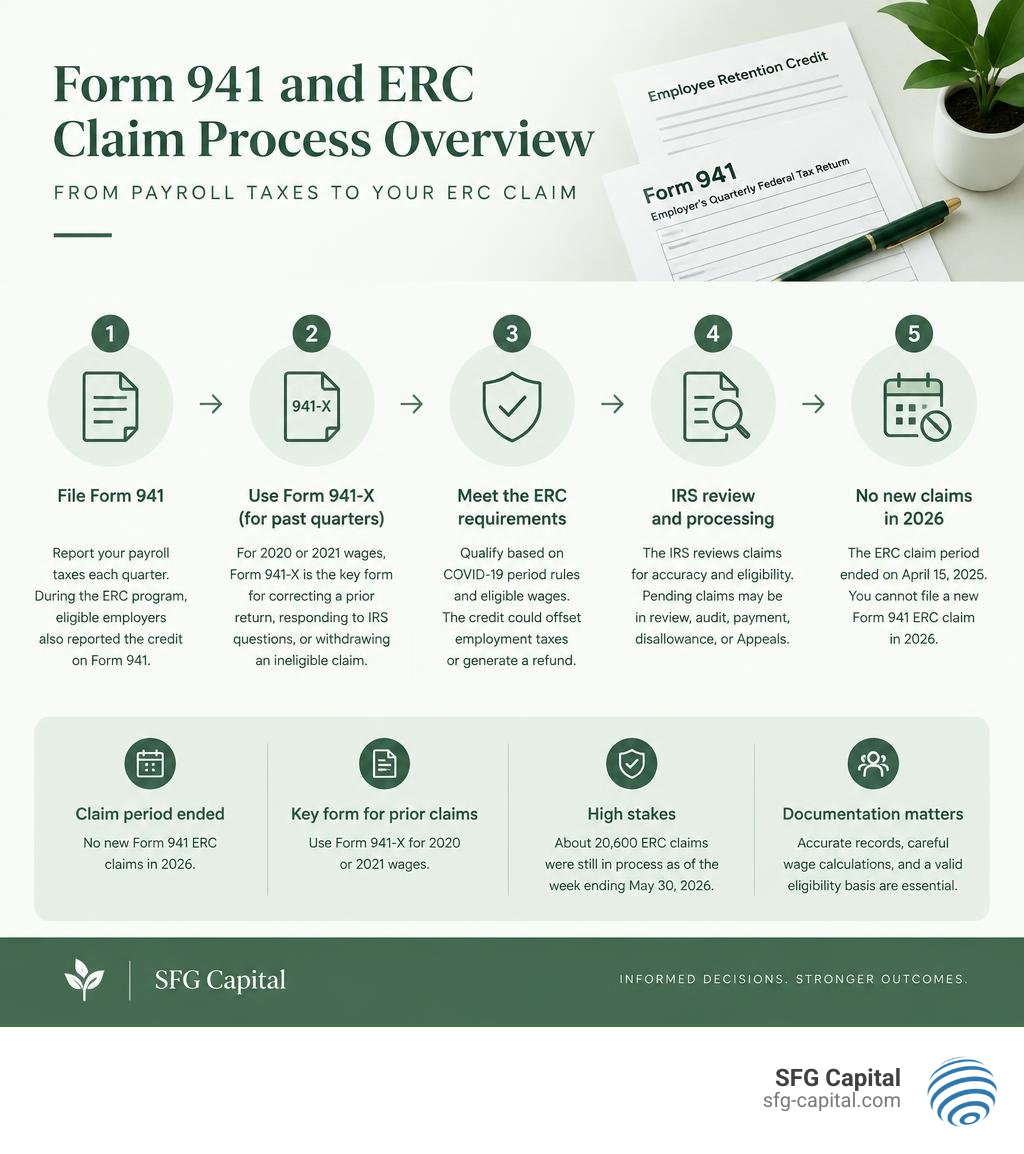
You cannot file a new IRS Form 941 Employee Retention Credit claim in 2026. The ERC claim period ended on April 15, 2025. If you already filed a valid claim for 2020 or 2021 wages, Form 941-X is the key form for correcting that prior quarterly payroll tax return, responding to IRS questions, or withdrawing an ineligible claim before payment.
Form 941 is the quarterly return employers use to report payroll taxes. During the ERC program, eligible employers reported the credit for qualifying COVID-19 periods on Form 941 or, more often for late claims, on Form 941-X. The credit could offset employment taxes and generate a refund, but the rules differ sharply between 2020 and 2021.
The stakes remain high for pending claims. As of the week ending May 30, 2026, the IRS reported about 20,600 ERC claims still moving through review, audit, payment, disallowance, or Appeals. Careful records, accurate wage calculations, and a valid eligibility basis matter more than a fast promise from an ERC promoter.
I am Santino Battaglieri, founder of SFG Capital, with more than nine years in financial services and experience supporting ERC advisory, compliance, and structured funding transactions. Our work with IRS Form 941 Employee Retention Credit claims centers on documentation, conservative eligibility analysis, and helping businesses understand their options while IRS processing continues.
Irs form 941 employee retention credit glossary:
Understanding the IRS Form 941 Employee Retention Credit Relationship
The Employee Retention Credit (ERC) was created under the CARES Act in March 2020 to encourage businesses to keep employees on their payrolls during pandemic-related shutdowns and downturns. Unlike income tax incentives, the ERC operates strictly as a refundable payroll tax credit. This structure links the credit directly to federal employment taxes reported quarterly.
How the IRS Form 941 Employee Retention Credit Mechanism Works
Every quarter, employers who pay taxable wages file Form 941 (Employer’s QUARTERLY Federal Tax Return) to report wages paid, federal income tax withheld, and both the employer and employee portions of Social Security and Medicare taxes (FICA). To gain deeper clarity on these structures, review our guide on understanding the payroll tax credit mechanism.
When the ERC was active, it functioned by offsetting the employer’s share of Social Security tax (for 2020 and early 2021) or Medicare tax (for later 2021 quarters). The credit mechanics are divided into two parts:
- Nonrefundable Portion: The portion of the credit that offsets the employer’s statutory tax liability for that specific quarter.
- Refundable Portion: Any credit amount exceeding that liability, which the IRS pays out directly to the employer as a cash refund check or electronic direct deposit.
For current quarterly operations, the IRS has modernized filing parameters. The Instructions for Form 941 (03/2026) | Internal Revenue Service reflect updated standard rates: the Social Security tax rate remains 6.2% each for employer and employee (up to the 2026 wage base limit of $184,500), while the Medicare rate is 1.45% each with no wage cap.
Form 941 vs Form 941-X: Amending Past Payroll Returns
Because most employers did not claim the ERC concurrently while paying wages in 2020 or 2021, the vast majority of claims were filed retroactively. You cannot retroactively adjust a payroll credit on a current Form 941. Instead, businesses use Form 941-X (Adjusted Employer’s QUARTERLY Federal Tax Return or Claim for Refund).
Form 941-X acts as the formal amendment mechanism. If you are examining how retroactive adjustments are processed, exploring how the ERC credit works helps clarify the underlying mechanics.
When filing Form 941-X for past quarters:
- Employers recalculate tax liability for the specific historical quarter.
- For wages paid after June 30, 2021 (Q3 and Q4 2021), employers must use Worksheet 4 rather than Worksheet 2 from the IRS instructions to compute the credit.
- The detailed steps and line allocations are outlined in the Instructions for Form 941-X (04/2022).
ERC Eligibility Breakdown and Key Differences (2020 vs 2021)
Eligibility rules changed significantly between 2020 and 2021 due to legislative amendments under the Relief Act and the American Rescue Plan Act (ARPA).
| Criteria / Feature | Tax Year 2020 | Tax Year 2021 (Q1, Q2, Q3) |
|---|---|---|
| Credit Percentage | 50% of qualified wages | 70% of qualified wages |
| Wage Cap per Employee | $10,000 for the entire year | $10,000 per calendar quarter |
| Maximum Credit | $5,000 per employee | $7,000 per employee / quarter ($21,000 total) |
| Gross Receipts Decline | > 50% decline vs. same 2019 quarter | > 20% decline vs. same 2019 quarter |
| Large Employer Threshold | > 100 full-time employees | > 500 full-time employees |
| Government Order Test | Full or partial suspension of operations | Full or partial suspension of operations |
| Recovery Startup Business | Not Applicable | Up to $50,000/quarter in Q3 & Q4 2021 |
Qualifying Rules and Gross Receipts Thresholds
To qualify for the ERC during eligible quarters, a business had to meet at least one of three distinct tests:
- Significant Decline in Gross Receipts:
- 2020: Gross receipts for a 2020 quarter were less than 50% of gross receipts for the identical calendar quarter in 2019.
- 2021: Gross receipts for a 2021 quarter were less than 80% (a 20% reduction) compared to the matching 2019 quarter.
- Full or Partial Suspension by Government Order: The business operations were fully or partially suspended due to orders from an appropriate governmental authority limiting commerce, travel, or group meetings due to COVID-19. Supply chain disruptions only qualified if directly caused by a government mandate that shut down a primary supplier.
- Recovery Startup Business (RSB): Available for Q3 and Q4 of 2021 for businesses that began operations after February 15, 2020, had average annual gross receipts under $1,000,000, and did not otherwise meet the standard gross receipts or shutdown tests. RSB claims were capped at $50,000 per quarter.
Properly evaluating ERC qualifications requires matching contemporaneous payroll logs directly against quarterly revenue journals.
Interplay with PPP Loans and Qualified Wages
Under the original CARES Act rules, receiving a Paycheck Protection Program (PPP) loan disqualified a business from claiming the ERC. Congress later repealed this restriction retroactively, allowing businesses to claim both benefits—provided there was no “double-dipping.”
To maintain compliance when navigating ERC IRS guidelines:
- Wage Allocation: Any dollar used for PPP loan forgiveness cannot be counted as qualified wages for the ERC.
- Qualified Health Plan Expenses: Pre-tax employer-paid health insurance costs allocable to qualified wages can be included in the calculation.
- Owner and Relative Wages: Wages paid to majority owners (greater than 50% ownership) and their direct familial relations are generally excluded under IRC §267(c) attribution rules.
Current IRS Status: Processing Deadlines and Audits in 2026

The IRS has placed intense scrutiny on the Employee Retention Credit due to a surge in improper and fraudulent filings submitted by aggressive third-party promoters.
2026 Processing Backlog and the IRS Review Pipeline
The IRS is actively processing its remaining inventory under strict audit and compliance standards. Official data confirms the exact distribution across the agency’s review pipeline:
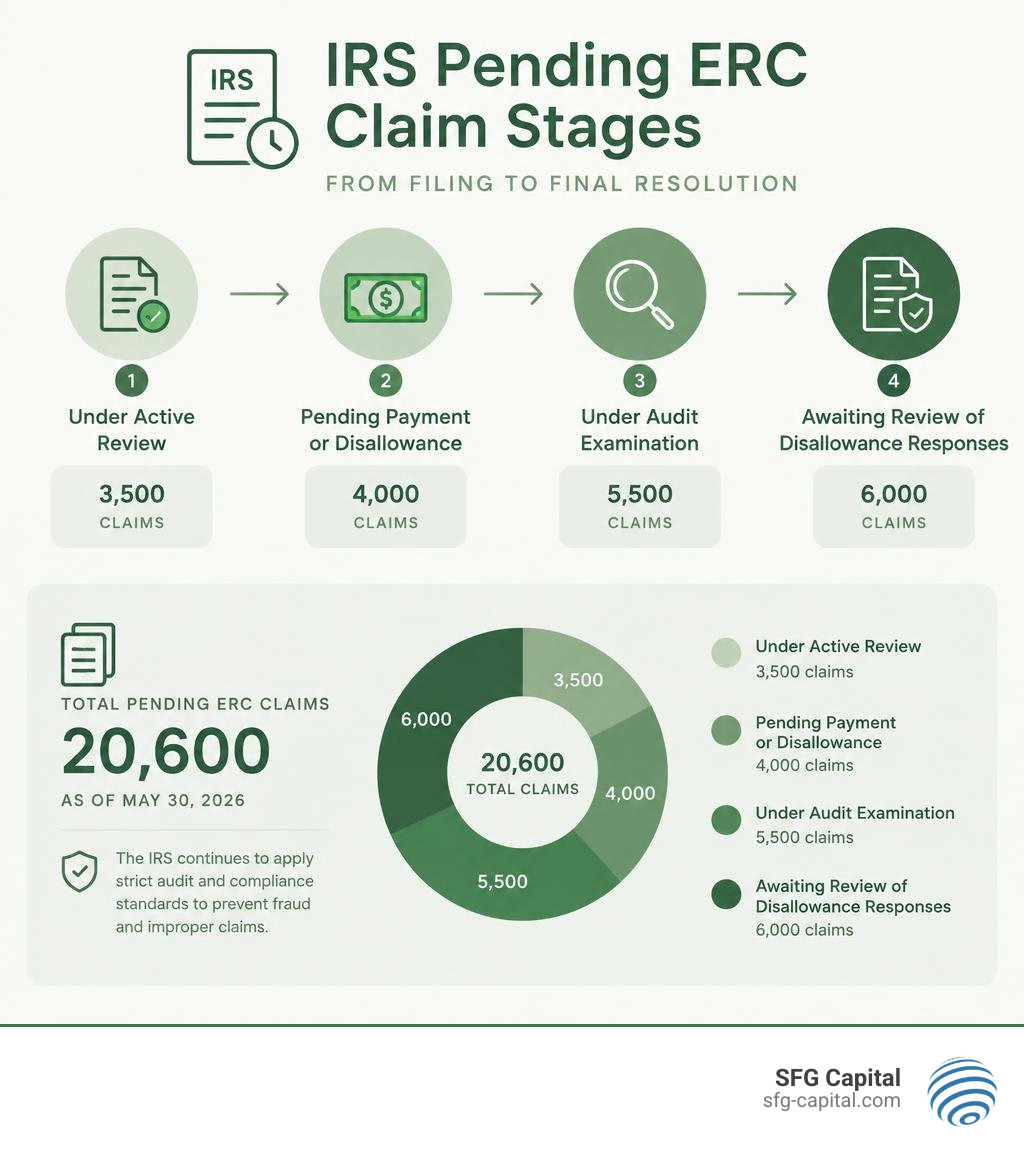
As of the week ending May 30, 2026, the IRS reported approximately 20,600 remaining ERC claims across the following operational stages:
- Under Active Review: 3,500 claims
- Pending Payment or Disallowance: 4,000 claims
- Under Audit Examination: 5,500 claims
- Awaiting Review of Disallowance Responses: 6,000 claims
- With the Independent Office of Appeals: 1,600 claims
Additionally, as of May 2025, the IRS had issued approximately 84,000 formal letters informing employers that their claims had been partially or fully disallowed. Businesses navigating this extended timeline can learn more about tracking the ERC refund journey through the Employee Retention Credit | Internal Revenue Service portal.
Legislative Deadlines and OBBBA Restrictions
The timeline for the Employee Retention Credit came to an official statutory close:
- Statutory Claim Deadline: The window to file adjusted payroll tax returns to claim the ERC closed permanently on April 15, 2025. No new claims can be filed.
- One Big Beautiful Bill Act (OBBBA): Under the OBBBA provisions (§70605(d)), Congress retroactively barred any ERC claims for the third or fourth quarters of 2021 if the filing was submitted after January 31, 2024.
- Extended Audit Statute: The statute of limitations for the IRS to assess erroneous ERC claims on 2020 and 2021 filings was extended to a full six-year window, giving IRS examiners through 2026 and 2027 to audit and recapture improper payments.
Correcting Claims: IRS Withdrawal Process and Income Tax Adjustments
If your business filed a claim that you now suspect contains errors or fails eligibility requirements, the IRS provides formal administrative remedies.
How to Withdraw an Ineligible Claim
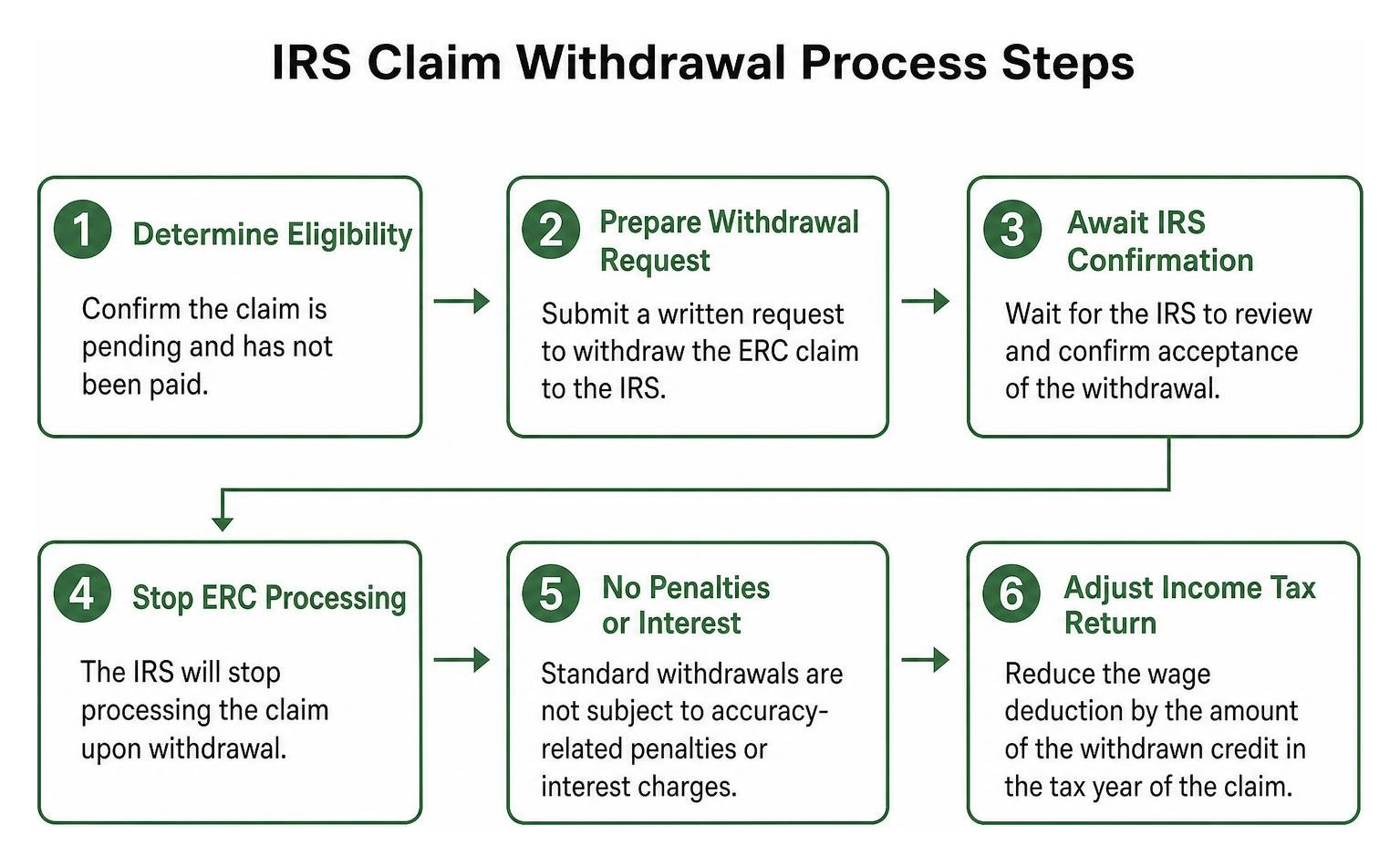
The IRS established an official ERC Claim Withdrawal Program to allow business owners to retract pending claims without facing accuracy-related penalties or interest charges.
To qualify for standard withdrawal:
- The claim must have been filed on an adjusted return (Form 941-X, 943-X, 944-X, or CT-1X) solely to claim the ERC, with no other adjustments.
- You must either have not yet received payment, or received an ERC refund check that has not been cashed or deposited.
Step-by-Step Withdrawal Execution:
- Make a copy of the previously filed Form 941-X.
- In the left margin of page 1, clearly write “Withdrawn.”
- In the right margin of page 1, an authorized corporate officer must sign, date, and print their full name and title.
- Fax the marked-up copy directly to the specialized IRS withdrawal fax line at 855-738-7609.
- If you received a paper refund check that was not deposited, void the check, write an explanatory note, and mail both items alongside your signed withdrawal request per the official guidance on how to Withdraw an Employee Retention Credit (ERC) claim.
Income Tax Impact and Wage Deduction Reductions (Form 1120-S)

A frequent area of confusion among business owners is the relationship between payroll credits and annual income tax returns. Under Internal Revenue Code §280C(a) and IRS Notice 2021-49, businesses cannot receive a “double tax benefit.”
When an employer receives an ERC, they must reduce their income tax wage deduction by the exact amount of the credit claimed for the tax year in which the qualified wages were paid:
- An ERC claimed on 2020 wages requires reducing wage deductions on the 2020 corporate return (e.g., Form 1120 or Form 1120-S).
- An ERC claimed on 2021 wages requires reducing wage deductions on the 2021 corporate return.
For S-Corporations filing Form 1120-S, reducing wage expense increases ordinary business income for that historical year. This necessitates issuing amended Schedule K-1s to shareholders, who must then adjust their individual Form 1040 returns. You can review these interactions in our comprehensive guide to ERC tax credits.
Warning Signs of ERC Scams and Improper Filings
The IRS Criminal Investigation division initiated 252 criminal investigations involving more than $2.8 billion of potentially fraudulent ERC claims. Much of this abuse was driven by unregulated “ERC mills.”
Identifying ERC Mills and Aggressive Promoters
Legitimate tax professionals adhere to Circular 230 ethical standards. Businesses should be vigilant regarding classic promoter warning signs:
- Unsolicited Solicitations: Direct mailers or telemarketing calls stating your business “automatically qualifies” before reviewing your financial books.
- Contingency Fee Abuse: Charging 15% to 30% of the gross refund amount, incentivizing inflated claim totals.
- Vague Supply Chain Claims: Claiming eligibility based on general economic inflation or supply chain delays without a direct government shutdown order affecting a tier-one supplier.
- Refusal to Sign Returns: Promoters who prepare Form 941-X returns but refuse to sign as the paid preparer, leaving the business owner entirely liable for penalties.
If you suspect an improper claim was filed on your behalf, seek reputable assistance through our guide on finding reliable ERC assistance.
Frequently Asked Questions About Form 941 and ERC
Can I still submit an initial ERC claim on Form 941 in 2026?
No. The final statutory window to submit original or amended claims for the Employee Retention Credit closed on April 15, 2025. Standard quarterly Form 941 filings in 2026 do not include active lines for COVID-19 employee retention credits. For additional details on statutory limits, consult the official Frequently asked questions about the Employee Retention Credit resource.
How do I handle a partial or full disallowance letter from the IRS?
If the IRS reviews your Form 941-X claim and issues Letter 105-C (Notice of Claim Disallowance), you have formal administrative appeal rights. You generally have 30 days from the date of the letter to submit a written protest requesting review by the IRS Independent Office of Appeals. If the administrative appeal does not resolve the matter, taxpayers have the right to file a tax refund suit in the appropriate United States District Court or the U.S. Court of Federal Claims.
Does receiving an ERC refund affect my business income tax deductions?
Yes. Under IRC §280C, you cannot deduct wages on your federal income tax return that were paid for by an Employee Retention Credit. You must reduce the wage deduction on your business return for the tax year the wages were paid (2020 or 2021). If that tax return has already been filed, you must file an amended income tax return to reflect the reduced deduction and pay any corresponding income tax difference.
Conclusion
The Employee Retention Credit provided vital support to businesses across the country during unprecedented economic challenges. However, the intersection of Form 941, Form 941-X, and strict IRS compliance requires careful navigation. With new claims closed since April 15, 2025, the priority for businesses today is ensuring pending claims are substantiated, audits are handled with defensible records, and improper claims are withdrawn to prevent severe penalties under the extended six-year audit statute.
At SFG Capital, we help businesses in Austin and throughout Travis County navigate ERC complexities. Whether you are dealing with IRS processing backlogs, require audit-ready record organization, or want to bypass extended government waiting times with fee-based liquidity solutions, our team provides trusted institutional guidance. To learn how we can support your business capital needs, explore SFG Capital financing and refund advance services today.
See what your business may qualify for.
60 seconds. No documents. No upfront cost.
General information only, not legal or tax advice. Eligibility and estimates are fact-specific and subject to review.