
Blog / Insights
InsightsFinding Fast ERC Payroll Help Without the Headache
October 14, 2026 · 8 min read · By the SFG Capital team
Fast ERC Payroll Help Starts With Claim Validation
Fast ERC payroll help should begin with a compliance check, not a refund promise. Before choosing a service, ask it to:
- Verify eligibility using payroll records, government-order evidence, and gross-receipts data.
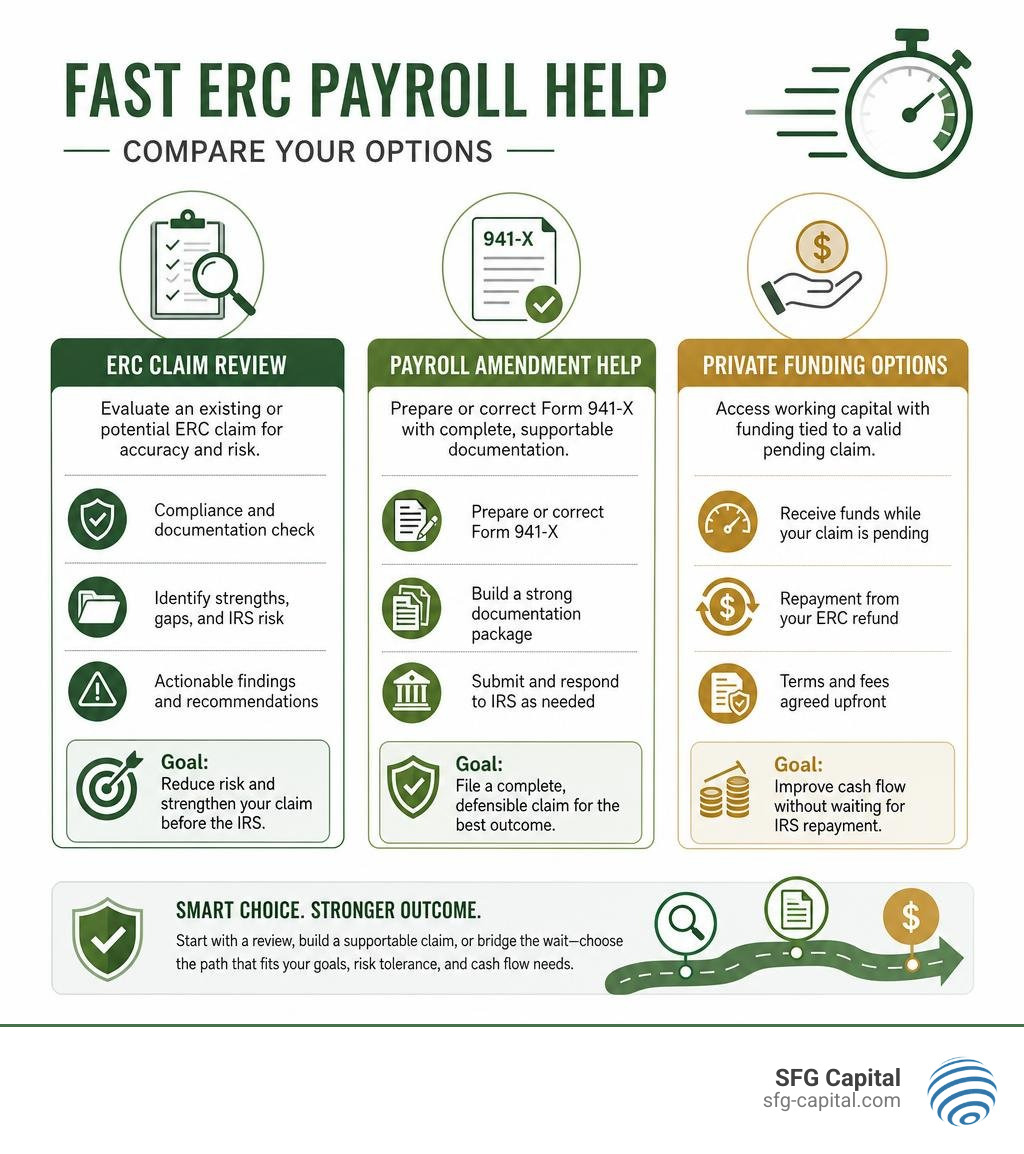
- Explain whether it will prepare or correct Form 941-X, review an existing claim, or offer funding tied to a valid pending claim.
- Put fees, repayment terms, and risk-sharing terms in writing.
- Involve a qualified tax professional when the claim is complex, disputed, or under IRS review.
The ERC is a refundable payroll tax credit for eligible employers that paid qualified wages from March 13, 2020, through December 31, 2021. But a fast option cannot make an ineligible claim valid or force the IRS to pay it sooner. As of May 30, 2026, the IRS reported about 20,600 ERC claims still moving through review, payment or disallowance, audit, response review, and Appeals stages.
That makes the key comparison simple: payroll amendment help focuses on preparing a supportable tax claim, while qualified funding or claim-purchase options may help an eligible business access working capital before the IRS finishes processing. Watch for promoters who guarantee approval, skip document review, charge unclear percentage-based fees, or push claims based on weak eligibility theories.
I am Santino battaglieri, founder of SFG Capital, with more than nine years in financial services and experience supporting and funding ERC transactions at scale. In the sections ahead, I will help you compare fast ERC payroll help options with a focus on documentation, transparency, and business protection.
Understanding ERC Eligibility and IRS Backlogs in 2026
The Employee Retention Credit remains one of the most substantial federal relief measures enacted for small-to-medium businesses during the COVID-19 pandemic. Specifically, the ERC is a refundable tax credit available to eligible employers that paid qualified wages to some or all employees after March 12, 2020, and before January 1, 2022.
To qualify, an employer generally needed to meet one of three primary tests during the eligible calendar quarters:
- Full or Partial Suspension of Operations: The business was subjected to orders from an appropriate governmental authority limiting commerce, travel, or group meetings due to COVID-19.
- Significant Decline in Gross Receipts: The business experienced a qualifying percentage drop in quarterly gross receipts compared to the same calendar quarter in 2019.
- Recovery Startup Business Status: For the third and fourth quarters of 2021, certain businesses that started operations after February 15, 2020, with average annual gross receipts under $1 million could claim up to $50,000 per quarter.
While the fundamentals appear straightforward, navigating official guidance on the Employee Retention Credit has grown increasingly challenging due to heightened scrutiny. As of the week ending May 30, 2026, the IRS maintains approximately 20,600 remaining ERC claims dispersed across several rigorous processing stages:
- Under Review: 3,500 claims
- Pending Payment or Disallowance: 4,000 claims
- Under Formal Audit: 5,500 claims
- Awaiting Review of Disallowance Responses: 6,000 claims
- Independent Office of Appeals: 1,600 claims
Because the rules changed substantially between tax years, eligibility calculations cannot be applied uniformly.
| Eligibility Criteria | 2020 Tax Year | 2021 Tax Year |
|---|---|---|
| Gross Receipts Decline Threshold | > 50% drop compared to 2019 quarter | > 20% drop compared to 2019 quarter |
| Alternative Quarter Lookback | Not Applicable | Available (prior calendar quarter) |
| Large Employer Threshold | > 100 full-time employees | > 500 full-time employees |
| Qualified Wages Cap | $10,000 per employee per year | $10,000 per employee per quarter |
| Maximum Credit Calculation | 50% of qualified wages | 70% of qualified wages |
| Maximum Annual Credit per Employee | Up to $5,000 total | Up to $21,000 ($7,000 per Q1, Q2, Q3) |

Evaluating Your Options for Fast ERC Payroll Help

Waiting on government agencies to process backlog inventory can strain any company’s working capital. When businesses seek fast ERC payroll help, they typically encounter two distinct categories of assistance: administrative tax remediation and liquidity-focused advance programs. Discerning the right fit depends on whether your roadblock is technical compliance, an ongoing IRS inquiry, or an immediate cash deficit.
Why Businesses Need Fast ERC Payroll Help for IRS Audits and Delays
The IRS has placed extreme focus on weeding out improper claims, creating multi-year processing lags even for entirely legitimate filings. Employers caught in this web often receive detailed information requests, preliminary rejection notices, or formal Letter 105-C claim disallowances.
When a claim is formally disallowed via Letter 105-C, the clock starts ticking immediately. Businesses have 30 days to file an administrative appeal or provide supplemental evidence to the IRS Independent Office of Appeals. Understanding and navigating the ERC funding process requires clear documentation, including detailed payroll ledgers, proof of direct operational suspension, and gross receipts spreadsheets.
For companies facing cash-flow shortages while waiting out these procedural hurdles, applying actionable strategies to expedite tax refunds helps ensure that filings move through compliance channels without unnecessary clerical holds.
Comparing Payroll Amendment Services vs. Advance Funding
When comparing support providers, it is critical to distinguish between payroll amendment services and specialized bridge funding providers.
- Payroll Amendment Services: These firms focus on the tax mechanics. They prepare, calculate, and submit adjusted employment tax returns using Form 941-X. Their primary job is ensuring that your qualified wage allocations, healthcare costs, and Paycheck Protection Program (PPP) loan forgiveness deductions align precisely with statutory rules.
- ERC Advance and Buyout Funding: Rather than waiting months or years for IRS disbursement, qualifying organizations leverage non-recourse advances or outright claim purchases. By using a complete guide to ERC advance funding, companies can turn a stalled government refund into immediate operating capital.
Choosing an option like securing an ERC refund advance allows a business to bypass treasury delays entirely. In these arrangements, a provider advances capital against the pending claim using a clear, performance-based fee structure, meaning the business is not left balancing debt service payments while waiting on IRS resolution.
How to Choose Fast ERC Payroll Help Without Falling for Promoters
The ERC marketplace has unfortunately seen an influx of predatory promoters and pop-up mills. To protect your business from civil audit penalties or reputational harm, watch for these common red flags:
- Contingency-Only Upfront Fees: Promoters who demand large non-refundable upfront retainers or take massive percentages without providing audit-defense support.
- Vague Supply Chain Arguments: Claiming eligibility solely on generic “supply chain disruptions” without showing a specific, direct government mandate that halted an essential vendor.
- Overlooking PPP Adjustments: Failing to back out payroll that was already forgiven under PPP loans, which creates an illegal double-dip under IRS regulations.
- Refusing to Sign Returns: Promoters who calculate returns but refuse to sign as a paid preparer on Form 941-X.

Employers should work directly with seasoned CPAs, enrolled agents, or dedicated funding partners. Consulting resources such as the US Chamber guide on how to claim the ERC or hiring reputable employee retention credit advisors ensures your claim is grounded in verifiable tax law rather than aggressive marketing hype.
How to Verify, Correct, or Withdraw Flawed ERC Claims
If an employer discovers that a previously submitted claim was based on erroneous advice or inflated wage calculations, immediate corrective action must be taken. The IRS provides official withdrawal and correction avenues that allow taxpayers to remediate errors and avoid harsh penalties.
- Evaluate via Official Checklists: Review your initial filing against the IRS ERC Eligibility Checklist to confirm qualifying government shutdown orders or clear gross receipts math.
- Execute the Claim Withdrawal Process: If you submitted Form 941-X but have not received payment (or received a check but have not cashed or deposited it), you can request a formal withdrawal. The IRS treats withdrawn claims as though they were never filed, shielding the business from civil penalties and audits.
- Adjust Federal Income Tax Returns: Claiming the ERC reduces your deductible wage expenses on your federal income tax return (e.g., Form 1120 or 1120-S) by the amount of the credit. If you correct or withdraw an ERC claim, you must also amend your income tax returns to restore your wage deductions.
- Explore Advance Options on Verified Portions: If only a subset of quarters requires adjustment, businesses often use reliable methods to advance your ERC refund today on the undisputed, clean portions of their claim to unlock capital while the paperwork settles.
If your business receives an adverse notice or Letter 105-C, follow this response roadmap:
- Step 1: Check the Timetable: Note the date on the Letter 105-C; you typically have 30 days to respond.
- Step 2: Collect Source Records: Gather contemporaneous government shutdown decrees, quarterly profit-and-loss statements, and raw payroll summaries.
- Step 3: Draft an Administrative Appeal: Write a detailed rebuttal highlighting the exact tax code sections and safe harbors supporting your qualified wages.
- Step 4: Request Independent Appeals Review: If the initial field agent upholds the disallowance, escalate your file to the IRS Independent Office of Appeals for an objective reassessment.
Frequently Asked Questions About ERC Payroll Assistance
What is the primary difference between 2020 and 2021 ERC eligibility?
The 2020 and 2021 program parameters differ significantly across employer thresholds, decline percentages, and maximum payouts:
- Employee Thresholds: In 2020, a “small employer” was defined as having 100 or fewer full-time employees, meaning all wages paid to staff counted. In 2021, that threshold expanded to 500 or fewer full-time employees.
- Gross Receipts Decline: The 2020 rules required a gross receipts decline of more than 50% compared to 2019. For 2021, the requirement was reduced to a 20% drop.
- Credit Caps: The 2020 credit provided up to 50% of $10,000 in qualified wages per employee across the entire year ($5,000 cap). The 2021 credit provided up to 70% of $10,000 in qualified wages per employee per quarter, yielding up to $21,000 per employee across Q1 through Q3.
How can an employer withdraw an ineligible ERC claim to prevent penalties?
Employers that filed an ERC claim but have not yet received or cashed a refund check can use the special IRS ERC claim withdrawal process. To withdraw:
- Prepare a copy of the original Form 941-X.
- Write “WITHDRAWAL” across the left margin of the first page.
- Have an authorized officer sign and date the right margin.
- Fax or mail the document to the dedicated IRS ERC withdrawal processing center.
If an uncashed refund check has already been mailed to you, write “VOID” in the endorsement section and return it with your withdrawal letter. This stops future audit exposure and interest accumulation.
How do advance funding and buyout options resolve IRS processing delays?
Advance funding and buyout solutions address liquidity bottlenecks by providing upfront capital secured by your pending tax credit claim. Rather than remaining stuck in multi-year federal processing queues, eligible business owners can access working capital within days.
By utilizing structured options for accessing employee retention cash now, the advance provider assumes the waiting period, transferring the timing burden away from your business operations.
Conclusion
Managing payroll while navigating complex tax credits requires clear compliance and dependable liquidity. At SFG Capital, we help businesses throughout Austin and Travis County evaluate their filings, overcome administrative bottlenecks, and access the funding they need without endless delays.
Whether you need a thorough claim compliance review or want to explore risk-free refund advances, our team provides transparent guidance backed by performance-based fee structures. Explore our comprehensive capitalization and advisory services today to secure your working capital and move forward with confidence.
See what your business may qualify for.
60 seconds. No documents. No upfront cost.
General information only, not legal or tax advice. Eligibility and estimates are fact-specific and subject to review.