
Blog / Insights
InsightsForm 7200 and the Ghost of ERC Past
October 14, 2026 · 8 min read · By the SFG Capital team
Form 7200: The Former Fast Track for ERC Cash
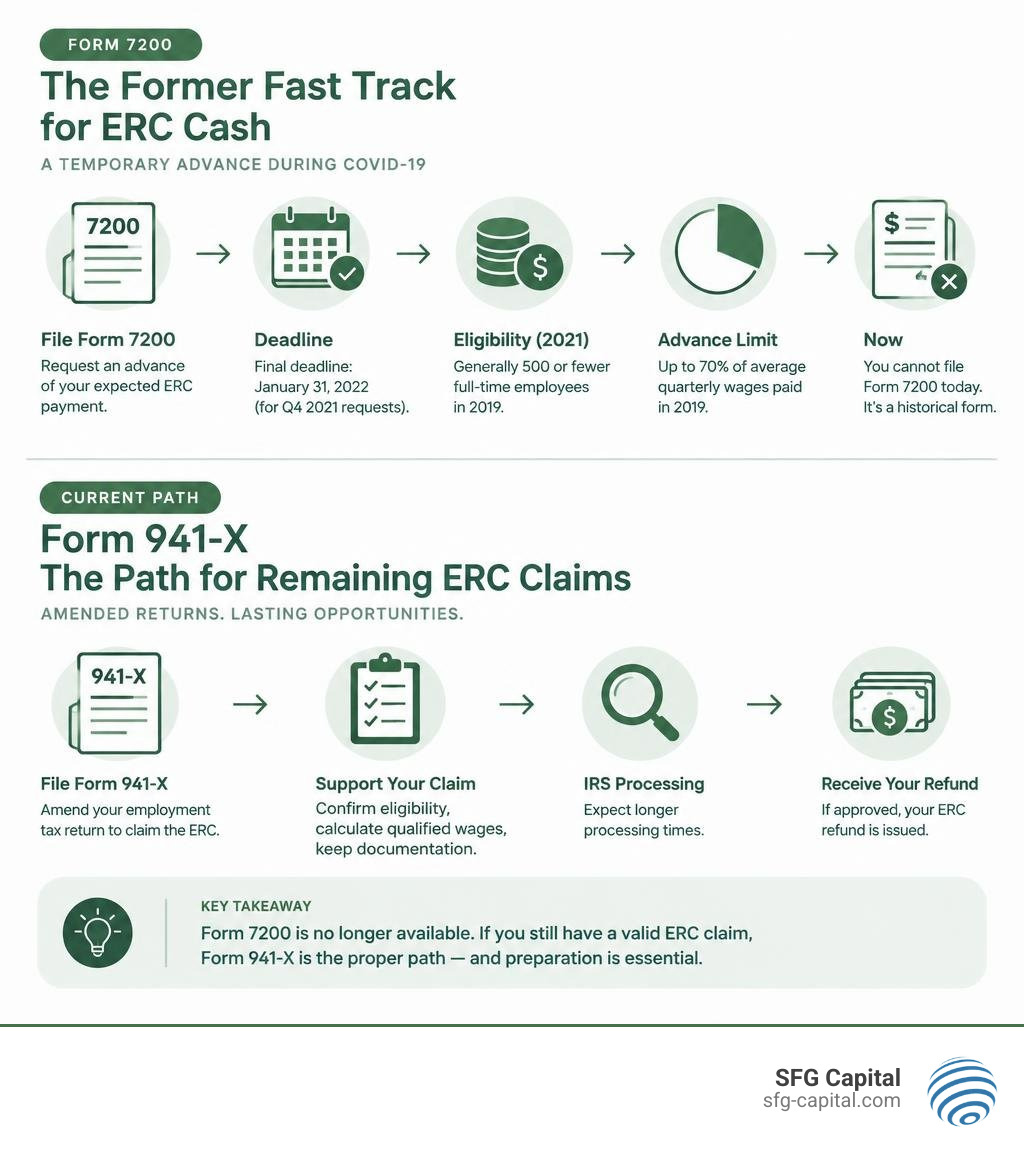
You cannot file IRS Form 7200 for an Employee Retention Credit advance today. The final deadline was January 31, 2022, for eligible fourth-quarter 2021 requests. Form 7200 was a temporary COVID-19 relief form that let certain small employers request part of an expected ERC payment before filing their regular payroll tax return.
If your business still has a valid ERC claim, the path is generally an amended employment tax return, such as Form 941-X – not Form 7200. That means careful eligibility support, wage calculations, and documentation matter more than ever, especially when IRS processing times are long.
During the pandemic, Form 7200 helped eligible employers bridge a cash-flow gap. It allowed them to request an advance after reducing payroll tax deposits, subject to strict limits. For 2021 ERC advances, an employer generally needed to average 500 or fewer full-time employees in 2019, and the requested advance could not exceed 70% of average quarterly wages paid in 2019.
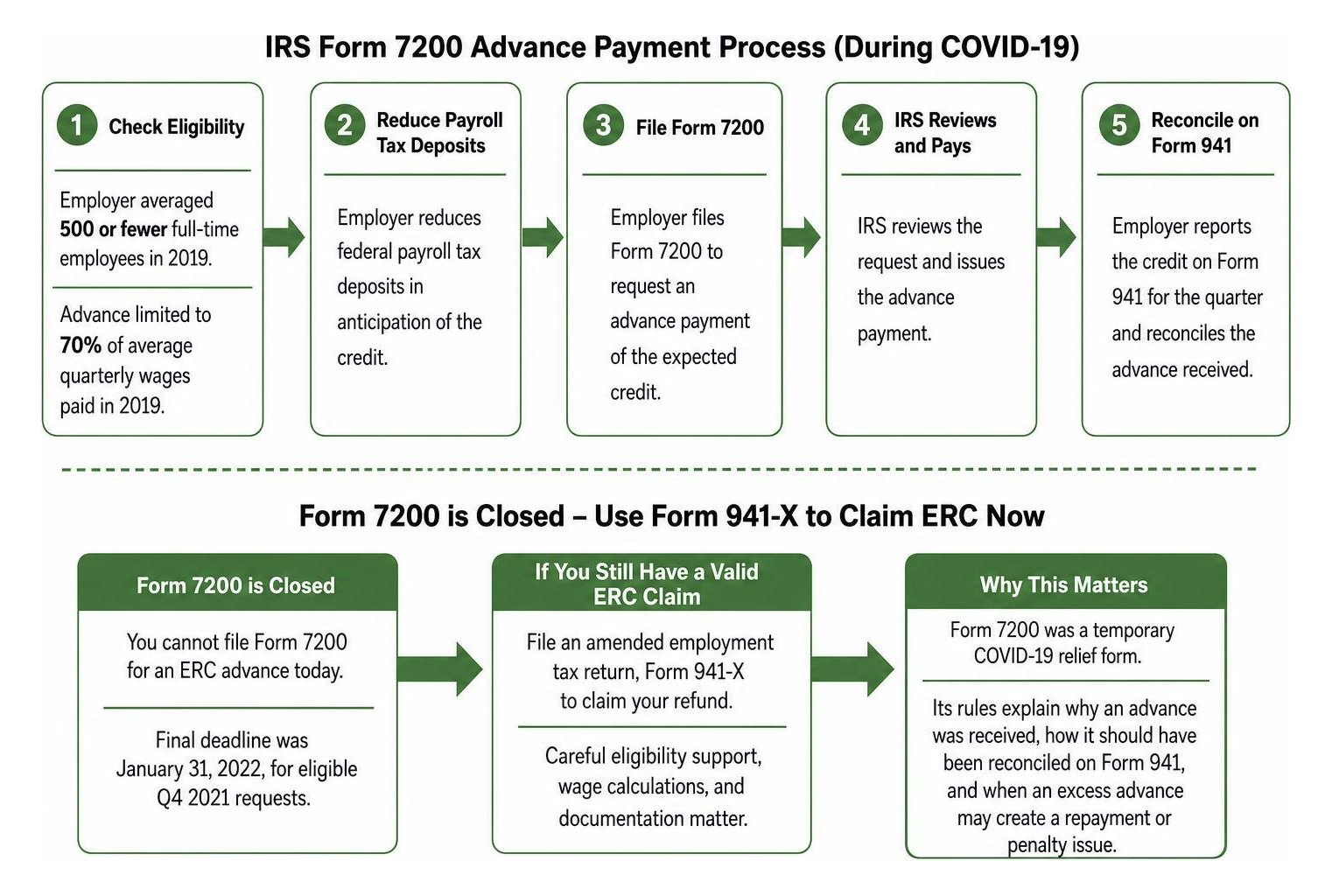
The form is now a historical part of the ERC program, but its rules still matter. They explain why an advance was received, how it should have been reconciled on Form 941, and when an excess advance may create a repayment or penalty issue.
I am Santino Battaglieri, founder of SFG Capital, with more than nine years in financial services and experience supporting ERC advisory, compliance, and funding transactions totaling over $500 million in claims. In this guide to the irs form 7200 employee retention credit, I will explain what Form 7200 did, why it ended, and what compliant options remain for businesses pursuing legitimate ERC refunds.
Key irs form 7200 employee retention credit vocabulary:
Understanding the IRS Form 7200 Employee Retention Credit Mechanism
During the height of pandemic economic disruptions, the federal government introduced relief measures through the Coronavirus Aid, Relief, and Economic Security (CARES) Act and the American Rescue Plan Act (ARPA). Chief among these provisions were advance payroll tax credits intended to keep workers on company payrolls.
To bridge the gap between paying wages and filing quarterly payroll returns, the IRS created Form 7200 (Advance Payment of Employer Credits Due to COVID-19). This mechanism covered three primary relief credits:
- The Employee Retention Credit (ERC)
- Qualified sick and family leave wages under the Families First Coronavirus Response Act (FFCRA)
- COBRA premium assistance payments under ARPA
Under normal tax administration, employers fund payroll credits when filing Form 941. However, Form 7200 enabled businesses to access liquidity ahead of schedule. Before requesting a direct cash disbursement, an employer was first required to reduce its federal employment tax deposits (including withheld federal income tax, employee Social Security and Medicare taxes, and the employer’s share of Social Security and Medicare taxes) up to the anticipated credit amount.
If eligible credit amounts exceeded total tax deposits for that pay period, the employer could submit Form 7200 to request the remaining balance directly from the IRS. Filers did not submit this document electronically or through standard postal channels; the IRS established a dedicated toll-free fax line to process incoming requests. For detailed historical instructions on how these credit lines functioned, refer to the official IRS Form 7200 instructions.
Small Employer Rules for the IRS Form 7200 Employee Retention Credit
The rules governing advance payments shifted substantially between 2020 and 2021. For the 2021 calendar quarters, advance payments were strictly reserved for small employers. To qualify, an employer must have averaged 500 or fewer full-time employees during calendar year 2019. Large employers (those averaging more than 500 full-time workers in 2019) were ineligible to request advance payments via Form 7200, though they could still claim credits directly on their employment tax returns.
Special provisions applied to Recovery Startup Businesses—entities that launched operations after February 15, 2020, and maintained average annual gross receipts under $1,000,000. These businesses qualified for the ERC during the third and fourth quarters of 2021 without needing to demonstrate a government-mandated shutdown or significant gross receipts decline. However, statute capped their total ERC at $50,000 per calendar quarter.
The 70% Advance Limit and PPP Coordination
Congress implemented mathematical guardrails to prevent businesses from drawing excessive advance disbursements. Under the 2021 framework, the advance payment requested on Form 7200 could not exceed 70% of the employer’s average quarterly wages paid in calendar year 2019.
When calculating wages toward qualifying for the tax credit, employers were permitted to include allocable qualified health plan expenses. However, statutory coordination rules barred “double-dipping.” Payroll costs allocated to Paycheck Protection Program (PPP) loan forgiveness could not serve as qualified wages for the ERC or advance claims under Form 7200.
How Employers Reconciled Form 7200 Advances with Form 941
Form 7200 operated strictly as an advance mechanism rather than a standalone tax return. Every dollar distributed through Form 7200 had to be formally reconciled on the employer’s regular quarterly federal tax return (typically Form 941, Form 943 for agricultural employers, Form 944 for annual filers, or Form CT-1 for railroad employers).
On Form 941, employers reported their total calculated tax credits in Part 1. They then accounted for advance distributions on the dedicated line for total advances received from filing Form 7200 for the quarter (Line 13f on standard 2021 Form 941 revisions).
Employers working with third-party payers—such as Professional Employer Organizations (PEOs) or Certified Professional Employer Organizations (CPEOs)—faced additional reporting requirements. PEOs reconciled these disbursements on Schedule R (Form 941), tying every client’s advance request directly to their aggregate quarterly tax filings.
| Metric / Step | Form 7200 (Advance Request) | Form 941 (Quarterly Reconciliation) |
|---|---|---|
| Primary Purpose | Accelerate cash flow prior to quarter close | Report total wages, taxes, credits, and final balance |
| Timing | Filed after reducing tax deposits, before Form 941 | Filed by the end of the month following quarter-end |
| Submission Method | Dedicated IRS Fax Line | Electronic Filing (e-file) or Paper Mail |
| Credit Cap Applied | 70% of 2019 average quarterly wages | 70% of qualified wages up to $10,000/employee/quarter (2021) |
| Resolution | Cash advance check mailed to employer | Reconciles advance on Line 13f to calculate final tax balance/refund |
If an employer claimed an advance that ultimately exceeded actual eligible wages at quarter-end, the excess created an underpayment of employment taxes on Form 941, triggering immediate repayment obligations.
Documenting Wages and Avoiding Penalties Under the IRS Form 7200 Employee Retention Credit
Because the IRS processed Form 7200 rapidly to disburse emergency relief, post-filing audit scrutiny is rigorous. Under Internal Revenue Code (IRC) § 6676, submitting an erroneous claim for refund or credit carries a 20% civil penalty on the excessive amount claimed, unless reasonable cause is established.
To defend legacy claims or reconcile past filings, employers must maintain full documentation for at least four years (or up to six years under extended assessment statutes), including:
- Detailed payroll journals and gross wage calculations per employee
- Documentation of allocable qualified health plan expenses
- Records demonstrating a full or partial suspension of operations due to government orders, including specific jurisdictional orders
- Quarterly financial statements showing eligible gross receipts reductions (e.g., >50% decline for 2020 quarters or >20% decline for 2021 quarters compared to 2019)
- PPP forgiveness documentation proving zero overlap between PPP payroll costs and ERC qualified wages
The Sunsetting of Form 7200 and Retroactive ERC Filing Today

The ability to request advance credit disbursements through Form 7200 ended on January 31, 2022, which served as the final filing deadline for fourth-quarter 2021 claims. Today, Form 7200 is obsolete for new requests and serves solely as a historical compliance reference.
Employers looking to claim remaining eligible credits must file an amended employment tax return using Form 941-X (Adjusted Employer’s QUARTERLY Federal Tax Return or Claim for Refund). The statutory deadlines for ERC claims cover qualified wages paid before January 1, 2022:
- 2020 Claims: Form 941-X was due within three years from the date the original return was filed or two years from payment (generally April 15, 2024).
- 2021 Claims: Subject to evolving legislative cutoff proposals and administrative review standards, 2021 claims historically aligned with an April 15, 2025 window.
However, the IRS has subjected amended ERC returns to strict fraud screenings, audits, and extended processing moratoriums. As a result, businesses waiting on valid Form 941-X claims frequently encounter prolonged delays. Employers navigating these processing backlogs often turn to modern advance funding solutions to unlock their capital rather than waiting on federal processing queues. Current program parameters can be reviewed on the official IRS Employee Retention Credit program updates portal.
Securing Capital While Navigating Current IRS Backlogs
IRS processing delays on amended payroll returns can disrupt working capital, particularly for small and mid-sized employers. Although the IRS no longer offers administrative advance distributions via Form 7200, businesses can address liquidity constraints through private advance funding arrangements.
At SFG Capital, we help businesses in Austin and throughout Travis County, Texas, access their pending tax credits without waiting through indefinite IRS processing queues. Through our private advance funding mechanisms, we provide credit buyouts and bridge advances that convert pending ERC refund claims into immediate operational capital. Our performance-based approach ensures comprehensive file compliance, audit defense readiness, and rapid liquidity.
Frequently Asked Questions About IRS Form 7200
Can businesses still submit Form 7200 to request an ERC advance in 2026?
No. Form 7200 was permanently sunset by the IRS on January 31, 2022. Any retroactive claims for the Employee Retention Credit must be submitted by filing an amended quarterly employment tax return (Form 941-X).
What happened if an employer received an advance larger than their actual credit?
If an employer received advance funds via Form 7200 that exceeded their final calculated ERC on Form 941, the difference was treated as an underpayment of employment taxes. The employer was required to repay the excess amount to the IRS. Failure to repay by the quarterly return due date exposed the business to statutory failure-to-pay penalties, daily compounding interest, and potential civil assessment under IRC § 6676.
How did PPP loan forgiveness affect Form 7200 calculations?
Under the Taxpayer Certainty and Disaster Tax Relief Act of 2020, employers could participate in both the PPP and the ERC. However, individual wage dollars could not be double-counted. When calculating the anticipated credit for Form 7200 advances, employers had to exclude any payroll costs dedicated to securing PPP loan forgiveness.
Conclusion: Navigating Legacy Claims and Modern Funding Options
IRS Form 7200 provided essential cash flow during the pandemic, but its expiration leaves employers dependent on Form 941-X filings subject to extensive review. Reconciling historical advances accurately and maintaining comprehensive audit trails remains essential for regulatory compliance.
If your enterprise has pending ERC claims locked in IRS backlogs, SFG Capital can help you secure immediate liquidity. Explore our comprehensive capital services to resolve legacy filings, navigate IRS compliance, and access the funding your business needs to grow.
See what your business may qualify for.
60 seconds. No documents. No upfront cost.
General information only, not legal or tax advice. Eligibility and estimates are fact-specific and subject to review.