
Blog / Insights
InsightsFrom E-file to Bank Account: When Will My Refund Be Approved?
October 14, 2026 · 11 min read · By the SFG Capital team
Tracking Your Timeline: How Long Does It Take for a Refund to Get Approved?
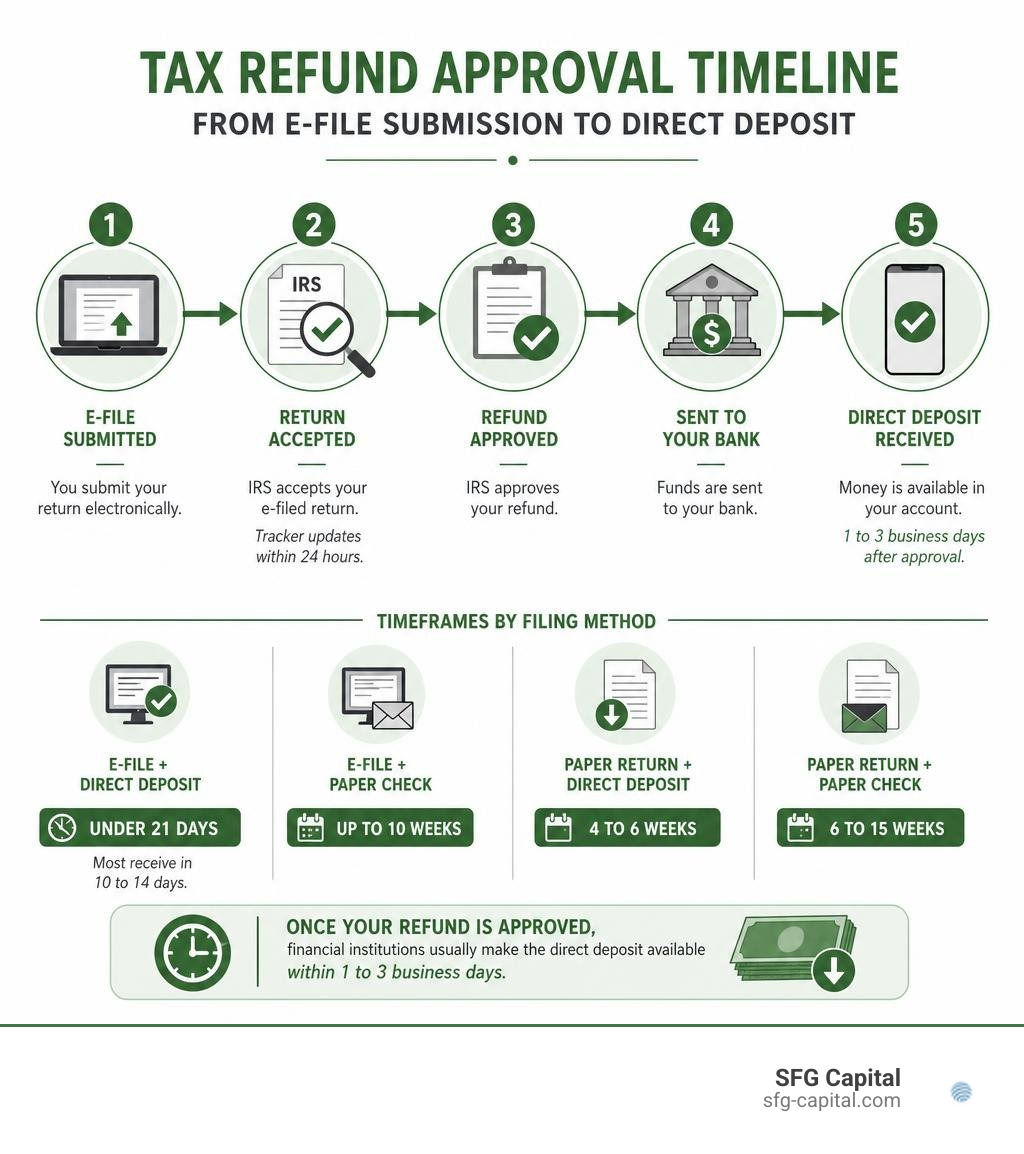
For most taxpayers who e-file and select direct deposit, the IRS approves and issues refunds within 21 days of accepting the return. In fact, more than 9 out of 10 e-filers receive their money even faster—typically between 10 to 14 days.
Here is the baseline breakdown by filing method:
- E-File + Direct Deposit: Approved and sent in under 21 days (tracker updates within 24 hours).
- E-File + Paper Check: Up to 10 weeks.
- Paper Return + Direct Deposit: 4 to 6 weeks.
- Paper Return + Paper Check: 6 to 15 weeks.
Once the IRS marks your return as “Refund Approved,” financial institutions usually make the direct deposit available within 1 to 3 business days.
I’m Santino Battaglieri, founder of SFG Capital, where our team has funded over $500 million in commercial claims to help businesses bypass severe administrative delays. Throughout my career, I have worked directly with filers to demystify how long does it take for refund to get approved and help them regain control of their capital.
How long does it take for refund to get approved further reading:
- average time for irs to approve refund
- how come my federal refund is taking so long
- irs time to process tax return
How Long Does It Take for Refund to Get Approved by the IRS?
When you submit a tax return, the IRS does not immediately hand over your cash. Instead, your submission moves through distinct operational phases: submission, acceptance, systematic validation, refund approval, and finally disbursement.
For the vast majority of individual filers, electronic filing combined with direct deposit represents the gold standard of speed. More than 9 out of 10 taxpayers who choose this route receive their money within 21 days of acceptance. If you are comparing your wait time against national averages, reading about the waiting game and the average time for IRS to approve refund helps set realistic expectations.
The IRS processes tens of millions of returns every season. Electronic returns flow into automated screening systems that cross-reference reported wages (such as Form W-2 and Form 1099 details) with third-party reporting data. When everything matches perfectly, your return moves quickly to approval without any manual human intervention.
| Filing Method | Disbursement Method | Typical IRS Approval Window | Total Expected Delivery Time |
|---|---|---|---|
| Electronic (E-file) | Direct Deposit | 10 to 21 calendar days | Under 21 days (often 10–14 days) |
| Electronic (E-file) | Paper Check | 2 to 4 weeks | Up to 10 weeks |
| Paper Form (Mailed) | Direct Deposit | 4 to 6 weeks | 4 to 8 weeks |
| Paper Form (Mailed) | Paper Check | 6 to 12 weeks | 6 to 15 weeks |
| Amended Return (1040-X) | Direct Deposit / Check | 16 to 20 weeks | Up to 20+ weeks |
E-File vs. Paper Returns: How Long Does It Take for Refund to Get Approved?
The single biggest factor dictating your refund approval speed is whether you file electronically or mail physical forms.
When you e-file, the IRS’s automated systems ingest your data almost immediately. Confirmation of return acceptance usually arrives within 24 to 48 hours. From there, your return enters the IRS Master File batch processing cycle, which updates systematically throughout the week.
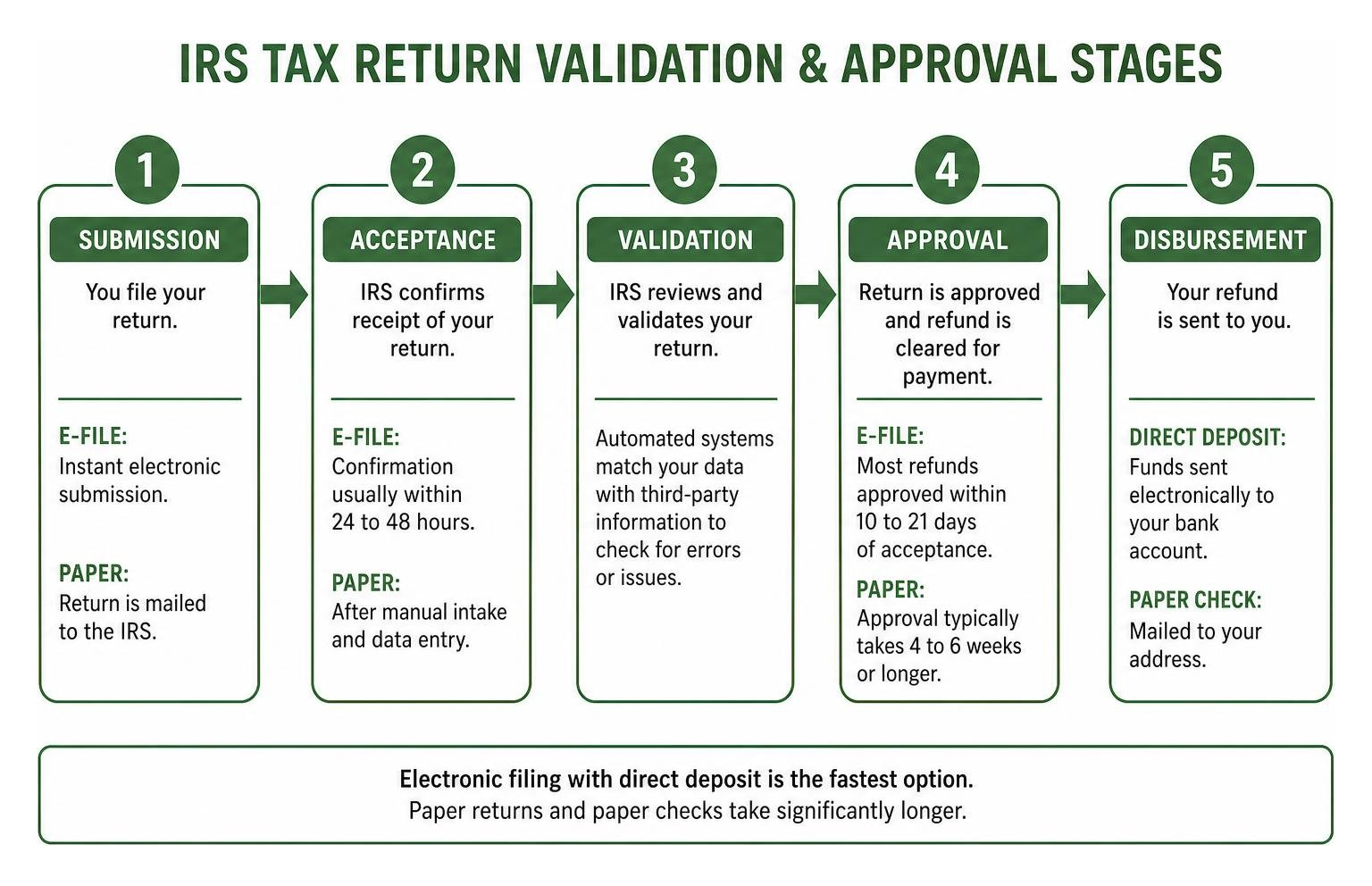
In contrast, paper-filed returns require manual intake. IRS staff must physically open envelopes, scan documents, verify signatures, and manually enter line items into internal databases. This physical handling immediately extends the approval baseline to at least 6 weeks. Any illegible handwriting, missing forms, or math errors on a paper document will pause processing indefinitely until correspondence is exchanged via mail.
Special Tax Credits: How Long Does It Take for Refund to Get Approved with EITC or ACTC?
If your return claims the Earned Income Tax Credit (EITC) or the Additional Child Tax Credit (ACTC), federal law dictates a mandatory pause on your refund release. Under the Protecting Americans from Tax Hikes (PATH) Act, the IRS cannot issue refunds on returns claiming these credits before mid-February (typically February 15).
This statutory hold applies to the entire refund, not just the portion associated with the child or income tax credits. Even if you e-file on the very first day the IRS opens tax season in January, automated systems will hold your return in an accepted, pre-approved state until the mid-February date passes.
The PATH Act was created to give the IRS adequate time to match employer-reported wage statements against individual returns, stopping fraudulent identity claims before funds leave the Treasury. Once the mid-February hold lifts, these returns are processed in rapid batches, with most direct deposits landing in bank accounts by late February or early March. For real-time updates regarding annual filing rules, review the official guidance on IRS refunds.
Understanding the IRS Status Stages: Accepted vs. Approved
Many taxpayers confuse having their return “accepted” with having their refund “approved.” These terms represent two completely separate operational milestones.

When using the IRS “Where’s My Refund?” tool or the IRS2Go app, you will see a progress bar moving across three specific milestones:
- Return Received (Accepted): The IRS has received your tax paperwork and completed initial formatting and identity verification checks.
- Refund Approved: The IRS has fully reviewed your return, verified all calculations, confirmed credit eligibility, and scheduled an exact direct deposit or check mailing date.
- Refund Sent: The IRS has formally transferred the payout instructions to the U.S. Department of the Treasury’s Bureau of the Fiscal Service for payment transmission.
If your status currently shows “Return Received,” you are in the review phase. For many filers, knowing that waiting for your tax refund is the hardest part makes tracking these distinct stages much easier to manage.
What Happens Between Return Acceptance and Refund Approval?
During the window between initial acceptance and final approval, the IRS’s automated fraud detection systems go to work. The return passes through several computerized filters designed to flag:
- Discrepancies between reported income and employer-filed W-2 or 1099 forms.
- Dependent Social Security numbers claimed across multiple separate tax returns.
- Unusual deductions or credit claims that deviate from standard statistical patterns.
- Mismatches between the taxpayer’s name, birthdate, and Social Security Administration records.
If your return clears all automated screening hurdles, it receives systematic approval, and an automated refund issue date is assigned. If an anomaly is identified, your return is diverted out of the automated stream and into a manual review queue, pausing the standard 21-day clock.
From ‘Refund Approved’ to Money in Your Bank Account
Once your tracker advances to “Refund Approved,” the IRS provides an exact date by which your funds will be sent.
The IRS does not directly send money to personal bank accounts; that disbursement is executed by the Bureau of the Fiscal Service (BFS). The BFS packages authorized payouts into electronic Automated Clearing House (ACH) network batches.
While the Treasury transmits funds on the scheduled date, individual banks process incoming ACH batches at different speeds. Major financial institutions generally make direct deposit funds available within 1 to 3 business days. Some modern digital banks make funds accessible the same day they receive the federal transmission.
Why Is My Refund Delayed Beyond the 21-Day Window?
If more than 21 days have passed since the IRS accepted your electronic return and your tracker still has not moved to “Refund Approved,” your file has likely encountered a delay trigger.
Understanding the IRS waiting game: common reasons for slow tax refunds can help pinpoint what is holding up your money. In many instances, filers asking how come my federal refund is taking so long? 7 common culprits find that their refund was caught in an administrative hold or diverted to cover an outstanding debt.
One frequent reason for a delayed or reduced payout is the Treasury Offset Program (TOP). Under federal law, the Bureau of the Fiscal Service can intercept all or part of your refund to satisfy delinquent obligations, including:
- Past-due federal income taxes.
- State income tax debts.
- Delinquent child support payments.
- Non-tax federal debts, such as defaulted student loans.
If an offset occurs, the BFS will issue a formal physical notice detailing the original refund amount, the offset deduction, and the specific agency that received the funds.
Common Filing Errors and Identity Verification Freezes
Simple typographical errors remain one of the most common causes of processing halts. Entering an incorrect routing number, misspelling a dependent’s surname, or miscalculating taxable income requires manual intervention from an IRS representative to reconcile the file.
Furthermore, identity verification protocols have increased significantly. If automated systems flag suspicious activity—such as an address change or unusual filing pattern—the IRS will place a security freeze on the refund.
When this happens, the agency mails an official identity verification notice (such as IRS Letter 5071C, 5747C, or 6331C). This letter requires you to verify your identity using ID.me online, over the phone, or in person at an IRS Taxpayer Assistance Center before processing can resume. If you find yourself in this situation, knowing what to do when your tax refund is stuck in processing limbo is essential to getting your file moving again.
Complex Filings and Business Payroll Credit Backlogs
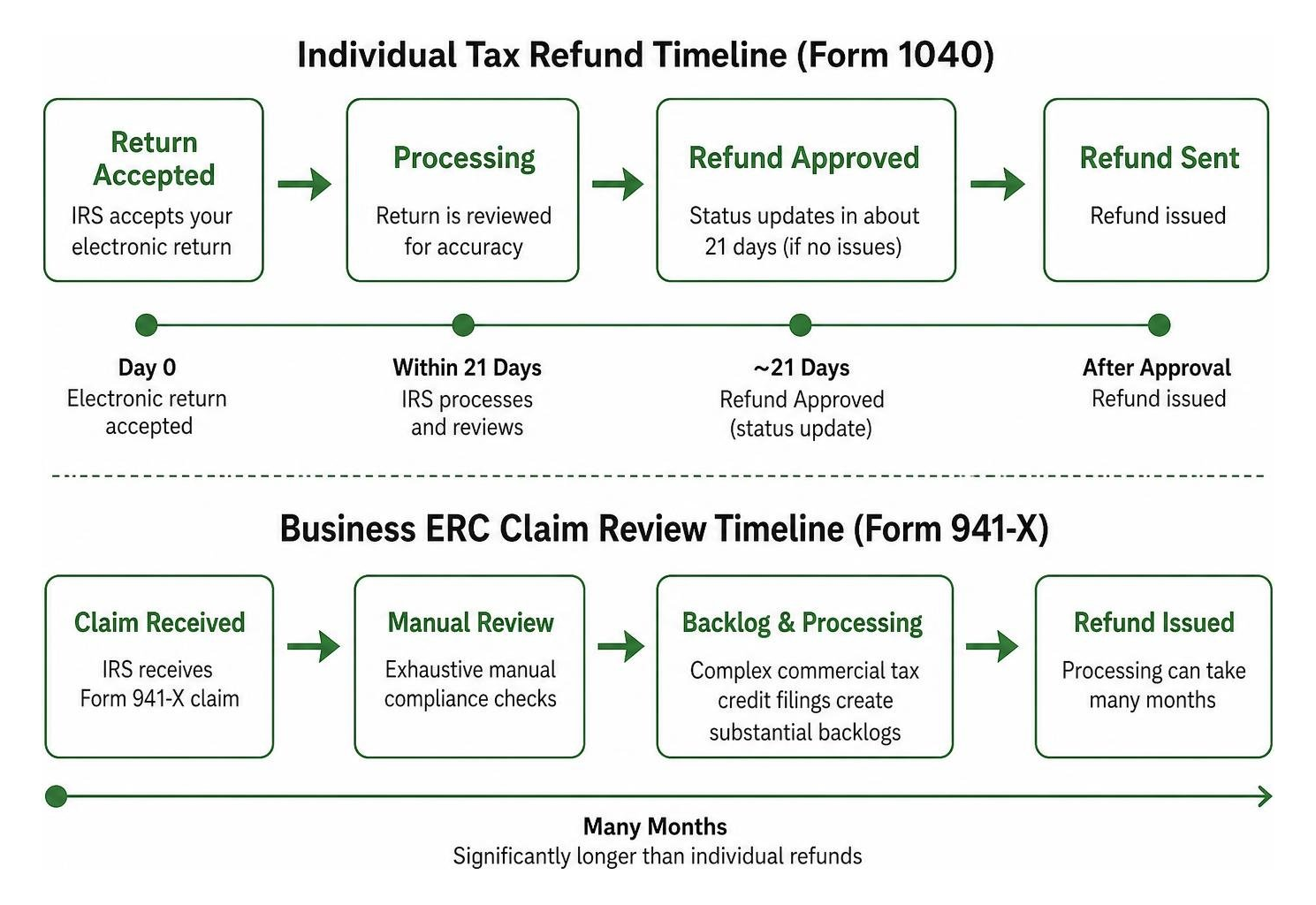
While individual Form 1040 returns typically process within 21 days, complex filings, amended returns, and commercial payroll tax adjustments operate on completely different timelines.
Filing an amended tax return using Form 1040-X immediately extends the processing window to 16 to 20 weeks (and often longer during peak periods), as each adjustment requires manual human audit.
For business owners—especially employers here in Austin and throughout Travis County who filed claims for specialized payroll relief like the Employee Retention Credit (ERC) using Form 941-X—administrative delays can stretch across many months. Complex commercial tax credit filings undergo exhaustive manual compliance checks, creating substantial processing backlogs.
If your enterprise is managing cash flow around commercial claims, learning how to estimate your ERC IRS processing time is critical for accurate operational budgeting.
How to Track Your Refund Status and Expedite Processing
Monitoring your tax refund approval status does not require guessing or spending hours waiting on hold. The IRS offers digital self-service tools that provide identical information to what telephone customer service agents see on their screens.
You can check your status via the official Where’s My Refund? portal on IRS.gov or by downloading the IRS2Go mobile application.
To check your refund status accurately, you must provide three pieces of matching data from your return:
- Your Social Security Number (SSN) or Individual Taxpayer Identification Number (ITIN).
- Your exact filing status (Single, Married Filing Jointly, Head of Household, etc.).
- The exact whole-dollar refund amount shown on your filed return.
IRS processing systems update their databases once every 24 hours, typically overnight between midnight and 6:00 AM. Checking the tool multiple times throughout the day will not yield new information. If you want to optimize your filing workflow from the start, check out these proven tactics to speed up your tax refund: strategies to expedite IRS processing.
When and How to Contact the IRS Directly
IRS phone lines are frequently overwhelmed, and agency representatives cannot provide refund updates until specific calendar thresholds have passed.
You should only call the IRS regarding your refund if:
- It has been more than 21 days since you e-filed your return.
- It has been more than 6 weeks since you mailed your paper return.
- The “Where’s My Refund?” tool explicitly directs you to call with a specific reference code.
When calling the main IRS customer support line (1-800-829-1040), ensure you have a physical copy of your filed tax return, prior-year tax forms, and any notices received in the mail readily accessible to verify your identity.
Requesting an Expedited Refund for Financial Hardship
In cases of extreme financial distress, the IRS has administrative procedures to manually expedite a refund release. However, this is not an open door for general impatience—you must meet strict economic hardship criteria.
Recognized hardship conditions include:
- Imminent eviction, foreclosure, or loss of primary housing.
- Pending utility shutoff notices.
- Inability to afford life-saving prescription medications or emergency medical treatments.
- Imminent risk of business failure or bankruptcy.
To request a manual hardship release, taxpayers must contact the IRS or work through the independent Taxpayer Advocate Service (TAS) by calling 1-877-777-4778. You must provide concrete, verifiable documentation, such as court eviction orders or final utility disconnection notices. Detailed instructions on these procedures are outlined in the Taxpayer Advocate Service guidance on expediting a refund.
For a complete walkthrough on assembling evidence and requesting immediate relief, read our guide, need for speed: your guide to getting a tax refund expedited.
That if your refund is subject to a non-tax federal debt offset through the Bureau of the Fiscal Service (such as back child support), the IRS cannot expedite or release those funds, regardless of extreme financial hardship.
Frequently Asked Questions About Refund Approval Timelines
Does IRS ‘Return Accepted’ mean my refund is officially approved?
No. “Return Accepted” merely confirms that your submission made it through initial gatekeeping checks—your Social Security number matches IRS databases, dependent IDs are not duplicated, and basic structural forms are intact.
“Refund Approved” only occurs after the IRS completes its detailed mathematical checks, cross-references income data, validates credits, and formally schedules an electronic funds transfer.
How often does the IRS update the ‘Where’s My Refund?’ tool?
The IRS updates its “Where’s My Refund?” tool and IRS2Go app once every 24 hours, usually overnight. Submitting multiple status checks in a single day is unnecessary, as data will not change until the next overnight batch cycle.
What should I do if my refund status says ‘Still Processing’ after 21 days?
If your tracker displays a message indicating your return is “Still Processing” past the 21-day mark, your file has been routed to a secondary review queue.
First, log in to your IRS Individual Online Account to inspect your official Tax Account Transcript for transaction codes (such as Code 570 for additional review or Code 846 for refund issuance). Second, check your physical mailbox for official IRS letters requiring identity verification or supporting documentation. If no letters arrive and transcripts show no movement, you may contact the IRS directly for clarification.
Conclusion
Waiting for your tax refund can feel stressful, but understanding the underlying IRS timelines keeps the process predictable. For standard individual filers submitting electronic returns with direct deposit, approvals consistently land within 21 calendar days, with many receiving deposits within two weeks. Avoiding simple math errors, selecting direct deposit, and tracking progress through official digital tools remain your best tools for a smooth filing season.
However, when administrative backlogs or complex business filings stall substantial capital, waiting on the IRS can disrupt company operations. At SFG Capital, we help businesses across Austin and Travis County bypass multi-month IRS processing backlogs by providing liquidity advances and buyout solutions for pending commercial claims, including the Employee Retention Credit.
If your enterprise cannot afford to wait on federal processing queues to access its rightful capital, explore our services today to discover how our performance-based solutions can unlock your funds immediately.
See what your business may qualify for.
60 seconds. No documents. No upfront cost.
General information only, not legal or tax advice. Eligibility and estimates are fact-specific and subject to review.