
Blog / Insights
InsightsFrom Processed to Paid in Record Time
October 14, 2026 · 9 min read · By the SFG Capital team
How Long It Takes to Get a Refund After Your Return Is Processed
For most taxpayers, an e-filed federal return with direct deposit results in a refund within about 21 days of IRS acceptance. Once the IRS has approved and sent the payment, your bank will often make the direct deposit available in 1 to 3 business days.
To set the fastest realistic timeline:
- File electronically.
- Choose direct deposit.
- Verify your routing number, account number, Social Security number, and refund amount before filing.
- Check Where’s My Refund? 24 hours after e-filing.
“Accepted” does not mean “approved.” Acceptance means the IRS received your return and it passed initial checks. Approval comes later, after the IRS finishes processing it and authorizes the refund. Paper returns take much longer – typically six weeks or more from the date the IRS receives them.
Delays can happen when a return has an error, needs identity verification, claims certain credits, or is subject to a debt offset. If an e-filed refund has not arrived after 21 days, use the IRS tracker first and look for any notice requesting action.
I am Santino Battaglieri, founder of SFG Capital, with more than nine years in financial services and structured funding, including work with tax professionals on compliance-focused ERC claims. For business owners asking how long after tax return is processed to get refund, I focus on setting clear expectations around IRS timing, documentation, and responsible access to working capital.
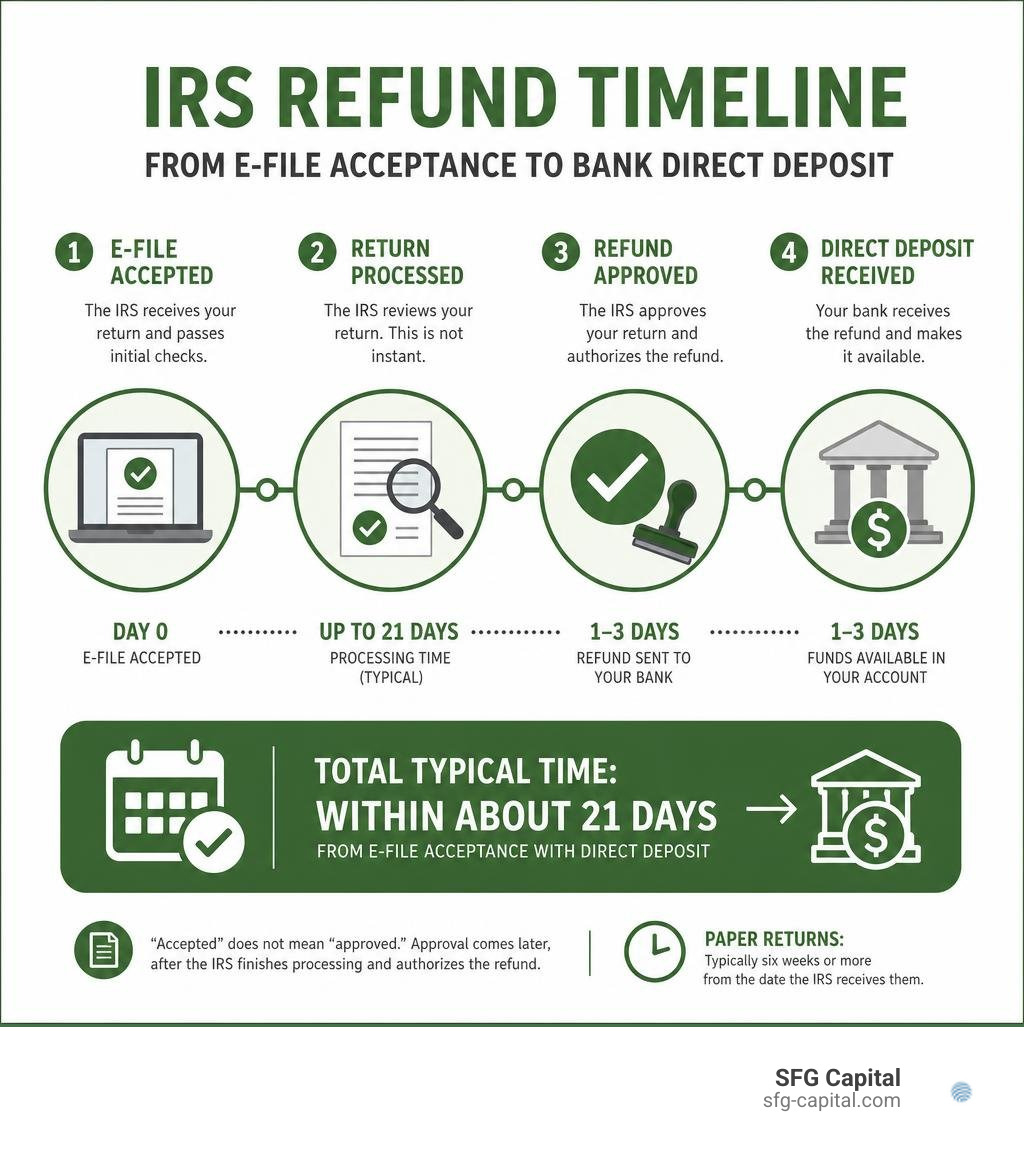
Quick look at how long after tax return is processed to get refund:
- average time for irs to approve refund
- how come my federal refund is taking so long
- irs time to process tax return
Understanding the IRS Stages: Accepted vs. Processed vs. Approved
Navigating federal tax terminology can feel like deciphering an ancient language, but understanding where your submission sits in the agency’s workflow eliminates unnecessary anxiety. Many filers assume that once an electronic return transmits successfully, the payout is already en route. In reality, the IRS moves every Form 1040 through distinct operational checkpoints before money moves into your account. Reviewing The Waiting Game and the Average Time for IRS to Approve Refund helps contextualize these milestones within normal IRS operations.
According to official resources on About refunds | Internal Revenue Service, the system operates across three separate statuses: Received (or Accepted), Approved, and Sent. Each phase represents a specific administrative hurdle.
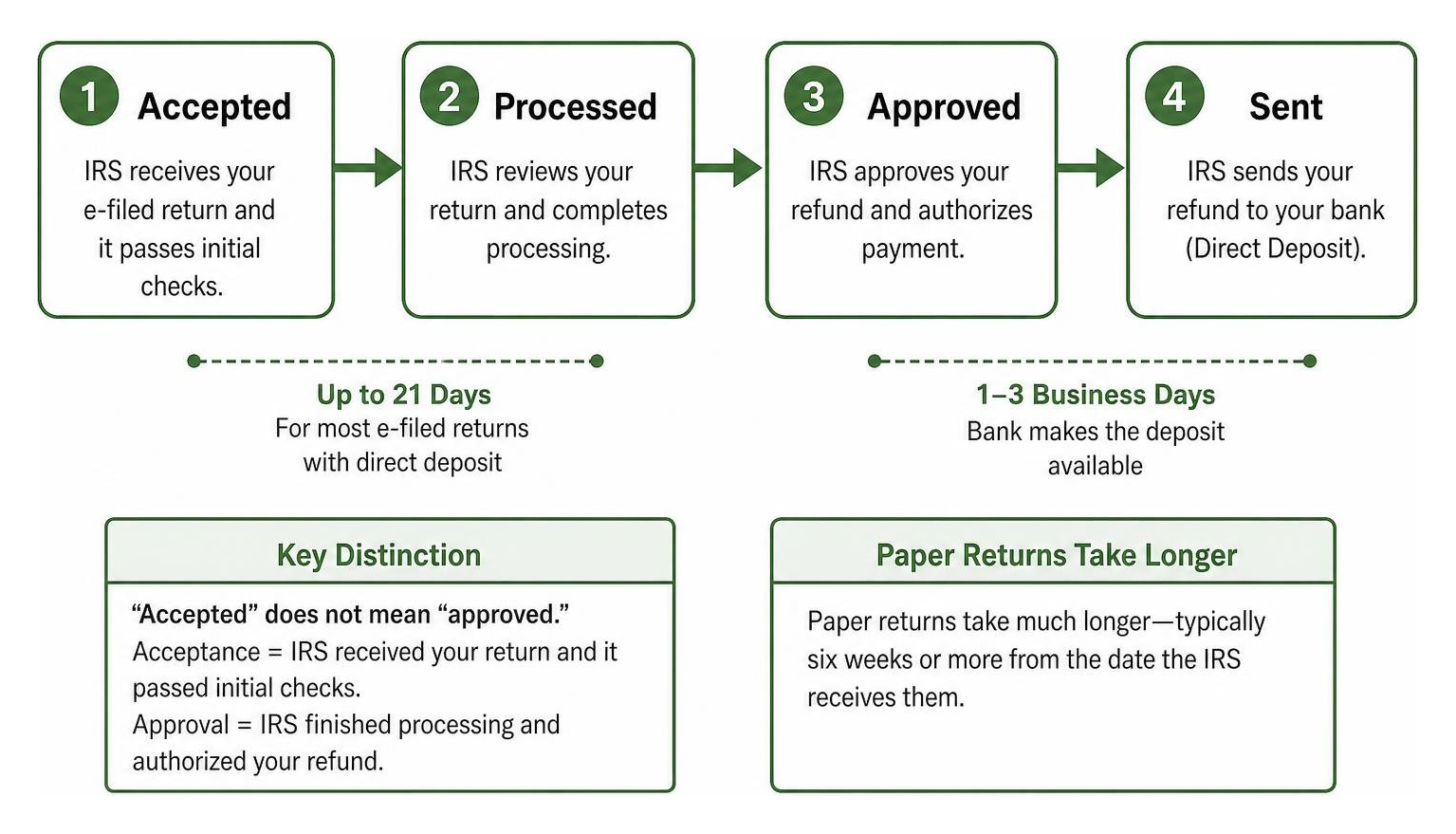
What Happens Between Return Submission and IRS Acceptance?
When you or your tax professional transmit an electronic filing, your software initiates an electronic handshake with IRS servers. During this initial window, which typically concludes within 24 to 48 hours, the IRS performs automated gatekeeping checks:
- Identity Verification: Matching Social Security Numbers (SSNs) or Individual Taxpayer Identification Numbers (ITINs) against Social Security Administration records.
- Name Control Validation: Ensuring the taxpayer’s legal name matches official records.
- Prior-Year PIN or AGI Authentication: Verifying that the filer has confirmed their prior-year Adjusted Gross Income or electronic filing PIN.
- Duplicate Filing Filters: Confirming that no other return has already been submitted under the same identifying numbers for the current tax year.
If all primary data matches, the system marks the return as “Accepted.” This step does not mean the agency has audited or agreed with your detailed calculations; it simply means your paperwork made it through the front door without structural formatting errors.
The Critical Difference Between Acceptance and Refund Approval
The transition from acceptance to approval represents the actual processing phase. During processing, IRS computer algorithms run your numbers through automated compliance filters, comparing reported wages against W-2s, 1099s, and employer filings.
More than 9 out of 10 taxpayers experience smooth processing, with the IRS approving the refund within 21 days of initial electronic acceptance. Once approved, the IRS authorizes the U.S. Department of the Treasury’s Bureau of the Fiscal Service (BFS) to issue the funds. BFS handles the direct disbursement—either initiating an Automated Clearing House (ACH) network transfer directly to your banking institution or printing a paper check.
How Long After Tax Return Is Processed to Get Refund: The Complete Timeline
Once the IRS completes its calculations and updates your status from “Processing” to “Approved,” the disbursement timeline depends almost entirely on the payout method you selected when filing. Discovering the most efficient path to Fast Cash from Uncle Sam and How to Get It comes down to avoiding manual paper handling at all costs.
Official guidance at Refunds | Internal Revenue Service outlines the baseline timelines across standard filing and delivery combinations:
| Filing Method | Selected Payout Method | Typical Total Timeline (Filing to Funds) | Post-Approval Disbursement Window |
|---|---|---|---|
| E-File | Direct Deposit | 10 to 21 calendar days | 1 to 3 business days |
| E-File | Paper Check via Mail | 3 to 4 weeks | 5 to 10 business days (USPS) |
| Paper Mail | Direct Deposit | 6 to 8 weeks | 1 to 3 business days |
| Paper Mail | Paper Check via Mail | 6 to 12 weeks | 7 to 14 business days (USPS) |
Direct Deposit Delivery: How Long After Tax Return Is Processed to Get Refund?
Direct deposit remains the gold standard for speed and security. After the IRS marks your refund as approved, they send an electronic payment instruction to the Federal Reserve bank system.
For the vast majority of filers, your financial institution will post these funds within 1 to 3 business days. Many modern banks and credit unions make deposits available the moment the Treasury notification arrives, while traditional institutions may hold funds until the official settlement date. That weekends and federal holidays do not count as banking days; an approval finalized on a Friday afternoon will typically settle between Tuesday and Thursday of the following week.
Paper Check Delivery: How Long After Tax Return Is Processed to Get Refund?
If you opted for a physical paper check or if the IRS was unable to complete a direct deposit due to incorrect account digits, the check is printed and mailed via the United States Postal Service (USPS).
Disbursement usually occurs within a few days of approval, but transit times mean you should allow 5 to 10 business days for postal delivery. If your check does not arrive within four weeks from the mailing date shown on the IRS tracking system, you can initiate a formal refund trace using Form 3911 (Taxpayer Statement Regarding Refund).
How to Track Your Refund Status Step-by-Step
You do not need to call a live representative or guess when your funds will arrive. The IRS provides accessible digital tools to check your return’s progression in real time. Following proven methods to Speed Up Your Tax Refund: Strategies to Expedite IRS Processing starts with proactive tracking rather than reactive phone calls.

Using IRS Online Tools and the IRS2Go Mobile App
The primary tool for monitoring your money is the IRS “Where’s My Refund?” web portal and the official IRS2Go mobile application. To check your status successfully, ensure you have three specific data points from your filed Form 1040:
- Social Security Number (SSN) or Individual Taxpayer Identification Number (ITIN).
- Filing Status (Single, Married Filing Jointly, Married Filing Separately, Head of Household, or Qualifying Surviving Spouse).
- Exact Refund Amount in whole dollars as shown on your return.
The tracker updates its database once every 24 hours, usually overnight, so checking multiple times throughout the day will not yield new information. The tool will display three progressive bars: “Return Received,” “Refund Approved,” and “Refund Sent.”
When and How to Contact the IRS for Assistance
IRS customer service representatives cannot provide additional information or speed up a return that is still within standard processing windows. You should only call live support if:
- It has been more than 21 calendar days since you e-filed.
- It has been more than 6 weeks since you mailed a paper return.
- The “Where’s My Refund?” tool explicitly directs you to contact the agency with a specific reference code.
If substantial delays occur that create extreme financial hardship, taxpayers can seek assistance from the independent Taxpayer Advocate Service (TAS).
Key Reasons Why Your Refund Might Be Delayed
While roughly 90% of returns clear the IRS within three weeks, certain returns trigger automatic manual reviews or statutory holds. Learning The IRS Waiting Game: Common Reasons for Slow Tax Refunds can help you identify why your file might be paused. Detailed scheduling calendars, like the IRS Tax Refund Schedule 2026: When to Expect Your Refund by Filing Date | Jupid, illustrate how specific tax provisions alter normal calendars.

PATH Act Holds and Special Credit Reviews
Under the Protecting Americans from Tax Hikes (PATH) Act, federal law prohibits the IRS from issuing refunds that include specific refundable credits before mid-February. If your return claims:
- The Earned Income Tax Credit (EITC), or
- The Additional Child Tax Credit (ACTC),
the IRS will hold your entire refund until the statutory review period concludes. Even if you e-file on the very first day the IRS opens tax season in January, your funds will not release until mid-to-late February. This measure was implemented to curb identity theft and fraudulent refund claims.
Filing Errors, Identity Verification, and Treasury Offsets
Other common culprits that lengthen the turnaround time include:
- Incomplete or Inconsistent Data: Math errors, misspelled names, or mismatched wage amounts require manual intervention, adding anywhere from 30 to 60 days.
- Identity Verification (Letter 5071C or 4883C): The IRS may pause processing and mail a verification notice requiring you to confirm your identity online or by phone before completing the return.
- Treasury Offset Program (TOP): Administered by the Bureau of the Fiscal Service, this program can intercept all or part of your refund to cover delinquent obligations such as past-due federal taxes, state income tax debts, child support arrears, or defaulted federal non-tax debts. If an offset applies, you will receive an explanatory notice showing the adjusted amount.
- Injured Spouse Allocation (Form 8379): If you filed jointly and your refund was offset due to your spouse’s past-due debts, submitting Form 8379 to reclaim your portion of the refund can add 11 to 14 weeks to total processing times.
Frequently Asked Questions About Tax Refund Timelines
How long does it take for direct deposit to hit your bank account after refund approval?
Once the IRS approves your refund and marks it as “Sent,” direct deposit transfers generally post to your bank account within 1 to 3 business days. Financial institutions handle ACH clearing batches during regular business hours, meaning transfers sent over weekends or federal holidays settle on the following business days.
When can I start checking my refund status after filing?
You can start tracking your refund status 24 hours after the IRS receives your e-filed current-year return (or 3 days after an e-filed prior-year return). If you filed a paper return via postal mail, you must wait 4 weeks before information appears in the IRS tracking system.
What should I do if my refund takes longer than 21 days?
If 21 days have passed since your e-file was accepted, first check the “Where’s My Refund?” portal or the IRS2Go mobile app for any special instruction codes. Review your mailbox for official IRS letters (such as CP05 or Letter 5071C) that request additional documentation or identity confirmation. If no status changes appear and no notices have arrived, you may contact the IRS individual assistance hotline at 800-829-1040 for live file research.
Conclusion
Waiting on tax funds requires patience, but knowing the operational milestones makes the process predictable. For standard individual filers in 2026, combining electronic filing with direct deposit remains the fastest, most reliable method to move money from the IRS ledger directly into your bank account in 21 days or less.
While individual Form 1040 refunds move relatively quickly, commercial claims—such as retroactive payroll tax credits or amended business returns—operate on substantially longer government timelines. At SFG Capital, located in Austin and serving businesses throughout Travis County, TX, we help commercial clients bypass prolonged federal waiting games. We specialize in providing upfront advances and performance-based liquidity solutions for complex tax claims, including the Employee Retention Credit (ERC).
Explore our full suite of commercial funding options by reviewing our services to keep your business operating with continuous, predictable capital.
See what your business may qualify for.
60 seconds. No documents. No upfront cost.
General information only, not legal or tax advice. Eligibility and estimates are fact-specific and subject to review.