
Blog / Insights
InsightsGet Your Max Refund with Professional ERC Expert Assistance
October 23, 2026 · 8 min read · By the SFG Capital team
Get ERC Refund Expert Assistance Without Adding Compliance Risk
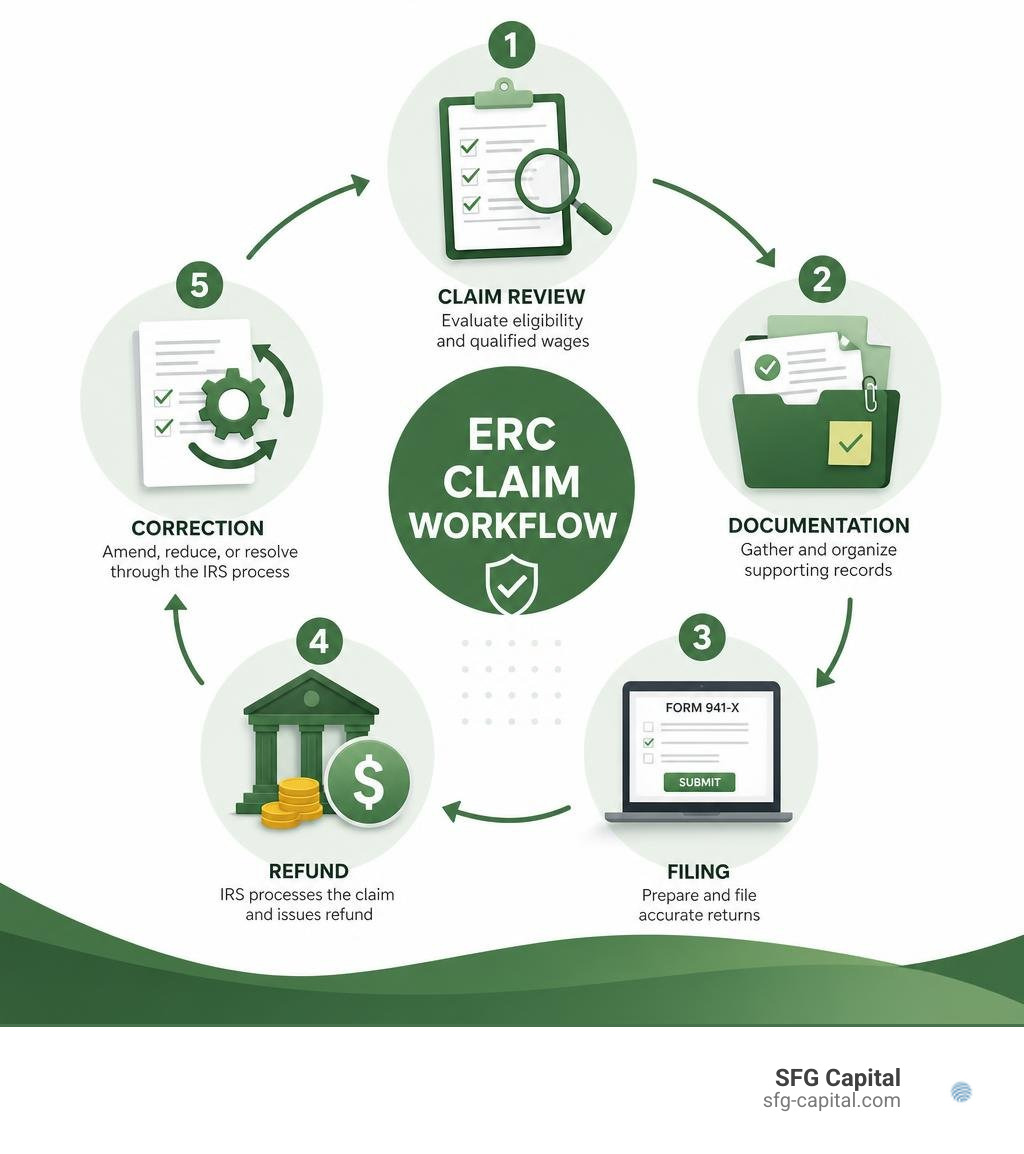
ERC refund expert assistance should start with a careful eligibility review, not a promise of a fast or oversized credit. Before filing or pursuing an existing claim, ask a qualified tax professional to verify your qualifying wages, revenue-decline or government-order test, PPP wage allocation, and payroll records. If the claim is valid, they can help document it correctly and coordinate the tax and bookkeeping changes. If it is not, they can help you amend, reduce, or resolve it through the proper IRS process.
The Employee Retention Credit was a pandemic-era payroll tax credit for eligible employers that paid qualified wages in 2020 and 2021. It can still create major value for businesses with legitimate claims, but IRS scrutiny of questionable filings makes documentation and accurate calculations essential.
A good ERC advisor helps you protect the business, not just chase a refund. That includes evaluating an unfiled claim, reviewing a filed Form 941-X, preparing support for an IRS inquiry, and working with your CPA on the required wage-expense and income-tax adjustments.
I am Santino Battaglieri of SFG Capital. Through ERC advisory, compliance support, and structured funding work involving more than $500 million in ERC claims, I have seen why disciplined ERC refund expert assistance matters when cash flow needs are urgent but the risks of a weak claim are real.
Understanding ERC Eligibility and Claim Fundamentals
The Employee Retention Credit (ERC) was established under the Coronavirus Aid, Relief, and Economic Security (CARES) Act to encourage employers to keep workers on payroll during severe economic disruptions. Understanding the baseline mechanics of the credit is the first step toward confirming compliance. You can review our detailed employee retention credit specialist guide for an exhaustive look at statutory definitions, but the core fundamentals center on qualified wages, qualified health plan expenses, and employer eligibility tests across specific calendar quarters in 2020 and 2021.
Eligibility hinges primarily on meeting one of two main tests during applicable calendar quarters:
- Gross Receipts Test: Demonstrating a significant decline in gross receipts (a 50% decline for a 2020 quarter compared to the same calendar quarter in 2019; an 80% threshold/20% decline for a 2021 quarter compared to 2019).
- Government Suspension Test: Experiencing a full or partial suspension of normal business operations due to direct governmental orders limiting commerce, travel, or group meetings due to COVID-19.
Who Qualifies for Qualified Wages Relief
Determining qualification requires navigating rules regarding employer size, full-time equivalent (FTE) employee counts, and supply chain impacts. For 2020 claims, small employers were defined as having 100 or fewer average full-time employees in 2019, allowing them to claim all qualified wages paid to employees during eligible periods. For 2021, that small employer threshold expanded to 500 or fewer full-time employees.
To establish partial suspension, businesses must substantiate that a specific government mandate had a more than nominal effect on operations. In regions like Travis County, Texas, local businesses often accessed various municipal resources such as Apply for Assistance | Travis County, Texas while trying to maintain operational stability. When it comes to the ERC, however, eligibility is tied strictly to federal tax statutes and documented local emergency decrees.
Why You Need ERC Refund Expert Assistance for Complex Filings
The IRS has placed the Employee Retention Credit under intense scrutiny due to widespread improper filings by aggressive third-party promoters who promised automated windfalls without performing due diligence. To protect your business from statutory penalties, working with seasoned specialists ensures that every dollar claimed is legally defensible. You can unlock your business potential with top tier ERC consulting to avoid common filing traps and build an audit-proof file.

Navigating Audits with ERC Refund Expert Assistance
Receiving an IRS examination notice can be stressful, but professional representation ensures your position is clearly articulated with comprehensive work papers. The IRS actively checks for:
- Improper wage double-dipping between ERC and Paycheck Protection Program (PPP) loan forgiveness.
- Non-qualifying supply chain disruption claims lacking formal government order documentation.
- Incorrect FTE calculations exceeding small-employer thresholds.
Working with an expert helps your business navigate information document requests (IDRs), seek formal penalty abatement where appropriate, and avoid potential promoter liability traps.
Correcting and Amending Claims with Form 941-X
If you discover an error on a filed return—such as an overstatement of qualified wages or miscalculated healthcare allocations—you cannot simply adjust it informally. Employers must file Form 941-X (Adjusted Employer’s QUARTERLY Federal Tax Return or Claim for Refund) for each affected quarter. Review your guide to getting ERC claim assistance to see how our team recalculates qualified wages quarter-by-quarter to bring your payroll filings into exact statutory alignment.
Resolving Ineligible or Improper Claims with the IRS
If a business filed an ERC claim and subsequently discovered it was ineligible, the IRS established specific resolution paths depending on whether the refund has been processed, cashed, or deposited.
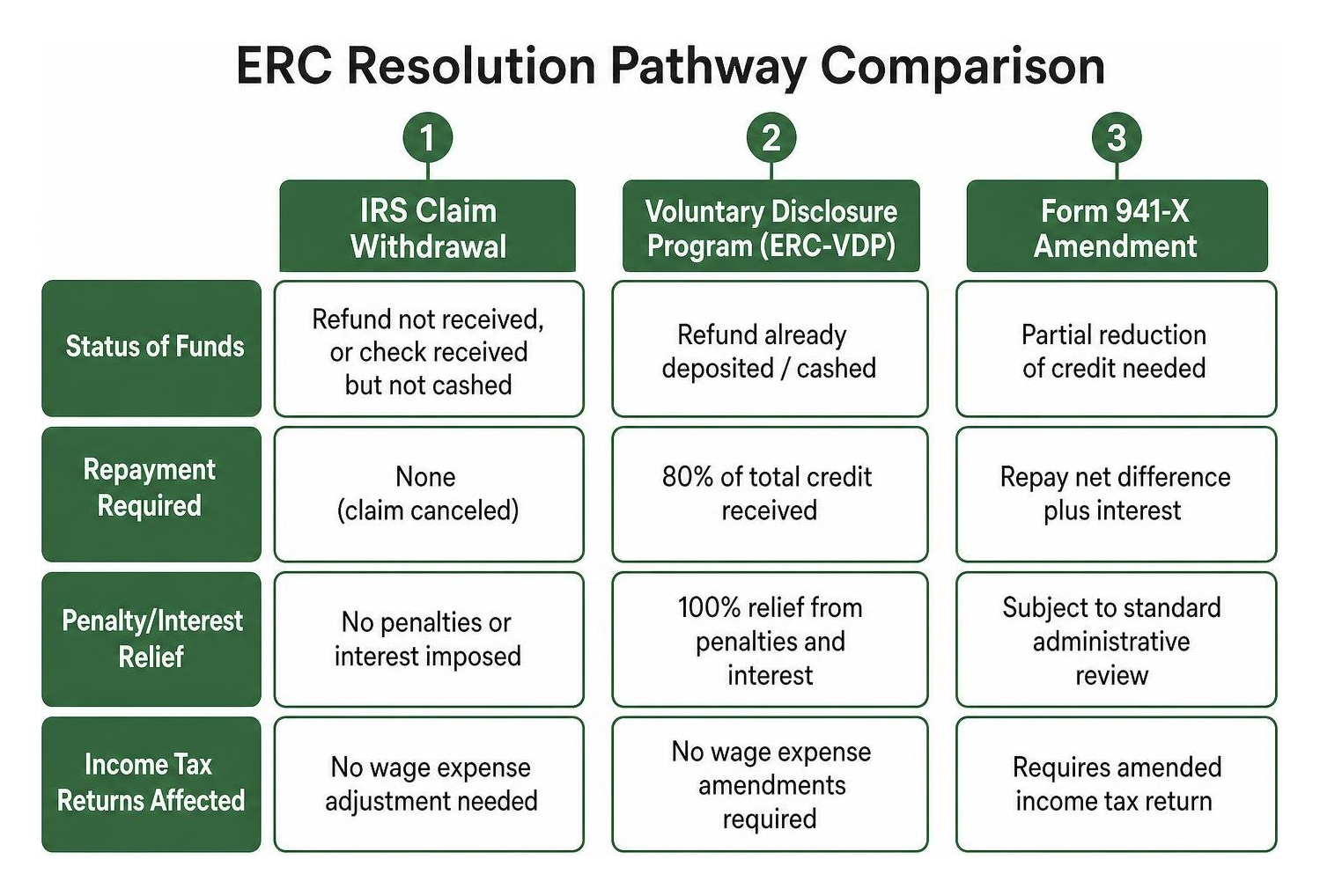
| Resolution Pathway | Status of Funds | Repayment Required | Penalty/Interest Relief | Income Tax Returns Affected |
|---|---|---|---|---|
| IRS Claim Withdrawal | Refund not received, or check received but not cashed | None (claim canceled) | No penalties or interest imposed | No wage expense adjustment needed |
| Voluntary Disclosure Program (ERC-VDP) | Refund already deposited / cashed | 80% of total credit received | 100% relief from penalties and interest | No wage expense amendments required |
| Form 941-X Amendment | Partial reduction of credit needed | Repay net difference plus interest | Subject to standard administrative review | Requires amended income tax return |
How the IRS Claim Withdrawal Process Works
The IRS Withdrawal Program allows employers that filed an ERC claim to request that the IRS treat the claim as if it were never filed, provided they have not received the refund or have received the check but not deposited or cashed it.
Key components of the withdrawal process:
- Dedicated Fax Line: Fax withdrawal requests to the dedicated IRS fax line at 855-738-7609.
- Uncashed Checks: If a paper check was delivered, write “Void” in the endorsement area, include a clear letter of explanation, and mail it to the designated IRS processing center.
- Third-Party Payroll Filers: If a professional payroll service filed the Form 941-X on your behalf, coordinate directly with them to submit the formal withdrawal.
- Official Acceptance: The withdrawal is not finalized until the IRS issues an official acceptance letter confirming that the claim has been zeroed out.
For businesses looking for reliable cash flow strategies while clearing up past filings, partnering with an ERC funding specialist provides clear guidance on navigating IRS requirements safely.
ERC Voluntary Disclosure Program and Penalty Relief
For businesses that received and deposited an improper ERC refund, the IRS created the ERC Voluntary Disclosure Program (ERC-VDP). Under this program, employers repay only 80% of the total credit received, retaining the remaining 20% to help cover third-party filing costs.
Under the ERC-VDP terms:
- The 20% retained amount is treated as non-taxable income.
- The IRS does not demand repayment of interest paid on the refund.
- No civil penalties are assessed if the 80% balance is settled by the time the signed closing agreement is returned.
- Employers do not need to amend income tax returns to reduce wage deductions.
Official IRS resources and webinars detail these compliance steps to help business owners resolve legacy filings transparently.
Proper Accounting and Tax Treatment for Your ERC Refund
One of the most commonly misunderstood elements of the ERC is its relationship to your annual federal income tax returns. Under Internal Revenue Code Section 280C, businesses cannot claim a double tax benefit on the same wages.
Whenever you claim the ERC, you must reduce your deductible wage expenses by the exact amount of the credit for the tax year in which the qualified wages were paid. Working with qualified ERC specialists who can help ensures your business makes the appropriate adjustments seamlessly.
Maximizing Compliance Through ERC Refund Expert Assistance
Because wage reductions apply to the year wages were paid (2020 or 2021) rather than the year the refund check arrives, employers often need to coordinate closely with their CPA to file amended income tax returns (e.g., Form 1120, 1120-S, or 1065). Partnering with experienced professionals simplifies finding the best processing company to manage these calculations cleanly without triggering unnecessary tax penalties.
Recording Deposits in QuickBooks Online and Amending Returns
When recording the receipt of an ERC refund check in accounting software like QuickBooks Online:
- Do Not Code to Income: Never create a generic “Other Income” account for the deposit.
- Offset Payroll Expenses: Code the deposited funds directly against your Wages Expense / Payroll Expense account to reflect the statutory wage reduction.
- Record IRS Interest Separately: Any interest paid by the IRS on your refund check is taxable gross income and should be categorized as Interest Income.
Frequently Asked Questions About ERC Processing
Is an ERC refund considered taxable income?
The ERC refund itself is not categorized as gross income; however, under IRC Section 280C, you must reduce your deductible wage expenses by the credit amount for the year the wages were paid. This reduction increases your net taxable income for that specific tax year, requiring an amended income tax return.
What happens if I withdraw an incorrect ERC claim?
When the IRS accepts your withdrawal request, the claim is treated as if it were never filed. The IRS will not impose penalties or interest on the withdrawn claim. However, withdrawing a claim does not protect an employer from potential criminal investigation if fraudulent intent was present during the initial filing.
What steps should a business take to reduce rather than withdraw an ERC claim?
If your claim was partially overstated, you cannot use the IRS withdrawal program. Instead, you must file an adjusted employment tax return using Form 941-X for each applicable quarter, detailing the adjusted qualified wage amounts and paying back any excess credit with applicable statutory adjustments.
Conclusion
Navigating the Employee Retention Credit requires balancing financial recovery with strict IRS tax compliance. At SFG Capital, we provide local Austin and Travis County business owners with reliable liquidity solutions, claim buyouts, and advances to bypass processing delays safely. By pairing sound funding mechanisms with professional compliance reviews, we help your business move forward with confidence. Explore our comprehensive resources across SFG Capital Taxes to secure expert assistance tailored to your business needs.
See what your business may qualify for.
60 seconds. No documents. No upfront cost.
General information only, not legal or tax advice. Eligibility and estimates are fact-specific and subject to review.