
Blog / Insights
InsightsHow long after filing taxes do you get your refund
October 14, 2026 · 8 min read · By the SFG Capital team
How Long After Filing Taxes Do You Get Your Refund?
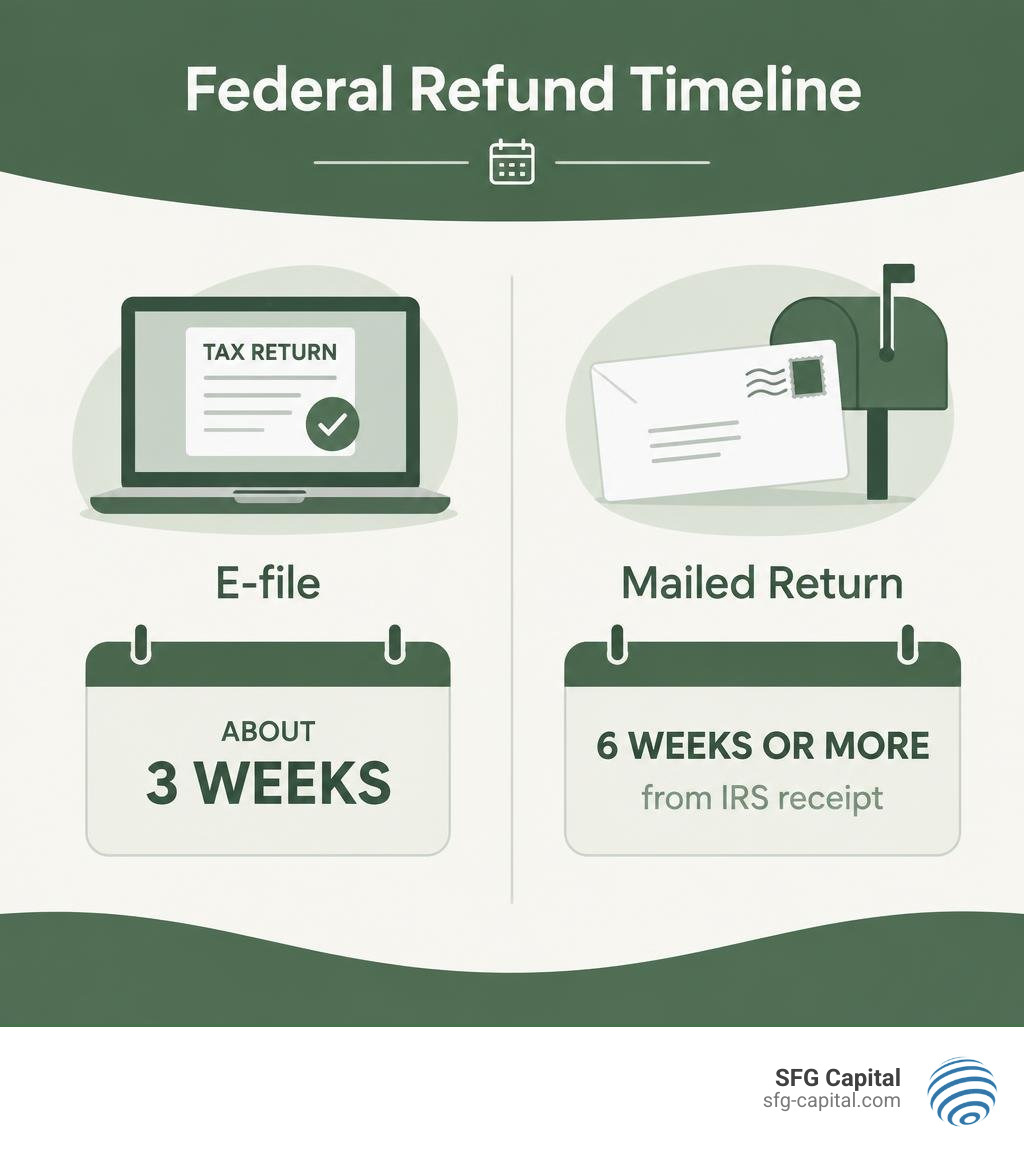
Most people who e-file a federal tax return receive their refund within three weeks. If you mail a paper return, expect six weeks or more from the day the IRS receives it. E-filing with direct deposit is usually the fastest route, but errors, extra review, or certain tax credits can add time.
These estimates apply to individual tax returns. Employee Retention Credit (ERC) claims follow a different process and should not be expected on the same schedule.
I’m Santino Battaglieri, founder of SFG Capital, which has purchased and funded over $500 million in ERC claims. With more than nine years in financial services, I know that the answer to “how long after filing taxes do you get your refund” depends on the type of return or claim you filed.
How long after filing taxes do you get your refund vocab to learn:
- average time for irs to approve refund
- how come my federal refund is taking so long
- irs time to process tax return
How Long After Filing Taxes Do You Get Your Refund: Standard Processing Timelines
The Internal Revenue Service (IRS) processes hundreds of millions of individual returns every year. While the agency issues most refunds in less than 21 calendar days, the exact turnaround time depends heavily on your filing method, delivery selection, and the complexity of the credits claimed.
| Filing Method | Delivery Method | Expected Refund Timeline | Status Availability Online |
|---|---|---|---|
| Electronic (E-File) | Direct Deposit | 10 to 21 calendar days | 24 hours after acceptance |
| Electronic (E-File) | Paper Check | 3 to 4 weeks | 24 hours after acceptance |
| Paper Return (Mail) | Direct Deposit | 6 to 8 weeks | 4 weeks after receipt |
| Paper Return (Mail) | Paper Check | 6 to 10+ weeks | 4 weeks after receipt |
| EITC / ACTC Return | Direct Deposit | Late February (approx. Feb 27) | 24 hours after acceptance |
Understanding the typical timeframe for IRS refund approvals allows filers to plan their personal finances and avoid unnecessary panic during tax season.
How Long After Filing Taxes Do You Get Your Refund via E-File vs. Mail?
Electronic filing remains the fastest path to a tax refund. When you e-file, automated IRS intake systems scan and validate data almost immediately. If no discrepancies or security red flags arise, your refund is typically approved and sent within a standard 3-week window. In fact, many straightforward e-filed returns paired with direct deposit see funds land in their account in as few as 10 business days after acceptance.
Mailing a paper tax return, by contrast, adds significant processing friction. A mailed return requires physical mail transit, manual sorting at an IRS processing center, and manual data entry by an IRS employee. Consequently, standard paper processing takes at least 6 weeks from the day the IRS receives the envelope, and backlogs can easily extend that window to 8 to 12 weeks.
How Long After Filing Taxes Do You Get Your Refund When Claiming EITC or ACTC?
If your return claims either the Earned Income Tax Credit (EITC) or the Additional Child Tax Credit (ACTC), federal law sets a mandatory delay on your entire refund. Under the Protecting Americans from Tax Hikes (PATH) Act, the IRS cannot issue refunds on returns claiming these credits before mid-February.
This statutory hold gives the IRS additional time to verify wage records and prevent identity theft or fraudulent refund disbursements. Even if you e-file on the first day the IRS opens tax season in January, the earliest your funds will typically arrive in your bank account is around February 27. Filers can consult official IRS guidance on expected refund delivery to monitor annual updates on PATH Act processing schedules.
Primary Factors That Accelerate or Delay Your Tax Refund

While the baseline 21-day window covers most e-filed returns, certain errors, identity checks, or administrative holds will pause your refund. Familiarizing yourself with the most frequent culprits behind delayed tax refunds can help you prevent preventable filing mistakes:
- Calculation and Math Errors: Inconsistent income numbers, transcription typos, or mismatched dependent information trigger manual human review.
- Missing Signatures: Unsigned forms (or missing digital signatures on joint e-filed returns) halt processing until signed documentation is provided.
- Identity Verification Flags: If the IRS fraud detection system flags your return, you will receive an identity verification letter (such as Form 5071C or 4883C) requiring you to confirm your identity online or by phone before processing continues.
- Injured Spouse Allocations (Form 8379): If you file Form 8379 to protect your portion of a joint refund from a spouse’s past-due debt, processing times can take up to 14 weeks.
- Amended Tax Returns (Form 1040-X): Amended returns require manual review and generally take 16 to 20 weeks to complete.
The Fastest Route: Direct Deposit and Modern Disbursement Channels
Direct deposit is by far the safest, most reliable way to receive a refund. Once the IRS approves your return, electronic disbursements generally clear within 1 to 5 business days. You can implement several actionable strategies to speed up IRS refund processing during filing:
- Direct deposit into up to three separate accounts (checking, savings, or IRA) via Form 8888.
- Routing to reloadable prepaid debit cards, mobile payment applications, or digital wallets that provide valid routing and account numbers.
- Modern federal initiatives and Executive Order 14247 continue to modernize federal disbursements, steadily reducing reliance on slower paper check printings.
Refund Reductions and Bureau of the Fiscal Service Offsets
The Bureau of the Fiscal Service (BFS), an arm of the U.S. Department of the Treasury, oversees the Treasury Offset Program (TOP). If you have certain outstanding debts, federal law permits the BFS to seize all or part of your tax refund before disbursement.
Common obligations that trigger a refund offset include:
- Past-due federal income taxes from prior tax years.
- Unpaid state income tax liabilities.
- Delinquent child support or spousal maintenance obligations.
- Past-due non-tax debts owed to federal agencies (such as defaulted government loans).
If an offset occurs, the BFS mails you an offset notice outlining the original refund amount, the dollar amount withheld, and the contact information for the agency collecting the debt.
How to Track Your Refund Status with IRS Tools

The IRS offers secure digital tracking tools that provide real-time updates without the need to call an agent. You can track your return using the official IRS refund status tracker via the “Where’s My Refund?” web portal or through the IRS2Go mobile app.
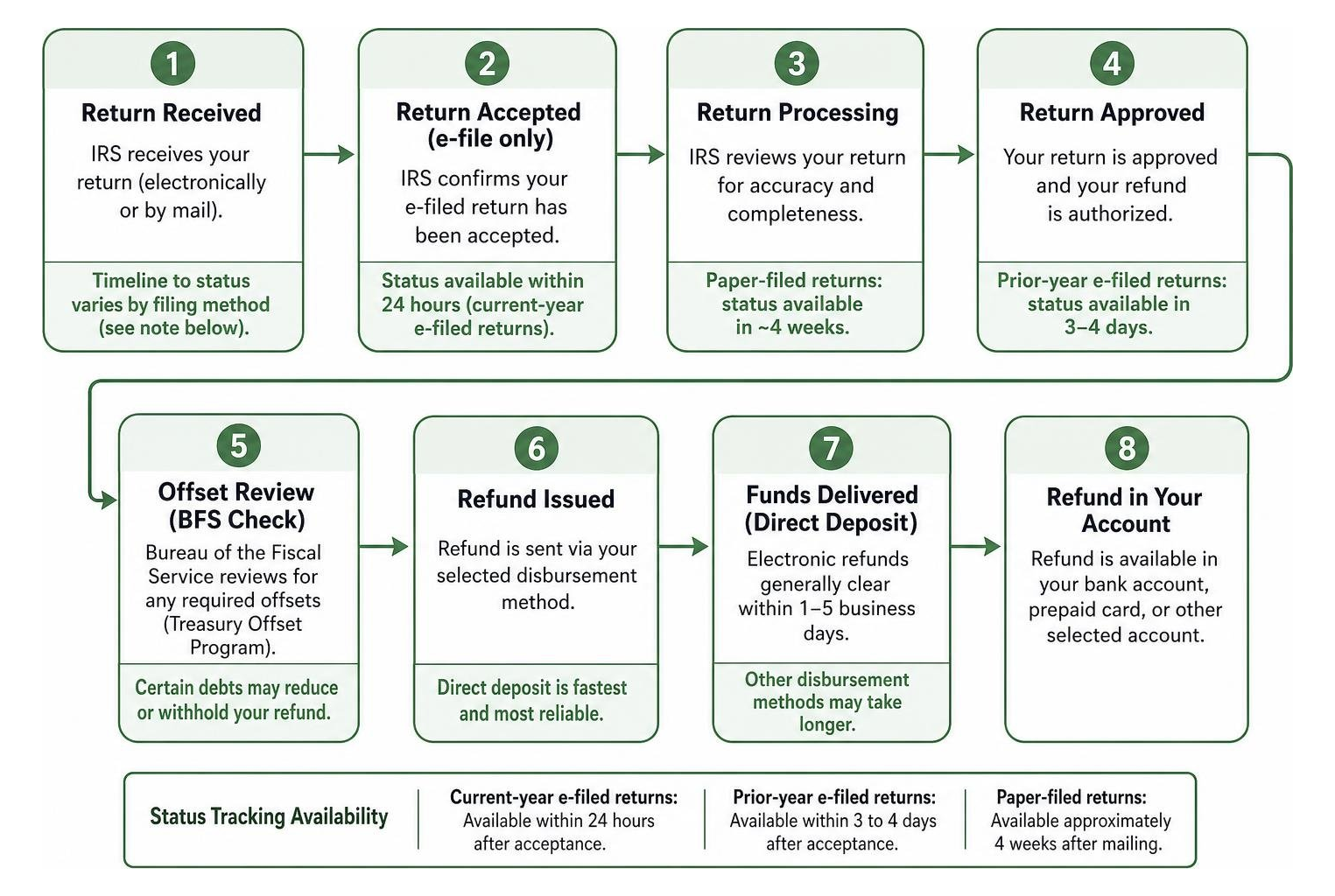
The tool updates once daily, usually overnight, so checking multiple times per day will not yield new information. Status tracking availability depends on your filing method:
- Current-year e-filed returns: Available within 24 hours after the IRS confirms acceptance.
- Prior-year e-filed returns: Available within 3 to 4 days after acceptance.
- Paper-filed returns: Available approximately 4 weeks after mailing.
Information Needed to Check Your Refund Status
To look up your refund information securely, have the following details from your filed tax return on hand:
- Primary taxpayer’s Social Security Number (SSN) or Individual Taxpayer Identification Number (ITIN).
- Exact filing status (Single, Married Filing Jointly, Married Filing Separately, Head of Household, or Qualifying Surviving Spouse).
- The exact whole-dollar refund amount shown on your return.
- The applicable tax year being queried.
Understanding Status Messages: Return Received, Approved, and Sent
The IRS tracker moves across three sequential progress milestones:
- Return Received: The IRS has successfully received your tax return and entered it into its processing system.
- Refund Approved: The IRS has verified your calculations, approved your refund amount, and scheduled a specific direct deposit or check mailing date.
- Refund Sent: The Bureau of the Fiscal Service has transmitted the electronic payment instruction to your financial institution or placed your paper check in the mail. Direct deposits typically appear in bank balances within 1 to 5 days following this status update.
Next Steps When Your Refund Is Missing, Delayed, or Lost
If your refund has taken longer than expected, taking systematic action will help you determine the cause and resolve any pending holds. If you find your individual filing or business return facing long delays, navigating tax refunds stuck in IRS processing involves knowing when to wait and when to escalate.
When and How to Contact the IRS Directly
IRS phone lines experience high call volumes. You should only contact an IRS telephone representative under specific conditions:
- More than 21 calendar days have passed since you e-filed.
- More than 6 weeks have passed since you mailed your paper return.
- The “Where’s My Refund?” tool explicitly directs you to call the agency.
When calling, keep a copy of your completed tax return, prior-year tax returns, W-2s, 1099s, and any correspondence notices received in front of you. If you face significant economic hardship due to an administrative delay, you can also reach out to the independent Taxpayer Advocate Service (TAS) for specialized assistance.
What to Do If Your Refund Check Is Lost or Stolen
If your refund check was mailed but failed to arrive, was stolen, or was accidentally destroyed, you can initiate a formal refund trace.
If you filed a joint return, both spouses must complete and submit IRS Form 3911 (Taxpayer Statement Regarding Refund). For single filers, a trace can often be initiated directly through the automated phone hotline (800-829-1954) or online tracker once the standard delivery window has expired. If the check was not cashed, the IRS typically cancels the original draft and reissues a replacement within 4 to 6 weeks.
Frequently Asked Questions About Tax Refund Timelines
Can you check your refund status immediately after submitting your return?
No. You must wait approximately 24 hours after submitting a current-year e-file before the IRS database updates its records. For mailed paper returns, the record will not appear in the tracking system for about 4 weeks.
How many years do you have to claim an overdue tax refund?
Under federal law, taxpayers have a 3-year statutory window from the original return due date to file and claim an overdue tax refund. If you do not file within 3 years, the unclaimed funds legally become the property of the U.S. Treasury.
Why did my direct deposit arrive in an amount different from my tax return?
Discrepancies usually occur because the IRS corrected a mathematical error, adjusted a tax credit claim, or applied a mandatory offset through the Treasury Offset Program for outstanding debts. The IRS will mail an explanation notice detailing the exact adjustments made.
Conclusion
Understanding refund timelines helps you set realistic expectations every tax season. For standard individual income tax returns, e-filing with direct deposit remains the fastest and most secure method to ensure your refund arrives within 10 to 21 calendar days.
For business owners managing specialized tax credits like the Employee Retention Credit (ERC), processing windows differ substantially from standard individual returns due to ongoing federal review backlogs. At SFG Capital, we provide specialized funding advances and claim buyouts to help business owners bypass lengthy government delays and unlock their capital immediately. Explore our specialized funding and credit advisory solutions to discover how we can help your business optimize cash flow today.
See what your business may qualify for.
60 seconds. No documents. No upfront cost.
General information only, not legal or tax advice. Eligibility and estimates are fact-specific and subject to review.