
Blog / Insights
InsightsHow Texas Businesses Can Claim the ERC Right Now
October 14, 2026 · 11 min read · By the SFG Capital team
Understanding the Rules for the ERC Tax Credit Texas Employers Must Follow
To claim the ERC tax credit, Texas businesses must evaluate their quarterly eligibility, calculate qualifying employee wages after segregating Paycheck Protection Program (PPP) payroll funds, and submit amended federal payroll tax returns using Form 941-X. Employers qualify on a quarter-by-quarter basis either by demonstrating a qualifying decline in gross receipts compared to 2019 baseline quarters or by documenting full or partial business suspensions resulting from government COVID-19 orders. Once eligible wages and allocable health plan expenses are computed, the amended returns generate direct cash refund checks from the IRS.
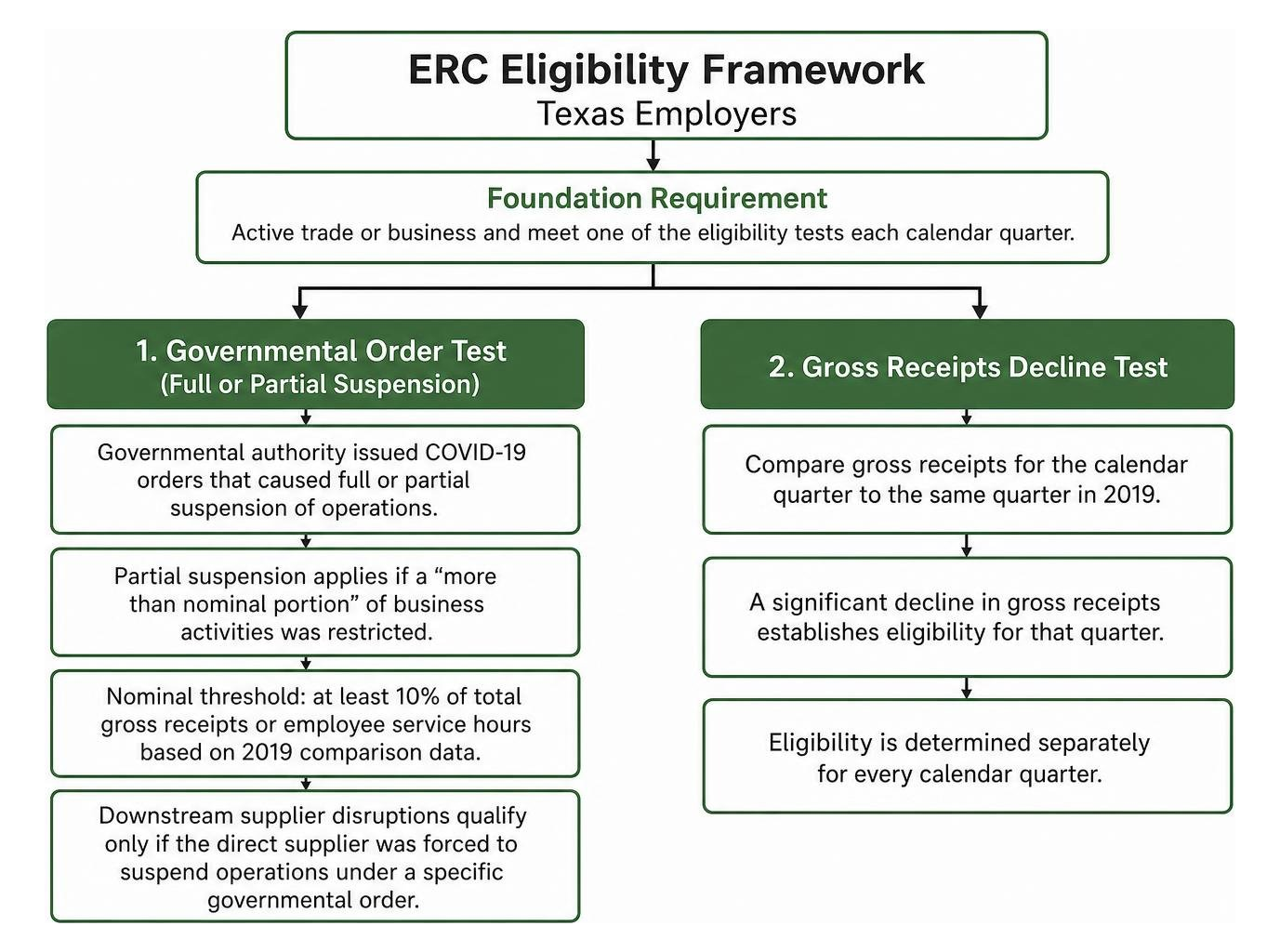
First established under the Coronavirus Aid, Relief, and Economic Security (CARES) Act and expanded by subsequent relief legislation, the Employee Retention Credit offers substantial payroll relief for employers across Austin, Travis County, and the entire state. To claim the refund, an employer must satisfy strict statutory standards outlined in official Employee Retention Credit guidance such as IRS Notice 2021-20. Meeting the essential ERC eligibility requirements requires proving an active trade or business and satisfying one of the core testing pathways established by Congress.
Governmental Orders vs Gross Receipts Decline Tests
Employers generally establish eligibility through one of two primary pathways:
- The Governmental Order Test (Full or Partial Suspension): An employer qualifies if an appropriate governmental authority issued orders directly related to COVID-19 that resulted in a full or partial suspension of commercial operations. Under IRS Notice 2021-20, an operation is considered partially suspended if a “more than nominal portion” of business activities was restricted. The IRS defines this nominal threshold as affecting at least 10% of total gross receipts or employee service hours based on 2019 comparison data. Furthermore, downstream supplier disruptions can only qualify an employer if the direct supplier was forced to suspend operations under a specific governmental mandate, rather than general market shortages.
- The Gross Receipts Test: This objective financial test compares quarterly revenue to baseline periods in 2019:
- For 2020 Quarters: An employer experienced a significant decline if gross receipts for any calendar quarter dropped by more than 50% compared to the identical quarter in 2019. Eligibility continued until the end of the quarter in which gross receipts recovered to more than 80% of the comparable 2019 quarter.
- For 2021 Quarters: The threshold relaxed significantly. An employer needed only a 20% decline in quarterly gross receipts compared to the matching 2019 quarter. Additionally, businesses can utilize the alternative quarter election, allowing them to assess eligibility for a quarter (such as Q1 2021) based on the financial performance of the immediately preceding quarter (Q4 2020 compared to Q4 2019).
Recovery Startup Businesses and Special Classifications
Businesses launched during the pandemic received a dedicated qualification pathway under IRC Section 3134. A Recovery Startup Business is defined as an entity that:
- Began active operations after February 15, 2020;
- Maintained average annualized gross receipts not exceeding $1,000,000 across its operating tax years under IRC Section 448(c)(3); and
- Did not otherwise satisfy the general governmental order suspension or gross receipts decline tests.
Recovery startups were eligible to claim the ERC exclusively for the third and fourth quarters of 2021, subject to a statutory maximum credit limit of $50,000 per calendar quarter ($100,000 total).
Another narrow classification exists for Severely Financially Distressed Employers—businesses experiencing a severe gross receipts drop exceeding 90% compared to 2019. These employers were permitted to treat all wages paid to employees during eligible 2021 quarters as qualified wages, regardless of employer size or whether employees provided active services. Detailed criteria can be found by reviewing current ERC qualification details.
Calculating Credit Amounts and PPP Offsets for 2020 and 2021
Calculating the ERC requires evaluating eligible wages, allocable qualified health plan expenses, and employer full-time equivalent (FTE) headcount thresholds from 2019.
The size of the employer determines which wages qualify:
- 2020 Headcount Limit: Small employers were defined as having 100 or fewer full-time employees on average in 2019, allowing all wages paid to employees during eligible periods to qualify. Large employers (over 100 FTEs) could only count wages paid to workers for hours they were not providing active services.
- 2021 Headcount Limit: The small employer ceiling expanded to 500 full-time employees in 2019, allowing substantially more mid-sized businesses to count active working wages toward their credit calculations.
The following table summarizes the baseline calculation rules across both calendar years:
| Parameter | Calendar Year 2020 | Calendar Year 2021 (Q1, Q2, Q3) |
|---|---|---|
| Credit Percentage | 50% of qualified wages | 70% of qualified wages |
| Wage Cap per Employee | $10,000 annually across all quarters | $10,000 per calendar quarter |
| Maximum Credit per Employee | $5,000 per year | $7,000 per quarter ($21,000 regular total) |
| Small Employer FTE Threshold | 100 or fewer full-time employees | 500 or fewer full-time employees |
| Gross Receipts Drop Requirement | > 50% decline vs. 2019 | > 20% decline vs. 2019 |
| Qualified Period End Date | December 31, 2020 | September 30, 2021 (Dec 31 for Startups) |
Calculating Potential Refunds Under the ERC Tax Credit Texas Guidelines
The mathematical gap between 2020 and 2021 credits is substantial. For 2020, an employee earning $10,000 in qualified compensation over the qualifying periods generates a total tax credit of $5,000 ($10,000 × 50%).
In contrast, 2021 allowed up to $7,000 per quarter per worker ($10,000 × 70%). Over the three statutory calendar quarters of 2021 (Q1 through Q3), that equals up to $21,000 per individual. Combined with 2020, an eligible employer could theoretically claim up to $26,000 per employee (or up to $28,000 if qualifying as a recovery startup in Q4 2021). Learning how the ERC program works for business owners makes it clear why accurate math is essential to protect these substantial sums.
Paycheck Protection Program (PPP) Loan Interplay
Under the CARES Act, businesses were initially prohibited from claiming the ERC if they received a Paycheck Protection Program (PPP) loan. The Taxpayer Certainty and Disaster Tax Relief Act eliminated this ban retroactively, permitting businesses to claim both benefits while establishing a strict statutory prohibition against “double dipping.”
Wages reported and utilized to support PPP loan forgiveness cannot be included as qualified wages for the ERC. To maximize both benefits, employers should:
- Allocate non-payroll expenses (rent, commercial mortgage interest, covered utilities, and operational expenditures) toward the 40% non-payroll bucket permitted on PPP loan forgiveness applications.
- Confine PPP payroll costs strictly to the minimum 60% threshold required for full forgiveness.
- Sequence wage allocations so that excess payroll beyond the PPP forgiveness requirement flows directly toward ERC calculations.
- Account for other federal grant programs, such as Shuttered Venue Operators Grants (SVOG) and Restaurant Revitalization Fund (RRF) awards, which follow identical anti-duplication rules.
For a deeper dive into optimizing cash flows across various relief funds, consult our comprehensive Texas business refund overview.
Texas State Tax Treatment, Franchise Tax, and Federal Wage Reductions
Understanding the overall financial yield of an ERC claim requires evaluating the federal tax code alongside state-specific rules. The credit provides non-taxable cash at the payroll level, but federal tax statutes require offsetting accounting adjustments.
Taxpayers should review professional analyses, including the Texas CPA tax credit analysis, when coordinating retroactive adjustments via Form 941-X.
Federal Wage Expense Disallowance Under IRC Section 280C
Under Internal Revenue Code Section 280C(a), taxpayers cannot claim a tax credit and take an ordinary business expense deduction on the exact same dollar of wages. Although IRS Notice 2021-20 confirms that the ERC is not included in gross income for federal income tax purposes, the employer must reduce deductible wage expenses by the gross amount of the credit claimed for the tax year in which the qualified wages were paid.
This deduction disallowance generates practical compliance steps:
- Entity Return Amendments: Claiming retroactive 2020 or 2021 ERC requires filing amended income tax returns (such as Form 1120-X for C-corporations or Form 1040-X for sole proprietorships) for the year wages were incurred.
- Pass-Through Entities: S-corporations must file Form 1120S-X and issue revised Schedule K-1s to pass the increased taxable income to shareholders. Partnerships subject to the Bipartisan Budget Act (BBA) of 2015 must file an Administrative Adjustment Request (AAR) using Form 8082.
- Net Cash Impact: For a standard C-corporation subject to the 21% federal corporate tax rate, a $100,000 ERC generates a $21,000 increase in federal tax liability, resulting in a net cash benefit of roughly $79,000.
Interaction with Texas Franchise Tax and State R&D Credits
Texas does not have a individual or corporate personal income tax, but taxable entities operating in the state are subject to the Texas Franchise Tax administered by the Texas Comptroller of Public Accounts.
- Texas Franchise Tax Margin Calculations: Texas franchise tax is calculated on taxable margin using one of four methods: total revenue minus Cost of Goods Sold (COGS), total revenue minus compensation, 70% of total revenue, or the EZ computation. Because the ERC is a payroll tax credit rather than gross business receipts, it is generally excluded from gross revenue. Furthermore, under Texas Tax Code Chapter 171, Texas compensation deductions follow specific state definitions, protecting state-level deductions from automatic federal disallowance under Section 280C.
- Texas R&D Franchise Tax Credit Alignment: Texas businesses conducting technical innovation can leverage the state research credit alongside federal programs. Effective in 2026, the state overhauled its research incentives via Senate Bill 2206, transitioning from Subchapter M to the permanent Subchapter T Texas R&D franchise tax credit rules.
- Under Subchapter T, Texas provides a standard credit rate of 8.722% on excess qualified research expenses (QREs) incurred in Texas derived from federal Form 6765, and an enhanced rate of 10.903% for research conducted under contracts with Texas higher education institutions.
- The Texas R&D credit allows a 20-year carryforward and can offset up to 50% of franchise tax liability (or provide refundable cash credits for qualifying entities with no franchise tax liability).
- Dual Claiming: A business may claim both the ERC and research credits, provided wages are segregated. Wages counted toward the federal ERC cannot be claimed as qualified research labor on IRS Form 6765 or the Texas franchise tax return.
Overcoming IRS Processing Delays and Audit Enforcement
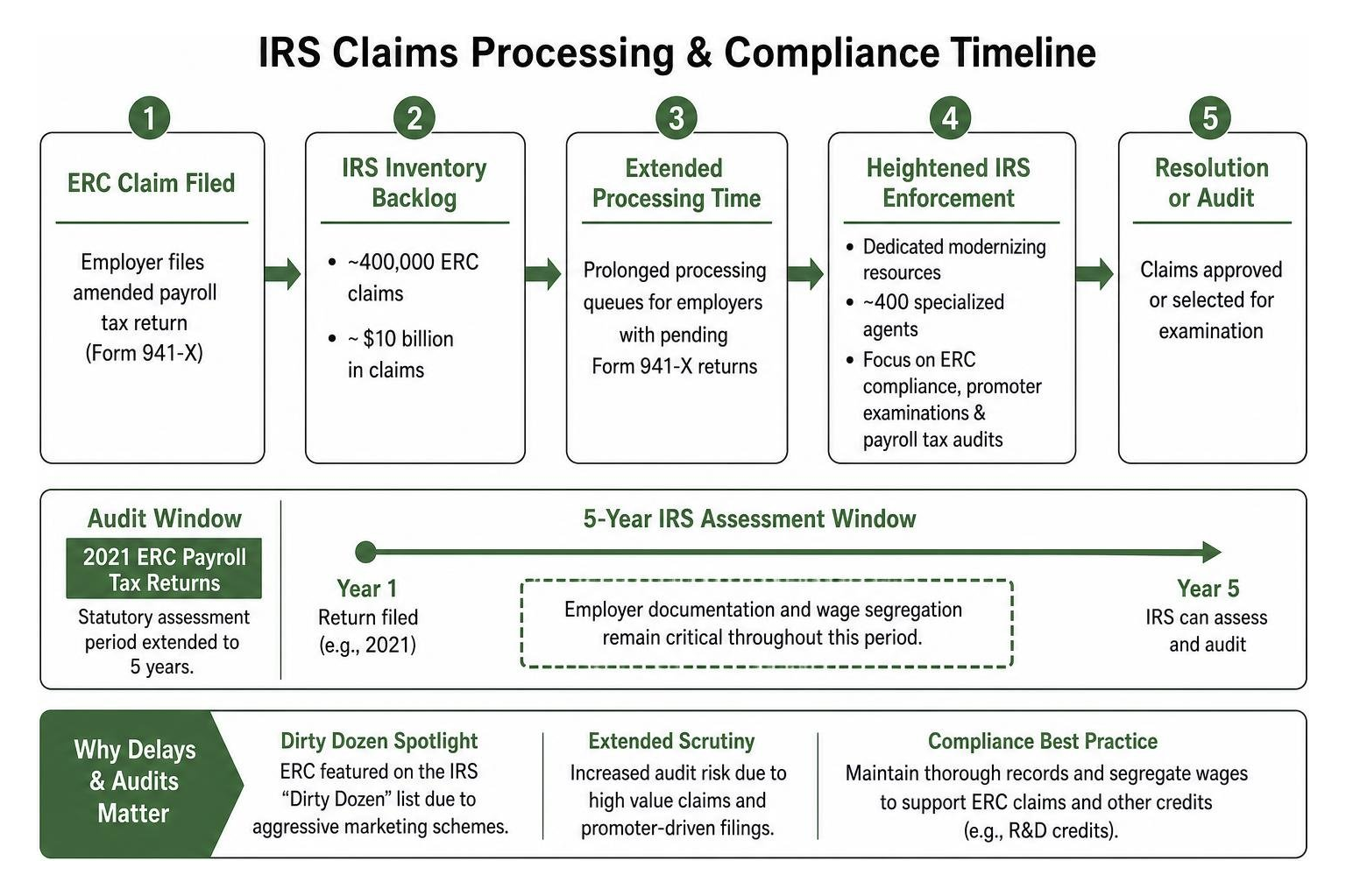
The IRS has placed the Employee Retention Credit under heightened enforcement scrutiny. The agency received dedicated modernizing resources and trained approximately 400 specialized agents focused exclusively on ERC compliance, promoter examinations, and payroll tax audits.
Currently, the IRS is working through an inventory of roughly 400,000 ERC claims worth approximately $10 billion, resulting in prolonged processing queues for employers with pending Form 941-X returns.
Avoiding Audit Risks and Pitfalls with the ERC Tax Credit Texas Claims
Because the ERC appeared prominently on the IRS “Dirty Dozen” list of tax scams due to aggressive marketing promoters, claims face rigorous examination standards. The statutory assessment period for 2021 ERC payroll tax returns was extended to five years, granting the IRS an extended window to audit filings.
To mitigate compliance exposure:
- Maintain Complete Substantiation: Retain contemporaneous records, including quarterly payroll summaries, health insurance invoices, detailed PPP loan forgiveness calculations, and precise revenue ledgers comparing 2019 baseline quarters.
- Document Specific Mandates: If qualifying under the Governmental Order Test, retain copies of the specific city, county, or state emergency orders, documenting the operational impact and proving it exceeded the 10% nominal threshold.
- Circular 230 Standards: Work exclusively with qualified tax professionals adhering to Treasury Circular 230 standards who evaluate aggregation rules under IRC Section 448(c) across parent-subsidiary and brother-sister entities.
- Remediation Options: If an employer submitted an improper or aggressive promoter-backed claim, they can utilize the formal IRS Claim Withdrawal Program to retract uncashed claims without facing civil penalties or interest. If an erroneous disallowance is issued (such as IRS Letter 105-C), businesses have formal administrative appeal rights through the IRS Independent Office of Appeals.
A structured roadmap for preparing an audit-ready filing is available in our step-by-step ERC application procedures.
Financing and Advance Options for Pending Claims
Given processing backlogs and moratorium-related review delays, many employers find their expected cash flow locked in IRS processing queues. For expanding companies in Travis County and across Central Texas, these multi-month delays disrupt working capital, hiring plans, and equipment purchases.
To bridge this operational gap, commercial financing options allow businesses to monetize their filed claims:
- ERC Advance Loans: Non-recourse or limited-recourse credit facilities secured against the anticipated Form 941-X refund check.
- Refund Buyouts: Direct purchases of approved claims, transferring the waiting period to institutional funders while providing immediate working capital to the employer.
At SFG Capital, we provide Travis County and Texas employers with performance-based refund advances and buyout options that eliminate IRS waiting times. You can explore expedited ERC funding and loan options to unlock capital immediately.
Frequently Asked Questions About Texas ERC Filings
Can Texas businesses claim both the ERC and Texas R&D tax credit?
Yes. Texas businesses can take advantage of both the federal Employee Retention Credit and the state research credit under Subchapter T. However, employers must maintain distinct accounting allocations: wage dollars claimed as qualified wages for the ERC cannot simultaneously be reported as qualified research expenses (QREs) on federal Form 6765 or Texas franchise tax filings.
Does Texas tax the Employee Retention Credit on state franchise returns?
No. The ERC is a federal payroll tax credit and is not included in gross revenue for Texas franchise tax reporting. Furthermore, because Texas calculates its margin tax deductions under state-specific rules rather than strict federal taxable income conformity, the federal Section 280C wage deduction disallowance does not adversely reduce an employer’s compensation deduction under Texas Tax Code Chapter 171.
What should a Texas employer do if their ERC claim is audited or delayed?
If your claim is experiencing processing delays, monitor your IRS transcript to confirm Form 941-X receipt. If the IRS initiates an audit or issues a Letter 105-C Notice of Disallowance, compile your contemporaneous 2019 baseline financials, qualifying executive orders, and PPP wage segregation spreadsheets. You have 30 days to request an administrative appeal with the IRS Independent Office of Appeals or pursue formal dispute resolution pathways with professional representation.
Conclusion

The Employee Retention Credit remains one of the largest corporate relief measures in modern tax history, providing vital capital injection for qualified employers who supported their workforce through unprecedented disruptions. However, claiming the credit successfully requires meticulous documentation, careful navigation of Section 280C federal wage disallowances, and a clear understanding of Texas franchise tax interactions.
With approximately 400 dedicated IRS agents auditing claims and a 400,000-claim processing backlog, Texas employers must ensure their filings are fully substantiated and defensible. For businesses with verified claims waiting on federal checks, waiting months for the IRS to release funds is often an unnecessary strain on operations.
At SFG Capital, we help businesses throughout Austin, Travis County, and across Texas turn pending refund claims into immediate liquidity. Through transparent, performance-based advance funding and refund buyout solutions, our team helps you bypass government backlogs so you can focus on scaling your business. Contact our specialists today to evaluate your claim and access our comprehensive financial and credit advance services.
See what your business may qualify for.
60 seconds. No documents. No upfront cost.
General information only, not legal or tax advice. Eligibility and estimates are fact-specific and subject to review.