
Blog / Insights
InsightsHow to Find the Best ERC Funds Expert Assistance
October 30, 2026 · 11 min read · By the SFG Capital team
Find ERC Refund Expert Guidance That Protects Your Claim
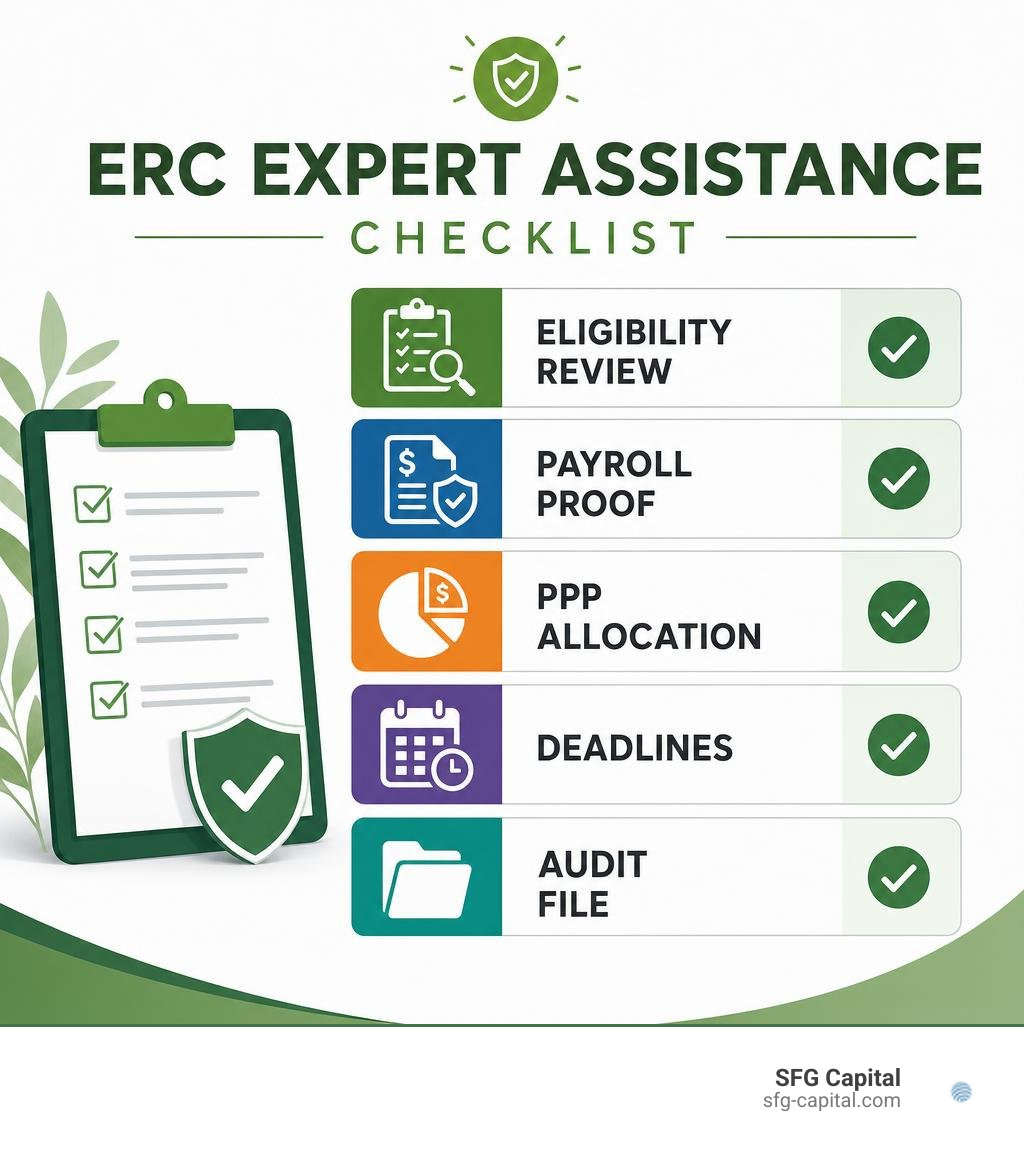
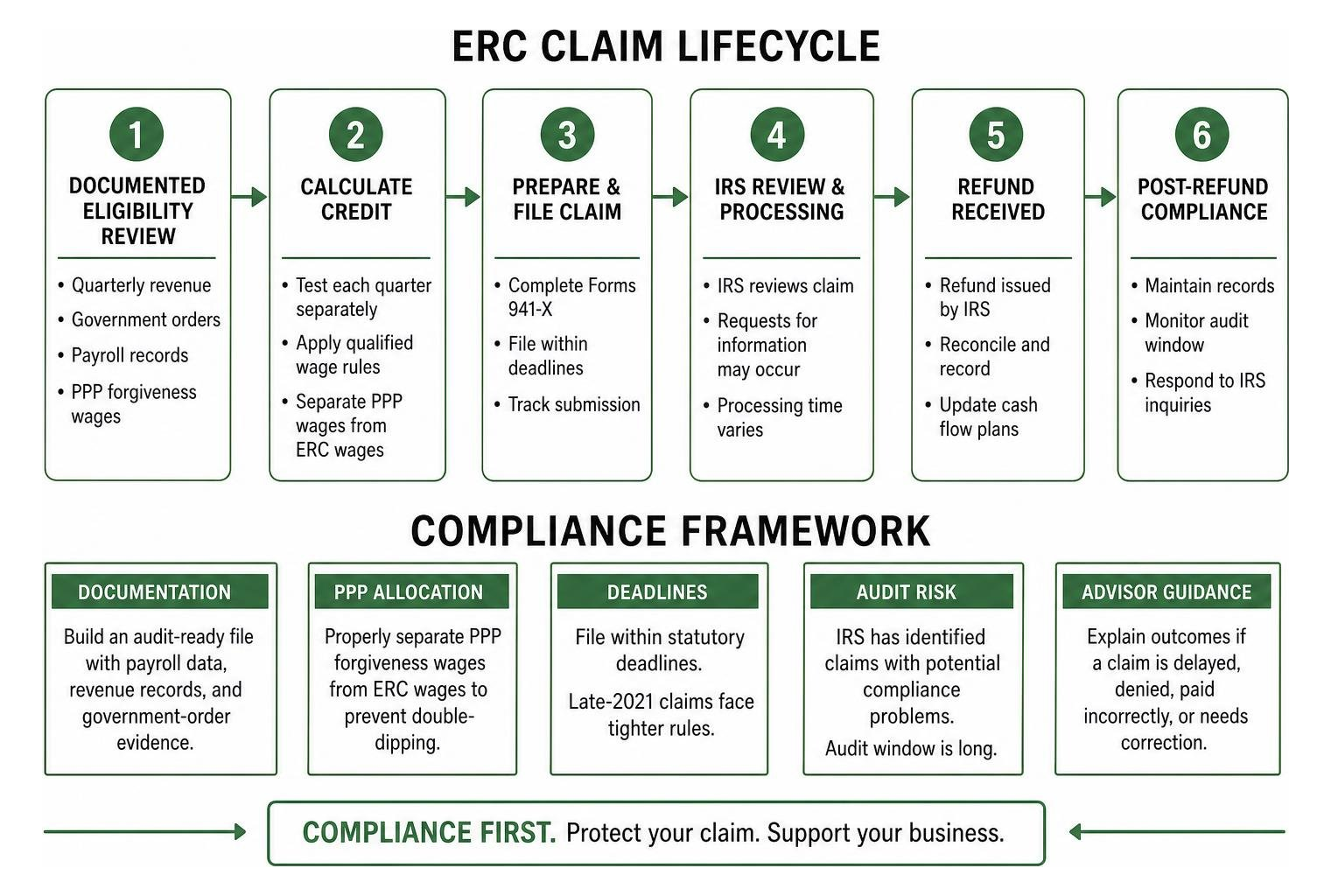
The best ERC refund expert guidance starts with a documented eligibility review, not a promise of fast money. Before hiring help, ask whether the advisor will review your quarterly revenue, the exact government orders that affected operations, payroll records, and PPP forgiveness wages. They should also explain filing deadlines, audit risk, fees, and what happens if the IRS challenges the claim.
In 2026, this matters more than ever. The IRS has identified more than one million ERC claims with potential compliance problems, while late-2021 claims face tighter rules and a longer audit window. A qualified advisor can help you pursue a valid refund, protect working capital plans from IRS delays, and avoid the costly mistakes often tied to high-pressure ERC promoters.
Look for a team that will:
- Test eligibility quarter by quarter instead of relying on generic industry claims.
- Separate PPP forgiveness wages from ERC wages to prevent double-dipping.
- Build an audit-ready file with payroll data, revenue records, and government-order evidence.
- Explain options if a claim is delayed, denied, paid incorrectly, or needs correction.
- Put compliance ahead of a large projected refund.
I am Santino Battaglieri of SFG Capital. My background in structured funding and ERC transactions, including more than $500 million in funded or purchased claims, informs a disciplined approach to ERC refund expert guidance, documentation, and responsible liquidity planning.
Understanding ERC Fundamentals and Critical 2026 Deadlines
The Employee Retention Credit (ERC) began under the Coronavirus Aid, Relief, and Economic Security (CARES) Act in 2020 and expanded under the American Rescue Plan Act (ARPA) in 2021. Designed as a refundable payroll tax credit, it rewarded businesses that retained employees despite severe economic disruptions. However, navigating the statutory landscape today requires understanding how earlier rules intersect with current enforcement priorities.
Core Eligibility Criteria and Qualified Wage Rules
To establish eligibility for the credit, an employer must satisfy one of two primary statutory standards for any given calendar quarter:
- Gross Receipts Reduction Test: For 2020 quarters, an employer must demonstrate at least a 50% decline in gross receipts compared to the corresponding calendar quarter in 2019. For 2021 quarters, the threshold dropped to a 20% decline compared to the same quarter in 2019 (or the immediately preceding quarter).
- Full or Partial Suspension of Operations: The business must have been subject to a federal, state, or local government order directly mandating a suspension of operations, reduction in operating hours, or restriction on customer capacity. Generalized supply chain slowdowns or self-imposed safety measures do not establish eligibility.
Qualified wages are capped at $10,000 per employee per year for 2020 (yielding a maximum 50% credit of $5,000 per worker). For 2021, the credit expanded to 70% of qualified wages up to $10,000 per employee per quarter for the first three quarters (yielding up to $7,000 per employee per quarter, or $21,000 total).
Large employer headcount rules also dictate which wages qualify:
- 2020: Companies averaging over 100 full-time employees in 2019 could only claim wages paid to employees who were not providing services.
- 2021: The threshold increased to 500 full-time employees.
For newer entities, a Recovery Startup Business (launched after February 15, 2020, with annual gross receipts under $1,000,000) could claim up to $50,000 total per quarter for Q3 and Q4 of 2021 without proving revenue declines or government shutdown orders. Reviewing the U.S. Chamber of Commerce guide on ERC fundamentals and consulting our employee retention credit specialist guide ensures your foundational numbers align with statutory limits.
OBBBA Legislative Updates and the Six-Year Audit Horizon
Federal legislation under the One Big Beautiful Bill Act (OBBBA) reshaped the post-pandemic tax environment. OBBBA instituted a retroactive disallowance cutoff: any ERC claims for the third and fourth quarters of 2021 submitted after January 31, 2024, are barred by statute.
Furthermore, Congress extended the assessment period for late-2021 ERC claims. While the normal three-year statute of limitations for Q1 and Q2 2021 closed on April 15, 2025, the audit window for Q3 and Q4 2021 claims was extended to six years, running through April 15, 2027. Practitioners and business owners must navigate these extended timeframes carefully, as highlighted in the Thomson Reuters analysis on ERC audit rules.
PPP Coordination and Double-Dipping Restrictions
Employers can claim both Paycheck Protection Program (PPP) loan forgiveness and the Employee Retention Credit. However, federal law strictly prohibits “double-dipping”—using the exact same dollar-for-dollar wages to claim both benefits.
When filing retroactive adjustments on IRS Form 941-X, businesses must conduct a forensic payroll wage allocation. If payroll dollars were designated on your PPP forgiveness application to reach 100% forgiveness, those specific wages cannot be included in your ERC qualified wage pool. Ensuring clear wage reconciliation between non-payroll costs, PPP allocations, and qualified tax credits is central to moving from compliance to claims with top ERC tax credit services.
Navigating IRS Disputes: ERC Refund Expert Guidance on Litigation and Appeals

IRS enforcement has reached unprecedented levels. In 2025 alone, the IRS issued approximately 720,000 formal Notices of Claim Disallowance across all tax categories, including tens of thousands of automated ERC disallowances based on internal risk filter models. When an agency notice arrives, understanding administrative versus judicial remedies is crucial.
Managing the Section 6532 Two-Year Statute of Limitations
When the IRS issues a formal Notice of Claim Disallowance (such as Letter 105C or Letter 106C), a strict procedural clock begins. Under Internal Revenue Code (IRC) Section 6532(a), taxpayers have exactly two years from the mailing date of the disallowance notice to file a refund lawsuit in federal court.
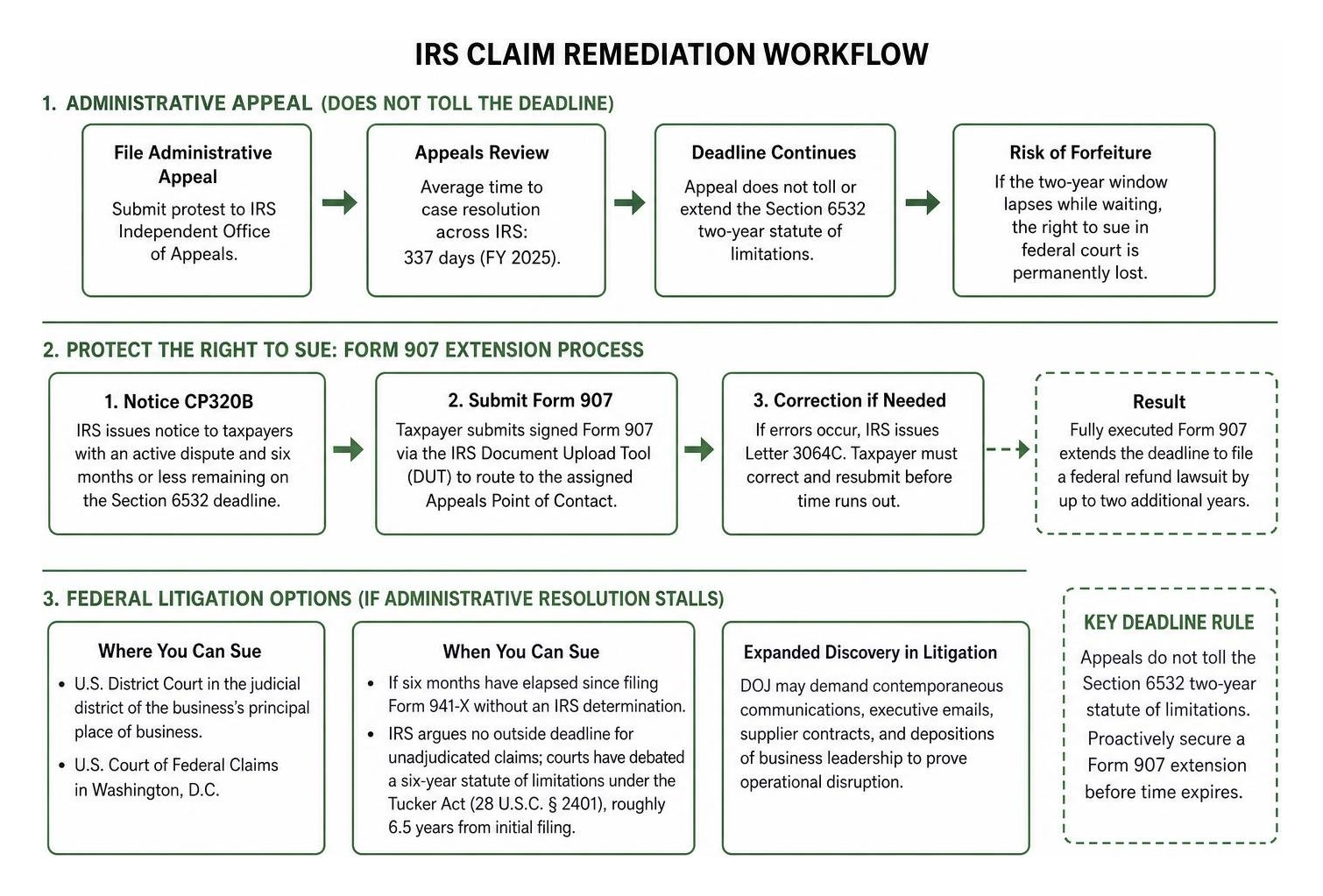
A dangerous trap for employers is assuming that filing an administrative appeal pauses this deadline. Filing a protest with the IRS Independent Office of Appeals does not toll or extend the Section 6532 two-year statute of limitations.
In fiscal year 2025, the average time from an initial taxpayer appeal request to case resolution across the IRS was 337 days. With IRS Appeals facing significant case volumes, administrative reviews often outlast the two-year litigation clock. If that two-year window lapses while you wait for an Appeals Officer, your legal right to challenge the denial in federal court is permanently extinguished, as detailed in Venable LLP insights on ERC refund lawsuits.
Securing Form 907 Extensions Through ERC Refund Expert Guidance
To prevent the forfeiture of refund rights while administrative appeals are pending, taxpayers must execute IRS Form 907 (Agreement to Extend the Time to Bring Suit). A fully executed Form 907 extends the deadline to file a federal refund lawsuit by up to two additional years.
The IRS introduced a streamlined submission process:
- Notice CP320B: The IRS issues this notice to taxpayers who have an active administrative dispute with six months or less remaining on their Section 6532 deadline.
- Document Upload Tool (DUT): Taxpayers can submit signed Form 907 agreements directly via the IRS Document Upload Tool to route them to an assigned Appeals Point of Contact.
- Correction Handling: If errors occur on the form, the IRS issues Letter 3064C, requiring swift correction before statutory time runs out.
If you are within six months of your two-year deadline, do not wait for a notice. Proactively requesting Form 907 execution is an essential part of your guide to getting ERC claim assistance.
Federal Court Venues and Discovery Substantiation
If administrative remedies stall or a disallowance cannot be resolved administratively, an employer can pursue a formal refund suit in:
- The U.S. District Court in the judicial district of the business’s principal place of business.
- The U.S. Court of Federal Claims in Washington, D.C.
Taxpayers can also file suit if six months have elapsed since filing Form 941-X without receiving an IRS determination. While the IRS takes the position that unadjudicated claims carry no outside deadline, federal courts have debated whether the general six-year statute of limitations under the Tucker Act (28 U.S.C. § 2401) creates an outside window roughly 6.5 years from the initial filing.
Transitioning from an administrative audit to federal litigation expands the scope of discovery. The Department of Justice (DOJ) may demand contemporaneous communications, executive emails, supplier contracts, and depositions of business leadership to prove operational disruption.
Resolving Questionable Claims: Remediation and Tax Reporting in 2026
With the IRS issuing up to 30,000 Letter 6577-C recapture notices targeting over $1 billion in improper payouts, businesses that used aggressive third-party promoters must resolve questionable filings before formal civil fraud penalties apply.
Rectifying Improper Filings with ERC Refund Expert Guidance
Following the closure of previous IRS Voluntary Disclosure Programs (VDP 1.0 and VDP 2.0), employers must use standard statutory correction mechanisms to address errors:
- IRS Claim Withdrawal Process: If you filed an adjusted return (Form 941-X) that has not yet been paid, or if you received a refund check that has not been cashed or deposited, you can request a formal withdrawal. The IRS treats withdrawn claims as though they were never filed, shielding the business from 20% accuracy-related penalties.
- Self-Correction via Form 941-X Amendment: If improper funds were deposited, the business must file a corrective Form 941-X to repay the tax credit plus applicable statutory interest.
- Responding to Recapture Notices: If you receive Letter 6577-C or Letter 6612, you generally have 30 days to provide documentation or arrange repayment before formal assessments and director fiduciary payroll liabilities are established.
For an extensive roadmap on navigating post-VDP corrections, review the guide on post-VDP ERC claim withdrawal and audit defense and consult experienced professionals when you need ERC help to find top employee retention credit advisors here.
Reporting Delayed 2026 Refunds and Protective Claims
Under IRC Section 280C, employers receiving an ERC refund must reduce their deductible wage expenses by the exact amount of the credit. Historically, this required amending original 2020 or 2021 income tax returns.
However, for refunds received in 2026 where the original 2020 and 2021 tax years are barred by the standard three-year income tax statute of limitations, the IRS instructs taxpayers to include the refund amount as gross income on their 2026 tax return.
While this prevents reopening closed tax returns, it creates legal tension with the traditional tax benefit rule. As detailed in the Berger CPA analysis on handling 2026 ERC refunds, the recommended compliance strategy is two-fold:
- Report the delayed refund on your 2026 tax filing and pay the corresponding tax to remain compliant with IRS administrative instructions.
- Concurrently file a formal protective refund claim for 2026. This preserves your legal standing to recover the tax paid if federal courts determine the IRS cannot force closed-year wage adjustments into current-year taxable income.
How to Choose Legitimate Advisors Over High-Risk Credit Mills

The proliferation of unregulated contingency-fee “credit mills” caused substantial disruption in the small business sector. Many promoters charged 15% to 25% fees while submitting unsupported claims based on generic, non-statutory templates.
| Assessment Factor | Qualified CPA / Tax Advisory Firm | Predatory ERC Credit Mill |
|---|---|---|
| Eligibility Method | Documented revenue tests and specific government shutdown orders | Boilerplate industry summaries, generic OSHA rules, or supply chain claims |
| Fee Structure | Standard professional hourly or transparent fixed-fee engagements | Contingency fees (15%–25%) demanding percentage retainers |
| PPP Reconciliation | Forensic wage-by-wage separation to eliminate double-dipping | Aggressive wage grouping with no PPP forgiveness cross-checks |
| Audit Defense | Complete workpapers, contemporaneous proof, and signed representation | Disappears upon claim submission; no audit representation |
| Preparer Accountability | Signs return as paid preparer with PTIN / CPA license | Unsigned Form 941-X returns or third-party “ghost” filing |
Identifying Red Flags in Promoter-Driven Filings
To protect your business from promoter penalties ($1,000 per violation plus 20% of the erroneous refund amount), look out for these common warning signs:
- Promoters asserting that simple supply chain delays or general CDC recommendations qualify an employer without citing specific local government closure mandates.
- Advisors claiming “every business qualifies” regardless of headcount or financial results.
- Firms refusing to sign Form 941-X as the paid preparer.
Working with verified ERC specialists who can help your business claim its credit ensures your filings are supported by verifiable law rather than marketing rhetoric.
Essential Documentation and Audit Defense Preparation
A defensible ERC file requires rigorous substantiation assembled prior to filing or responding to an examination:
- Quarterly Revenue Journals: Detailed profit and loss statements reconciling gross receipts from 2019 through 2021 against filed federal income tax returns (Form 1120, 1120-S, or 1065).
- Executive Orders: Copies of the specific municipal, county, or state executive orders that mandated the partial or full operational suspension of your physical facilities.
- Payroll Detail: Individual employee pay stubs, Form 941 filings, W-2 forms, and health plan premium invoices reflecting employer-paid portions.
- Related-Party Exclusions: Clear documentation excluding majority business owners (greater than 50% ownership) and their direct familial relations from the qualified wage base.
Structuring these records is key when you unlock your business potential with top-tier ERC consulting.
Frequently Asked Questions about ERC Expert Assistance
Can I still file an ERC refund claim in 2026?
The statutory deadlines to file new retroactive ERC claims on Form 941-X have passed for most employers. The deadline for 2020 claims lapsed on April 15, 2024, and the deadline for Q1 and Q2 2021 claims lapsed on April 15, 2025. Additionally, the One Big Beautiful Bill Act (OBBBA) retroactively disallowed Q3 and Q4 2021 claims filed after January 31, 2024. Current expert guidance focuses primarily on claim tracking, audit defense, administrative appeals, refund litigation, and remediation.
How does an administrative appeal affect my deadline to file a refund lawsuit?
Filing a protest with the IRS Independent Office of Appeals does not pause or extend the strict two-year statute of limitations under IRC Section 6532(a). To protect your right to file a federal refund lawsuit, you and the IRS must execute IRS Form 907 before your two-year window expires.
What happens if I received an ERC refund for a closed tax year?
If you receive an ERC refund in 2026 for 2020 or 2021 tax years that are closed under the three-year statute of limitations, IRS administrative guidance directs you to report the refund amount as gross income on your 2026 return. To protect against paying unnecessary tax if courts overturn this guidance, file a protective refund claim alongside your 2026 return.
Conclusion
Navigating the Employee Retention Credit landscape in 2026 requires strict adherence to statutory deadlines, robust audit documentation, and sound legal strategies. For business owners across Austin and Travis County, waiting on multi-year IRS administrative backlogs can place an unnecessary strain on working capital and growth plans.
At SFG Capital, we help businesses in Travis County bypass IRS processing gridlock through structured ERC refund advances and claim buyouts. Backed by a performance-based fee model, our team delivers immediate liquidity while ensuring your underlying documentation meets stringent compliance and audit standards.
To resolve liquidity delays and protect your business with institutional-grade compliance, explore our services today.
See what your business may qualify for.
60 seconds. No documents. No upfront cost.
General information only, not legal or tax advice. Eligibility and estimates are fact-specific and subject to review.