
Blog / Insights
InsightsHow to Qualify for ERC in Austin and Travis County
October 16, 2026 · 7 min read · By the SFG Capital team
Understanding the Employee Retention Credit in Travis County
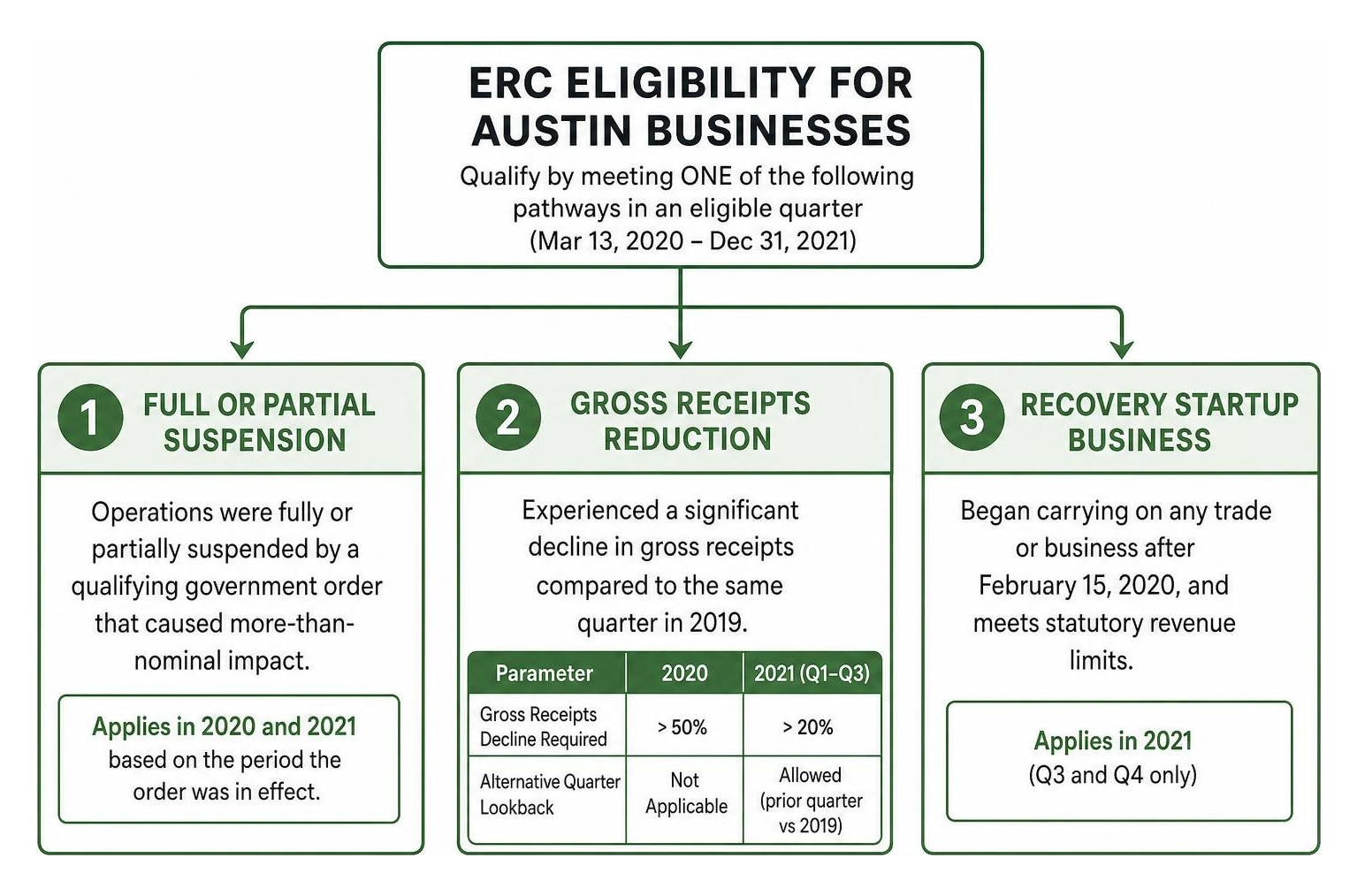
To qualify for the Employee Retention Credit (ERC) in Austin and Travis County, your business must meet one of three tests during eligible 2020 or 2021 quarters: (1) a full or partial suspension of operations due to a government order, such as City of Austin capacity restrictions or stay-home orders; (2) a significant decline in gross receipts—more than 50% compared to the same 2019 quarter for 2020, or more than 20% for 2021; or (3) status as a Recovery Startup Business that began operations after February 15, 2020, with average annual gross receipts of $1 million or less. The ERC originated under the Coronavirus Aid, Relief, and Economic Security (CARES) Act to encourage employers to keep workers on payroll during widespread economic disruption. At its core, the ERC explained as a refundable payroll tax credit rather than a loan or discretionary grant. Because it is refundable, any credit amount exceeding your federal employment tax liability is returned directly to your business as a cash refund.
Austin employers claim these funds retroactively by filing adjusted quarterly employment tax returns using IRS Form 941-X. Eligible employers calculate credit amounts based on qualified wages and allocable qualified health plan expenses paid to employees during specific calendar quarters in 2020 and 2021. For businesses seeking foundational knowledge, the U.S. Chamber of Commerce provides federal guidance on how to claim the tax credit.
Distinguishing Federal Payroll Tax Credits from Texas TCEQ Emission Credits
When researching “ERC in Texas,” business owners frequently encounter another state-level acronym: the Emission Reduction Credit (ERC) program administered by the Texas Commission on Environmental Quality.
These two programs serve entirely different purposes:
- Federal Employee Retention Credit (IRS ERC): A federal tax relief program providing cash refunds based on payroll wages paid during 2020 and 2021 disruptions.
- Texas Emission Reduction Credit (TCEQ ERC): An environmental regulatory mechanism allowing facilities in nonattainment air quality regions to bank and trade reductions in stationary, mobile, or industrial emissions.
Austin businesses seeking payroll relief need to look exclusively at federal tax regulations under the Internal Revenue Code, ensuring local environmental banking rules are not confused with federal tax recovery.
Core Rules Governing ERC Eligibility for Austin Employers
To successfully claim the credit, an Austin business must satisfy specific statutory benchmarks. Meeting the essential ERC qualifications requires fulfilling one of three independent tests during an eligible calendar quarter between March 13, 2020, and December 31, 2021:
- Full or Partial Suspension: The operation of your trade or business was fully or partially suspended by a qualifying government order.
- Gross Receipts Reduction: Your business experienced a significant decline in gross receipts relative to 2019 baseline quarters.
- Recovery Startup Business: Your enterprise launched after February 15, 2020, and met statutory revenue limits.
The IRS maintains official IRS eligibility guidance to help employers determine qualification boundaries.
| Metric / Criteria | 2020 ERC Parameters | 2021 ERC Parameters (Q1–Q3) |
|---|---|---|
| Gross Receipts Decline Required | > 50% drop compared to 2019 quarter | > 20% drop compared to 2019 quarter |
| Alternative Quarter Lookback | Not Applicable | Allowed (prior calendar quarter vs 2019) |
| Maximum Qualified Wages Per Employee | $10,000 across all quarters combined | $10,000 per calendar quarter |
| Credit Percentage | 50% of qualified wages | 70% of qualified wages |
| Maximum Credit Per Employee | $5,000 for the entire year | $7,000 per quarter ($21,000 total) |
| Small Employer Full-Time Threshold | Up to 100 average full-time employees (2019) | Up to 500 average full-time employees (2019) |
Government Shutdown Orders and ERC Eligibility for Austin Hospitality
Austin’s vibrant hospitality, live entertainment, and service sectors faced substantial operational constraints due to local emergency mandates. Under IRS rules, general supply chain slowdowns or customer hesitation do not qualify a business; there must be a direct link to a local, state, or federal government mandate that exerted a more-than-nominal impact on business operations.
Critical local directives impacting Austin and Travis County included:
- March 2020 Special Event Cancellations: The cancellation of South by Southwest (SXSW) marked the initial onset of emergency restrictions across Travis County venues and event hospitality providers.
- City of Austin “Stay Home-Work Safe” Orders: Mandated closures for non-essential business operations and physical office premises.
- Austin Public Health Risk-Based Guidelines: Multi-phased staging limits restricting indoor dining room capacity, limiting bar operations, and establishing mandatory curfew hours for late-night entertainment districts.
For restaurants, music venues, and retail shops across downtown Austin and East Austin, capacity rollbacks (e.g., operating at 25% or 50% capacity) and mandatory indoor service suspensions qualify as partial suspensions under IRS Notice 2021-20 for the precise duration those orders remained in force.
Gross Receipts Reduction Rules and ERC Eligibility for Austin Tech and Retail
For businesses that remained operational—such as professional services, software developers, and retail shops—the gross receipts test provides an objective, numbers-based pathway to eligibility. When evaluating ERC refund requirements, employers compare quarterly financial figures against corresponding 2019 quarters:
- 2020 Calendar Quarters: Eligibility begins in the quarter where gross receipts fell below 50% of the same quarter in 2019. It ends in the quarter following the quarter in which receipts recovered to more than 80% of the comparable 2019 period.
- 2021 Calendar Quarters: Eligibility requires a drop of more than 20% in gross receipts compared to the same quarter in 2019. Businesses can also utilize an alternative quarter lookback rule, comparing the immediately preceding quarter against the corresponding 2019 quarter.
Gross receipts accounting must align with federal tax definitions, reconciling total sales, investment income, and gross receipts without including forgiven Paycheck Protection Program (PPP) proceeds.
Recovery Startup Business Provisions for Central Texas Ventures
Austin is one of the premier startup hubs in the country. Businesses founded during the pandemic are not excluded from relief. A Recovery Startup Business (RSB) represents a distinct qualifying category designed for ventures that:
- Began trade or business operations after February 15, 2020.
- Maintained average annual gross receipts of $1,000,000 or less across applicable operating years.
- Did not otherwise qualify under the full/partial suspension or gross receipts tests.
Recovery startups can claim credits for qualified wages paid in Q3 2021 and Q4 2021, capped at a maximum of $50,000 per calendar quarter ($100,000 total).
Essential Documentation and Application Process for Austin Businesses
Filing an accurate ERC claim requires an organized audit file that supports every dollar claimed. The IRS reviews claims rigorously, making substantiation vital prior to filing Form 941-X.

Following a structured, step-by-step ERC filing process ensures complete compliance:
- Gather Payroll Reports: Collect detailed payroll journals by employee, date, and compensation breakdown for all 2020 and 2021 quarters.
- Document Health Insurance Costs: Extract employer-paid healthcare contributions allocable to qualified wage periods.
- Isolate PPP Forgiveness Wages: Identify and segregate exact payroll expenses used to justify PPP loan forgiveness to avoid double-dipping.
- Compile Government Mandates: Archive specific City of Austin and Travis County emergency orders demonstrating operational disruption periods.
- Prepare Form 941-X: Accurately complete amended payroll tax returns for each eligible quarter and adjust income tax wage deductions accordingly.
Navigating IRS Backlogs and Enforcement in 2026
As of September 2026, IRS processing centers continue to process a substantial inventory of Form 941-X submissions under heightened scrutiny. The agency is actively auditing claims, reviewing high-risk filings, and issuing formal disallowance notices (such as Letter 105-C).
For employers experiencing extended processing cycles, managing the ERC refund journey requires proactive tracking. Employers who discover an improper claim filed by an aggressive third-party promoter can utilize official IRS claim withdrawal and correction procedures to avoid statutory penalties. To review current processing parameters, see the official IRS FAQ on credit processing.
Frequently Asked Questions About Austin ERC Qualifications
Can Austin businesses claim the ERC if they already received PPP loan forgiveness?
Yes. Under the Taxpayer Certainty and Disaster Tax Relief Act, businesses that received PPP loans can claim the ERC. However, the exact payroll dollars allocated toward PPP loan forgiveness cannot be counted as qualified wages for the ERC. Careful wage-by-wage cross-referencing is required to maximize both relief programs legally.
Which Travis County COVID-19 orders qualify an employer under the suspension test?
Qualifying directives include City of Austin “Stay Home-Work Safe” resolutions, Austin Public Health emergency staging rules restricting gathering sizes and dining capacity, Travis County executive orders limiting commercial facility operations, and mandatory event moratoriums that directly curtailed commercial operations.
What documentation is required to defend an Austin ERC claim during an audit?
A defensible audit file includes:
- Quarterly federal tax filings (Forms 941 and 941-X).
- Detailed employee wage ledgers and health plan contribution statements.
- PPP forgiveness application forms showing specific wage allocations.
- Quarterly revenue profit-and-loss statements comparing 2020/2021 against 2019 baseline quarters.
- Copies of the specific local government directives demonstrating business disruption.
Conclusion
Determining whether your business qualifies for the Employee Retention Credit requires balancing complex federal tax codes against local operational realities in Travis County. When properly documented, the ERC remains a powerful liquidity mechanism for eligible Austin employers who supported their teams through economic uncertainty.
At SFG Capital, we provide Travis County business owners with clear claim evaluation, conservative audit-ready preparation, and specialized advance funding solutions to bridge prolonged IRS processing timelines. Explore our comprehensive capital and advisory services to substantiate your eligibility and unlock your business’s capital.
See what your business may qualify for.
60 seconds. No documents. No upfront cost.
General information only, not legal or tax advice. Eligibility and estimates are fact-specific and subject to review.