
Blog / Insights
InsightsHow to Request a Tariff Refund in 3 Simple Steps
November 28, 2026 · 7 min read · By the SFG Capital team
How to Request Tariff Refunds
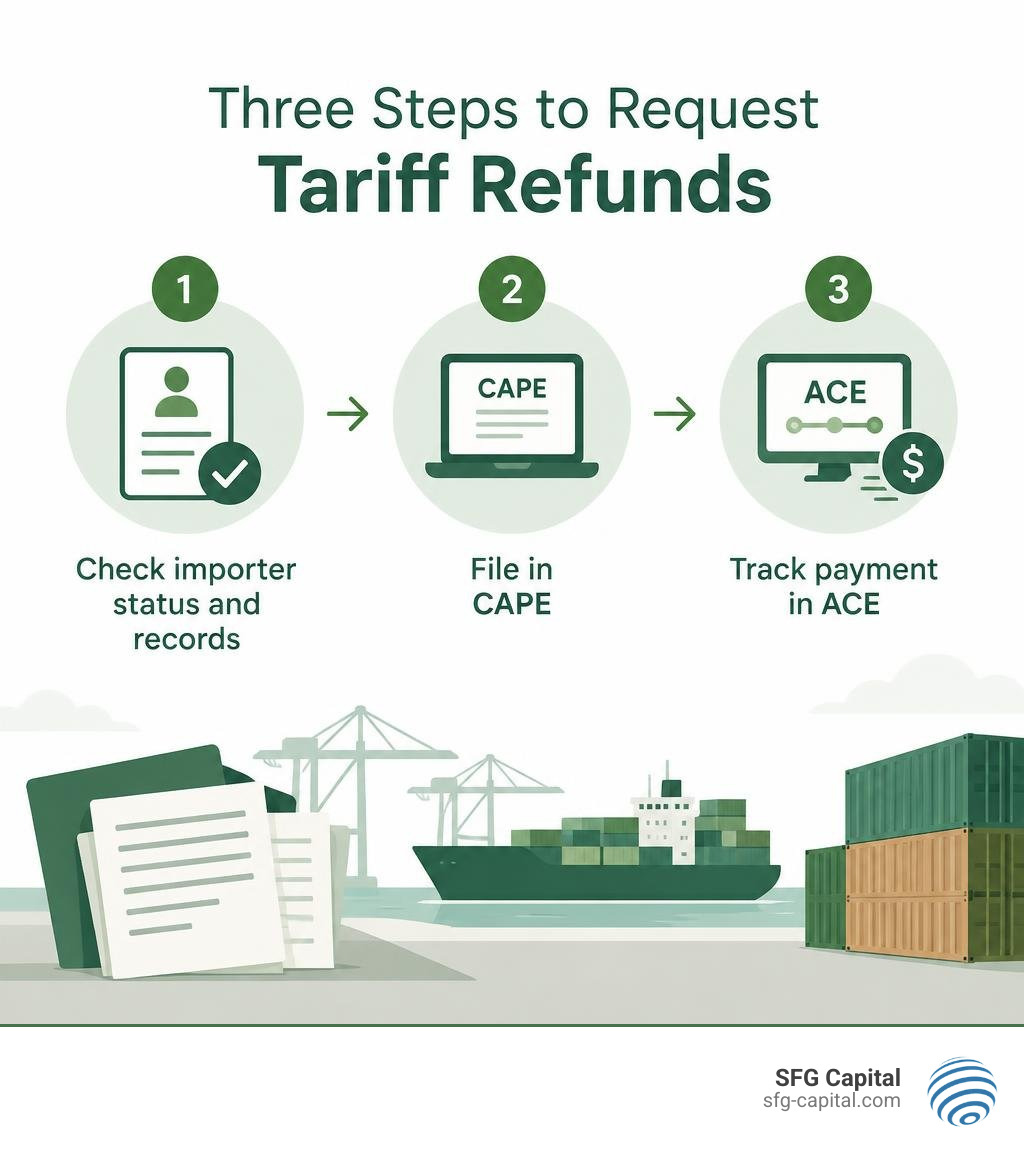
To request tariff refunds, first confirm that your enterprise serves as the verified legal importer of record for historical commercial entries charged emergency IEEPA duties. Next, gather all formal customs entry packets, official deposit receipts, and commercial payment records. Once documentation is organized, submit a formatted CAPE Declaration through CBP’s Automated Commercial Environment (ACE) portal, and establish automated ACH refund profiles so your business can track, verify, and receive electronic disbursements. Eligibility, refund amounts, and timing depend on CBP review.
The Supreme Court struck down the contested IEEPA emergency tariffs in February 2026, prompting CBP to open the CAPE module for administrative recovery requests. While public reporting places the total potential national refund pool at roughly $166 billion, that aggregate estimate is not a promise of payment or guarantee to any individual business. Every submitted file undergoes stringent administrative scrutiny.
I’m Santino Battaglieri, founder of SFG Capital. My firm has successfully purchased and funded more than $500 million in complex federal ERC claims, and I bring that exact same institutional focus on granular documentation, compliance auditing, and thorough record review to modern customs duty recovery.
IEEPA Invalidation: Who Is Eligible for Duty Recovery?
The legal basis to recoup deposited customs duties stems directly from the Supreme Court’s landmark February 2026 ruling, which determined that executive trade emergency levies enacted under the International Emergency Economic Powers Act (IEEPA) exceeded statutory executive authority. With this judicial invalidation, the federal government faced an estimated cumulative liability reaching up to $175 billion in deposited duties subject to potential administrative reimbursement.
To manage this unprecedented restitution process, U.S. Customs and Border Protection (CBP) established official administrative channels for International Emergency Economic Powers Act (IEEPA) Duty Refunds. However, not every historical import transaction qualifies immediately under preliminary administrative parameters. Under the agency’s Phase 1 implementation rules, eligible trade entries generally include:
- Unliquidated Entries: Open import transactions where final statutory duty assessments have not yet been completed or finalized by CBP auditing officials.
- Recently Liquidated Entries: Commercial entries finalized within the preceding 80 days, allowing CBP port directors to complete voluntary administrative reliquidations within the statutory 90-day window authorized under 19 U.S.C. § 1501.
If your organization paid emergency import duties directly to customs officials, you can see if you qualify with our short form, featuring no documents to start and no upfront cost. All individual eligibility determinations, estimated disbursements, and claim funding options depend on full claim review.
Importer of Record vs. Consumer Claims
A critical legal distinction in customs duty recovery is the fundamental difference between the legal Importer of Record (IOR) and downstream commercial or retail buyers. CBP disburses duty refunds exclusively and directly to the specific IOR identified on official CBP Form 7501 filings or their licensed customs brokers.
Retail consumers who absorbed higher shelf prices cannot file claims with CBP because retail businesses integrated import levies directly into general product pricing structures. Conversely, international freight couriers frequently billed emergency trade duties as distinct, standalone itemized surcharges to individual business shippers.
| Feature | Courier Itemized Surcharges | Retail Integrated Pricing |
|---|---|---|
| Billing Structure | Explicit tariff line item on freight invoices | Built directly into overall shelf pricing |
| Direct Payer | Courier acting on behalf of individual client | Retail corporation listed as the legal IOR |
| Refund Obligation | Direct pass-through to avoid unjust enrichment | Retained by retailer to cover operational costs |
| CBP Direct Access | Accessible via courier refund portals | Restricted exclusively to the corporate IOR |
Potential Universal Tariff Refunds
Ongoing federal court proceedings continue to reshape the regulatory and administrative landscape surrounding duty restitution. In nationwide legal challenges, including the certified class action Freestyle World, Inc. v. United States, plaintiff representatives have advocated for automated global relief across all 330,000+ eligible registered importers of record. Recent media coverage highlights that American importers are one step closer to receiving reported potential $166 billion in universal tariff refunds, though current executive directives still mandate manual electronic submission through designated agency portals. Actual recovery amounts depend entirely on verified entry records and individual agency audit determinations.
How to Secure Tariff Refunds in 3 Simple Steps
CBP manages customs duty restitution centrally through the Consolidated Administration and Processing of Entries (CAPE) module integrated into the Automated Commercial Environment (ACE) portal.

Step 1: Audit Entry Summaries and Prepare Documentation
Begin your recovery process by assembling every relevant CBP Form 7501 Entry Summary, commercial invoice, bill of lading, and official bank payment record showing deposited IEEPA assessments. Conduct a thorough internal compliance audit to confirm that historical records do not suffer from HTS misclassification, which could trigger administrative rejections, extended validation holds, or penalty inquiries. Additionally, verify that corporate identification details on CBP Form 5106 remain active in ACE and that an ACH Refund account profile is properly configured for electronic direct deposit disbursements.
Step 2: Format and Submit the CAPE Declaration
As the Trump administration launches tariff refund portal features within ACE, file preparation requires strict adherence to standardized technical formatting requirements:
- Generate a clean .CSV file containing only your valid 11-digit entry summary numbers without spaces, dashes, or punctuation.
- Prefix any entry number containing leading zeros with an apostrophe (e.g.,
'00012345678) to prevent standard spreadsheet tools from truncating leading digits. - Restrict file sizes to under 1MB and limit batches to a maximum of 9,999 individual entry lines per upload.
- Upload the validated file through the CAPE interface within your ACE portal to secure an official confirmation and tracking declaration number.
Step 3: Track Liquidation and Receive Statutory Disbursements
Once submitted, monitor entry liquidation progress through standardized ACE reports including ES-022 and REV-603. Approved administrative refunds incorporate statutory interest authorized under 19 U.S.C. § 1505, calculated from the original duty deposit date through final entry reliquidation. Base tariff liabilities tied to standard trade classifications remain unaffected, and all submissions must be reconciled against previous duty drawback claims to avoid prohibited double recovery. Importers seeking to bypass prolonged agency queues can see if you qualify for accelerated claim financing through our short form, with no documents required to start and no upfront cost; all financing terms depend on review.
Managing Government Processing Delays and Liquidity Gaps
While CBP has disbursed over $115 billion back to American businesses through CAPE, standard agency timelines typically require an estimated 60 to 90 days following initial declaration acceptance. However, actual turnaround times remain subject to unpredictable government backlogs, inter-agency audits, and technical documentation validation holds across regional ports.
If calculation errors or entry rejections occur during administrative liquidation, importers retain a strict 180-day statutory window under 19 U.S.C. § 1514 to file a formal administrative protest. For growing companies facing working capital constraints while waiting in bureaucratic processing queues, exploring specialized advance funding provides immediate liquidity backed by verified government receivables rather than waiting months for direct federal disbursements.
Frequently Asked Questions About Customs Claims
Can individual retail consumers file for IEEPA duty compensation?
No. Federal customs regulations strictly limit duty reimbursement to the documented Importer of Record. Consumers who encountered higher retail prices cannot file claims with CBP, as import taxes were absorbed into general corporate operating overhead and merchandise markups.
When will CBP process and disburse tariff refunds?
CBP estimates processing valid CAPE declarations within approximately 60 to 90 days following formal acceptance, though complex multi-port filings, missing documentation, or manual audit reviews can extend this timeline significantly. Approved disbursements are issued electronically via ACH and include applicable statutory interest. All timing estimates depend entirely on administrative agency review.
What happens if my company has outstanding debt with CBP?
Under 19 C.F.R. § 24.72, the federal government enforces mandatory administrative debt netting. If an importing enterprise maintains delinquent customs duties, outstanding administrative penalties, or undisputed liabilities with other federal agencies, CBP will automatically offset and divert the necessary portion of the refund to satisfy that obligation before releasing any remaining balance.
Conclusion
Securing customs duty recovery demands comprehensive entry auditing, meticulous CAPE data formatting, and vigilant ACE profile management. While federal mechanisms continue to disburse funds to qualified importers across the nation, businesses must take decisive, structured steps to verify documentation and ensure every eligible dollar is pursued accurately.
At SFG Capital, we help commercial enterprises across the United States, including Austin and Travis County, navigate complex government receivables with speed and confidence. Take the first step today and see if you qualify by completing our short form with no documents to start and no upfront cost. You can also talk to a specialist to evaluate customized tariff refund options structured to strengthen your working capital. All program estimates, disbursements, and funding options depend on full file review.
See what your business may qualify for.
60 seconds. No documents. No upfront cost.
General information only, not legal or tax advice. Eligibility and estimates are fact-specific and subject to review.