
Blog / Insights
InsightsHow Your Federal Tax Return Moves Through the IRS Machine
October 14, 2026 · 10 min read · By the SFG Capital team
How the Income Tax Refund Process Moves From Filing to Payment
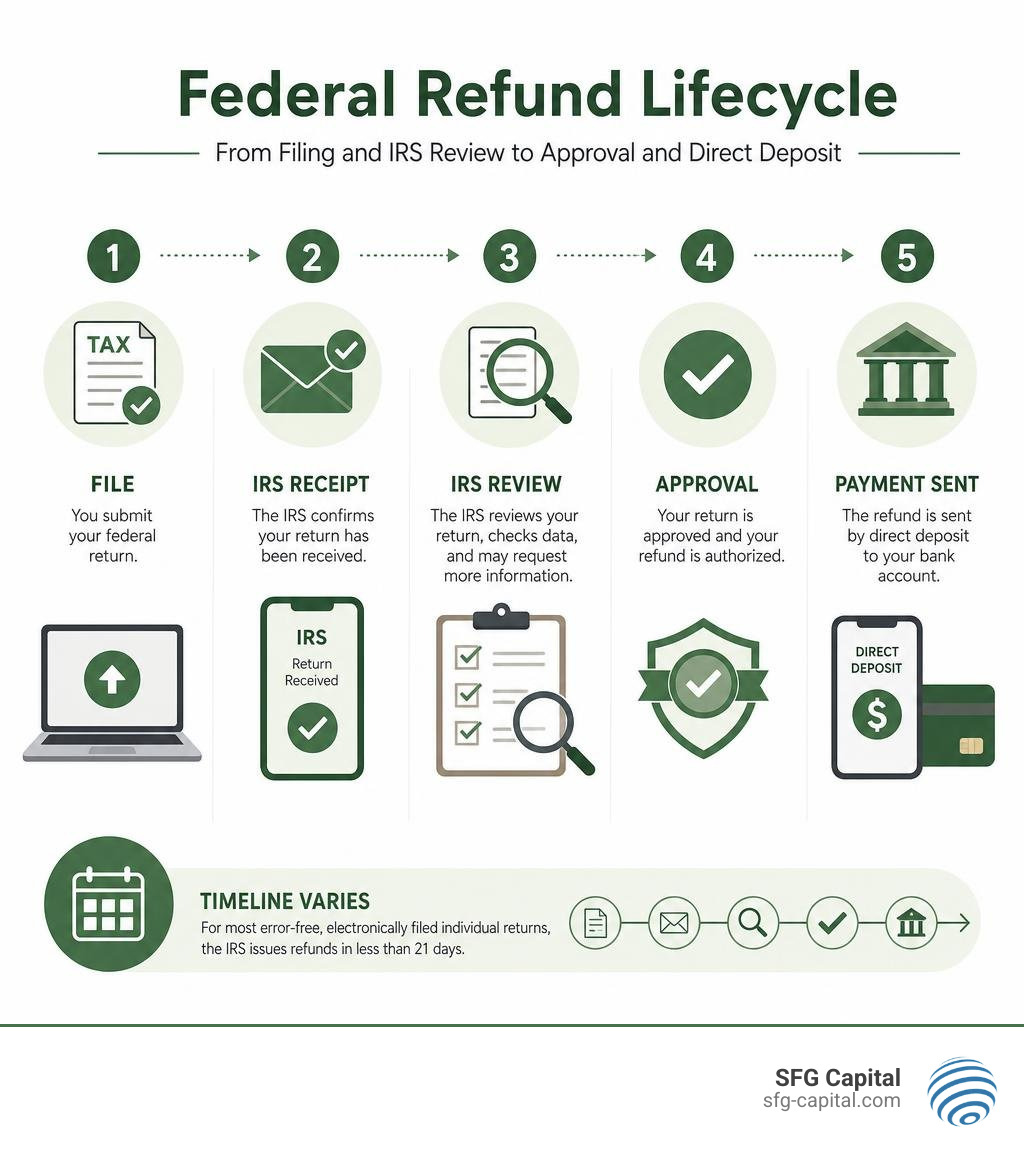
Your federal return moves through a clear sequence: file the return, confirm IRS receipt, complete any review, receive approval, and wait for payment to be sent. To avoid preventable delays, e-file when possible, choose direct deposit, check every figure and account number before filing, and use the IRS refund tracker after the return is accepted.
For most error-free, electronically filed individual returns, the IRS issues refunds in less than 21 days. Paper returns usually take 6 weeks or more after the IRS receives them. A return can take longer if it has errors, needs identity or income verification, claims certain credits, or requires manual review.
A federal refund is not simply released when you press “submit.” The IRS first checks the return against its systems and may correct math, match reported income, or request more information. Once approved, the Bureau of the Fiscal Service sends the payment by direct deposit or check.
For business owners awaiting an ERC-related payment, the same core lesson applies: clean records, complete support, and prompt responses to government notices help reduce avoidable friction. But payroll tax credit claims follow different forms and processing paths than an individual Form 1040 refund.
I am Santino Battaglieri of SFG Capital, where I work with tax professionals and businesses on compliant ERC claim evaluation, documentation, and funding solutions. My experience with the income tax refund process focuses on helping businesses understand the operational and documentation issues that can affect when a legitimate tax-related refund becomes available.
Essential income tax refund process terms:
- average time for irs to approve refund
- how come my federal refund is taking so long
- irs time to process tax return
Inside the Intake Machine: How the IRS Evaluates Returns
Every tax season, tens of millions of returns pour into the IRS processing pipeline. When you press submit on your tax software, your return enters the Modernized e-File (MeF) system. This intake hub serves as the front door of the federal tax agency, running instant diagnostic checks to decide whether to accept or reject the electronic transmission within minutes.

If your submission fails basic formatting checks—like an invalid Social Security Number (SSN), a misspelled dependent name, or a missing electronic signature PIN—the MeF system rejects it outright. However, once accepted, the return enters the processing pipeline.
Understanding how the system moves your file helps you apply practical speed up your tax refund strategies to expedite IRS processing, ensuring your return avoids the dreaded Error Resolution System (ERS) where manual reviews add weeks to your timeline.
Initial Return Screening and Fraud Checks
Once a return passes initial formatting, it encounters the automated screening filters of the IRS Return Integrity and Compliance Services (RICS). These algorithms match your reported figures against third-party wage data submitted by employers, banks, and brokerage houses.
The system also applies strict statutory rules. Under the Protecting Americans from Tax Hikes (PATH) Act, federal law mandates that the IRS hold tax refunds on returns claiming the Earned Income Tax Credit (EITC) or the Additional Child Tax Credit (ACTC) until mid-February. This pause gives the agency time to verify W-2 wage data and prevent identity theft scams.
Even if you e-file on the opening day of the tax season in January, an EITC or ACTC refund will not be released until mid-February, with funds typically reaching bank accounts by March 1.
Automated Math Verification vs. Manual Audit Flagging
The automated pipeline performs arithmetic cross-checks on every line item, recalculating taxable income, standard deductions, and tax liabilities. When the computer finds a mismatch between your numbers and reported third-party data (like 1099-MISC, 1099-NEC, or 1099-K forms), the return gets diverted to an examiner.
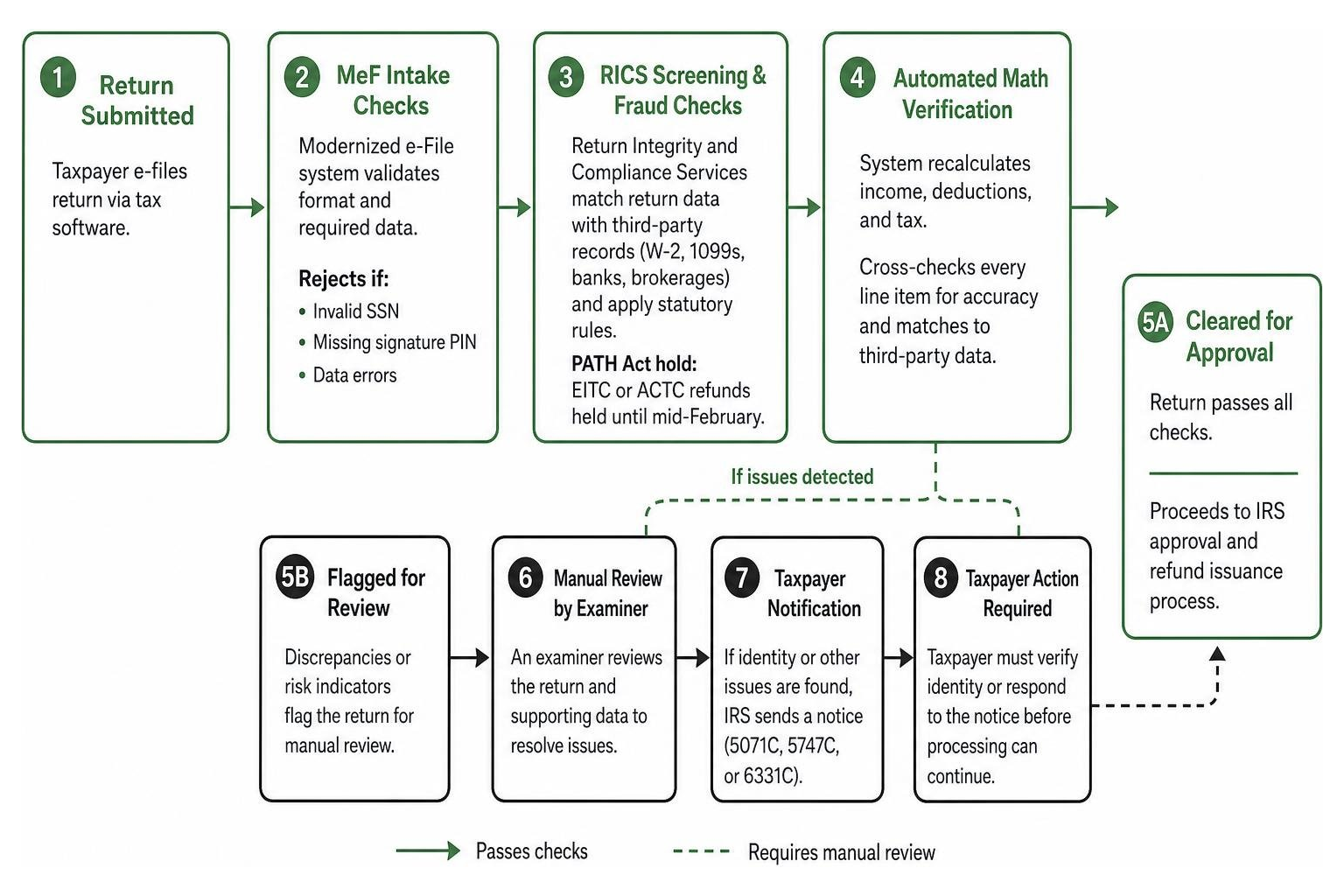
When manual review becomes necessary, taxpayers face the classic IRS waiting game and common reasons for slow tax refunds. If the Taxpayer Protection Program flags your return for identity confirmation, the IRS issues a formal letter (such as a 5071C, 5747C, or 6331C notice) instructing you to verify your identity online or by phone before processing can continue.
Step-by-Step Breakdown of the Federal Income Tax Refund Process
The journey of an individual or business tax refund involves two main government entities: the Internal Revenue Service (which verifies liability and authorizes payments) and the Bureau of the Fiscal Service (BFS), a branch of the U.S. Department of the Treasury that disburses the actual funds.
Tracking Milestones in the Modern Income Tax Refund Process
Timing depends heavily on the filing method you choose. Electronic submissions paired with direct deposit represent the gold standard, while paper filings introduce severe physical bottlenecks.
| Filing Method | Status Available Online | Typical Refund Delivery Timeframe | Payment Method Options |
|---|---|---|---|
| Current-Year E-File | 24 Hours after receipt | Under 21 Days (9 out of 10 filers) | Direct Deposit or Mailed Check |
| Prior-Year E-File | 3 Days after receipt | 3 to 4 Weeks | Direct Deposit or Mailed Check |
| Paper Mailed Return | 4 Weeks after mailing | 6 or More Weeks | Direct Deposit or Mailed Check |
| Amended Return (1040-X) | Up to 3 Weeks | Up to 16 to 20 Weeks | Direct Deposit or Mailed Check |
When you mail a paper return, physical processing centers must open, sort, scan, and manually transcribe your forms into the IRS Master File. Any illegible handwriting or missing schedules immediately stops the process.
Dissecting Return Received, Refund Approved, and Refund Sent
The IRS tracking tracker displays three distinct operational stages:
- Return Received: This status confirms that the IRS has accepted your electronic data or logged your paper form. Your return is currently in the processing queue. It does not mean your return is approved or that your calculations have been accepted as accurate.
- Refund Approved: The IRS has completed its automated checks, reconciled your credits and tax withholdings, and determined your final refund amount. At this stage, the system assigns a specific direct deposit date or paper check mailing date.
- Refund Sent: The IRS has officially transferred the payment instruction to the Bureau of the Fiscal Service. If direct deposit was requested, the BFS transmits the funds through the Automated Clearing House (ACH) network to your financial institution. Banks can take 1 to 5 business days to make those funds available in your account.
Navigating Tracking Tools for Federal and State Filings
Taxpayers have several self-service options to track their money without waiting on phone lines. The online systems update once every 24 hours (usually overnight), so checking multiple times a day is unnecessary.
Before checking your status, ensure you have three pieces of information from your return:
- Your Social Security Number (SSN) or Individual Taxpayer Identification Number (ITIN)
- Your exact filing status (Single, Married Filing Jointly, Married Filing Separately, Head of Household, or Qualifying Surviving Spouse)
- The exact whole-dollar refund amount shown on your return
Online Portals, Mobile Apps, and Dedicated Phone Lines
You can track your federal status using the official IRS refund tracker, the IRS2Go mobile app, or by logging into your individual IRS Online Account.
If you prefer phone inquiries:
- Standard Individual Refunds: Call the automated hotline at 800-829-1954.
- Amended Returns (Form 1040-X): Call the dedicated line at 866-464-2050.
- Complex Account Issues: If an online tool directs you to contact the IRS, you can reach live assistance through standard IRS customer service channels at 800-829-1040.
Phone representatives have access to the exact same tracking data as the online tool. Calling before 21 days have passed since your e-file submission will not expedite your payment.
How to Track State Department of Revenue Refunds
State income tax refunds are managed entirely separately from federal refunds. State revenue agencies use their own processing centers, fraud detection parameters, and disbursement schedules.
If you filed in a state that levies individual income tax, you must use that state’s Department of Revenue portal. You can find direct links to every state’s revenue division through the USAGov federal and state tax status portal. State processing times range from a few business days to over 12 weeks depending on state-level fraud review procedures.
Resolving Processing Delays, Bank Failures, and Treasury Offsets
When a refund does not arrive within the expected 21-day window, a system flag has likely halted automatic processing.
If you discover your tax refund is stuck in processing limbo, the cause is usually an administrative error, a banking mismatch, or a statutory debt collection offset.
Overcoming Roadblocks in the Income Tax Refund Process
Several common filing errors trigger manual holds:
- Incomplete schedules or missing wage forms (such as omitting a W-2 or 1099)
- Typographical errors in Social Security numbers or dependent identity records
- Inaccurate routing or account numbers entered for direct deposit
- Selecting an incorrect filing status that contradicts previous years’ filings
- Claiming credits without attaching mandatory supporting schedules (such as Form 8862)
If your direct deposit fails because you entered an invalid account number, or if the account is closed, the receiving bank will reject the ACH transfer and bounce the funds back to the IRS. In this scenario, the IRS cancels the electronic transfer and automatically issues a paper check to the address listed on your return, adding 2 to 4 weeks to your wait.
Furthermore, if you are wondering how come my federal refund is taking so long, your refund may have been intercepted by the Treasury Offset Program (TOP).
Operated by the Bureau of the Fiscal Service, TOP automatically diverts federal tax refunds to pay qualifying delinquent debts, including:
- Past-due child support
- Delinquent non-tax federal debts (such as defaulted federal student loans)
- State income tax obligations
- Unemployment compensation debts owed to a state
If an offset occurs, the BFS mails you an offset notice showing the original refund amount, the deduction amount, and the agency that received the funds. The IRS cannot adjust or answer questions regarding third-party debt offsets; you must contact the specific creditor agency listed on your BFS notice.
What to Do for Missing, Stolen, or Erroneous Refund Checks
If the IRS tracker indicates that a paper check was mailed, but you have not received it after 4 weeks from the mailing date, you can initiate a formal refund trace.
If you filed as Single or Head of Household, you can initiate the trace through the online refund tool or by calling the automated phone hotline. If your filing status was Married Filing Jointly, IRS regulations require both spouses to complete and submit Form 3911 (Taxpayer Statement Regarding Refund).
Once a trace begins:
- Uncashed Checks: If the check has not been cashed, the BFS cancels the original physical check and issues a replacement check within 4 weeks.
- Cashed Checks: If the check was intercepted and cashed fraudulently, the BFS sends you a claim package containing a copy of the endorsed check. You must complete the fraud affidavit and return the package. The BFS then conducts an official signature analysis, which can take up to 6 weeks, before issuing a replacement payment.
If you receive an erroneous refund that is higher than expected due to an IRS calculation error, do not spend the excess funds. The IRS will issue Notice CP12 detailing the adjustment. If you receive an erroneous physical check or direct deposit, follow IRS return procedures immediately to avoid statutory interest and penalty assessments on the overpayment.
Frequently Asked Questions About Federal Tax Refunds
When will I receive my tax refund after filing?
The IRS issues more than 9 out of 10 refunds in fewer than 21 calendar days when returns are filed electronically with direct deposit.
If you mail a paper return, expect processing to take at least 6 weeks from the date the IRS receives your package. Tax returns claiming the Earned Income Tax Credit (EITC) or Additional Child Tax Credit (ACTC) are subject to mandatory PATH Act holds, with refunds released in late February and deposited by March 1.
Why was my refund amount smaller than expected?
A reduced refund usually results from one of two things: an IRS calculation correction or a Bureau of the Fiscal Service debt offset.
If the IRS adjusts your math or disallows a claimed credit, they will send a Notice CP12 detailing the changes. If your refund was reduced to settle non-tax federal debts, past-due child support, or state tax liabilities, the BFS will mail an offset notice detailing the reduction and providing contact details for the collecting agency.
Does the IRS pay interest on delayed tax refunds?
Yes. By law, if the IRS takes longer than 45 days past the April tax filing deadline (or 45 days after the date you filed, whichever is later) to process your refund, they are required to pay statutory interest on the delayed amount.
The interest rate is set quarterly and compounds daily until the refund is issued. Any refund interest paid by the IRS is considered taxable income and must be reported on your federal return for the tax year in which you receive it.
Conclusion
Understanding how your return moves through intake, verification, approval, and disbursement takes the mystery out of tracking your money. By filing electronically, double-checking banking information, and monitoring your return using official portals, you can avoid unnecessary delays and keep your filing moving smoothly.
While individual tax returns follow a reliable 21-day timeline, business tax credits often involve far more complex administrative processes. For commercial enterprises in Austin and across Travis County, navigating business tax filings and specialized relief claims—such as the Employee Retention Credit (ERC)—can lead to lengthy government review periods.
At SFG Capital, we support business owners by providing clarity on complex federal claims, compliant documentation assistance, and liquidity advance solutions to help you bypass prolonged government backlogs. Explore our complete range of commercial advisory services to discover how we help businesses streamline tax liquidity and protect their bottom line.
See what your business may qualify for.
60 seconds. No documents. No upfront cost.
General information only, not legal or tax advice. Eligibility and estimates are fact-specific and subject to review.