
Blog / Insights
InsightsNavigating the 2026 IRS Refund Backlog
October 14, 2026 · 9 min read · By the SFG Capital team
How to Resolve Lingering IRS Refund Delays for Tax Year 2022
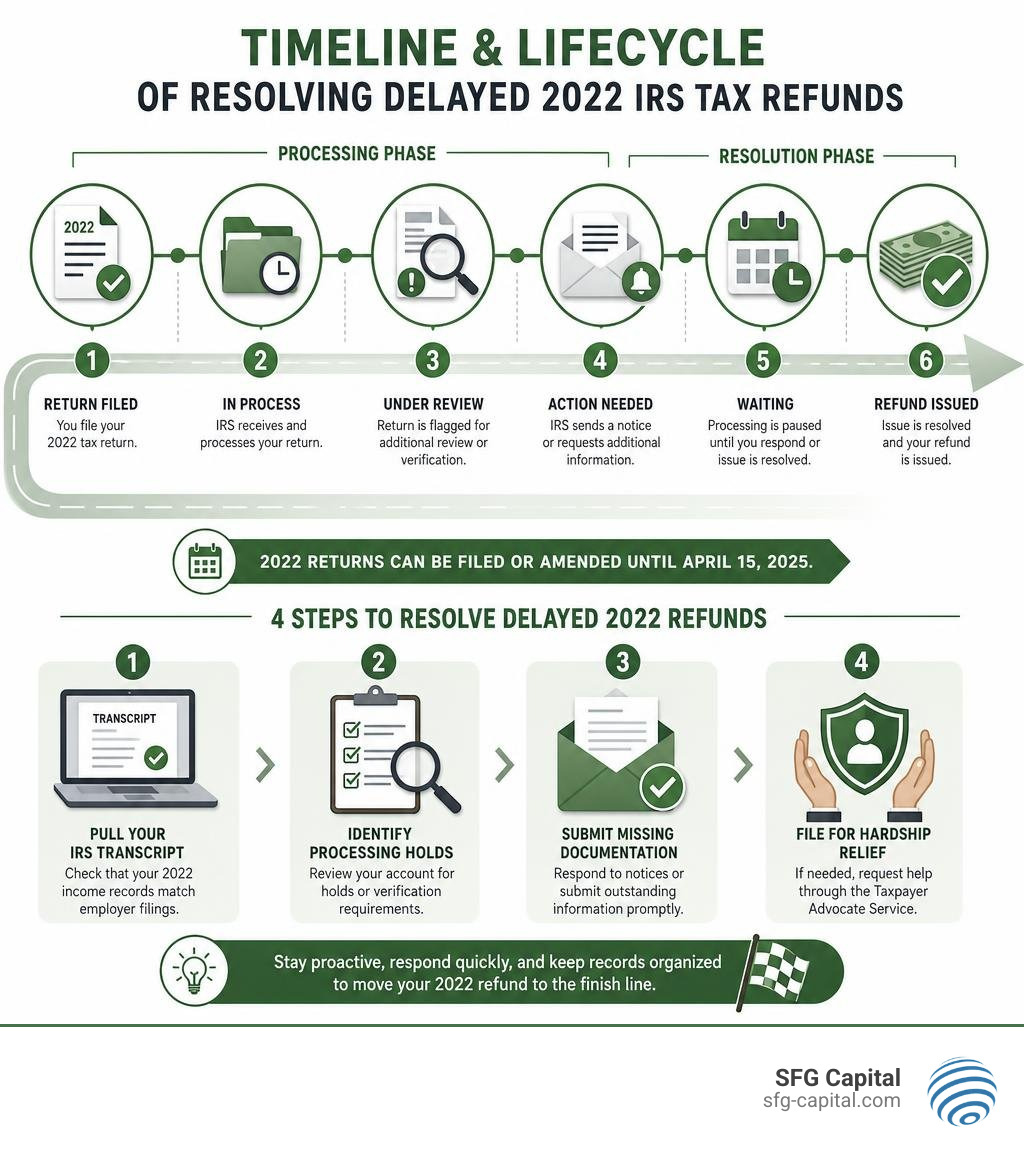
If you are still struggling to collect your money, you can resolve irs refund delays 2022 by taking four direct steps:
- Pull your IRS transcript: Access the Get Transcript Online tool on IRS.gov to check whether your 2022 income records match employer filings.
- Identify processing holds: Review your IRS Online Account to see if your return was flagged by the Error Resolution System (ERS) or identity verification filters.
- Submit missing documentation: Respond immediately to any outstanding IRS notices (like CP75 or 5071C), or submit unfiled 2022 returns before the three-year statutory window closes.
- File for hardship relief: If unpaid refunds threaten your payroll or basic business operations, submit Form 911 to request immediate help from the Taxpayer Advocate Service.
The 2022 filing season saw unprecedented agency backlogs, with unprocessed returns peaking above 21 million and phone answer rates dropping below 20%. For small business owners waiting on amended returns and payroll credits, these administrative bottlenecks created severe cash flow disruptions.
I’m Santino Battaglieri, founder of SFG Capital, where we have funded more than $500 million in business claims to help leaders bypass painful irs refund delays 2022. Our team works closely with CPAs and tax attorneys to provide structured capital solutions and navigate complex federal processing backlogs.
Terms related to irs refund delays 2022:
Root Causes Behind the IRS Refund Delays 2022 Crisis

The tax filing season for 2022 became a historic operational bottleneck for the Internal Revenue Service. While the agency routinely processes over 150 million individual and corporate filings each cycle, the intersection of pandemic-era legislation, legacy systems, and acute resource shortages created an administrative storm.
According to the comprehensive GAO report on 2022 filing backlogs, the agency entered 2022 carrying a massive overhang of approximately 10.5 million unprocessed paper returns and suspended filings from 2021. Rather than normalizing, inventories compounded throughout the spring. By late September 2022, the IRS still had roughly 12.4 million returns awaiting processing, including 9.2 million original paper returns.
| Metric | Fiscal Year 2019 | Fiscal Year 2022 | Impact on Taxpayers |
|---|---|---|---|
| Peak Paper Return Backlog | Under 2 Million | 21.3 Million (May 2022) | Paper-filed refund turnaround stretched past 6–10 months |
| Average Correspondence Processing Time | 74 Days | 251 Days | Over 8 months to resolve standard math errors and notices |
| Telephone Call Answer Rate | ~29% | <10% (1 in 10 calls) | Millions of filers unable to receive live status updates |
| Average Phone Hold Time | 16 Minutes | 29 Minutes | Widespread customer service breakdowns |
| Identity Theft Resolution Time | ~120 Days | ~360 Days | Filers faced roughly a full calendar year of frozen funds |
Paper Return Backlogs, Manual Keystroking, and Staffing Bottlenecks
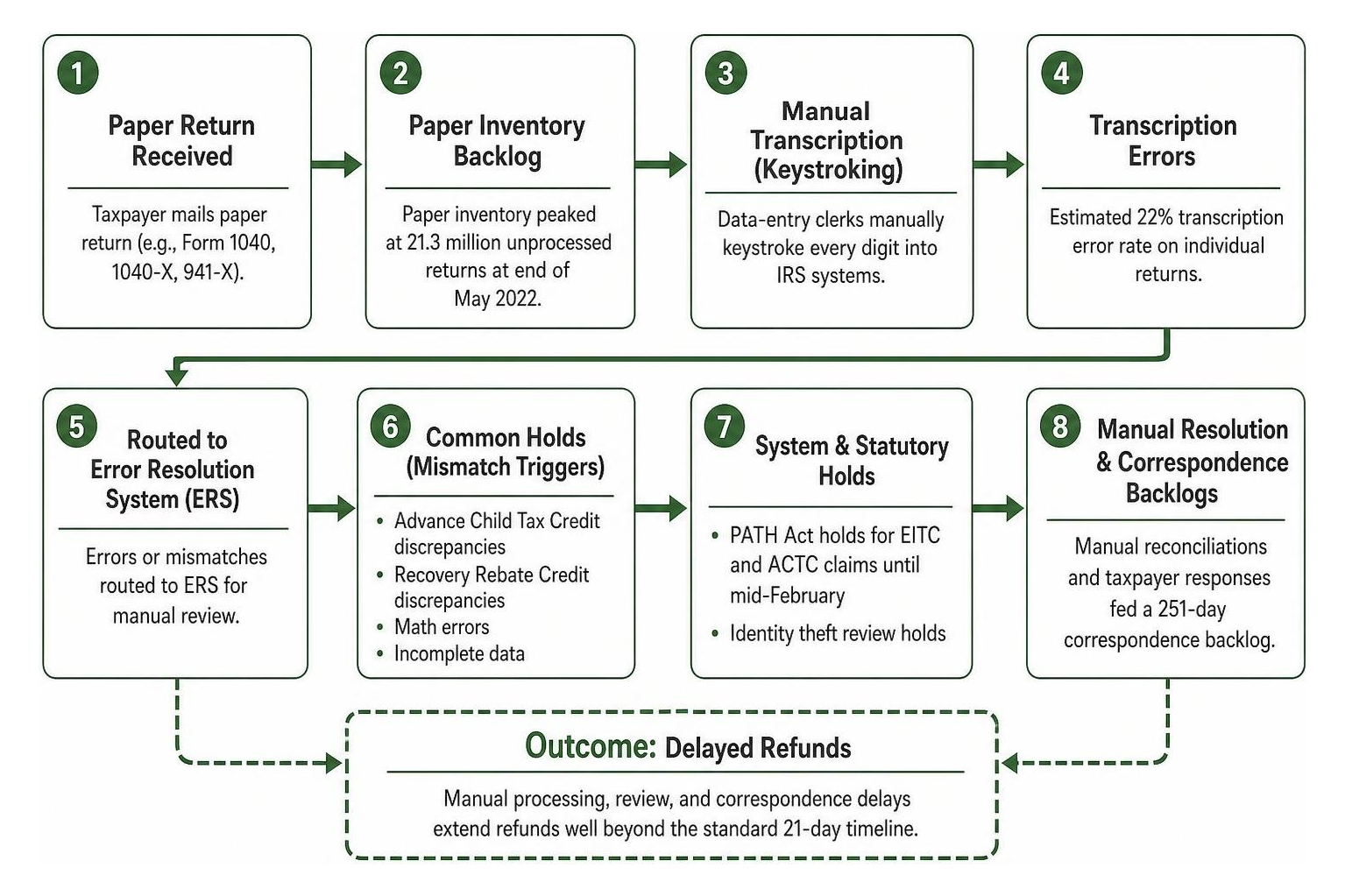
A primary driver of the crisis was the agency’s antiquated intake workflow for paper submissions. In 2022, the IRS continued to rely on manual data transcription, requiring data-entry clerks to manually keystroke every single digit from physical paper forms into IRS databases. This labor-intensive approach generated an estimated 22% transcription error rate on individual returns, routing millions of otherwise clean filings into manual review queues.
At the end of May 2022, the paper inventory peaked at an astonishing 21.3 million unprocessed returns—a 7% increase over the previous year. As highlighted in the National Taxpayer Advocate mid-year report, the processing speed of Form 1040s sat at roughly 205,000 per week, far below the 500,000-per-week rate required to balance incoming volumes.
Hiring constraints exacerbated the gridlock. Although Congress granted direct hire authority to expedite seasonal staffing, approval arrived late; roughly 95% of direct hires were unable to start until after the peak filing season concluded. To manage mounting paperwork, the IRS shifted customer service representatives off telephone lines to process manual correspondence. While this reduced the written correspondence queue from 5 million items to 400,000 by late September 2022, it caused telephone service levels to collapse, answering less than one out of every ten calls from frustrated filers.
Pandemic Relief Credits and Error Resolution System Holds
The rollout of complex temporary relief programs added another layer of friction. Tax year 2021 filings processed in 2022 required reconciling Advance Child Tax Credit payments and third-round Economic Impact Payments (Recovery Rebate Credit). Any discrepancy between the numbers entered on Form 1040 and the IRS’s internal master file automatically routed the return to the Error Resolution System (ERS).
These common culprits behind slow federal refunds caused returns to sit in holding queues for months. The IRS published guidance on delayed electronic refunds noting that manual reconciliations, incomplete data, and statutory holds prevented automated processing within the standard 21-day timeline. When the IRS issued automated Math Error notices to adjust these credits, taxpayers had a strict 60-day window to request an abatement to defend their original figures, which in turn fed into the 251-day correspondence backlog.
Who Was Hit Hardest by Processing Holds?

While millions of standard filers experienced unexpected wait times, specific categories of individual taxpayers and commercial entities bore the brunt of the administrative slowdown.
How IRS Refund Delays 2022 Hit Paper Filers and Small Businesses
Taxpayers who submitted physical paper returns faced extraordinary delays exceeding six to ten months. This issue was especially acute for commercial enterprises submitting Form 1040-X amendments and Form 941-X quarterly payroll adjustments.
For companies pursuing payroll tax relief, business owners facing ERC delays experienced prolonged working capital freezes. Because Form 941-X claims could not be submitted through standard electronic filing channels, hundreds of thousands of claims were pushed directly into manual paper intake centers. In Austin, TX and throughout Travis County, TX, employers who budgeted for prompt payroll relief found their capital trapped in federal holding queues for multiple quarters.
Identity Theft Flags, Math Error Notices, and PATH Act Restrictions
Statutory anti-fraud protections created long holding periods for vulnerable filers:
- PATH Act Mandates: Under federal law, returns claiming the Earned Income Tax Credit (EITC) or Additional Child Tax Credit (ACTC) were held until mid-February to allow wage matching against Social Security Administration records.
- Identity Theft Reviews: Filers flagged by automated fraud algorithms faced extraordinary waits. Resolving identity verification affidavits averaged approximately 360 days before refunds could be released.
- Injured Spouse Allocations: Filers submitting Form 8379 to protect their portion of a joint overpayment faced manual review timelines extending up to 14 weeks.
Taxpayers dealing with administrative freezes can consult Taxpayer Advocate Service guidance on held refunds to understand how specific notice codes affect processing.
Step-by-Step Guide: How to Track and Claim Your Delayed Tax Year 2022 Funds
Under Internal Revenue Code Section 6511, taxpayers generally have a three-year window from the original due date to claim an overpayment refund. For tax year 2022, unfiled returns or uncollected refunds face a hard statutory cutoff, after which unclaimed capital permanently reverts to the U.S. Treasury.
Actionable Steps to Resolve Unclaimed IRS Refund Delays 2022
If you still have an unissued or unfiled 2022 refund, follow this systematic resolution process:
- Pull Official Tax Transcripts: Navigate to IRS.gov and use the Get Transcript Online tool to download your 2022 Wage and Income Transcript and Account Transcript. If online access is unavailable, submit Form 4506-T via mail.
- Reconcile Wage and Withholding Records: Cross-examine your employer-reported W-2s and 1099s against IRS transcripts. If an employer failed to transmit your wage data to the Social Security Administration, your refund will remain indefinitely frozen until corrected documentation is supplied.
- Submit Outstanding Filings Immediately: As outlined in the IRS notice on unclaimed tax refunds, over $1.15 billion in potential refunds across 1.3 million filers remained uncollected for tax year 2022. File your return electronically where eligible or send signed physical documents via certified mail with tracking.
- Respond to Open Notice Codes: If you received notices such as CP75 (EITC audit), Letter 5071C (Identity Verification), or CP21-A (Adjustment Notice), submit all requested supporting materials right away. Filers unsure of their account status should review what to do when your refund is stuck in limbo to prevent unneeded delays.
Utilizing Taxpayer Advocate Services and Form 911 for Hardship Relief
If you are experiencing significant financial hardship—such as an inability to meet commercial payroll, impending eviction, or severe business cash flow distress—you may qualify for direct case intervention:
- Complete and file IRS Form 911 (Request for Taxpayer Advocate Service Assistance).
- Demonstrate that normal administrative channels have failed to resolve your refund within standard agency timeframes.
- Qualified low-income individuals can seek free legal representation through Low Income Taxpayer Clinics (LITC).
Filers can review criteria for expediting a refund through TAS to evaluate eligibility for emergency relief processing.
Business Tax Return Delays and ERC Recovery Options
For commercial enterprises, lingering backlogs on amended employment taxes have created significant liquidity challenges. Businesses waiting on substantial payroll overpayments often find themselves constrained by extended federal processing windows.
Navigating Form 941-X Processing Freezes and Payroll Tax Credits
Amended quarterly payroll filings submitted on Form 941-X have faced extensive scrutiny and processing moratoriums. As explored in our analysis of how long until your ERC refund arrives, manual intake backlogs, enhanced fraud filtering, and shifting administrative review standards have extended commercial wait times across the United States.
Many companies in Travis County, TX and across the country have waited quarters or even years for paper-filed amended returns to be adjudicated, putting strain on operational planning and capital allocation.
Bridge Financing and Buyout Strategies to Unlock Trapped Capital
To overcome extended federal delays, businesses frequently evaluate non-debt capital alternatives. SFG Capital provides direct advances and refund buyouts designed to unlock illiquid tax credit claims.
By purchasing or advancing funds against verified Form 941-X filings, we enable business owners to bypass IRS processing backlogs entirely, securing immediate working capital without adding balance sheet debt or waiting on administrative queues.
Frequently Asked Questions About Delayed 2022 IRS Refunds
Can I still claim my 2022 tax refund in 2026?
Yes, provided you submit your original or amended return within the three-year statutory window established by IRC Section 6511. Once this three-year period expires, the IRS is legally prohibited from issuing a refund check or crediting overpayments to other tax periods, and the funds permanently become property of the U.S. Treasury.
Why did the IRS take so long to answer calls regarding 2022 refunds?
During the 2022 tax season, the IRS received roughly 73 million inbound telephone calls while shifting customer service personnel to clear a multi-million-item backlog of physical paper returns. This operational reallocation reduced the telephone response rate to below 10%, resulting in average wait times exceeding 29 minutes for the rare callers who successfully connected.
Does the IRS pay interest on delayed 2022 tax refunds?
Yes. Under federal tax law (the 45-day rule), if the IRS takes longer than 45 days past the filing deadline or the actual filing date (whichever is later) to issue your refund, it is required to pay statutory daily compounding overpayment interest on the delayed balance.
Conclusion
The processing hurdles that defined the 2022 tax filing season highlight the importance of proactive documentation, electronic record retrieval, and decisive action before statutory deadlines expire. For business owners carrying trapped payroll credits or navigating complex amended returns, waiting on government queues is rarely the only path forward.
At SFG Capital, we partner with CPAs, CFOs, and business leaders across Travis County, TX and nationwide to monetize delayed filings, overcome processing gridlock, and deliver reliable working capital. Contact our team today for expert Employee Retention Credit assistance and learn how our buyout solutions can unlock your capital.
See what your business may qualify for.
60 seconds. No documents. No upfront cost.
General information only, not legal or tax advice. Eligibility and estimates are fact-specific and subject to review.