
Blog / Insights
InsightsNavigating the IRS Maze from Filing to Approval
October 14, 2026 · 12 min read · By the SFG Capital team
Start the Federal Tax Return Process With a Clear Plan
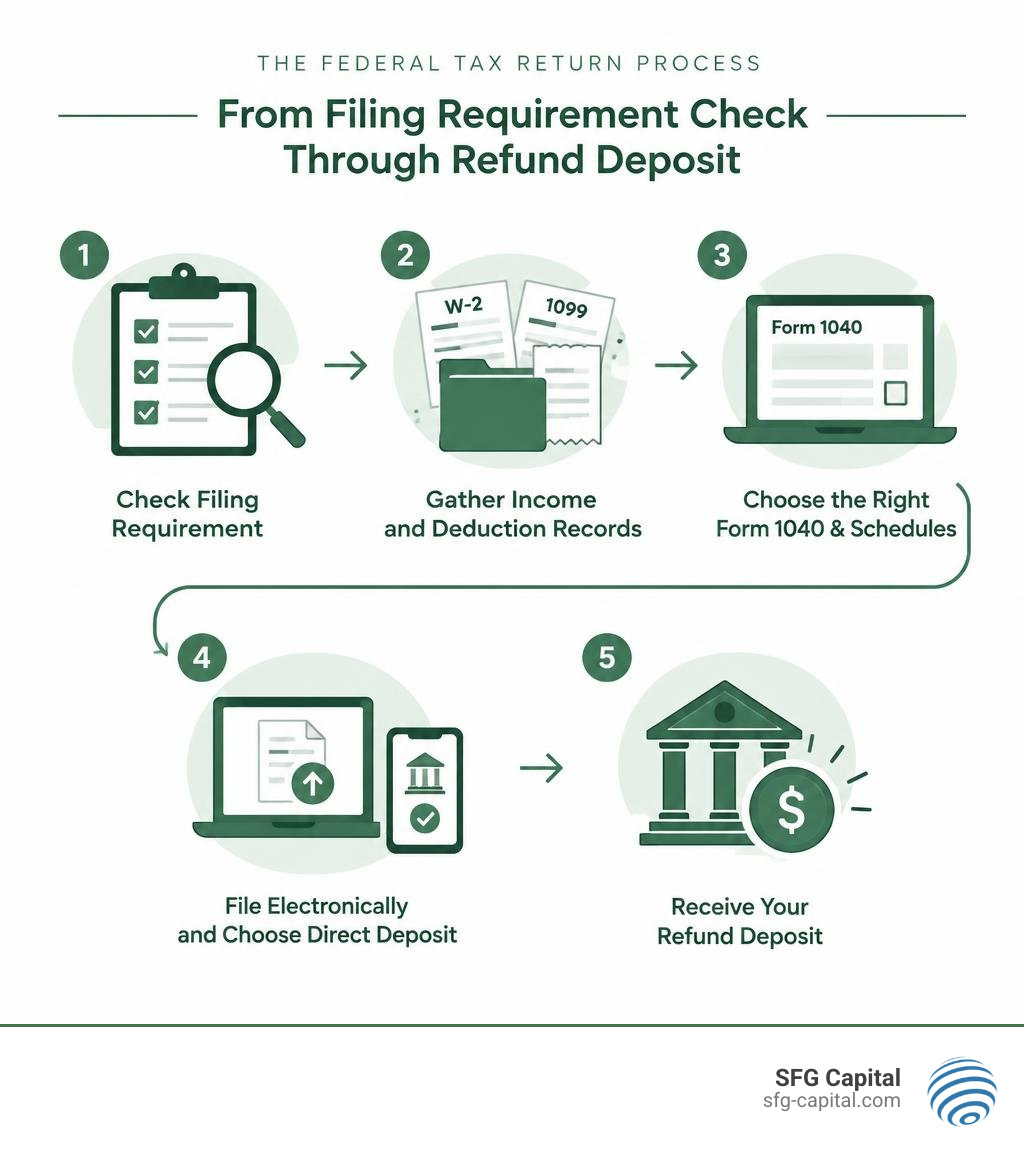
The federal tax return process is straightforward when you take it in order: confirm whether you must file, collect every income document and deduction record, choose the right Form 1040 and schedules, then file electronically and select direct deposit if you expect a refund. For most people filing a 2025 return, the deadline is April 15, 2026. If you need more time, file Form 4868 by that date, but pay any estimated tax due by April 15 to limit interest and penalties.
A clean filing also helps avoid delays. The IRS generally processes e-filed individual returns within 21 days, while paper returns can take six weeks or longer. Keep a copy of your completed return, your adjusted gross income, and your refund amount after filing.
For business owners waiting on complex IRS-related refunds, understanding these stages matters: accurate records, timely filing, and prompt responses to IRS notices can reduce avoidable friction.
I am Santino Battaglieri, founder of SFG Capital, with more than nine years of financial-services experience and extensive work supporting documentation-focused tax credit and funding transactions. That compliance-first background informs this guide to the federal tax return process and the practical steps that follow.
Easy federal tax return process glossary:
- average time for irs to approve refund
- how come my federal refund is taking so long
- irs time to process tax return
Determining Filing Requirements and Deadlines
Every tax season starts with a baseline question: are you legally required to file? The IRS sets annual filing thresholds based on your gross income, filing status, age, and whether you are claimed as a dependent. Gross income means all income you received in the form of money, goods, property, and services that is not exempt from tax.
Even if your income falls below the official filing threshold, you may still want to submit a return. If your employer withheld federal income tax from your paychecks, or if you are eligible for refundable tax credits—such as the Earned Income Tax Credit (EITC), the refundable Child Tax Credit, or the Premium Tax Credit—filing is the only way to get that money back into your bank account. According to IRS data as of February 21, 2025, the average refund received during the 2024 filing season was $3,453, underscoring that an overlooked return often means leaving significant cash on the table.
Assessing Gross Income Thresholds and Exemptions
For the 2025 tax year, standard deduction thresholds reflect statutory adjustments:
- Single filers: $15,750
- Married Filing Jointly: $31,500
- Head of Household: $23,625
- Married Filing Separately: $5
If your gross income meets or exceeds the standard deduction for your filing status, you must submit a return. Special rules apply to self-employed individuals and independent contractors: if your net earnings from self-employment are $400 or more, you must file a federal return and pay self-employment tax, regardless of whether you received a Form 1099-NEC.
Dependents with unearned income (such as interest or dividends) above basic threshold amounts, or earned income above their standard deduction, also face distinct requirements. You can verify your exact scenario by reviewing the IRS step-by-step filing guidance and testing your numbers against the IRS Chart A, B, and C tables.
Critical Deadlines and Extension Rules
For standard calendar-year filers, the annual tax deadline is April 15, 2026. When April 15 falls on a weekend or a legal holiday (such as Emancipation Day in Washington, D.C.), the IRS automatically moves the due date to the next business day.
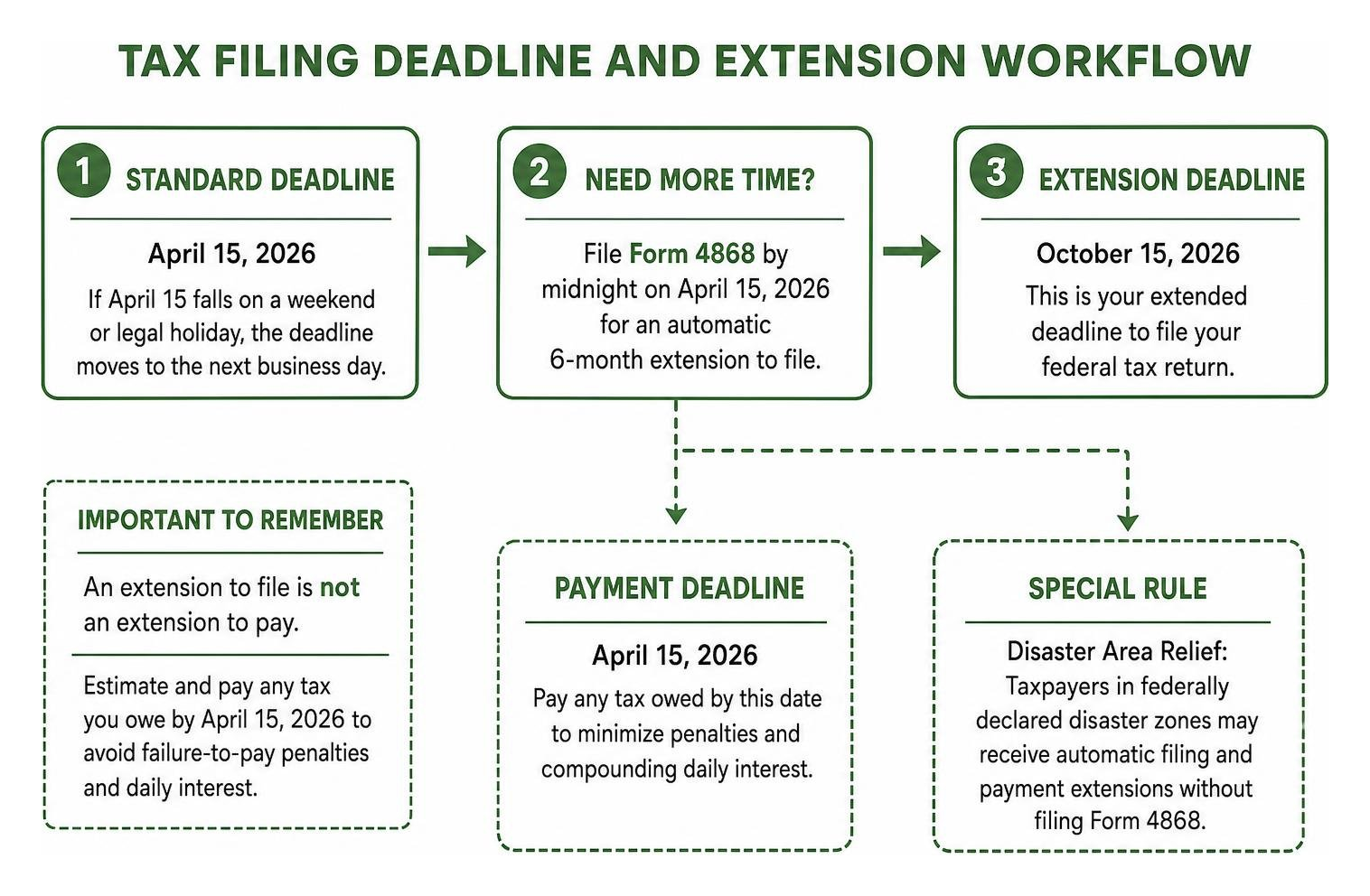
If you cannot complete your return on time, submit Form 4868 before midnight on April 15 to secure an automatic six-month extension, pushing your filing deadline to October 15, 2026.
That an extension to file is not an extension to pay. You must estimate any tax liability and submit payment by April 15 to minimize failure-to-pay penalties and compounding daily interest. Special rules apply to specific groups:
- Disaster Area Relief: Taxpayers located in federally declared disaster zones often receive automatic filing and payment extensions without submitting Form 4868.
- Military Personnel: Service members serving in designated combat zones receive an automatic extension of at least 180 days after leaving the combat zone.
- Expatriates: U.S. citizens and resident aliens living and working outside the United States receive an automatic two-month extension to June 15 to file and pay, though interest accrues on unpaid balances starting April 15.
To review regional exceptions and filing rules, check the official IRS guidelines on when and how to file.
Mastering the Federal Tax Return Process: Step-by-Step
Navigating your return smoothly comes down to an organized workflow. Breaking the process into discrete phases prevents missing forms, math discrepancies, and rejection notices from the IRS e-file gateway.

Preparing Documents for the Federal Tax Return Process
Before opening your tax software or meeting with a preparer, gather all source documentation. Having these items organized eliminates data-entry errors:
- Identification Documents: Valid Social Security numbers (SSNs) or Individual Taxpayer Identification Numbers (ITINs) for you, your spouse, and all listed dependents. Non-citizens without an SSN must submit Form W-7 to obtain or renew an ITIN.
- Income Statements:
- Form W-2: Wage and salary statements from all employers.
- Form 1099-NEC / 1099-MISC: Nonemployee compensation and freelance earnings.
- Form 1099-INT / 1099-DIV: Interest and dividend distributions from banks and brokerages.
- Form 1099-B / 1099-DA: Proceeds from stock, bond, and digital asset/crypto transactions.
- Form 1099-R: Distributions from pensions, annuities, IRAs, or retirement plans.
- Form 1099-G: Unemployment compensation or state tax refunds.
- Health Insurance Verification: Form 1095-A (Health Insurance Marketplace Statement) is mandatory if you enrolled in coverage through a state or federal exchange, as it is required to reconcile advance Premium Tax Credits using Form 8962.
- Expense and Deduction Records: Real estate property tax receipts, mortgage interest statements (Form 1098), charitable donation acknowledgments, medical expense logs, and student loan interest statements (Form 1098-E).
Selecting the Right Tax Forms and Schedules
The central document for individual federal filing is Form 1040. Seniors aged 65 and older have the option to use Form 1040-SR, which features larger print and integrated standard deduction charts. Depending on your financial activity during the year, you may need to attach supplementary schedules:
| Form / Schedule | Primary Purpose | Who Needs to File |
|---|---|---|
| Form 1040 | U.S. Individual Income Tax Return | All individual taxpayers reporting annual income |
| Form 1040-SR | Simplified return for seniors (age 65+) | Senior filers wanting larger type and quick deduction charts |
| Schedule 1 | Additional Income and Adjustments | Filers with business income, unemployment, educator expenses, or IRA deductions |
| Schedule 1-A | New 2025 Deductions | Filers claiming qualified tips, overtime, car-loan interest, or senior enhancements |
| Schedule A | Itemized Deductions | Filers whose deductible medical, state/local taxes, mortgage interest, and gifts exceed the standard deduction |
| Schedule B | Interest and Ordinary Dividends | Filers with taxable interest or dividend income exceeding $1,500 |
| Schedule C | Profit or Loss From Business | Sole proprietors, freelancers, independent contractors, and single-member LLCs |
| Schedule D | Capital Gains and Losses | Taxpayers who sold stocks, real estate, cryptocurrency, or other capital assets |
| Schedule SE | Self-Employment Tax | Filers with net self-employment earnings of $400 or more |
Filing Methods: Free File, Software, and Certified Volunteers
Taxpayers have several avenues to prepare and transmit their return:
- IRS Free File: Taxpayers with an Adjusted Gross Income (AGI) of $89,000 or less can access brand-name commercial tax software at no cost through IRS.gov. Filers with an AGI above $89,000 can utilize Free File Fillable Forms, which provide electronic versions of IRS paper forms without guided software assistance.
- Volunteer Programs (VITA & TCE): The Volunteer Income Tax Assistance (VITA) program offers free tax preparation to individuals earning $69,000 or less, persons with disabilities, and limited-English-speaking taxpayers. Tax Counseling for the Elderly (TCE) provides specialized filing assistance for individuals aged 60 and older.
- Commercial Software and Tax Professionals: Approximately 37% of taxpayers qualify to file simple Form 1040 returns for free using basic software tiers, while complex returns involving rental properties, multi-state income, or businesses require premium software or a Certified Public Accountant (CPA) / Enrolled Agent (EA).
When transmitting your return, choose direct deposit for your refund and provide an accurate bank routing and account number. The IRS issues more than 9 out of 10 refunds in less than 21 days when taxpayers combine electronic filing with direct deposit.
Navigating 2025 Tax Changes and Maximizing Deductions
The 2025 tax year introduced structural updates designed to alleviate specific consumer burdens and encourage targeted economic activity.

Key Updates: Schedule 1-A, Standard Deductions, and Credits
Taxpayers completing their 2025 filings should note several major legislative developments:
- Schedule 1-A Deduction Allocations: A dedicated schedule allows eligible taxpayers to claim targeted deductions, including qualified tip income (up to $25,000), overtime compensation (up to $12,500), passenger automobile car-loan interest (up to $10,000), and an enhanced senior deduction of up to $6,000 for individuals aged 60 and older.
- Child Tax Credit (CTC) and Additional Child Tax Credit (ACTC): The maximum CTC stands at $2,200 per qualifying child under 17, with the refundable ACTC portion capped at $1,700 per child.
- State and Local Tax (SALT) Cap: The maximum deduction cap for state and local income, sales, and real estate taxes was raised to $40,000 for 2025, providing substantial relief for itemizers in high-tax jurisdictions.
- New Savings Vehicles: Specialized provisions introduced pilot contributions for qualified family accounts and expanded catch-up retirement contributions (up to $11,250) for individuals aged 60 to 63.
For line-by-line thresholds, phase-out ranges, and deduction worksheets, consult the comprehensive Publication 17 guidance on individual taxes.
Resolving Tax Liabilities and Payment Plans
If completing Form 1040 reveals an amount owed on line 37, do not delay filing. The penalty for failing to file on time is 5% of the unpaid taxes for each month the return is late (capping at 25%), whereas the failure-to-pay penalty is only 0.5% per month.
The IRS provides several pathways to resolve tax liabilities:
- IRS Direct Pay: Pay directly from your checking or savings account with no transaction fees via IRS.gov.
- Debit/Credit Cards and Digital Wallets: Approved payment processors handle card payments for a nominal processing fee (typically 1.85% to 2.5%).
- Online Payment Agreements (Installment Plans): If you owe $50,000 or less in combined tax, penalties, and interest, you can establish a monthly installment agreement through the IRS website in minutes. Short-term payment plans give you up to 180 days to pay in full, while long-term plans allow monthly payments over up to 72 months.
- Offer in Compromise (OIC): Filers experiencing severe financial hardship may qualify to settle their tax liability for less than the full amount owed by submitting Form 656 and demonstrating that the full liability cannot realistically be collected.
IRS Processing Timelines and Refund Tracking
Once your return is submitted, it enters the IRS processing queue. Understanding how returns move through IRS systems helps you set realistic expectations for your refund.
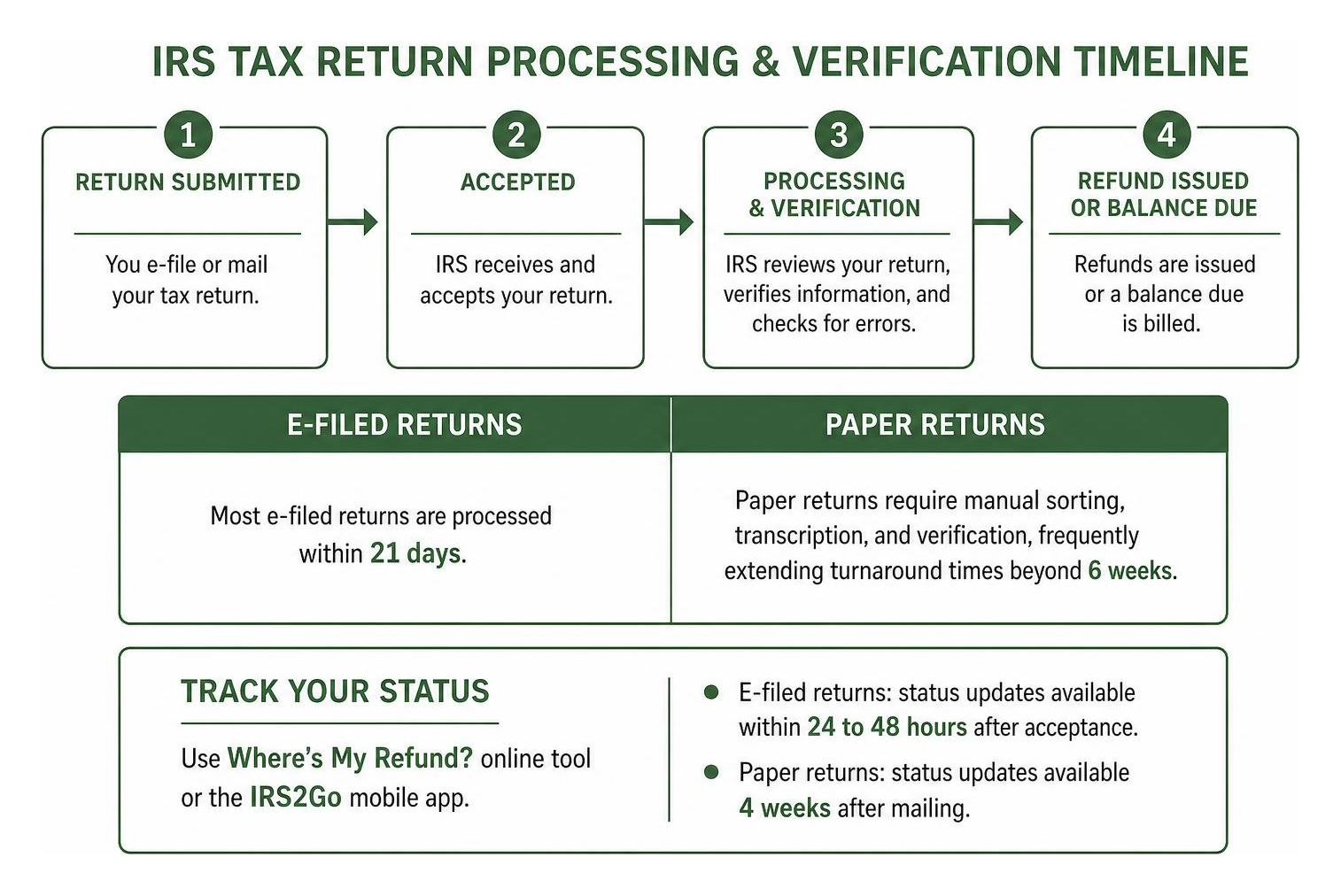
While the IRS processes most e-filed returns within 21 days, paper returns require manual sorting, transcription, and verification, frequently extending turnaround times beyond 6 weeks. If you want to shorten these windows, review established strategies to expedite IRS processing.
Tracking Status in the Federal Tax Return Process
You can track your return’s progress using the IRS Where’s My Refund? online tool or the IRS2Go mobile app. Status updates appear within 24 to 48 hours after an e-filed return is accepted, or four weeks after mailing a paper return.
To check your status, have three items ready:
- Your Social Security Number or ITIN
- Your filing status (Single, Married Filing Jointly, Head of Household, etc.)
- The exact whole-dollar refund amount shown on your return
The tool displays three successive status stages:
- Return Received: The IRS has received your submission and is processing it through initial validation checks.
- Refund Approved: The IRS has completed processing, calculated adjustments, and scheduled your direct deposit or paper check mailing date.
- Refund Sent: The IRS has transmitted the refund to your financial institution or mailed your check. (Direct deposits may take an additional 1 to 5 business days to clear your bank’s internal settlement system).
You can monitor agency-wide workload backlogs and updates via the official IRS tax form processing status page.
Troubleshooting Delays and Filing Amended Returns
If your refund takes longer than 21 days, your return may have encountered a processing hold. Common triggers include:
- Math errors or missing schedules (such as omitting Form 8962 for Marketplace health insurance)
- Discrepancies between reported W-2/1099 withholding and employer wage reports transmitted to the Social Security Administration
- Identity verification flags requiring you to complete online or phone authentication (Letter 5071C or 4883C)
- Statutory holds under the Protecting Americans from Tax Hikes (PATH) Act, which prohibits the IRS from issuing refunds claiming the EITC or Additional Child Tax Credit before mid-February
Reviewing the fundamental reasons for slow tax refunds can help pinpoint what is holding up your file, and you can learn practical remedies for when your tax refund is stuck in processing limbo.
If you discover an omission or mistake after filing, do not submit a duplicate original return. Instead, file Form 1040-X (Amended U.S. Individual Income Tax Return). Form 1040-X can be e-filed through modern tax software for recent tax years. To claim an additional refund, you generally must submit Form 1040-X within three years from the date you filed your original return or within two years from the date you paid the tax, whichever is later.
Frequently Asked Questions about the Tax Filing Process
How long does it take for the IRS to process my tax return and refund?
Electronically filed returns with direct deposit are typically processed within 21 days of IRS acceptance. Paper-filed returns take 6 weeks or longer. If you claim the Earned Income Tax Credit (EITC) or Additional Child Tax Credit (ACTC), federal law mandates that the IRS hold the entire refund until mid-February to conduct fraud checks, regardless of how early you e-file.
What should I do if I cannot pay my tax bill by the April deadline?
Always file your return (or Form 4868 extension) by the April deadline even if you cannot pay. The penalty for late filing is ten times higher than the penalty for late payment. Pay as much as you can by April 15, then apply for an IRS Online Payment Agreement or monthly installment plan through IRS.gov to settle the remaining balance over time while keeping penalties low.
How do I correct an error on a previously filed tax return?
To correct income figures, filing statuses, deductions, or credits on a submitted return, file Form 1040-X (Amended U.S. Individual Income Tax Return). The IRS accepts electronic Form 1040-X submissions for recent tax years. Be sure to attach any relevant documentation supporting the adjustment, such as a corrected Form W-2c or an added Schedule C.
Conclusion
Mastering the federal tax return process requires organized document collection, careful schedule selection, and adhering to strict IRS deadlines. Filing electronically and opting for direct deposit remains the single most reliable way to secure an accurate return and rapid refund turnaround.
For businesses and commercial enterprises in Travis County and across the nation, navigating complex IRS refund pipelines—such as payroll tax adjustments and Employee Retention Credit (ERC) claims—can introduce substantial working-capital friction. At SFG Capital, we provide specialized solutions to help businesses bypass extended IRS processing delays through advance funding and clear guidance.
Explore our specialized business tax and advisory services to see how our team can support your capital requirements and tax-credit liquidity.
See what your business may qualify for.
60 seconds. No documents. No upfront cost.
General information only, not legal or tax advice. Eligibility and estimates are fact-specific and subject to review.