
Blog / Insights
InsightsNeed Cash Now? The Guide to Fast Employee Credit Payouts
October 14, 2026 · 8 min read · By the SFG Capital team
How Austin Quick ERC Advances Can Speed Up Business Cash Flow
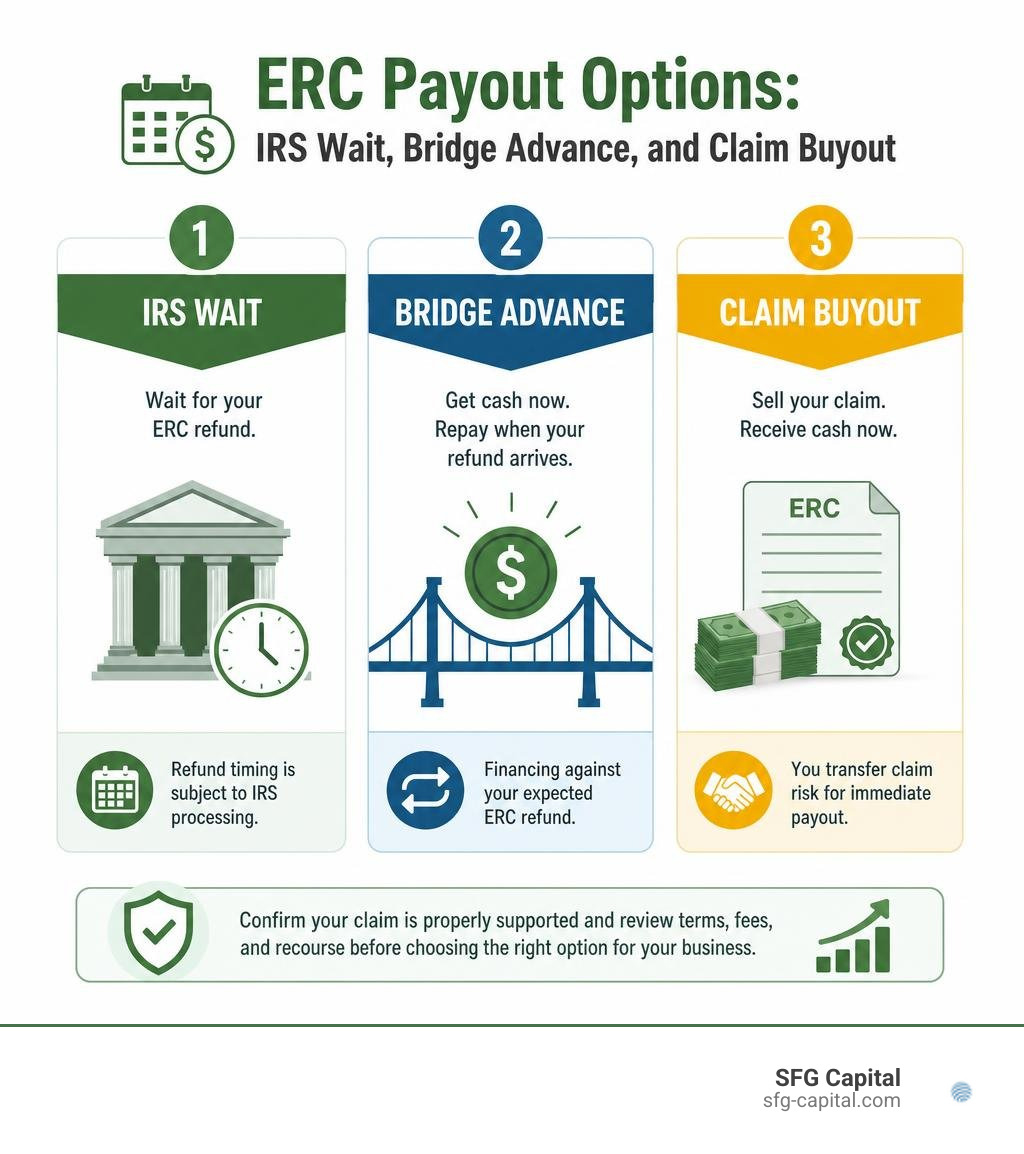
If you need ERC cash sooner, first confirm that your claim is properly supported, then compare a bridge advance with a claim buyout. The phrase Austin Quick ERC advances is not an IRS program, so treat it as a search for local or fast ERC funding options – and verify every provider’s terms, fees, recourse rules, and document requirements before signing.
A compliant funding provider may review your filed Form 941-X, payroll records, eligibility support, and income-tax treatment. A bridge advance is generally financing against an expected refund. A buyout may transfer more claim-related risk to the purchaser, but it can produce a lower payout than the face value of the expected credit.
The IRS has also provided paths to reduce needless amended-return work in some cases. Businesses that received an ERC refund without previously reducing wage deductions may be able to include the refund in income for the year received. If a claim is finally disallowed and the business does not contest it, it may be able to restore wage expense in that year. A qualified tax professional should review the facts before filing.
I am Santino battaglieri, and I work with businesses evaluating compliant ERC funding, documentation, and claim-purchase structures. Through SFG Capital, our team has purchased and funded more than $500 million in ERC claims, bringing practical experience to Austin Quick ERC advances and related liquidity decisions.
Austin quick erc advances vocab to learn:
Navigating Austin Quick ERC Advances for Faster Working Capital

As of August 2026, business owners across Central Texas continue to manage the financial strain of federal refund queues. While the Employee Retention Credit remains one of the most substantial payroll relief mechanisms created, extended processing timelines have kept vital capital locked away. When working capital is tied up in administrative backlogs, daily operations, hiring, and capital investments can stall.
Navigating private liquidity options allows employers to convert their pending tax credits into immediate cash flow. Rather than passively waiting on federal queues, companies can leverage structured advance funding to unlock liquidity and stabilize their balance sheets.
Why Travis County Employers Prioritize Austin Quick ERC Advances
The local business climate in Travis County is dynamic, , and highly competitive. Local enterprises face rising operational expenses, evolving market dynamics, and competitive payroll demands. For many regional employers, learning how to turn your Austin ERC refund into cash today has become a central financial strategy to preserve payroll and maintain operational reserves.
Public initiatives like the Austin-Travis County Fast-Track Cities initiative highlight the region’s broader commitment to efficient, fast-acting organizational execution. Travis County businesses apply that same urgency to their finances. Securing an advance bridges the gap between filing an amended return and receiving funds, providing immediate capital to reinvest in local talent, maintain vendor relationships, and navigate seasonal fluctuations without incurring restrictive long-term debt.
Comparing Payout Structures: Loans Versus Complete Claim Buyouts
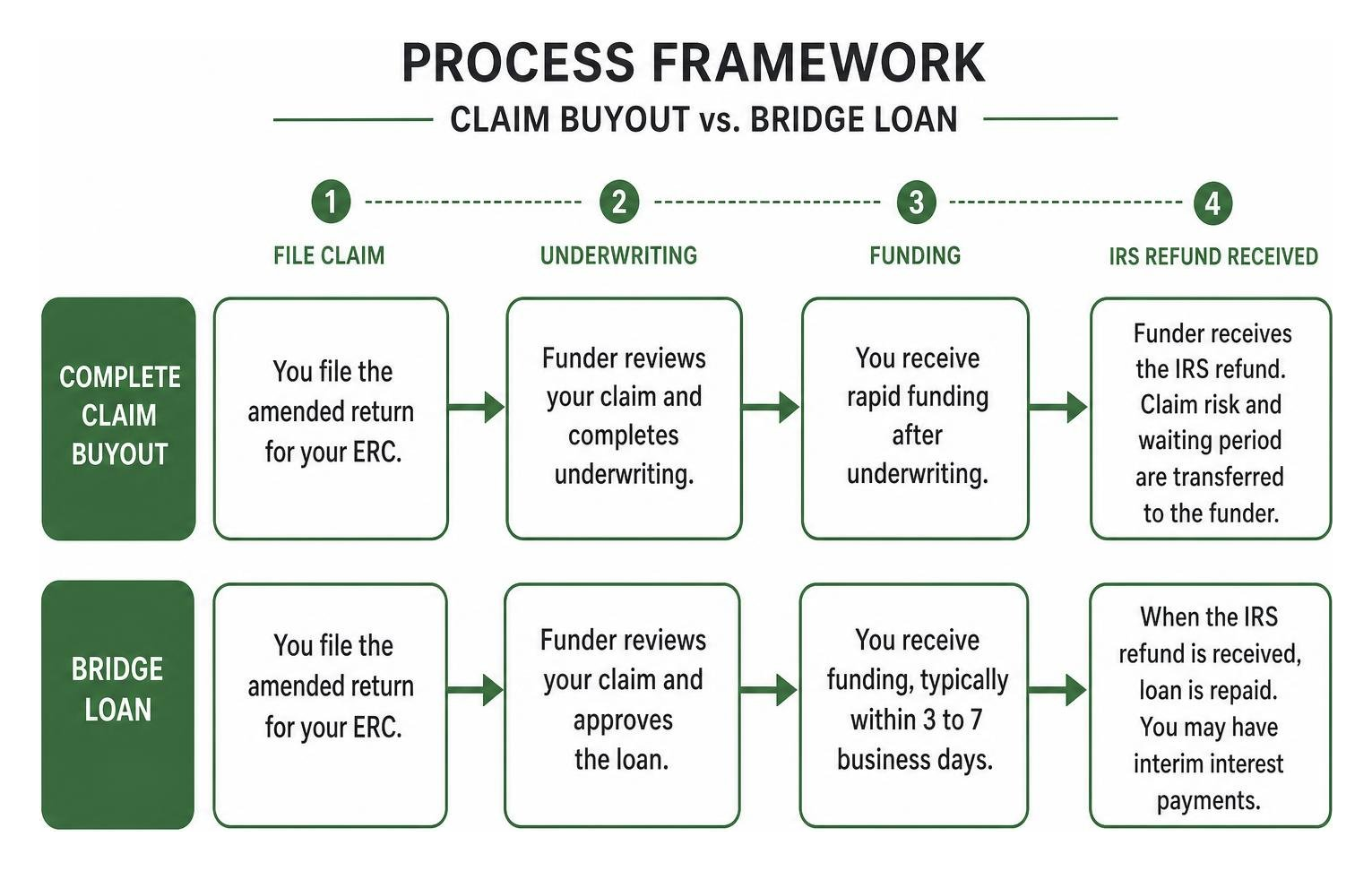
When evaluating liquidity options, business owners typically choose between two main structures: standard bridge loans and outright claim buyouts. A traditional ERC refund advance structured as a loan provides capital upfront while your refund serves as collateral. In contrast, an outright buyout purchases your credit claim directly, transferring the waiting period and processing uncertainties to the funding partner.
| Feature | Bridge Advance Loan | Complete Claim Buyout |
|---|---|---|
| Structure | Short-term credit facility | Direct claim purchase |
| Balance Sheet Impact | Reflected as debt liability | Debt-free liquidity |
| Risk Allocation | Borrower remains liable for repayment | Claim risk shifts to the purchaser |
| Monthly Debt Service | May require interim interest payments | Zero monthly debt obligations |
| Liquidity Timeline | Typically 3 to 7 business days | Rapid funding post-underwriting |
Choosing between these structures depends on your balance sheet goals, cash requirements, and appetite for ongoing administrative involvement.
Top Funding Structures to Expedite Employee Retention Credit Cash
Selecting the right funding mechanism requires understanding how each structure impacts your cash reserves, risk profile, and financial reporting. Working capital optimization aims to secure maximum liquidity while protecting long-term financial health.
Direct Advance Funding and Buyout Programs
Direct buyouts provide immediate liquidity without adding debt to your balance sheet. When you choose to bridge the gap advance your ERC refund today, our team evaluates your filing and acquires the rights to the future refund for an upfront cash payment.
Selling your claim enables your business to eliminate future collection risks. To understand how claim purchases work, explore sell your ERC claim a guide to advance payments and buyouts. This approach gives business owners debt-free working capital, allowing management to focus entirely on growth rather than tracking government processing updates.
Commercial Credit Facilities and Bridge Loans

For organizations seeking temporary financing while retaining full entitlement to their refund check, bridge loans serve as an alternative. When companies need cash now top ERC lenders to finance your credit provide credit facilities secured against the anticipated refund amount.
Underwriting for bridge loans centers on validating your Form 941-X filing and assessing your business credit profile. To review the mechanics of borrowing against a credit, see from application to advance demystifying ERC credit financing. While bridge facilities involve interest rates and debt service, they offer structured access to capital for businesses with established lending relationships.
Regulatory Updates, Compliance, and Cross-Sector Definitions
Navigating tax credits requires close attention to regulatory guidance, proper income tax reporting, and an understanding of key terms across different industries.
Managing Wage Expense Adjustments and Mitigating Whipsaw Assessments
Under historical IRS rules, businesses claiming the Employee Retention Credit had to file amended income tax returns to reduce their wage expense deductions for the tax years in which the qualified wages were paid. This created an administrative burden and exposed taxpayers to “whipsaw” assessments, where a business might repay a credit while facing closed amendment windows to reclaim lost wage deductions.
Updated IRS administrative relief simplifies this reporting. If your business receives an ERC refund but did not previously amend its past income tax returns to lower wage deductions, you can report the refund as gross income on your tax return in the year the payment is received.
Furthermore, if an ERC claim is ultimately disallowed and you choose not to contest the finding, you can increase your wage expense deduction on your current-year return rather than filing retroactive amendments.
These practical compliance paths support local business stability, aligning with community resilience efforts like the Raising Travis County: Child Care and Out-of-School Time Fund initiative that strengthen local economic foundations.
Distinguishing Federal Tax Relief from Texas Research and Legal Entities
The acronym “ERC” appears across multiple distinct sectors in Texas, and differentiating these entities is essential for clear regulatory and business research:
- Employee Retention Credit (ERC): The federal payroll tax relief program administered by the IRS under the CARES Act and subsequent legislation.
- NASCENT Engineering Research Center: Based at the University of Texas at Austin, this National Science Foundation (NSF) Nanosystems Engineering Research Center focuses on nanomanufacturing systems for mobile computing and energy technologies. It develops high-density memory systems like Spin Transfer Torque RAM (STT-RAM) and roll-to-roll manufacturing innovations.
- NSF SECO Program: The Small-Business/ERC Collaborative Opportunity, which provides translational research grants to help commercialize engineering discoveries from NSF research centers.
- Texas Education Research Center (ERC): A statewide longitudinal data system repository housing Texas public education and higher education data for academic and policy researchers.
- Professional & Legal Namesakes: Corporate legal practitioners such as Austin M. Quick | Lawyers | Kirkland & Ellis LLP represent commercial entities in private legal matters, entirely distinct from federal tax credit programs or university research hubs.
Understanding these distinctions ensures that business owners focus strictly on statutory payroll tax provisions when seeking liquidity.
Underwriting Criteria to Secure Austin Quick ERC Advances
To secure fast funding, businesses must provide comprehensive, audit-ready documentation to verify their claim’s validity. Thorough underwriting confirms that filings adhere to all statutory standards before advance capital is issued.
To streamline verification and utilize the fast track to your ERC cash a guide to advance funding, prepare the following records:
- Form 941-X Copies: Signed, dated, and verified copies of all filed amended quarterly federal payroll tax returns.
- Detailed Payroll Journals: Comprehensive reports demonstrating qualified wages paid to eligible employees for each claimed calendar quarter.
- Eligibility Substantiation: Complete documentation establishing qualifying gross receipts declines or specific local government suspension orders that mandated partial or full operational shutdowns.
- Healthcare & Benefit Records: Statements validating qualified health plan expenses allocated to eligible employee wages.
- Prior Income Tax Returns: Relevant federal returns showing how wage deductions were accounted for across applicable tax years.
Frequently Asked Questions About Employee Retention Credit Payouts
How do updated IRS wage deduction rules impact an ERC refund received this year?
If you receive an ERC refund this year and did not previously file amended federal income tax returns to reduce your historical wage expense deductions, updated IRS guidance allows you to report the refund amount as gross income on your current-year tax return. This approach avoids the expense and administrative complexity of amending prior-year filings. Additionally, if an ERC claim is disallowed and uncontested, you can increase your wage expense deduction on your current-year return to offset past reductions.
What is the primary difference between an ERC buyout and a bridge advance loan?
The main distinction lies in debt obligation and risk allocation. A bridge loan is a financing instrument that creates a balance sheet liability, requiring repayment regardless of when the IRS issues your refund check. A buyout is a direct purchase where you sell your claim rights in exchange for upfront cash. Review our ERC Advance Funding Complete Guide to evaluate which structure best fits your company’s balance sheet needs.
How quickly can a business access funds through an advance provider?
Once all underwriting files—including Form 941-X filings, payroll summaries, and eligibility substantiation—are submitted and verified, funding can occur rapidly. Leading providers typically complete claim verification within 24 to 48 hours, with direct deposit disbursement of funds following shortly after document execution.
Conclusion
Prolonged IRS processing times do not have to restrict your operational momentum. Central Texas employers can bypass administrative queues, protect their payroll reserves, and secure vital working capital by partnering with seasoned funding specialists. At SFG Capital, we provide tailored liquidity structures and non-recourse buyouts designed to get cash back into your business quickly and compliantly.
To explore how our team can help your organization unlock its pending tax relief, visit our services to review our complete range of funding options.
See what your business may qualify for.
60 seconds. No documents. No upfront cost.
General information only, not legal or tax advice. Eligibility and estimates are fact-specific and subject to review.