
Blog / Insights
InsightsProven Strategies to Handle IRC ERC Processing Delays
October 14, 2026 · 10 min read · By the SFG Capital team
How to Respond to IRC ERC Processing Delays Without Losing Your Refund Rights
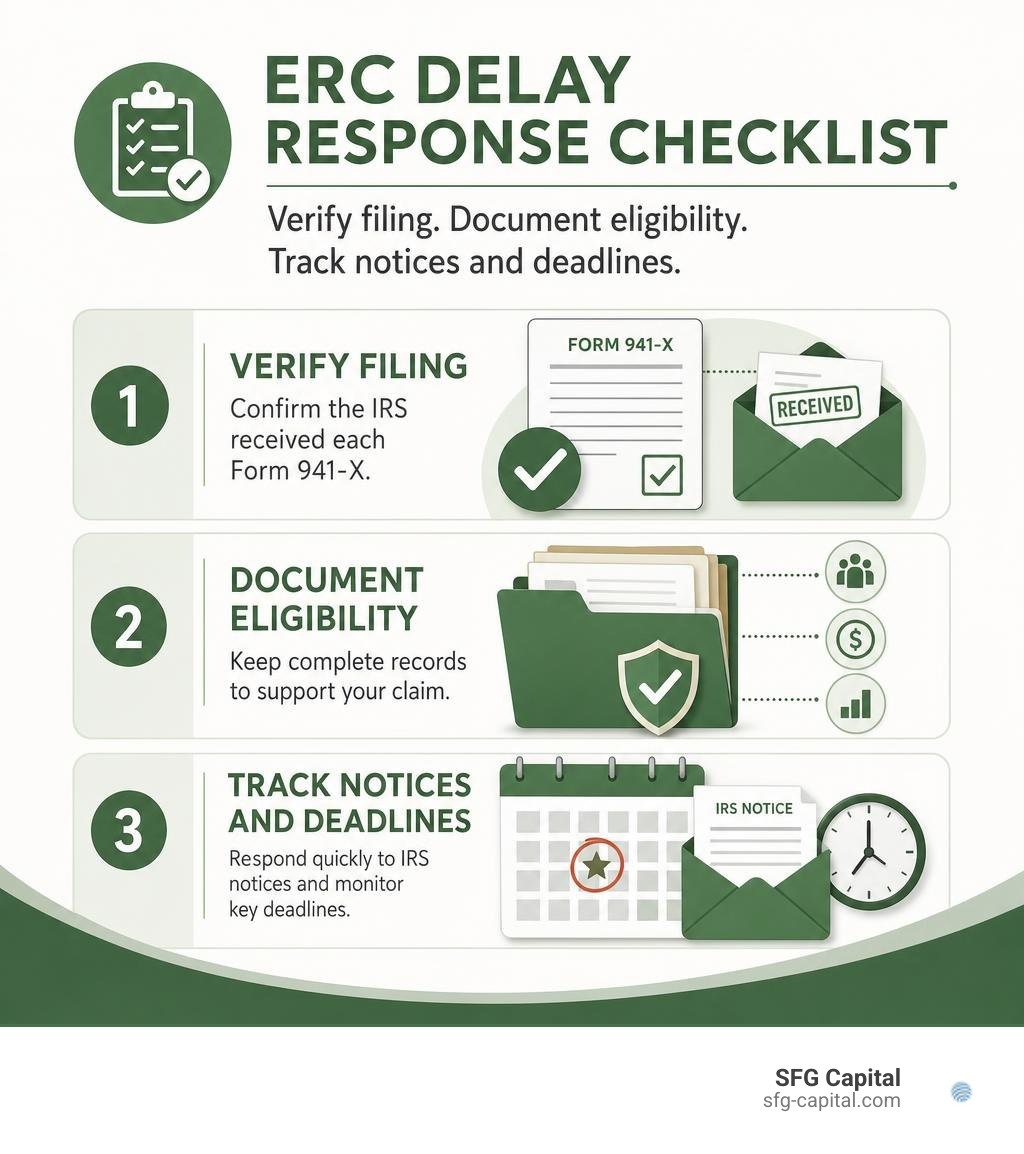
If IRC ERC processing delays are holding up your refund, do not simply wait. Confirm the IRS received each Form 941-X, keep complete eligibility records, address any IRS notice quickly, and track legal deadlines yourself. If a claim has been formally disallowed, the two-year deadline to bring a refund suit generally keeps running during an IRS protest or Appeals review.
The Employee Retention Credit was created during COVID-19 to help eligible employers keep workers on payroll. But aggressive promoter activity, paper-filed amended payroll returns, and the IRS’s September 2023 anti-fraud moratorium created a major backlog. The National Taxpayer Advocate reported that about 1.2 million claims remained unprocessed as of October 26, 2024, with average processing time rising to 381 days in processing year 2024.
For businesses that need working capital, the delay can create a second problem: ERC rules may require wage-deduction adjustments on income tax returns even before the payroll-tax refund arrives. A denial or prolonged review can therefore affect both cash flow and tax compliance.
I am Santino Battaglieri of SFG Capital. My work in ERC advisory, compliance support, and structured funding, including more than $500 million in ERC claims funded or purchased, has shown how careful documentation, deadline tracking, and a clear plan can help businesses navigate IRC ERC processing delays.
Root Causes of IRC ERC Processing Delays and the IRS Backlog
Every Employee Retention Credit refund claimed retroactively begins on paper with Form 941-X (Adjusted Employer’s Quarterly Federal Return or Claim for Refund). Because these amended returns cannot be processed through standard electronic e-filing pipelines, each submission enters a physical queue requiring manual data entry, manual cross-referencing, and individual agent evaluation.
In processing years 2021 through 2023, the IRS processed standard claims in under 120 days (often between 72 and 117 days). However, by processing year 2024, the average processing duration climbed to 381 days. As of late October 2024, approximately 98 percent of the slightly more than one million unprocessed ERC claims were older than 120 days, compared to only five percent prior to late 2023. Understanding these timelines is critical; our team breaks down the ongoing timeline mechanics in a comprehensive guide to 2026 ERC and 941-X processing times.
CARES Act Origins and the September 2023 Moratorium
Congress enacted the ERC under the Coronavirus Aid, Relief, and Economic Security (CARES) Act in 2020 to incentivize employers to maintain payroll amid mandatory shutdowns. The credit provided up to $5,000 per employee in 2020 (50 percent of up to $10,000 in qualified wages). Later amendments under the Consolidated Appropriations Act and the American Rescue Plan Act expanded the credit for 2021 to 70 percent of up to $10,000 in wages per quarter for Q1 through Q3 (and Q4 for Recovery Startup Businesses), yielding up to $21,000 per worker in 2021, or a maximum total of $26,000 per employee.
This substantial financial incentive attracted unregulated third-party promoters who marketed universal qualification aggressively across digital and broadcast media. In response to a flood of improper filings, the IRS enacted an immediate moratorium on September 14, 2023, pausing the processing of newly submitted claims. The agency developed computerized risk filters to separate filings into low-, medium-, and high-risk tiers. As outlined in the National Taxpayer Advocate ERC report, the moratorium halted routine production lines while the IRS built automated risk-scoring systems to identify improper claims.
How Moratorium Rules Created IRC ERC Processing Delays
The anti-fraud moratorium protected the Treasury from billions in fraudulent payouts, but it also halted legitimate filings. Across the life of the program, the IRS has disbursed approximately $242 billion in ERC refunds while incurring an estimated $8.1 billion in overpayment interest. Approximately $1.7 billion of that interest was paid solely because processing exceeded the statutory 45-day window under IRC § 6611(e)(2).
By late 2024, only 113,000 claims were processed in processing year 2024, compared to 1.33 million in 2023 and 1.53 million in 2022. Business owners who followed every statutory requirement found themselves caught in the great ERC wait, with internal agency directives instructing telephone representatives to provide no estimated completion dates.
Navigating Downstream Tax and Compliance Consequences
When an ERC claim is trapped in processing inventory, the financial disruption extends beyond delayed cash flow. Taxpayers face severe tax compliance mismatches on their corporate and individual returns, compounded by strict administrative examination procedures.
Managing Section 280C Wage Deductions and Income Tax Amendments
Under the Internal Revenue Code (analogous to IRC § 280C rules), employers cannot claim a business expense deduction for wages funded by an ERC refund. Consequently, businesses must reduce their wage expense deductions on their income tax returns (such as Form 1120, 1120-S, or 1065) for the taxable year in which the qualified wages were paid or incurred.
This rule creates a difficult timing dilemma:
- Amending Prior Returns Before Refund Arrival: If an employer amends their income tax return to reduce wage deductions while the ERC claim is still pending, it generates an immediate income tax liability. Taxpayers who did this often faced IRS penalty and interest assessments on the resulting tax balance while waiting years for the payroll credit.
- Waiting for the Refund Before Amending: If a business waits to amend until the refund check arrives, the three-year statute of limitations for amending the relevant income tax return under IRC § 6511 may expire. If the ERC claim is ultimately denied or modified after the amendment window closes, the business risks losing the ability to reclaim its original wage deductions.
When refunds stall indefinitely, business owners must explore options for what to do when your tax refund is stuck in limbo to prevent compounding penalties and preserve statutory amendment rights.
Automated Disallowance Notices and Reverse Audit Vulnerabilities
During the summer of 2024, the IRS mailed approximately 28,000 disallowance notices (primarily Letter 105C and Letter 106C) blocking roughly $5 billion in claims. As reported in the Journal of Accountancy report on ERC disallowance letters, these bulk notices were largely triggered by automated risk algorithms rather than field audits conducted by revenue agents.
This approach created a “reverse audit” dynamic. Instead of examining books and records before proposing an adjustment, the agency disallowed claims automatically, shifting the burden onto the taxpayer to assemble audit-grade substantiation within strict 30-day response windows.
To defend an ERC claim against automated disallowance or formal examination, maintain a comprehensive substantiation file containing:
- Government Orders: Complete copies of state, county, or municipal executive orders mandating full or partial suspension of operations, cross-referenced against exact calendar dates.
- Operational Impact Records: Concrete proof showing that government orders had a more than nominal impact on business operations (such as capacity restrictions, sanitation pauses, or supply chain disruptions).
- Quarterly Gross Receipts Schedules: Detailed accounting ledgers and revenue statements comparing 2020 and 2021 quarters against the 2019 baseline (confirming drops greater than 50% for 2020 or greater than 20% for 2021).
- Payroll & PPP Allocation Ledgers: Detailed employee-by-employee wage reports proving qualified wages did not overlap with Paycheck Protection Program (PPP) loan forgiveness, Shuttered Venue Operators Grants, or Restaurant Revitalization Funds.
Proven Administrative and Legal Strategies to Overcome Delays

When administrative delays threaten working capital, businesses must decide whether to continue pursuing administrative remedies or take legal action in federal court.
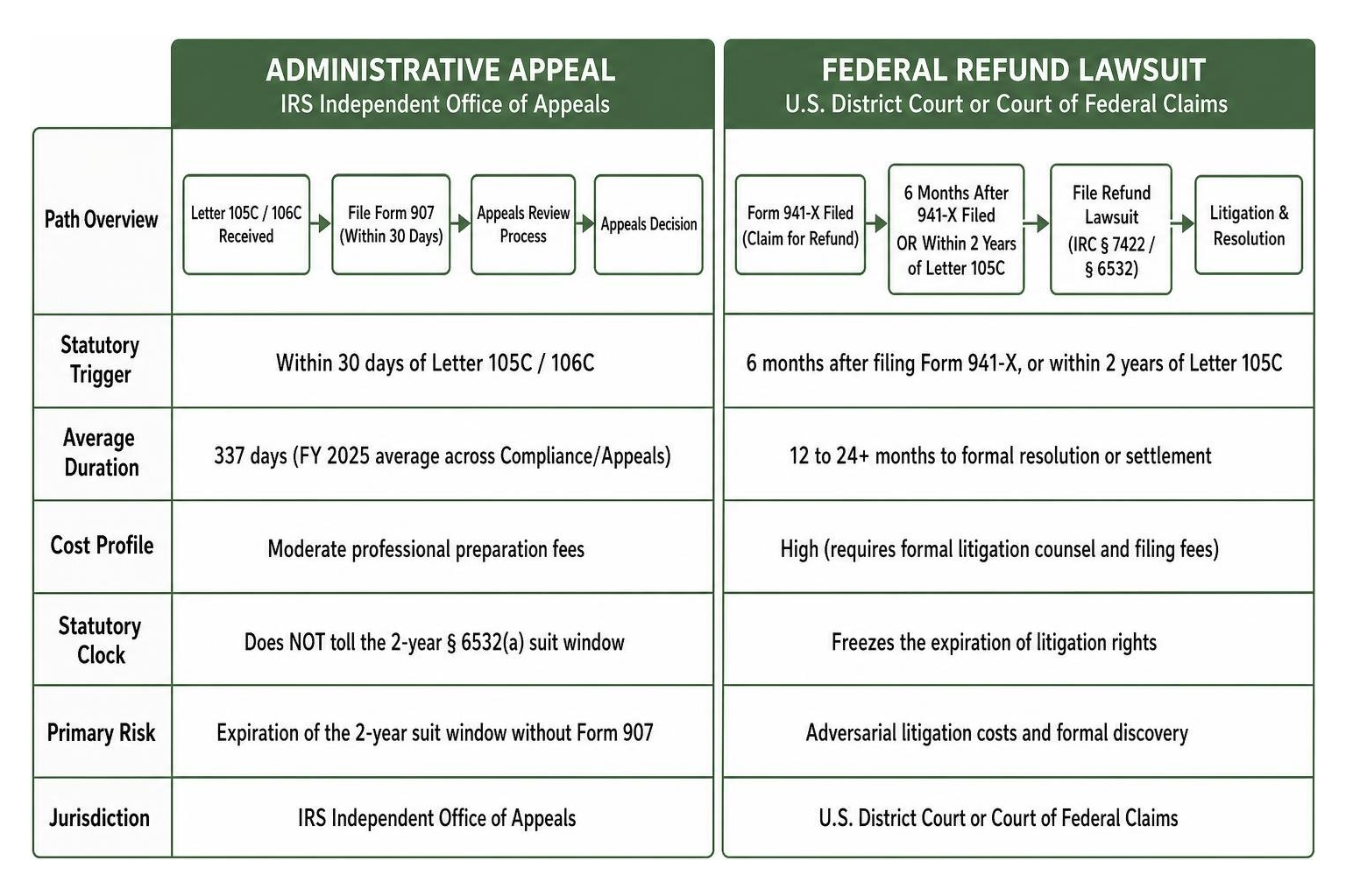
| Feature / Strategy | Administrative Protest / Appeals | Federal Refund Suit (IRC § 7422 / § 6532) |
|---|---|---|
| Jurisdiction | IRS Independent Office of Appeals | U.S. District Court or Court of Federal Claims |
| Statutory Trigger | Within 30 days of Letter 105C / 106C | 6 months after filing Form 941-X, or within 2 years of Letter 105C |
| Average Duration | 337 days (FY 2025 average across Compliance/Appeals) | 12 to 24+ months to formal resolution or settlement |
| Cost Profile | Moderate professional preparation fees | High (requires formal litigation counsel and filing fees) |
| Statutory Clock | Does NOT toll the 2-year § 6532(a) suit window | Freezes the expiration of litigation rights |
| Primary Risk | Expiration of the 2-year suit window without Form 907 | Adversarial litigation costs and formal discovery |
Administrative Solutions to Overcome IRC ERC Processing Delays
Before pursuing litigation, businesses can use several administrative avenues to track and advance their claims:
- Pull IRS Account Transcripts: Rather than relying on telephone representatives, pull official IRS Form 941 business tax account transcripts. Review transaction codes for key markers, such as Code 810 (refund freeze), Code 976 (duplicate/amended return received), or Code 846 (refund issued).
- Use the IRS Document Upload Tool (DUT): When responding to information requests or disallowance notices, submit documentation electronically via the DUT using provided access codes to establish a verifiable digital timestamp.
- Engage the Taxpayer Advocate Service (TAS): If an ERC processing delay causes severe financial harm—such as an inability to meet payroll, impending bankruptcy, or loan default—file Form 911 (Request for Taxpayer Advocate Service Assistance). While TAS cannot override national compliance holds, advocates can help resolve processing freezes on documented low-risk returns. Performing an ERC refund status check confirms whether your file has been assigned to a specific service center before escalating.
Protecting Refund Rights with Form 907 and Notice CP320B
The most critical legal risk in the ERC process is the two-year statutory clock under IRC § 6532(a). Filing an administrative protest with the IRS Independent Office of Appeals does not pause or toll this two-year deadline. If the two-year period from the date on Letter 105C expires while your appeal is pending, the IRS is legally barred from issuing your refund, and you forfeit all rights to file suit in federal court.
To address cases stuck in administrative review, the IRS introduced a streamlined extension process using Notice CP320B and Form 907 (Agreement to Extend the Time to Bring Suit). As detailed in Taxpayer Advocate Service guidance on statutory refund deadlines:
- Eligibility Window: The IRS issues Notice CP320B to taxpayers with pending protests who have six months or less remaining on their two-year statutory limitation period.
- Form 907 Execution: The notice includes instructions and a direct QR code allowing the taxpayer to execute Form 907 via the Document Upload Tool, extending the litigation deadline by up to two additional years.
- Proactive Execution: If your claim is within six months of the two-year deadline and you have not received Notice CP320B, contact your assigned Appeals Officer or submit Form 907 proactively to preserve your refund rights.
Filing Federal Refund Suits Under IRC § 6532 and § 7422
Under IRC § 7422 and IRC § 6532(a)(1), taxpayers are not required to wait indefinitely for the IRS to process a claim. Once six months have elapsed from the filing of Form 941-X without an IRS determination, the taxpayer may file a formal civil refund suit in the appropriate U.S. District Court or the U.S. Court of Federal Claims.
Federal litigation removes the case from the IRS backlog and transfers jurisdiction to the Department of Justice Tax Division. When evaluating this path, business owners should consult legal counsel regarding deciding whether to sue or wait for ERC refunds. In federal court, taxpayers must prove their credit qualification de novo, but they can also pursue statutory overpayment interest under IRC § 6611 and reasonable litigation costs under IRC § 7430 if the government’s position was not substantially justified.
Frequently Asked Questions about ERC Delays
What caused the multi-year backlog in ERC claim processing?
The multi-year backlog resulted from the intersection of paper-filed Form 941-X returns, an influx of aggressive promoter filings, and the IRS’s September 14, 2023 processing moratorium. Because each paper return requires manual processing and review against automated risk scoring filters, average resolution times increased significantly, leaving over one million claims backlogged in 2024.
Does filing an administrative appeal pause the two-year deadline to file a refund suit?
No. Under IRC § 6532(a), the two-year statutory clock to file a federal refund suit begins on the mailing date of IRS Letter 105C or Letter 106C and runs continuously. Pursuing an administrative appeal does not pause this deadline. To preserve your rights without filing an immediate lawsuit, you must execute a formal Form 907 extension agreement with the IRS before the two-year period lapses.
How does claiming the ERC affect business income tax wage deductions?
Under Section 280C principles, you must reduce your deductible wage expenses on your federal income tax return by the amount of the ERC claimed for the tax year the wages were paid. If an ERC claim is delayed or denied after you have already amended your income tax return, work with a qualified tax professional to evaluate whether to file a corrective amended return or apply the tax benefit rule to restore the disallowed deduction.
Conclusion
IRS processing delays require business owners to take a proactive approach to protect their claims. By monitoring IRS account transcripts, maintaining organized substantiation files, watching the two-year statutory deadline under IRC § 6532(a), and executing Form 907 extensions when necessary, you can protect your rights throughout the review process.
For businesses in Austin and Travis County, Texas, that need access to capital without waiting for IRS administrative processing, SFG Capital provides liquidity options. We assist businesses nationwide with advance funding and buyout solutions for pending claims. Learn more about our services to explore how we can help you navigate IRS delays and secure the capital your business needs.
See what your business may qualify for.
60 seconds. No documents. No upfront cost.
General information only, not legal or tax advice. Eligibility and estimates are fact-specific and subject to review.