
Blog / Insights
InsightsQualifying for ERC During a Partial Shutdown
October 14, 2026 · 7 min read · By the SFG Capital team
IRS Criteria to Qualify ERC Partial Shutdown Operations
The Employee Retention Credit was established under the CARES Act to reward employers who maintained their workforce during the height of the COVID-19 pandemic. While many organizations evaluate their eligibility strictly through top-line revenue, understanding the fundamentals of what the ERC is reveals an equally viable pathway: the government suspension test.
Under IRS Notice 2021-20, an employer can claim the credit if operations were fully or partially suspended due to orders from an appropriate governmental authority. Unlike a complete cessation of business, a partial shutdown occurs when an employer continues some business activities while others are halted or severely curtailed by law.
The IRS differentiates clearly between a standard drop in revenue and operational limitations imposed by emergency mandates. Per official IRS guidelines on suspension orders, qualifying under this pathway does not require you to show a catastrophic loss of revenue. Instead, you must prove that legal restrictions caused a direct, operational bottleneck that affected a meaningful segment of your daily trade.
What Legally Constitutes a Partial Suspension of Operations
A partial suspension occurs when a mandatory government directive directly restricts your business capacity, hours, or ability to serve customers.
Common real-world examples that satisfy these statutory ERC qualifications include:
- A full-service restaurant ordered to close indoor dining rooms while allowed to maintain curbside pick-up or delivery.
- A retail establishment subjected to strict physical capacity caps (such as 25% or 50% occupancy limits) that made serving standard customer volumes impossible.
- A business required to slash operating hours to comply with mandatory local curfews.
- A medical clinic prohibited from conducting elective surgeries or routine procedures, even while emergency care remained open.
In each scenario, commerce, travel, or group meetings were constrained by a legally enforceable mandate.
Measuring the 10 Percent Nominal Test to Qualify ERC Partial Shutdown Filings
To prevent businesses from claiming the credit based on trivial operational changes, the IRS established the “more than nominal” standard in Notice 2021-20. An employer satisfies this bright-line safe harbor if the suspended portion of the business accounts for at least 10% of total gross receipts or at least 10% of total employee service hours, using the corresponding calendar quarter in 2019 as the baseline.
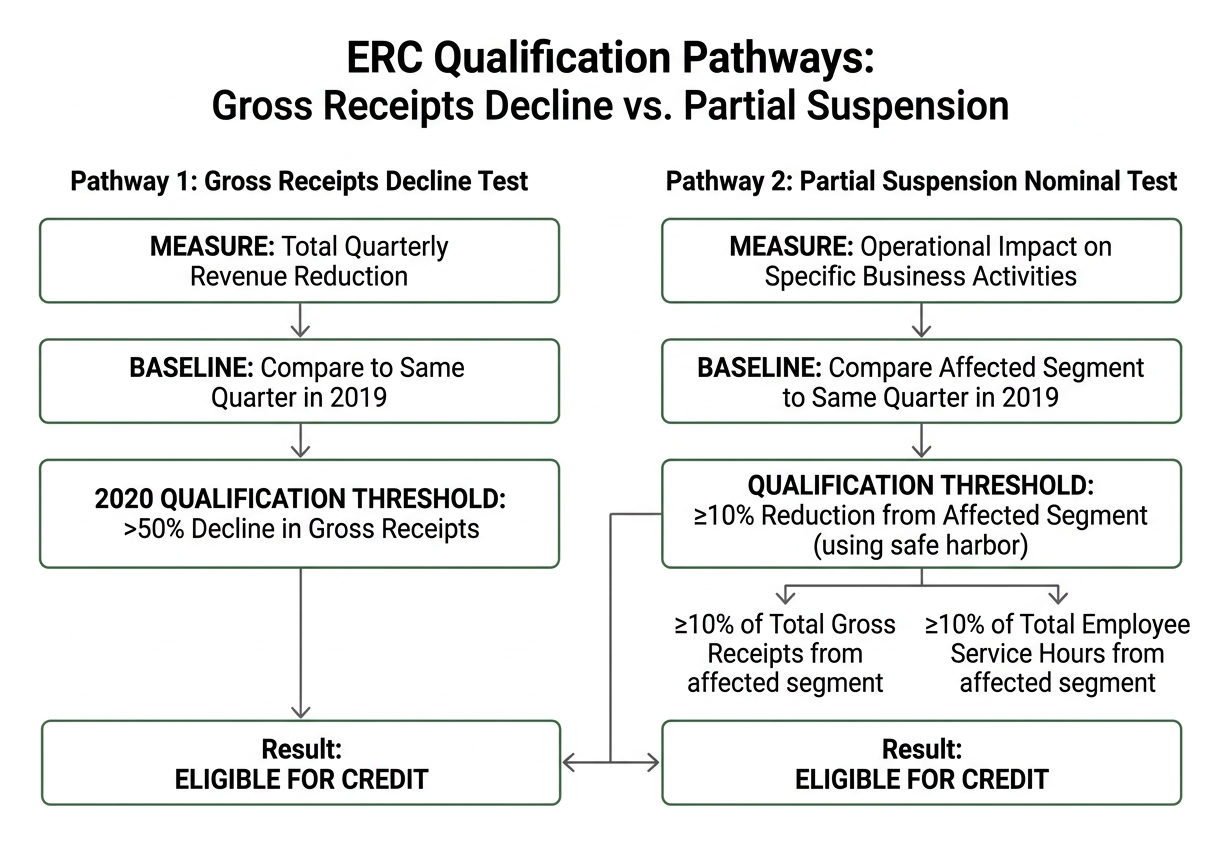
| Feature | Gross Receipts Decline Test | Partial Suspension Nominal Test |
|---|---|---|
| Primary Measurement | Total quarterly revenue reduction | Operational impact on specific business activities |
| Baseline Comparison | Same calendar quarter in 2019 | Same calendar quarter in 2019 |
| 2020 Qualification Threshold | >50% decline in gross receipts | ≥10% reduction in gross receipts OR employee hours from affected segment |
| 2021 Qualification Threshold | >20% decline in gross receipts | ≥10% reduction in gross receipts OR employee hours from affected segment |
| Claim Duration | Entire calendar quarter | Only the specific calendar dates the government order was active |
| Applicable Evidence | Profit and loss statements, sales tax filings | Specific government orders, shift logs, segment revenue |
For instance, suppose a specialty bakery generated 85% of its 2019 revenue from pre-packaged retail deliveries and 15% from its sit-down coffee counter. If local emergency orders mandated the closure of indoor seating, the suspended segment represents more than 10% of 2019 baseline receipts. As a result, the business satisfies the nominal test for the duration of that order.
Enforceable Government Orders vs Voluntary Guidance
A critical distinction in partial suspension claims is the legal authority behind the disruption. For ERC purposes, a qualifying government order must:
- Be issued by a federal, state, or local government agency with jurisdiction over your operations.
- Carry the force of law (such as an executive order, public health proclamation, or emergency city ordinance).
- Directly mandate operational modifications or closures.
Voluntary actions do not meet this standard. If an employer reduced store hours or transitioned to curbside pickup out of an abundance of caution, those choices do not qualify.
Furthermore, statements, recommendations, and bulletins from agencies such as the Centers for Disease Control and Prevention (CDC) or the Occupational Safety and Health Administration (OSHA) are advisory guidelines rather than legal mandates. Unless a state governor, county judge, or municipal mayor explicitly incorporated those advisories into an enforceable local order, CDC and OSHA publications cannot serve as the legal foundation for an ERC claim.
Operational Factors That Affect Partial Shutdown Eligibility
Reviewing a comprehensive ERC eligibility checklist helps confirm whether operational constraints genuinely disrupted normal business functions.
Can Essential Businesses and Remote Work Qualify ERC Partial Shutdown Eligibility?
Being deemed an “essential business” does not automatically disqualify an employer from claiming the ERC under a partial suspension. If an essential business operated distinct, non-essential divisions that were forced to close, it can qualify if those segments represented more than a nominal portion of its 2019 operations.
Similarly, if an essential employer was subjected to physical workspace mandates—such as mandatory physical distancing rules that forced the physical removal of 40% of manufacturing workstations—the business experienced a partial suspension despite remaining open.
However, the ability to seamlessly transition to telework can negate a partial shutdown claim. Under IRS rules, if an employer was subject to a stay-at-home order but employees were equipped to conduct comparable operations remotely without significant disruption to client deliverables or service capacity, the business is not considered partially suspended.
Qualifying Through Qualifying Supplier and Supply Chain Disruptions

A business that was not directly subject to a shutdown order may still qualify if its primary supplier was forced to suspend operations due to a qualifying government order.
To successfully claim ERC under the supply chain rule:
- The supplier must have been forced to suspend operations because of an enforceable government order.
- The business must have been unable to obtain the required materials or components from alternate suppliers, regardless of cost.
- The inability to procure those specific goods must have caused a partial or full suspension of the employer’s own operations.
General supply delays, port congestion, shipping rate spikes, or raw material shortages caused by widespread market dynamics do not qualify. The bottleneck must trace directly back to a supplier under a mandatory government shutdown.
Common Pitfalls and Required Documentation for ERC Audits
Filing an ERC claim involves submitting an amended payroll tax return via Form 941-X. Because the IRS actively scrutinizes partial suspension filings, maintaining a meticulous audit file is essential. Employers can streamline filing amended employment tax claims by assembling their documentation thoroughly before filing.
Documentation Standards for Government Mandate Claims
To protect against audit risks, maintain the following records:
- Exact Legal Mandates: Copies of the specific executive orders, state health decrees, or local emergency declarations that applied to your business location.
- Operational Impact Analysis: A chronological narrative detailing how the specific order disrupted daily trade, including dates of implementation and lifting.
- Quantitative Nominal Calculations: Baseline 2019 financial ledgers and payroll journals proving the affected segment generated at least 10% of gross receipts or employee service hours.
- Shift Logs and Timecards: Shift schedules demonstrating the direct reduction of on-site service hours during the shutdown window.
- Supply Chain Evidence: Written confirmation and copies of government orders from suppliers proving their mandatory closure, along with documentation demonstrating that alternative vendors were unavailable.
Avoiding Promoter Errors and Extended Assessment Risk
The IRS has warned business owners about aggressive ERC marketing promoters who claim that nearly every business qualifies based on generic supply chain delays or advisory CDC safety recommendations. The IRS’s “Dirty Dozen” tax scams warning highlights improper ERC claims as a top enforcement priority.
While the standard statute of limitations for assessing employment taxes is three years, Congress extended the assessment window for third- and fourth-quarter 2021 ERC claims to five years. Employers must remain aware of statutory ERC claim deadlines and assessment periods and ensure their positions are legally defensible.
Frequently Asked Questions About the ERC Partial Suspension Test
Does a voluntary reduction in business hours count as a partial shutdown?
No. A voluntary decision to adjust hours, limit occupancy, or modify service models to protect employee health does not satisfy IRS criteria. The operational change must be compelled directly by a binding government order.
How does the 10 percent nominal test compare to the gross receipts test?
The gross receipts test looks at overall quarterly financial performance, requiring a 50% drop in 2020 or a 20% drop in 2021 compared to 2019. In contrast, the 10% nominal test evaluates operational disruption to a specific division or service line, regardless of whether your total company revenue fell.
Can an employer claim ERC for the entire quarter if the shutdown lasted two weeks?
No. When qualifying solely under a partial suspension, you can only claim qualified wages paid during the specific calendar days the government order was active. Once the mandate expired or was modified to remove the restriction, wage eligibility under the suspension test ends immediately.
Conclusion
Navigating the ERC partial shutdown rules requires a firm grasp of IRS Notice 2021-20, precise nominal threshold calculations, and verifiable government orders. Establishing clear documentation protects your business and substantiates your claim against extended IRS review windows.
For business owners in Travis County seeking to avoid lengthy IRS processing times, SFG Capital provides specialized claim review alongside direct funding advance and buyout options. Explore SFG Capital’s funding and advisory services to substantiate your partial suspension claim and access your earned capital without unnecessary delay.
See what your business may qualify for.
60 seconds. No documents. No upfront cost.
General information only, not legal or tax advice. Eligibility and estimates are fact-specific and subject to review.