
Blog / Insights
InsightsQualifying for ERC with Your 2020 Wages
October 14, 2026 · 9 min read · By the SFG Capital team
How to Qualify for ERC on 2020 Wages in 2026
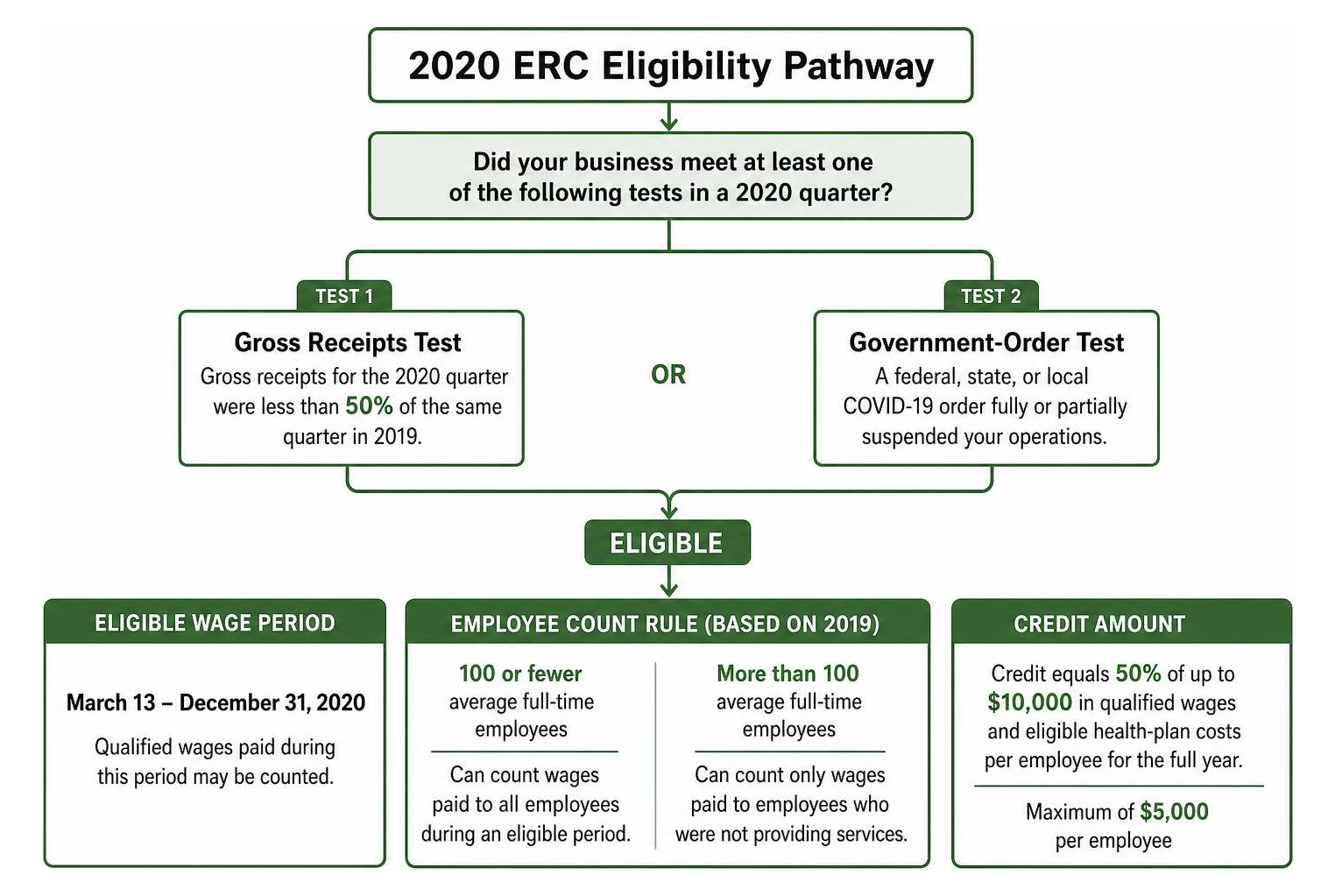
To qualify for ERC 2020 wages under current 2026 IRS review standards, your business generally needed to meet one of these tests during 2020:
- Gross receipts test: Your gross receipts for a 2020 quarter were less than 50% of the same quarter in 2019.
- Government-order test: A federal, state, or local COVID-19 order fully or partially suspended your operations.
If eligible, you may count qualified wages paid from March 13 through December 31, 2020. Employers with 100 or fewer average full-time employees in 2019 can generally count wages paid to all employees during an eligible period. Larger employers can generally count only pay for employees who were not providing services. The credit equals 50% of up to $10,000 in qualified wages and eligible health-plan costs per employee for the full year – a maximum of $5,000 per employee.
The rules are detailed, and the stakes are real. In 2026, a valid claim requires clear payroll records, quarter-by-quarter revenue calculations or a specific government order, and careful separation of wages used for PPP loan forgiveness or other payroll-based credits.
I am Santino Battaglieri, founder of SFG Capital, with more than nine years in financial services and experience supporting ERC transactions at scale. Our compliance-focused work helps businesses assess whether they qualify ERC 2020 wages with documentation and risk controls in mind before pursuing a refund or buyout in 2026.
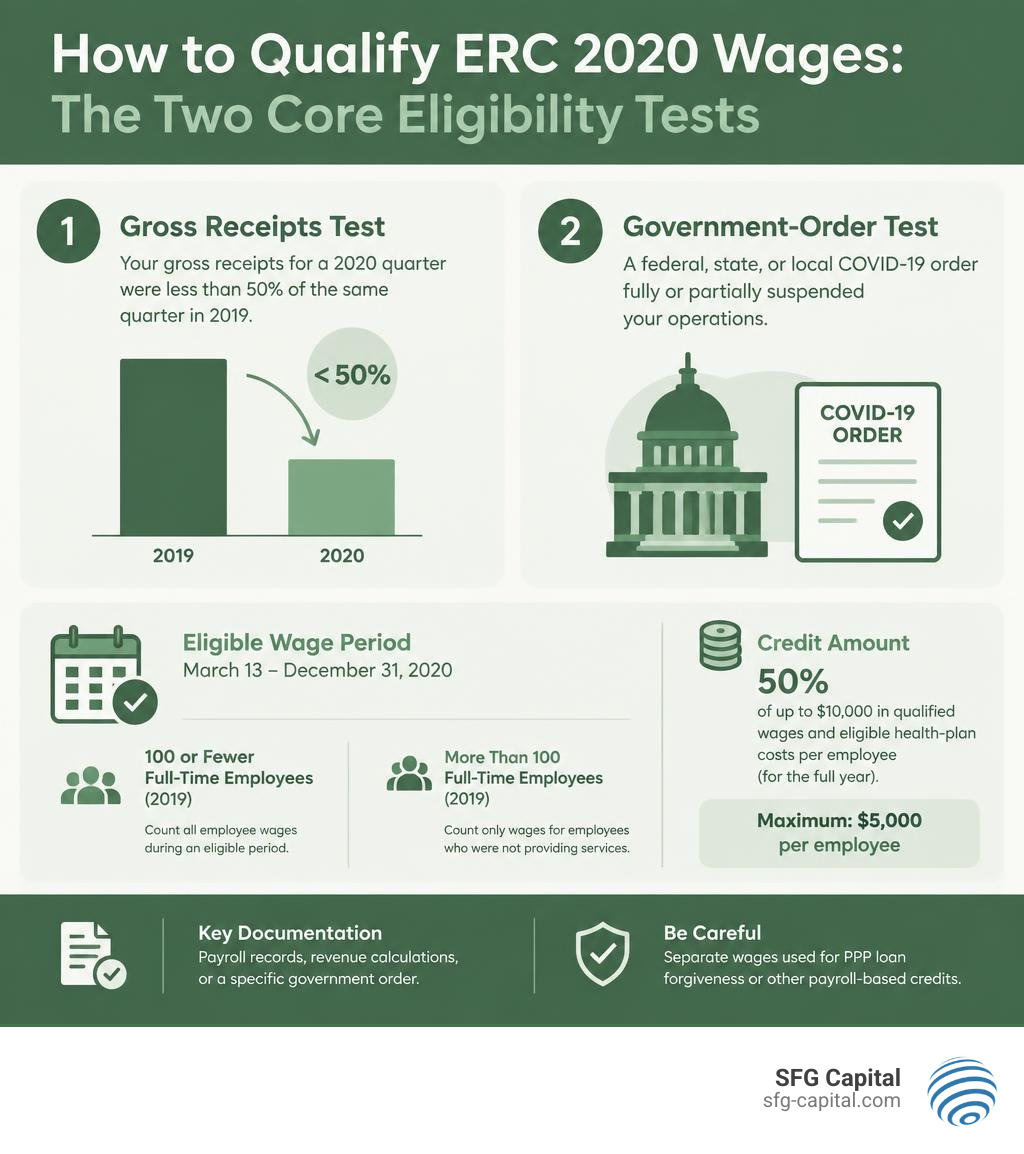
How to Qualify ERC 2020 Wages in 2026: The Two Core Eligibility Tests

The Employee Retention Credit was established under Section 2301 of the Coronavirus Aid, Relief, and Economic Security (CARES) Act to encourage employers to keep workers on payroll during the height of the COVID-19 pandemic. Navigating the program in 2026 starts with reviewing the essential guide to ERC eligibility requirements.
To claim or defend the 2020 credit, an employer—whether a for-profit trade or business or a 501(c) tax-exempt organization—must establish eligibility on a quarter-by-quarter basis. Governmental entities and self-employed individuals claiming credits on their own earnings are not eligible. Qualification in 2020 rests on two distinct legal pathways:
Gross Receipts Reduction: The 50% Revenue Decline Test
The gross receipts test is an objective, mathematical metric. Under the 2020 statutory provisions, an employer qualifies beginning in the first calendar quarter of 2020 where its gross receipts are less than 50% of gross receipts for the identical calendar quarter in 2019.
- Eligibility Onset: The decline is measured against 2019 figures. If your Q2 2020 receipts were $40,000 compared to $100,000 in Q2 2019 (a 60% decline), the business meets the threshold.
- Duration and Recovery: Under the statutory framework outlined in the IRS 2020 vs 2021 comparison guide, once an employer triggers eligibility under the 50% rule, eligibility continues through each subsequent calendar quarter until the end of the quarter following the one in which gross receipts recover to more than 80% of the comparable 2019 quarter.
Gross receipts generally encompass all revenue received or accrued under the employer’s accounting method (cash or accrual), including sales, investment income, and interest, while excluding forgiveness amounts from Paycheck Protection Program (PPP) loans.
Full or Partial Suspension Under Government Orders and the 10% Safe Harbor
If a business did not experience a 50% decline in revenue, it may establish eligibility if its commercial operations were fully or partially suspended due to an appropriate government order.
Under Guidance on the Employee Retention Credit under Section 2301 issued in IRS Notice 2021-20:
- Qualifying Government Order: The mandate must be an enforceable federal, state, or local government order, decree, or emergency proclamation related to COVID-19 that directly limits commerce, travel, or group meetings. Voluntary closures, general health advisories, or customer hesitation do not qualify.
- More Than Nominal Impact Safe Harbor: A partial suspension occurs when a government order restricts a distinct portion of business operations. The IRS established a safe harbor: an operation is considered partially suspended if the suspended portion accounted for at least 10% of total gross receipts or at least 10% of total employee service hours during the comparable quarter in 2019.
- Supplier Disruptions: If an employer’s supplier shut down due to a government order and could not deliver critical inventory or parts, the employer may qualify—provided contemporaneous documentation demonstrates that alternative suppliers were unavailable.
Defining Qualified Wages and Calculation Limits for 2020
Once eligibility is established for a specific calendar quarter or suspension window, you must identify which employee wages qualify. Working through the math behind your employee retention credit refund requires calculating eligible payroll and health costs within strict calendar boundaries.
Qualified wages for 2020 include gross compensation subject to FICA taxes plus allocable, pre-tax qualified health plan expenses paid between March 13, 2020, and December 31, 2020.
Small vs. Large Employer Rules to Qualify ERC 2020 Wages
A critical distinction in the 2020 ERC rules is the 100-employee threshold based on full-time employees (FTEs) in calendar year 2019. Understanding this cutoff is essential when evaluating your business’s ERC qualifications.
An average full-time employee for this test is defined under IRC § 4980H as an employee who worked an average of at least 30 hours per week or 130 hours per month in 2019.
| Metric / Rule | Small Employer (≤ 100 FTEs in 2019) | Large Employer (> 100 FTEs in 2019) |
|---|---|---|
| FTE Baseline Calculation | Average of 100 or fewer full-time employees across 2019 | Average of more than 100 full-time employees across 2019 |
| Working Wages Eligible? | Yes. All wages paid to employees during eligible periods count, even if employees performed full services. | No. Wages paid to employees while they are actively working/providing services cannot be counted. |
| Non-Working / Furlough Wages | Eligible (subject to caps) | Eligible (only wages paid for hours not worked due to suspension/decline) |
| Paid Leave Restrictions | Standard payroll exclusions apply | Pre-existing paid leave policies (accrued vacation/sick pay) are excluded |
Calculating the 50% Credit Rate and the $10,000 Annual Wage Cap
For 2020, the Employee Retention Credit equals 50% of qualified wages paid to each employee, subject to an annual cap of $10,000 in qualified wages per employee across all four calendar quarters combined.
- Maximum Credit: The absolute highest credit an employer can claim for an individual worker in 2020 is $5,000 ($10,000 × 50%).
- Wage Accumulation: If an employee was paid $6,000 in eligible wages in Q2 2020 and $6,000 in Q3 2020, the employer can claim $3,000 in Q2 (50% of $6,000) and only $2,000 in Q3 (50% of the remaining $4,000 eligible under the $10,000 annual limit).
- Health Plan Expenses: As confirmed in official IRS wage determination FAQ guidance, employer-paid health plan contributions can be included in qualified wages even if an employee was furloughed and received no taxable hourly or salary pay.
Interaction Between 2020 ERC Wages and PPP Loan Forgiveness
When the CARES Act was signed into law in March 2020, employers were forced to make a difficult choice: apply for a Paycheck Protection Program (PPP) loan or claim the Employee Retention Credit. The Taxpayer Certainty and Disaster Tax Relief Act of 2020 retroactively eliminated this restriction, allowing eligible employers to claim the ERC even if they received a PPP loan.
Avoiding Double-Dipping: Coordinating Payroll Across Relief Programs
The statutory relief came with a strict anti-double-dipping rule: the exact same dollar of payroll cannot be used for both PPP loan forgiveness and the Employee Retention Credit.
Employers must reconcile their payroll ledgers using clear tax credit coordination rules:
- PPP Covered Periods: Review the specific dates of your 8-week or 24-week PPP covered period.
- Non-Payroll Expense Optimization: If an employer reported non-payroll expenses (rent, utilities, covered mortgage interest) on its PPP forgiveness application, those costs reduce the amount of payroll required to justify complete PPP loan forgiveness, freeing up remaining wages for ERC qualification.
- Other Credit Exclusions: Wages used to claim Families First Coronavirus Response Act (FFCRA) emergency paid sick or family leave, the Work Opportunity Tax Credit (WOTC), or Research & Development (R&D) credits cannot be included in ERC calculations.
Audit Compliance, IRS Processing, and Amending Returns
The IRS maintains elevated scrutiny over ERC claims, actively examining filings for improper claims, inflated payroll numbers, and invalid government order assertions. Using a structured complete ERC checklist helps ensure that filings remain supported by verifiable records.
Step-by-Step Documentation to Qualify ERC 2020 Wages Under IRS Review
To withstand an IRS audit, businesses must maintain contemporaneous documentation verifying every element of their claim:
- Gross Receipts Ledgers: Quarterly income statements and sales tax returns comparing 2019 and 2020 figures, showing the required 50% decline.
- Government Order Files: Full copies of relevant municipal, county, or state public health emergency orders, noting the specific operational limitations imposed on the trade or business. Consult the Employee Retention Credit Eligibility Checklist for specific documentation standards.
- Nominal Impact Analyses: Time-tracking data, revenue breakdown by business segment, or operational records demonstrating that a partially suspended segment accounted for at least 10% of gross receipts or service hours.
- Detailed Payroll Runs: Employee-by-employee wage breakdowns for every payroll cycle in 2020, tracking the $10,000 annual wage cap per worker.
- PPP Forgiveness Worksheets: Documentation showing the precise allocation of payroll dollars between PPP forgiveness and ERC qualified wages.
Filing Form 941-X and Navigating Current IRS Processing Queues
Because 2020 employment tax periods have closed, retroactive claims are processed by filing Form 941-X (Adjusted Employer’s Quarterly Federal Tax Return or Claim for Refund).
Under the statutory framework, claiming the ERC requires reducing the income tax wage deduction on the employer’s federal income tax return (Form 1120, 1120-S, or 1065) for the corresponding 2020 tax year by the amount of the credit claimed.
Processing times for paper-filed amended returns remain subject to IRS workload management. As of mid-2026, IRS administrative reports reflect a processing pipeline handling roughly 20,600 unresolved ERC claims across multiple stages:
- 3,500 claims undergoing standard administrative review
- 4,000 claims pending final payment disbursement or disallowance determinations
- 5,500 claims assigned to active field or desk audits
- 6,000 claims awaiting review of formal disallowance responses
- 1,600 claims undergoing review with the IRS Independent Office of Appeals
If an employer discovers an error in a previously submitted, uncashed claim, the IRS provides a formal claim withdrawal process to eliminate audit exposure and potential penalties.
Frequently Asked Questions About 2020 ERC Wages
What is the maximum credit an employer can receive per employee for 2020?
The maximum ERC refund for 2020 is $5,000 per employee. This is calculated as 50% of up to $10,000 in qualified wages and allocable group health expenses paid to that employee across all eligible calendar quarters from March 13, 2020, through December 31, 2020.
Can wages paid to majority business owners or family members qualify for the 2020 ERC?
Under IRS rules and constructive ownership principles (IRC § 267(c)), wages paid to direct or indirect majority owners (individuals owning more than 50% of the value of the business) and their family members (including children, parents, siblings, aunts, uncles, and in-laws) generally do not qualify for the ERC if the owner has living familial relations subject to ownership attribution.
Do employers need to adjust federal income tax returns when claiming 2020 ERC wages?
Yes. Under IRC § 280C, employers cannot take a double tax benefit by deducting wages on their income tax return while receiving a dollar-for-dollar tax credit on those same wages. When an ERC claim is filed for 2020, the business must reduce its deductible wage expense for the 2020 tax year by the amount of the credit, which may necessitate filing an amended business income tax return.
Conclusion
The 2020 Employee Retention Credit remains a valuable avenue of pandemic financial relief, but strict statutory caps ($5,000 per worker for the year), detailed small-employer employee count thresholds (100 FTEs), and careful coordination with PPP loan forgiveness require rigorous compliance.
For businesses throughout Travis County and across the country in 2026 facing extended IRS processing timelines and formal claim reviews, navigating complex documentation requirements is critical. SFG Capital provides specialized guidance to help businesses evaluate their 2020 wage eligibility and explore specialized ERC buyout and advisory services to address processing backlogs with complete regulatory confidence.
See what your business may qualify for.
60 seconds. No documents. No upfront cost.
General information only, not legal or tax advice. Eligibility and estimates are fact-specific and subject to review.