
Blog / Insights
InsightsStop Refreshing the IRS Page and Use These ERC Status Tips
November 6, 2026 · 8 min read · By the SFG Capital team
Why Your ERC Refund Status Update Is So Hard to Find
If you’re looking for an erc refund status update, here’s the fastest way to check where your claim stands:
- Call the IRS Business Helpline at (800) 829-4933 — have your EIN, the quarters you filed for, your Form 941-X mailing date, and your expected refund amount ready.
- Ask your tax professional to call the Practitioner Priority Line at (877) 777-4778 for faster access.
- Visit your local IRS office in person if phone attempts are unsuccessful.
- Contact the Taxpayer Advocate Service if delays are causing real financial hardship.
Note: There is no online portal to track ERC refunds — unlike regular tax refunds, the IRS has no “Where’s My Refund” tool for ERC claims.
You filed your ERC claim months ago. Maybe longer. And every time you check, you get nothing — no update, no check, no clear answer from the IRS.
You’re not alone. As of late 2024, the IRS was still sitting on roughly 400,000 unprocessed ERC claims worth about $10 billion. Processing times have stretched from an initial estimate of 6–8 weeks to anywhere from 9 to 12 months — and some businesses have waited even longer.
The frustration is real. And for business owners who filed for working capital relief, the wait isn’t just annoying — it’s costly.
I’m Santino Battaglieri, founder of SFG Capital, a firm that has purchased and funded over $500 million in ERC claims and helped hundreds of businesses navigate IRS delays, moratoriums, and compliance reviews — making me deeply familiar with every stage of the erc refund status update process. In the sections below, I’ll walk you through exactly what to do, what your claim status likely means, and how to take action.
How to Get an Accurate ERC Refund Status Update

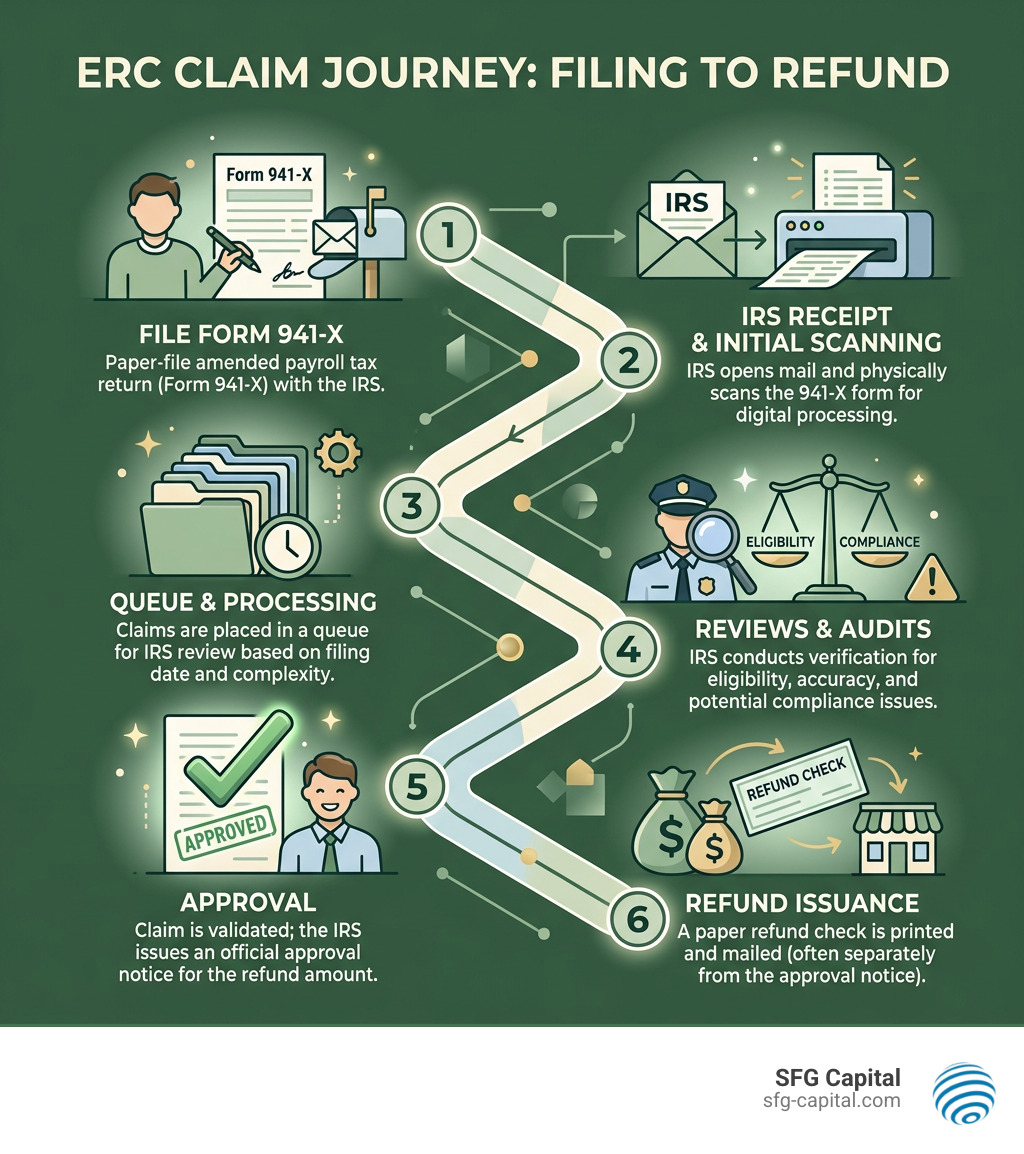
Checking your erc refund status update isn’t as simple as clicking a link. Because the Employee Retention Credit (ERC) is claimed via an amended payroll tax return (Form 941-X), it follows a different path than your annual income tax. These forms are paper-filed, meaning they have to be physically opened, scanned, and manually processed by an IRS agent.
To get a real answer, you have to go to the source. We recommend starting with a ERC Refund Status Check: Don’t Be Left in the Dark to understand the nuances of the current backlog. When you do reach out to the IRS, ensure you have your Employer Identification Number (EIN), the specific tax quarters you are inquiring about, and the exact date you mailed your Form 941-X.
Using the IRS Business Helpline for an ERC Refund Status Update
The primary way for most business owners to get an update is the IRS Business and Specialty Tax Line.
- Phone Number: 800-829-4933
- Hours: Monday through Friday, 7:00 a.m. to 7:00 p.m. local time.
- Best Time to Call: Be the “early bird.” Calling right at 7:00 a.m. usually results in shorter hold times.
When you get through, the agent can tell you if your return has been received and if it has been assigned to an examiner. However, keep your expectations in check. Many business owners report that agents can confirm receipt but cannot provide a specific “check-in-the-mail” date. For more official guidance on what the IRS is looking for during these calls, you can check the Employee Retention Credit | Internal Revenue Service page.
Leveraging Professional Tax Lines and Transcripts
If you’ve been stuck on hold for hours with no luck, it might be time to bring in the pros. Tax professionals have access to the Practitioner Priority Service (PPS) at 877-777-4778. This line is generally faster and staffed by agents who deal specifically with complex accounts.
Another high-level tactic we use is requesting a Tax Transcript, specifically the “Record of Account.” This document shows every action the IRS has taken on your file. If a refund has been approved but the check was lost in the mail, the transcript will show a “Refund Issued” code. Understanding these codes is vital for Navigating the ERC Refund Maze: What Your Claim Status Means.
Understanding the Current IRS Backlog and Processing Times
The “waiting game” has changed significantly over the last two years. Initially, the IRS aimed for a 6-week turnaround. Today, that is a distant memory.
As of late 2024, the IRS is actively working through a backlog of 400,000 claims. They have recently shifted their focus toward “low-risk” claims to move money faster. If your claim is straightforward and doesn’t have “red flags” (like claiming more employees than you ever had), you might see movement sooner. You can read more about this shift in the official newsroom update: IRS accelerates work on ERC claims. For a deeper dive into what 2025 and 2026 look like for filers, see our A Comprehensive Guide to 2026 ERC and 941-X Processing Times.
Why Your ERC Refund Status Update Might Be “Under Review”
If you call and hear that your claim is “under review,” don’t panic—but do pay attention. This status often means your claim has been caught in the enhanced fraud filters implemented during the September 14, 2023, moratorium.
The IRS is now categorizing claims into three buckets:
- Low Risk: These are being fast-tracked for payment.
- Medium Risk: These may require additional documentation or a “manual pull” for an agent to verify details.
- High Risk: These are often flagged for potential audit or disallowance due to discrepancies in wages or eligibility.
The Impact of the September 2023 Moratorium
On September 14, 2023, the IRS hit the “pause” button on processing new claims. This was done to implement safeguards against “ERC Mills”—unscrupulous promoters who pushed ineligible businesses to file.
While the IRS has begun lifting this moratorium for low-risk claims, any claim filed after that September date is subject to much higher scrutiny. The agency is moving forward with IRS moves forward with ERC claims and vigilance monitoring, which means if you filed recently, your “processing” clock hasn’t really started yet.
What to Do If Your Claim is Flagged or Disallowed
Receiving a Letter 105-C (Claim Disallowed) can be a gut punch. The IRS recently issued about 28,000 disallowance letters for claims totaling $5 billion. However, research suggests that up to 10% of these letters may have been issued in error.
If you receive one, you generally have a 30-day window to file an administrative appeal. If you miss that window, you still have up to two years to file a suit in district court, but the administrative appeal is much faster and cheaper. Before you decide your next move, weigh your options: ERC Refund Delays: Should You Sue or Just Keep Waiting?.
How to Withdraw an Ineligible ERC Claim
If you’ve realized that your claim was filed incorrectly—perhaps by a promoter who didn’t explain the rules properly—the IRS offers a “get out of jail free” card called the ERC Withdrawal Program.
By using this program, you can Withdraw an Employee Retention Credit (ERC) claim. If the IRS hasn’t paid the claim yet, withdrawing it treats the filing as if it never happened, protecting you from penalties and interest. This is a vital tool for those who realize they are ineligible but want to avoid an audit. For more on this, see Don’t Panic: Understanding the Status of Your Employee Retention Credit.
Can You Expedite Your ERC Refund?
In the standard IRS queue, there is no “express lane.” However, if your business is facing a genuine emergency—like an inability to meet payroll or an impending foreclosure—you can reach out to the Taxpayer Advocate Service (TAS).
You will need to file Form 911 and provide proof of financial hardship. While the TAS has been overwhelmed lately, they are often the only ones who can “unstick” a claim that has been sitting idle for over a year. Another option is a Congressional Inquiry; reaching out to your local representative in Travis County can sometimes prompt the IRS to provide a more detailed erc refund status update.
For more strategies on speeding things up, check out Expediting Your ERC Refund: What You Need to Know and our IRS ERC Backlog Update: Tracking Your Refund Status in 2025.
Frequently Asked Questions about ERC Status
Is there an online tool to track my ERC refund?
No. Despite what some third-party websites might claim, there is no official IRS online portal to track ERC refunds. You cannot use the “Where’s My Refund” tool. The only way to track it is through the phone lines mentioned above or by checking your tax transcripts. Is Your ERC Refund Here Yet? Ways to Track Your Employee Retention Credit.
How long is the average wait for an ERC check in 2025?
Expect a wait of 9 to 12 months. While the IRS is processing 400,000 claims, they are doing so with extreme caution. Smaller refunds (under $50,000) typically move faster than larger ones, which undergo secondary fraud reviews. For the latest timeline updates, see How Long Until Your ERC Refund Arrives? A 2026 Update.
What information do I need when calling the IRS?
Be prepared! You will need:
- Your EIN.
- The exact quarters filed (e.g., Q2 2020, Q3 2021).
- The exact dollar amount of the credit claimed for each quarter.
- The date you mailed the Form 941-X.
- Your personal information to verify you are an authorized officer of the company. Don’t Be Left Waiting: How to Track Your Employee Retention Credit Refund.
Conclusion
Waiting for the IRS is a full-time job that doesn’t pay. For many businesses in Travis County and Austin, TX, the capital tied up in an ERC claim is the difference between expanding your operations or just treading water.
At SFG Capital, we understand that you can’t run a business on “estimated” timelines. That’s why we offer ERC advances and buyouts. We can step in, evaluate your claim, and provide you with the funds you’re owed now, bypassing the 12-month IRS backlog entirely. We work on a performance-based fee, meaning we only succeed when you do.
Stop refreshing the IRS page and start moving your business forward. If you’re tired of the Waiting Game: Understanding and Overcoming ERC Refund Delays, we are here to help.
Learn more about our ERC services and let us help you get the liquidity you need today.
See what your business may qualify for.
60 seconds. No documents. No upfront cost.
General information only, not legal or tax advice. Eligibility and estimates are fact-specific and subject to review.