
Blog / Insights
InsightsStop Waiting on the IRS and Start Growing Your Business
November 7, 2026 · 10 min read · By the SFG Capital team
Introduction
Experiencing an IRS ERC refund delay in 2026 is usually caused by manual Form 941-X compliance reviews and automated fraud-filter holds, with average processing times exceeding 720 days. To move forward, employers should pull their business account transcripts to identify transaction codes, monitor the six-month and two-year legal deadlines under IRC §6532(a), or seek advance funding to access the credit without waiting on the IRS. When your business filed for the Employee Retention Credit (ERC), you likely expected a financial lifeline to help you invest in growth, stabilize payroll, or expand operations. Instead, you were met with a processing backlog that has left hard-earned cash frozen inside the agency’s systems. This ongoing delay creates a painful liquidity crunch for employers who built their operational budgets around expected payouts.
As months turn into years, tracking your claim can feel like trying to solve a puzzle in the dark. Below, we break down what is happening inside the agency, how to pinpoint your exact status, and the concrete steps you can take to unlock capital.
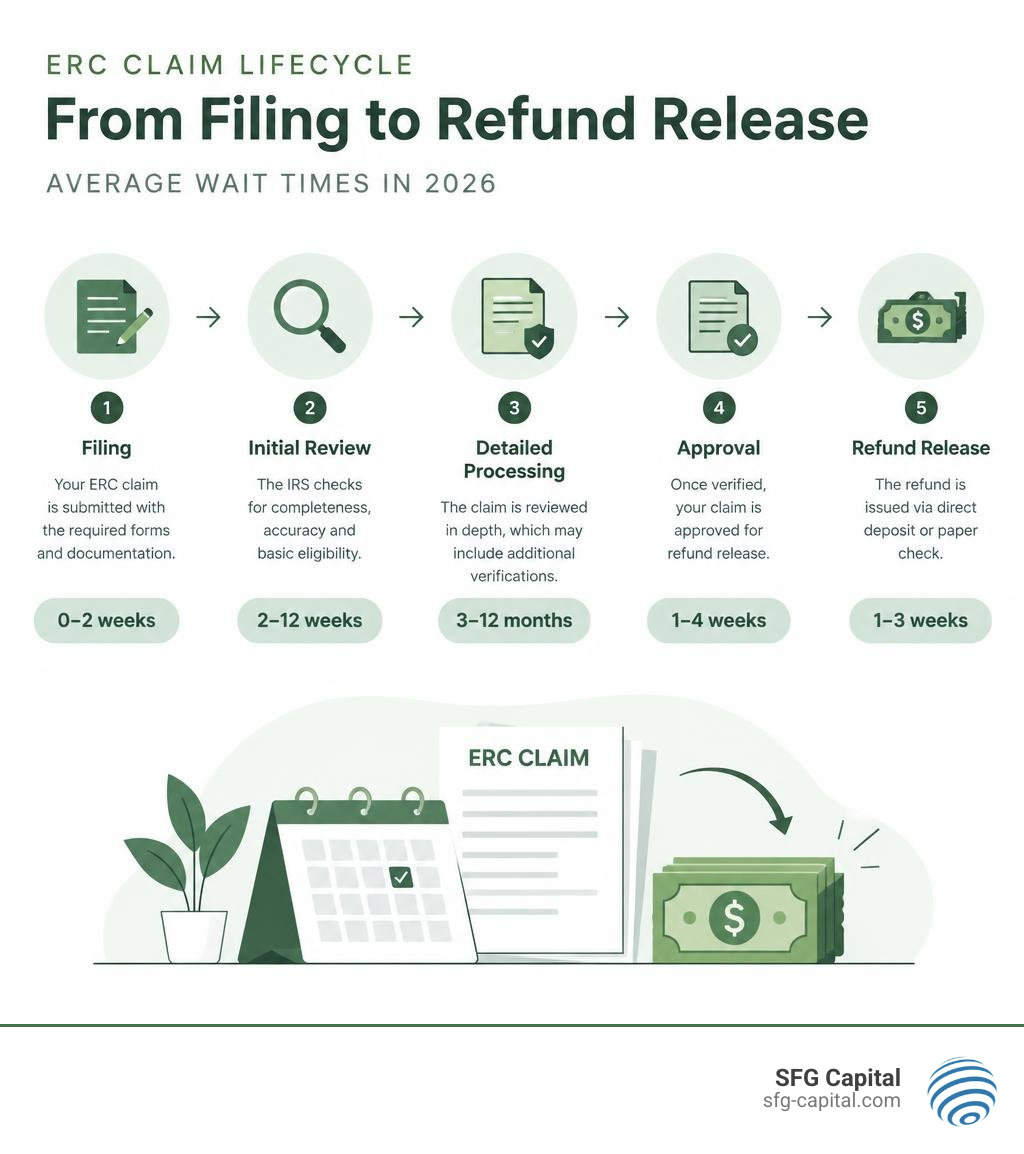
Diagnosing Your IRS ERC Refund Delay: Backlog Realities and Processing Stages in 2026
If you are dealing with an IRS ERC refund delay, you are not alone. While the original pandemic-era relief programs were designed to inject liquidity into local economies swiftly, the processing reality has been anything but fast. Gaining clarity on understanding your delayed Employee Retention Credit starts with looking at how the agency handles amended payroll returns.
Unlike individual returns, which flow through highly automated processing channels, business payroll adjustments filed on Form 941-X require intensive manual review. This structural bottleneck has transformed standard processing into a marathon.
Current 2026 Processing Stats and Claim Inventory
The overall inventory numbers paint a clear picture of the gridlock. The IRS has processed nearly 5 million ERC claims and distributed roughly $235 billion in total relief. However, a significant backlog remains unresolved.
According to tracking data and updates on 2026 ERC and 941-X processing times, the agency’s pipeline has slowed to a trickle:
- Recent weekly disbursements have seen as few as 44 refunds processed nationwide totaling just $7.53 million—with more than half of that dollar volume concentrated in a single $4 million outlier payment.
- In subsequent weeks, volume dropped further from 115 to 78 refunds, totaling under $5 million, with average processing times climbing to 805 days.
- By late summer 2026, roughly 14,900 to 17,300 active claims remained in the pipeline, with roughly 12,100 stuck in audits, disallowance reviews, or appeals.
- The Taxpayer Advocate Service (TAS) reports that approximately 41,000 ERC cases remain categorized under examination or compliance review.
Why the IRS ERC Refund Delay Stretches Beyond 700 Days
The average processing timeline from initial Form 941-X filing to refund issuance reached a record 720 days, and in many contested cases, wait times stretch past 800 days. Understanding these statutory delay mechanisms helps explain why claims take so long.
The Taxpayer Advocate Service has repeatedly highlighted that business amended returns represent one of the agency’s most severe operational challenges. When automated fraud filters flag a claim, it gets shifted out of the standard processing queue and into manual compliance units. TAS findings show that once a case is transferred to Exam, it adds an average cycle time of 435 to 572 days before Appeals even gets involved.
Understanding Claim Status: Pending, Exam, Disallowed, and Appeals
Not all delays are created equal. The IRS categorizes claims into distinct operational categories using a risk-based segmentation strategy. Knowing where your claim sits dictates your next legal and financial move.
| Claim Status | What It Means | Typical Next Step |
|---|---|---|
| Pending | Claim is logged into the master file but has not completed manual processing or risk scoring. | Pull business account transcripts; verify mailing proof; wait or check with IRS practitioner lines. |
| Under Examination | Flagged by compliance filters for audit; an examiner is assigned to review substantiation documents. | Assemble contemporaneous government orders, payroll records, and gross receipts ledgers. |
| Disallowed | Formally rejected via Letter 105-C or 106-C due to eligibility issues or late filing dates. | Calendar your 2-year lawsuit window under IRC §6532(a); evaluate an appeal or immediate litigation. |
| At Appeals | Transferred to the IRS Independent Office of Appeals for administrative dispute resolution. | Submit protest memos; request Form 907 to extend your lawsuit window while negotiations continue. |
How to Check Your Refund Status and Identify Account Holds
Standard tracking tools like “Where’s My Refund?” do not track Form 941-X filings. Relying on generic phone support often leads to vague answers. Performing a thorough ERC refund status check requires pulling business tax account transcripts directly.
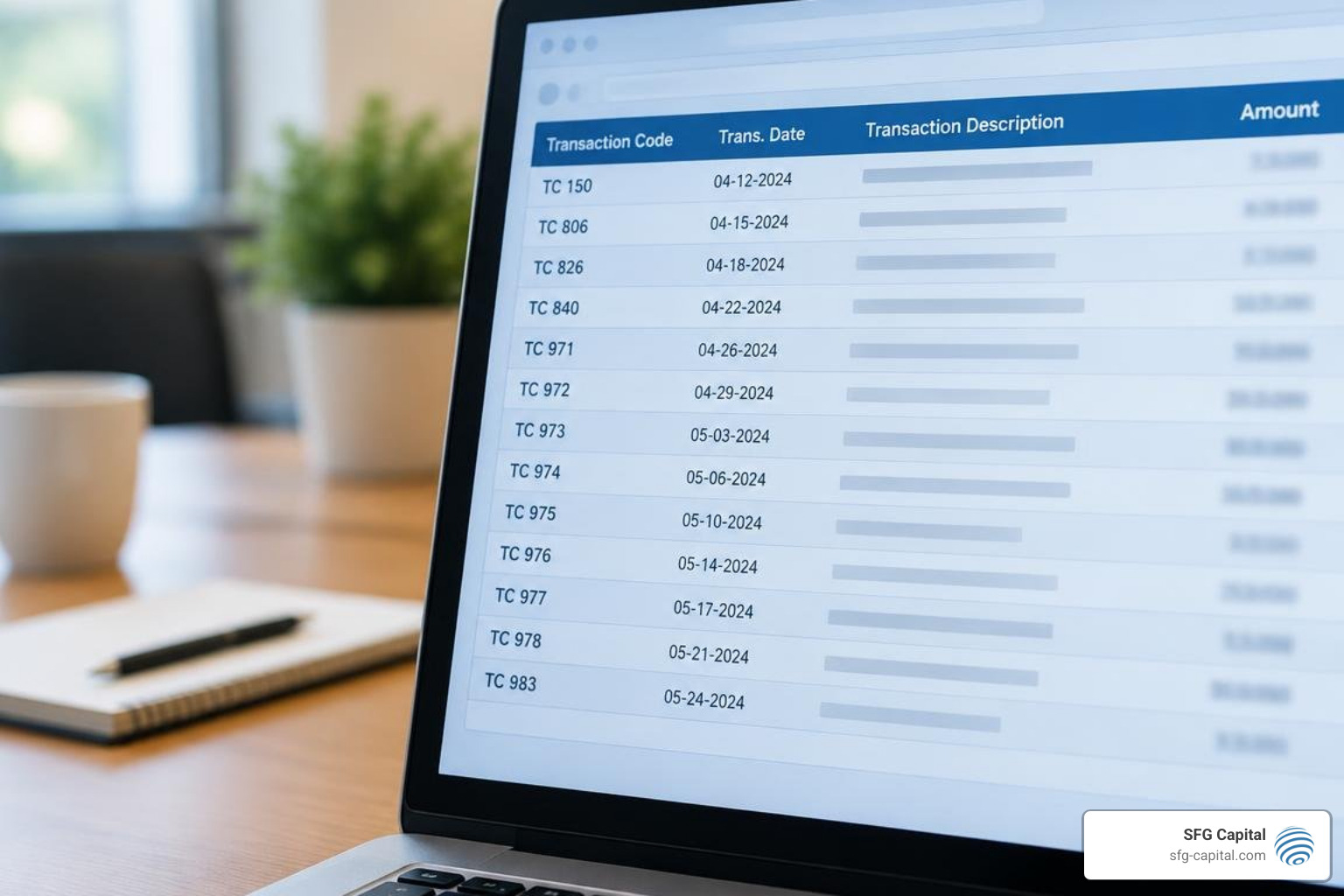
Reading Transcript Codes to Uncover Your IRS ERC Refund Delay
To see what is actually happening with your claim, access your IRS Business Tax Account or have your tax professional pull the account transcript for the quarterly Form 941 periods you amended. Look for these key Transaction Codes (TC):
- TC 976 / TC 977 (Amended Return Filed): Confirms the agency received and posted your Form 941-X. This code simply confirms receipt; it does not indicate approval.
- TC 810 (Refund Freeze): Signals that an administrative hold has stopped refund processing. This code often accompanies algorithmic audit flags.
- TC 420 / TC 424 (Examination Indicator): Shows your return was routed to the examination division for audit review.
- TC 570 (Additional Account Action Pending): Indicates an internal hold is delaying credit processing until another issue on the account is resolved.
- TC 846 (Refund Issued): The code every employer wants to see. It confirms that the credit was approved and payment (plus statutory interest) is scheduled for disbursement.
IRS Practitioner Line and Taxpayer Advocate Service (TAS) Intervention
If your transcripts show a multi-year freeze with no explanation, you have several administrative escalation routes:
- IRS Business & Specialty Tax Line: Call 800-829-4933 early in the morning. Have your EIN, exact entity legal name, and copies of all filed Forms 941 and 941-X ready.
- Practitioner Priority Service (PPS): If you work with a CPA or tax attorney holding an active Form 2848 (Power of Attorney), they can call the PPS line to speak directly with an agent who has broader access to internal tracking notes.
- Taxpayer Advocate Service (TAS): Submit Form 911 (Request for Taxpayer Advocate Service Assistance). TAS does not take every case simply because of a delay. However, they will step in if you can prove severe economic hardship—such as pending bankruptcy, risk of layoffs, or inability to meet operating expenses—or if the agency failed to meet its own promised resolution deadlines.
Critical Legal Deadlines: Statutes of Limitations, Appeals, and Lawsuits
When claims remain pending or receive rejection notices, tracking legal deadlines becomes essential. Many business owners assume they can wait indefinitely for an administrative resolution. In reality, strict statutory clocks are ticking.
If you are weighing whether you should sue or keep waiting, understanding these core deadlines is vital.
The Six-Month Refund Suit Rule vs. The Two-Year Clock After Letter 105-C
Under Internal Revenue Code (IRC) §6532(a), specific legal clocks govern your right to seek judicial relief:
- The Six-Month Waiting Rule: Once you properly file Form 941-X, the IRS has six months to act. If the agency has not issued a decision after six months, you are legally permitted to file a refund lawsuit in a US District Court or the US Court of Federal Claims. You are not required to sue at six months, but the legal door opens.
- The Two-Year Disallowance Clock: If the IRS formally denies your claim by issuing Letter 105-C or Letter 106-C (Notice of Claim Disallowance), a strict two-year statute of limitations begins on the exact mailing date of that letter. You have exactly two years from that date to file a lawsuit in federal court. If you miss this deadline, your right to recover the refund is permanently forfeited.
Why Appeals Does Not Stop the Clock and How Form 907 Protects Your Rights
One of the most dangerous traps for business owners is assuming that filing an administrative appeal pauses the two-year lawsuit window. It does not.
Hundreds of formal protests have been dismissed simply because the two-year clock expired while the case sat in the IRS Independent Office of Appeals. Tens of thousands more claims denied in mid-2024 are approaching their statutory cutoff in 2026.
If your appeal is taking longer than expected and you have less than six months remaining on your two-year window, you must execute Form 907 (Agreement to Extend the Time to Bring Suit) with the IRS. If the agency will not sign Form 907, you must file a lawsuit in federal court before the two-year mark expires to protect your claim.
Legislative Rules Under the OBBB Act and the Six-Year Audit Window
The legislative landscape has introduced additional compliance hurdles through the One, Big, Beautiful Bill Act (OBBB). Business owners must navigate two key provisions:
- Section 70605(d) Filing Cutoff: The act barred claims for Q3 and Q4 of 2021 that were submitted after January 31, 2024. If you submitted an amended return for late-2021 periods after that cutoff date, the claim is statutorily invalid.
- Extended Six-Year Audit Window: Standard payroll tax audits follow a three-year statute of limitations. The OBBB Act extended the IRS audit window for ERC claims to six years. This gives the agency ample time to audit, review, and challenge credit calculations long after funds have been disbursed.
Actionable Solutions: Audit-Proofing Your Claim or Bypassing IRS Delays
Navigating an extended refund delay requires a proactive approach. You can strengthen your files against incoming audits or explore private liquidity options to access your funds without waiting on government processing.
Audit-Proofing Your Documentation and Fixing Errors
To withstand agency review or navigate an appeal successfully, ensure your audit defense package includes clear, contemporaneous documentation:
- Gross Receipts Ledgers: Reconcile quarterly financial reports against annual federal income tax returns to prove declines under the required thresholds (a 50% drop for 2020 periods; a 20% drop for 2021 periods compared to 2019).
- Government Orders File: If qualifying under partial suspension, compile the specific, mandatory government executive orders from state or local authorities. Vague supply chain disruption claims without direct government mandates are routinely rejected.
- PPP Loan Reconciliation: Document wage allocation sheets proving no ERC-claimed payroll dollars overlapped with wages used for Paycheck Protection Program (PPP) loan forgiveness.
- Income Tax Amendments: Ensure you amended your historical income tax returns to reflect the required reduction in wage deductions for the tax years the credit was claimed.
Bypassing IRS Delays Through Advance Funding and Buyouts
For businesses needing working capital to manage payroll, buy inventory, or invest in expansion, waiting over 700 days for an agency check is not always feasible. Rather than watching your cash sit trapped in government pipelines, you can explore private capital alternatives.
Securing ERC advance funding or executing an outright claim buyout allows your business to unlock immediate capital. Under a buyout structure, an institutional funder purchases your verified claim, delivering liquidity directly to your balance sheet. This shifts the multi-year wait and administrative collection burden onto the funder, freeing you to focus entirely on running your business.
Frequently Asked Questions About ERC Processing
Can the IRS still process Q3 and Q4 2021 claims filed after January 31, 2024?
Under Section 70605(d) of the One, Big, Beautiful Bill Act (OBBB), claims for the third and fourth quarters of 2021 filed after January 31, 2024, are statutorily barred. The IRS is prohibited from processing or paying refunds on those specific late-filed periods.
What happens if my two-year refund lawsuit clock runs out while in IRS Appeals?
If your two-year statute of limitations under IRC §6532(a) expires while your case is pending in the IRS Independent Office of Appeals, you permanently forfeit your legal right to the refund. Administrative appeals do not pause the statutory clock. If your deadline is approaching, you must secure an executed Form 907 extension or file a refund suit in federal court.
What is the fastest way to get liquidity while waiting on an ERC refund?
The fastest way to access liquidity is through an ERC advance or buyout. Rather than waiting years for IRS processing, qualifying businesses can work with private funding firms to monetize their claims upfront.
Conclusion
The reality of the 2026 tax landscape is clear: between extensive review queues, strict statutory deadlines, and manual processing bottlenecks, waiting on government checks can drain your operational momentum. Business owners must stay vigilant with their account transcripts, track legal deadlines, and ensure their supporting files are thoroughly documented.
At SFG Capital, we help businesses across Travis County, Austin, and nationwide navigate these delays and unlock working capital. With over $500 million in purchased and funded claims, our team offers performance-based buyouts and advance structures designed to bypass government gridlock entirely. Explore our customized funding solutions today to turn your pending credit into working capital and get back to growing your business.
See what your business may qualify for.
60 seconds. No documents. No upfront cost.
General information only, not legal or tax advice. Eligibility and estimates are fact-specific and subject to review.