
Blog / Insights
InsightsSurviving the 2026 ERC Disallowance Wave
October 14, 2026 · 10 min read · By the SFG Capital team
What the 2024 ERC Update Means for Businesses Facing IRS Action in 2026
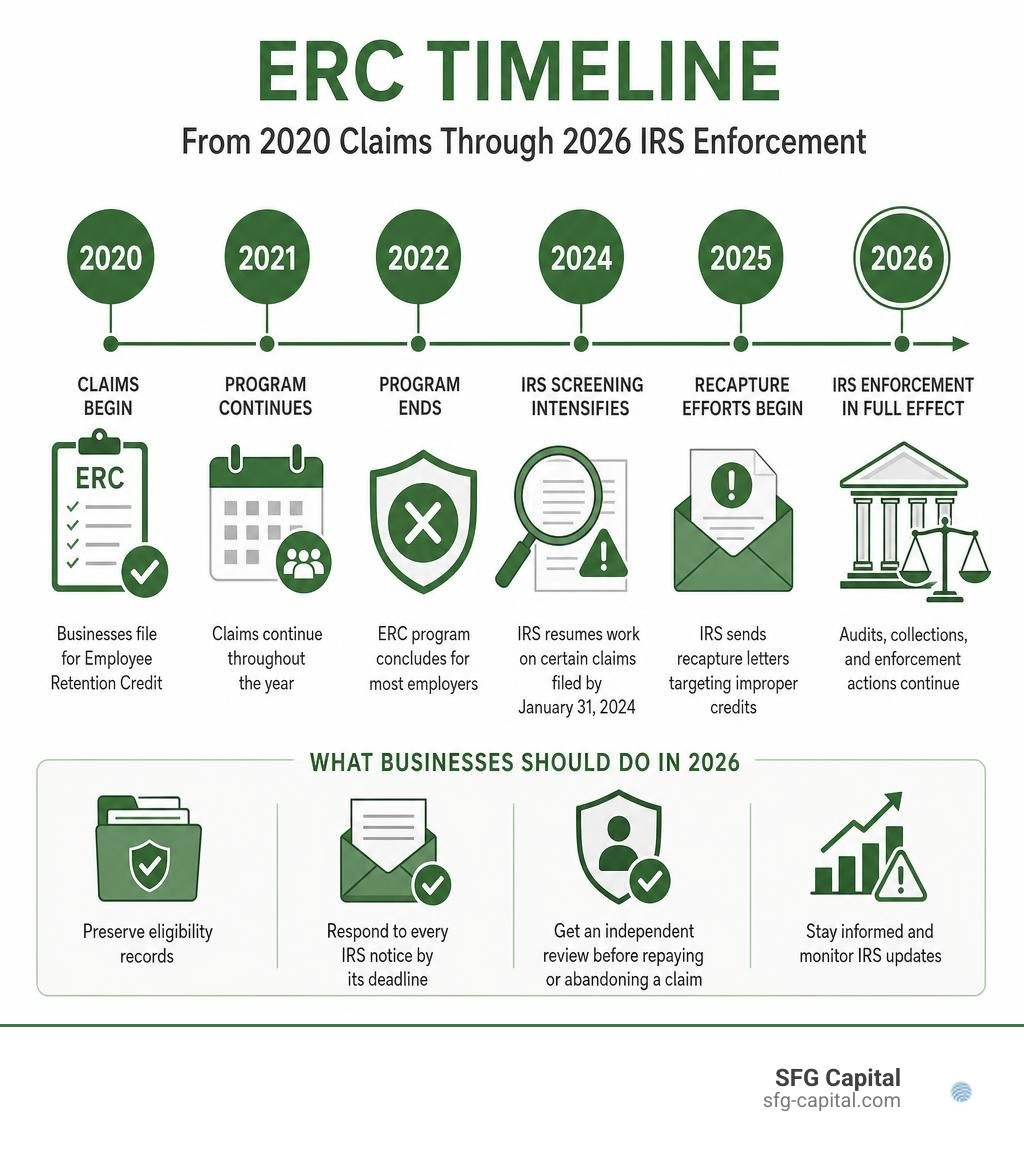
The ERC update 2024 marked a major shift from delayed refunds to tighter IRS screening, denials, and recapture efforts. The IRS began reviewing claims by risk level, resumed work on certain claims filed by January 31, 2024, and later sent recapture letters targeting improper credits. In 2026, businesses should protect themselves by preserving eligibility records, responding to every IRS notice by its deadline, and getting an independent review before repaying or abandoning a claim.
The stakes remain high. The IRS announced plans to send up to 30,000 recapture letters involving more than $1 billion in questionable ERC claims. Meanwhile, later legislation cut off many unpaid claims filed after January 31, 2024, and extended the IRS assessment period for certain 2021 claims. A delayed refund is no longer just a cash-flow problem. It can become an audit, collection, or litigation issue.
I am Santino Battaglieri, and I lead SFG Capital, a financial services firm focused on ERC advisory, compliance support, and structured funding solutions. My experience managing and funding more than $500 million in ERC claims gives me a practical perspective on the ERC update 2024 and the documentation, timing, and risk questions businesses face today.
Learn more about erc update 2024:
Key Takeaways from the IRS ERC Update 2024 Processing Strategy

The transformation of the Employee Retention Credit (ERC) landscape began in earnest when the Internal Revenue Service took aggressive administrative action to control rampant fraud. Originally enacted under the CARES Act to support employers who retained staff through COVID-19 pandemic disruptions, the program saw unprecedented demand. The total projected cost of the credit quickly escalated past $300 billion, nearly quadrupling initial government forecasts.
Faced with an overwhelming influx of aggressive, promoter-driven filings, the IRS placed a formal processing moratorium on all new claims submitted on or after September 14, 2023. This administrative halt contributed to a severe backlog of approximately 983,000 unprocessed amended employment tax returns (Form 941-X). For business owners waiting on legitimate liquidity, navigating these hurdles requires decoding ERC processing timelines to understand how claims move from submission to examination.
Risk Categorization and Moratorium Shifts: An ERC Update 2024 Review
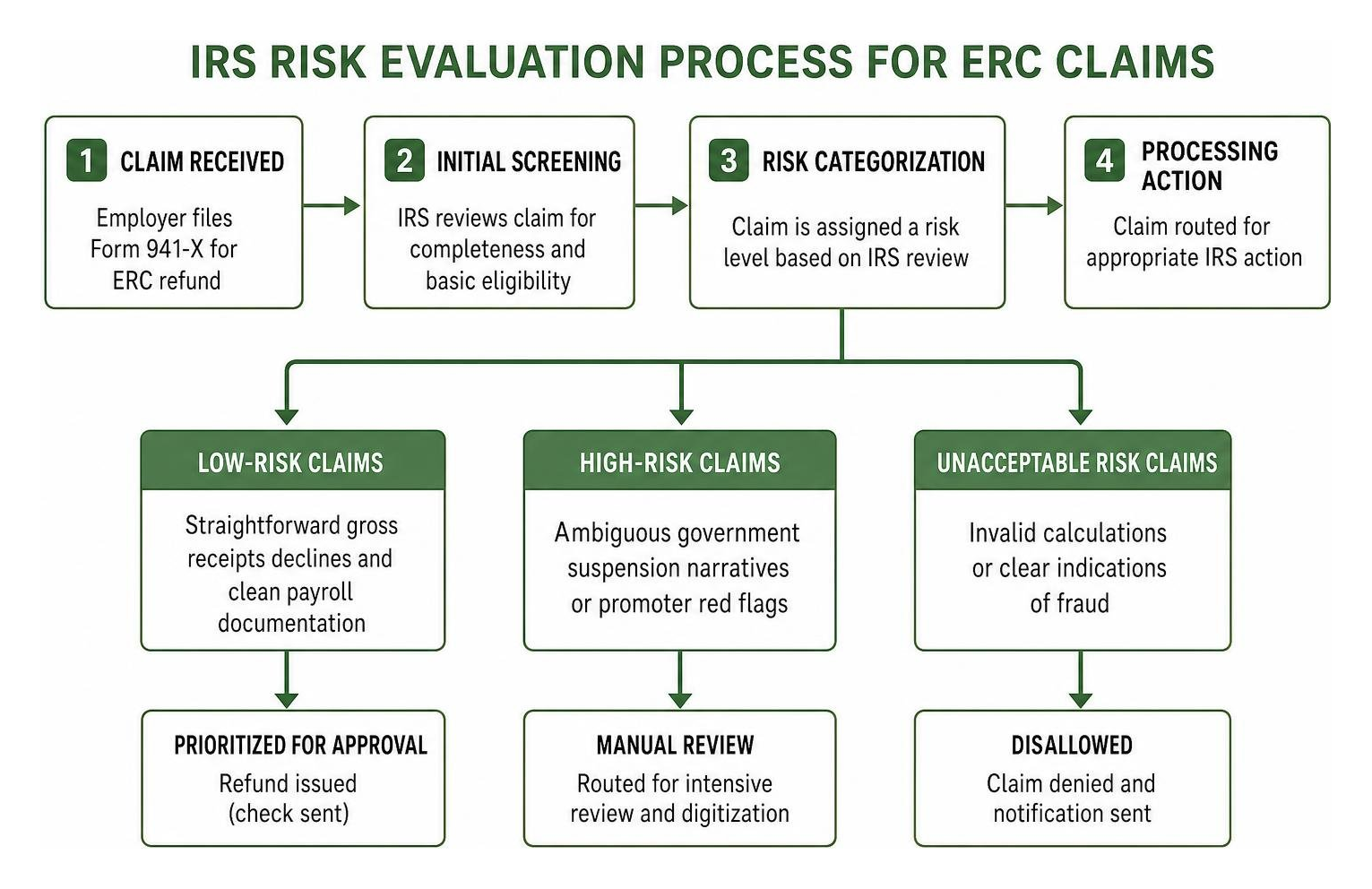
In June 2024, the IRS instituted a structured risk-tiering system to manage its massive inventory. Every unprocessed claim was segregated into one of three risk categories:
- Low-Risk Claims: Submissions with straightforward gross receipts declines and clean payroll documentation, which were prioritized for approval and check issuance.
- High-Risk Claims: Filings containing ambiguous government suspension narratives or promoter red flags, routed for intensive manual review and digitization.
- Unacceptable Risk Claims: Returns with fundamentally invalid calculations or clear indications of fraud, marked for immediate disallowance notices.
By August 2024, the IRS partially shifted the processing moratorium, resuming the examination of claims submitted between September 14, 2023, and January 31, 2024. This left business owners wondering whether is the IRS ERC program still accepting claims or if the window had closed entirely on retroactive relief.
Voluntary Disclosure Programs: Comparing VDP 1 and 2
To encourage non-compliant filers to come forward voluntarily without facing civil fraud penalties or criminal prosecution, the agency launched two distinct disclosure programs. The first Voluntary Disclosure Program (VDP 1) concluded in March 2024, yielding over 2,600 applications that disclosed $1.09 billion in erroneous claims. Under Announcement 2024-3, eligible participants retained 20% of the claimed funds while remitting the remaining 80%.
Building on this framework, the IRS opened a second Voluntary Disclosure Program (VDP 2) in August 2024, which ran through November 22, 2024. Targeted specifically at invalid 2021 tax period claims, VDP 2 required participants to remit 85% of the credit while keeping 15%.
| Program Feature | Voluntary Disclosure Program 1 (VDP 1) | Voluntary Disclosure Program 2 (VDP 2) |
|---|---|---|
| Application Window | December 2023 – March 22, 2024 | August 2024 – November 22, 2024 |
| Repayment Requirement | 80% of total credit received | 85% of total credit received |
| Retained Amount | 20% retained by business | 15% retained by business |
| Applicable Tax Periods | 2020 and 2021 claims | 2021 claims only |
| Penalties & Interest | Full penalty relief; keep overpayment interest | Full penalty relief; keep overpayment interest |
| Income Tax Adjustments | No Section 280C wage add-back required | No Section 280C wage add-back required |
Understanding IRS Enforcement: Letters 105C, 106C, and 6577-C Recapture Notices

As enforcement operations expanded throughout 2024 and into subsequent tax years, the IRS initiated widespread mailings to reject questionable claims and claw back improper refunds. These administrative notices carry critical legal distinctions:
- Letter 105C (Full Disallowance): Issued when the IRS fully denies an unadjusted claim, commonly citing lack of evidence for a qualifying government order suspension or failing to meet revenue reduction thresholds.
- Letter 106C (Partial Disallowance): Sent when the agency adjusts or disallows a portion of the claimed refund, frequently due to calculation errors or non-qualifying wage allocations.
- Letter 6577-C (Recapture Notice): Dispatched when the IRS actively seeks repayment of ERC funds that were already disbursed to the employer.
In the Fall 2024 recapture initiative, the IRS announced it would send up to 30,000 Letter 6577-C notices targeting over $1 billion in erroneous payouts. This followed earlier enforcement where letters sent to more than 12,000 entities for tax year 2020 yielded over $572 million in assessments. Businesses receiving these notices should review the official Taxpayer Advocate Service guidance on recapture letters to safeguard their administrative and judicial rights.
Decoding Disallowance Letters and Recapture Audits
Receiving a formal denial or recapture letter triggers strict, non-negotiable statutory deadlines. Taxpayers receiving Letter 105C or 106C generally have 30 days from the letter date to file an administrative appeal with the IRS Independent Office of Appeals.
If a business receives Letter 6577-C or a subsequent Notice of Intent to Levy (such as a CP504B notice), immediate action is required to avoid aggressive collection activity:
- Conduct an Internal Eligibility Audit: Compare qualifying payroll records and government suspension orders against the specific reasons for disallowance outlined in the letter.
- Submit a Written Protest: If you disagree with the adjustment, submit a formal written rebuttal with substantiating evidence within the required response window.
- Request Collection Due Process (CDP): File Form 12153 within 30 days of receiving a levy notice to preserve your right to challenge the underlying tax liability before the U.S. Tax Court.
- Utilize an Equivalent Hearing: If the strict 30-day CDP deadline is missed, request an Equivalent Hearing within one year, though this path waives future Tax Court review.
- Evaluate Relief and Payment Options: For legitimate balances due that cannot be paid immediately, submit an Installment Agreement (Form 9465), explore an Offer in Compromise, or request Currently Not Collectible status.
Legislative Fallout: OBBBA and the 6-Year Statute of Limitations
The legislative environment surrounding pandemic relief shifted significantly under the One Big Beautiful Bill Act (OBBBA). In an effort to curb ballooning costs and penalize improper filings, the legislation introduced a retroactive claim cutoff date of January 31, 2024. This provision effectively barred the processing of unpaid Q3 and Q4 2021 claims filed after that date, overriding the original statutory ERC claim deadline.
Furthermore, the OBBBA extended the IRS statute of limitations for assessing ERC claims for the third and fourth quarters of 2021 from five years to six years. As a result, the audit window for those periods remains open until January 31, 2030. The statute also enacted severe penalties for non-compliant third parties, imposing a $1,000 penalty per failure on promoters who breached statutory due diligence standards. For an in-depth analysis of these statutory measures, review the legal commentary on how federal tax legislation restricting the Employee Retention Credit fundamentally reshaped compliance exposure.
Navigating Administrative Appeals and Section 7422 Refund Litigation
The IRS Independent Office of Appeals serves as an administrative venue for resolving tax disputes without litigation. However, engaging in administrative appeals does not stop or toll the two-year statutory clock to file a refund lawsuit in federal district court once a formal notice of disallowance is mailed. Claimants must execute IRS Form 907 to formally extend the two-year period if negotiations remain unresolved.
Federal enforcement remains at historic highs. IRS Criminal Investigation (CI) initiated 301 criminal investigations involving more than $3.4 billion in suspected promoter fraud and improper credit claims. In total, CI identified over 323 investigations spanning more than $2.8 billion in potentially fraudulent claims from tax years 2020 through 2023. Businesses caught in these systemic bottlenecks often focus on overcoming ERC refund delays to preserve their operational stability while defense strategies are prepared.
Resolving Claim Delays: A Judicial ERC Update 2024 Perspective
Under Internal Revenue Code (IRC) Section 7422, a taxpayer who has filed a timely claim for refund that has remained pending with the IRS for more than six months without a formal determination has the legal right to file a refund complaint in federal district court or the U.S. Court of Federal Claims.
Filing a Section 7422 lawsuit shifts the procedural landscape:
- Department of Justice Authority: Under IRC Section 7122, filing a federal complaint immediately strips the IRS of direct settlement authority and transfers exclusive jurisdiction to the Department of Justice (DOJ).
- Binding Precedent: In JPM Restaurant LLC v. United States (E.D. TN, 2025), the court affirmed that administrative settlement agreements negotiated with the IRS become void once a federal complaint is filed, as sole settlement power rests with the DOJ.
- Strategic Finality: Litigation forces the government to evaluate the claim’s merits within established judicial deadlines rather than leaving the file indefinitely stalled in administrative queues.
Handling PEO Filings and Third-Party Payroll Errors
Employers that utilized Professional Employer Organizations (PEOs) face distinct operational hurdles because their credits were claimed under the PEO’s Employer Identification Number (EIN) on aggregate Form 941 filings and Schedule R attachments. If a PEO miscalculated wages or failed to disburse refund checks, the underlying employer faces direct business liability.
To resolve these complexities, the IRS introduced a supplemental claim process in September 2024. This mechanism permits third-party reporting agents and PEOs to adjust or withdraw improper ERC claims for specific client entities without delaying or invalidating the legitimate claims of compliant employers on the same aggregate schedule.
Correct Tax Return Adjustments and Wage Expense Reporting
Claiming the Employee Retention Credit carries direct federal and state income tax implications. Under IRC Section 280C, employers must reduce their deductible wage expenses by the exact amount of the ERC received for that specific tax year. This prevents a “double benefit” where an employer deducts payroll costs while simultaneously receiving a dollar-for-dollar tax credit against those same wages.
- Entity Adjustments: Pass-through entities must amend their Form 1120-S or Form 1065 returns for the corresponding tax period (2020 or 2021) to reflect the reduced wage deductions, flowing the adjusted taxable income through to shareholders or partners on Schedule K-1.
- Interest Income Treatment: Any statutory overpayment interest paid by the IRS alongside the credit is fully taxable as interest income in the tax year it is received.
- Disallowed Credits: If an ERC claim is subsequently disallowed or repaid during an audit or VDP settlement, the business may restore its deductible wage expenses on its income tax return in the year of repayment.
Maintaining thorough compliance requires confirming that your original wage calculations complied with all ERC eligibility requirements before finalizing income tax amendments.
Frequently Asked Questions About the ERC Wave
What should I do immediately after receiving IRS Letter 6577-C?
Upon receiving Letter 6577-C, review the stated reasons for recapture against your original eligibility substantiation. If you disagree with the determination, submit a detailed written explanation along with supporting documentation within the deadline specified in the letter. If you receive a subsequent Notice of Intent to Levy, file Form 12153 within 30 days to request a Collection Due Process (CDP) hearing to preserve your appeal rights before the U.S. Tax Court.
Can I still litigate an unprocessed ERC claim filed before 2024?
Yes. If your original, timely Form 941-X claim has been pending with the IRS for at least six months without a formal determination, you have the statutory right under IRC Section 7422 to file a refund complaint in federal district court. Initiating litigation transfers settlement authority to the Department of Justice and compels the government to resolve the claim under federal court supervision.
How are ERC refund interest and wage deductions reported on income taxes?
Under IRC Section 280C, you must reduce your business wage expense deductions on your income tax return (Form 1120, 1120-S, or 1065) for the year the qualifying wages were paid. Any interest received from the IRS is treated as ordinary interest income and must be reported in the tax year the check was issued. If your claim is disallowed and repaid, you can reclaim the wage deductions in the year of repayment.
Conclusion
The aggressive IRS audit initiatives and statutory adjustments stemming from the 2024 updates highlight the necessity of strong compliance, organized recordkeeping, and proactive legal defense. With the assessment window for 2021 claims open through January 31, 2030, businesses must verify their documentation and address IRS correspondence without delay.
For business owners operating in Austin and Travis County, navigating lengthy IRS backlogs while maintaining daily operational cash flow remains a critical challenge. At SFG Capital, we provide specialized claim advisory, audit substantiation support, and liquidity advances that allow qualified businesses to bypass processing delays. Discover how our team can support your organization through the ERC funding process and secure your pandemic-era tax credits today.
See what your business may qualify for.
60 seconds. No documents. No upfront cost.
General information only, not legal or tax advice. Eligibility and estimates are fact-specific and subject to review.