
Blog / Insights
InsightsThe Full-Time Employee Guide to ERC Eligibility
October 14, 2026 · 9 min read · By the SFG Capital team
ERC Eligibility Full-Time Employees: Start With Your 2019 Count
For ERC eligibility full-time employees, first calculate your average number of full-time employees in 2019. An employee counts as full-time if they averaged at least 30 hours per week or 130 hours in a month under the Affordable Care Act standard.
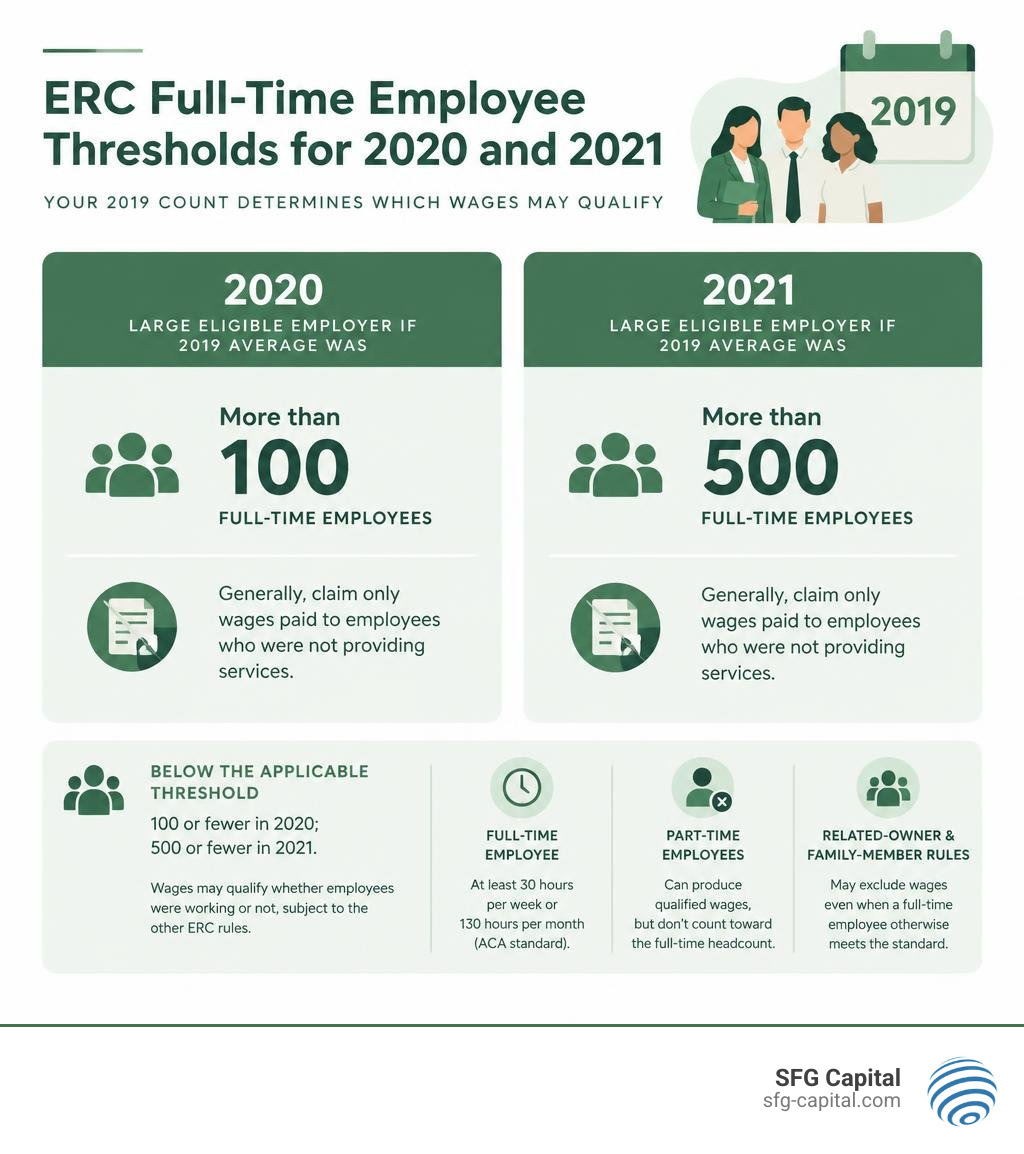
That 2019 count does not decide whether your business qualifies through a COVID-19 government-order suspension or a decline in gross receipts. It decides which wages you may treat as qualified wages:
| ERC wage period | Large eligible employer if 2019 average was | Result |
|---|---|---|
| 2020 | More than 100 full-time employees | Generally, claim only wages paid to employees who were not providing services. |
| 2021 | More than 500 full-time employees | Generally, claim only wages paid to employees who were not providing services. |
| Below the applicable threshold | 100 or fewer in 2020; 500 or fewer in 2021 | Wages may qualify whether employees were working or not, subject to the other ERC rules. |
Part-time employees can produce qualified wages, but their hours do not turn into full-time equivalents for this headcount test. Related-owner and family-member wage rules can also exclude wages even when a full-time employee otherwise meets the standard.
The ERC covered qualifying wages paid from March 13, 2020, through December 31, 2021. Although the original claim deadlines have passed for most employers, accurate employee-count and wage support remains vital for pending claims, IRS reviews, appeals, and any correction of an improper filing.
I am Santino Battaglieri, founder of SFG Capital, with more than nine years in financial services and experience supporting and funding ERC transactions at scale. My work on ERC eligibility full time employees focuses on careful documentation, conservative eligibility analysis, and coordination with qualified tax and legal professionals before a business relies on a claim.
Definition of a Full-Time Employee for ERC Purposes
Navigating the Employee Retention Credit requires mastering federal tax definitions that do not always align with everyday payroll terminology. For the purposes of the credit, the Internal Revenue Service adopts the definition found in Section 4980H of the Internal Revenue Code (IRC), commonly known as the Affordable Care Act (ACA) shared responsibility provision.
Under IRC Section 4980H, a full-time employee is defined as an individual who, for any calendar month in 2019, had an average of at least 30 hours of service per week or 130 hours of service in the month.

When establishing your baseline, you must look strictly at the 2019 calendar year, regardless of whether your business operations fluctuated during 2020 or 2021. To calculate the baseline, take the sum of the number of full-time employees for each calendar month in 2019 and divide that total by 12. Understanding this definition is critical; reviewing the Employee Retention Credit overview alongside our essential guide to ERC eligibility requirements will ensure your baseline math withstands rigorous scrutiny.
Full-Time Equivalents vs. Full-Time Employees
One of the most frequent errors made on amended payroll tax returns involves aggregating part-time hours into Full-Time Equivalents (FTEs). In standard business metrics and Paycheck Protection Program (PPP) forgiveness calculations, employers routinely combine part-time employee hours to determine FTE headcount.
For ERC size threshold determinations, do not calculate Full-Time Equivalents.
- Only count individual full-time workers: An employee who worked 20 hours per week in 2019 is a part-time worker and is counted as zero in the threshold calculation.
- No hour pooling: You do not add two 15-hour-per-week employees together to create one full-time employee.
- Monthly determination: If a worker logged 130 hours in March 2019, they count as 1 for that month; if they logged 110 hours in April, they count as 0 for April.
While part-time workers are excluded from the large employer threshold test, their paid compensation can still count as qualified wages if the business meets ERC refund requirements.
Related Individual and Majority Owner Rules
Even if an employee worked 40 hours every single week in 2019, 2020, and 2021, their compensation may be ineligible under IRS constructive ownership and related individual rules.
Under IRC Section 51(i)(1) and Section 267(c), wages paid to majority owners (individuals owning more than 50% of the value of the business, directly or indirectly) and their relatives do not constitute qualified wages for the credit. The attribution rules are expansive:
- Direct familial relationships: Children, stepchildren, siblings, step-siblings, parents, ancestors, step-parents, nieces, nephews, aunts, uncles, sons-in-law, daughters-in-law, fathers-in-law, mothers-in-law, brothers-in-law, and sisters-in-law.
- Entity-level attribution: If an individual owns 100% of a corporation, that ownership is attributed to their parents, children, and siblings. Consequently, if a brother and sister both work for the family business, the brother’s ownership is attributed to the sister, making her a constructive majority owner and disallowing her W-2 wages from the credit calculation.
- Household members: Any individual who shares the principal place of abode with the business owner.
Threshold Guidelines for ERC Eligibility Full Time Employees
Determining your business size establishes the playground rules for your entire claim. The 2019 full-time employee count dictates whether your business is classified as a small eligible employer or a large eligible employer.
To establish your threshold correctly, follow the official IRS ERC FAQ guidance and cross-reference our breakdown of ERC qualifications criteria. The rules apply distinct caps across the two operative calendar years:
| Program Metric | 2020 Calendar Year | 2021 Calendar Year |
|---|---|---|
| Small Employer Full-Time Limit | Up to 100 full-time employees (2019 average) | Up to 500 full-time employees (2019 average) |
| Large Employer Threshold | More than 100 full-time employees | More than 500 full-time employees |
| Qualified Wage Treatment (Small) | All wages paid to working & non-working staff | All wages paid to working & non-working staff |
| Qualified Wage Treatment (Large) | Only wages paid for time not providing services | Only wages paid for time not providing services |
| Max Qualified Wages Per Employee | $10,000 annually | $10,000 per calendar quarter (Q1–Q3) |
| Maximum Credit Percentage | 50% ($5,000 per employee) | 70% ($7,000 per employee per quarter) |
2020 vs 2021 Thresholds for ERC Eligibility Full Time Employees
The shift between 2020 and 2021 rules dramatically altered the credit’s reach. In 2020, Congress set a conservative limit: employers with more than 100 full-time staff in 2019 faced the restrictive “non-working wages only” standard.
When the Relief Act and the American Rescue Plan took effect for 2021, lawmakers expanded the small employer ceiling up to 500 full-time employees. A mid-sized business in Austin, Texas, with 250 full-time employees in 2019 was considered a large employer for 2020 claims, but qualified as a small employer for 2021. Review our practical ERC eligibility checklist to verify which thresholds apply to your quarterly filings.
Common Aggregation Pitfalls in Assessing ERC Eligibility Full Time Employees
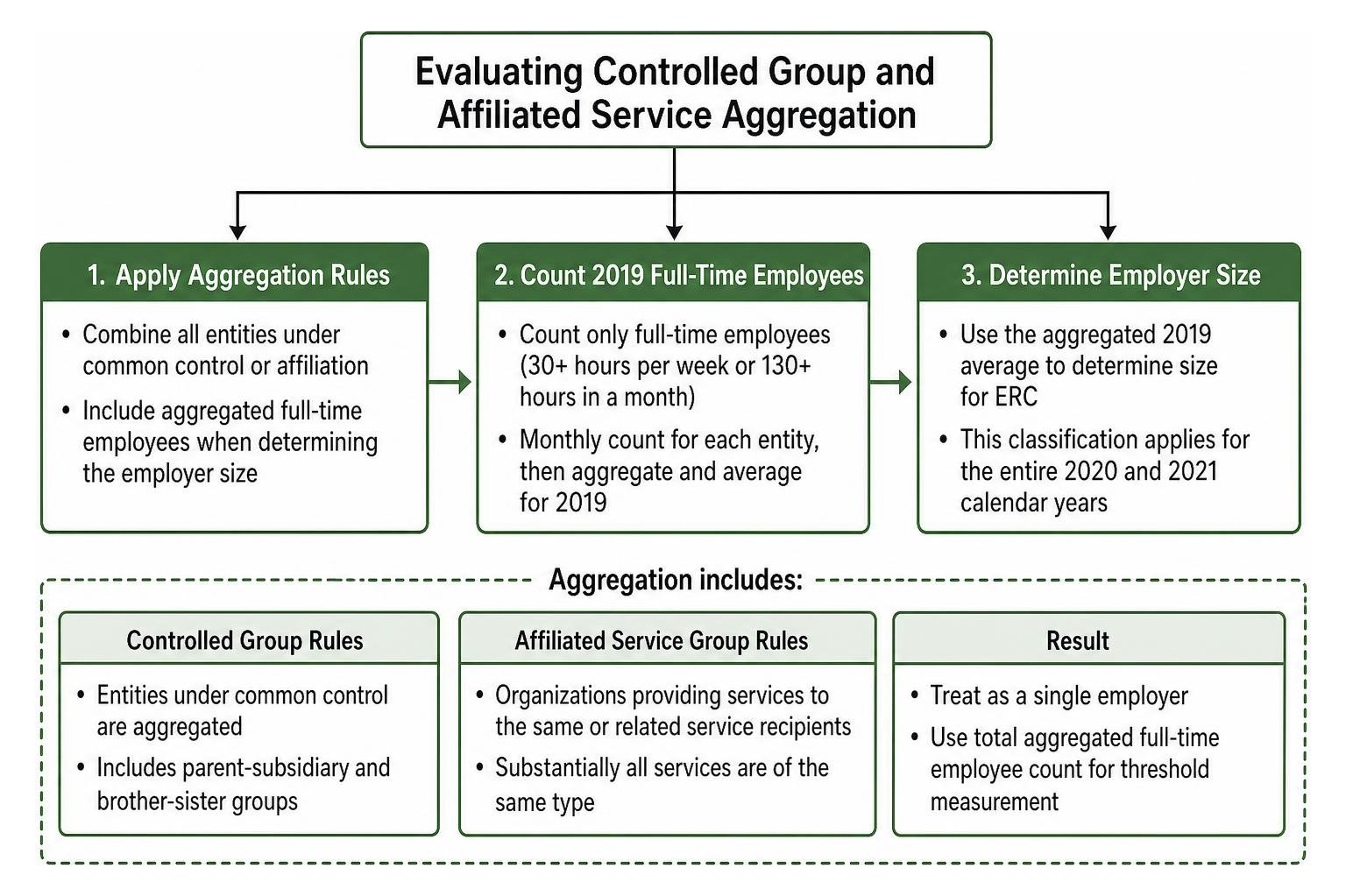
You cannot simply review an individual corporate entity or EIN in isolation. Under IRC Section 52(a), Section 52(b), Section 414(m), and Section 414(o), businesses that share common ownership or operational linkages must aggregate their employees into a single controlled group.

Common aggregation traps include:
- Parent-Subsidiary Groups: A parent entity owning at least 80% of voting power or share value in one or more subsidiaries must combine the 2019 headcount of all entities.
- Brother-Sister Groups: Five or fewer individuals owning at least 80% of multiple entities, with more than 50% identical ownership across each business, must pool their employee counts.
- Affiliated Service Groups: Service-based organizations (such as medical practices, legal firms, or engineering groups) that share management or specialized service personnel must aggregate their full-time headcounts.
If Entity A in Travis County had 60 full-time employees and Entity B had 55 full-time employees in 2019, and both share 100% common ownership, their aggregated baseline is 115 full-time employees. For 2020 claims, both entities are pushed into large employer status.
Small vs. Large Eligible Employer Treatment
The distinction between small and large employer status does not govern whether your business can submit a claim. Instead, it dictates the exact nature of the payroll expenses you are legally permitted to claim.
Whether your eligibility originates from a full or partial suspension of operations via an official government order or a significant decline in gross receipts (a >50% drop in 2020 or a >20% drop in 2021 compared to 2019), your employer size determines the eligible wage pool. The official IRS eligibility checklist outlines these core criteria, while our guide on what is ERC breaks down the specific payroll calculations.
Qualified Wages for Small Eligible Employers
For small eligible employers (100 or fewer full-time workers in 2019 for 2020 claims; 500 or fewer for 2021 claims), qualified wages encompass:
- Regular hourly compensation and salary paid to employees who continued working on-site or remotely.
- Qualified health plan expenses allocable to those employees, including pre-tax employee contributions.
- Compensation paid to employees during periods of reduced operations or paid administrative leave.
Because small employers can claim wages paid to actively working staff, they can capture the maximum credit rate—up to $5,000 per employee for 2020 and up to $21,000 per employee across the first three quarters of 2021.
Restrictions on Large Eligible Employers
Large eligible employers operate under much stricter statutory conditions. A large employer cannot claim wages paid to employees for carrying out their regular job duties.
To claim qualified wages, a large employer must prove that wages were paid to an employee specifically for time the employee was not providing services due to either:
- A government-ordered full or partial suspension of business operations, or
- A qualifying calendar quarter decline in gross receipts.
If a manufacturing facility in Travis County with 600 full-time staff continued operating at full capacity, it cannot claim wages for active work hours. However, if the business paid employees to stay home on paid standby during a mandatory county shutdown, those specific non-working hours qualify. For deep-dive local context on maximizing cash flow under complex tax rules, explore our Texas business guide to ERC refunds.
Frequently Asked Questions About ERC Eligibility and Full-Time Staff
Can wages paid to part-time employees be claimed for the ERC?
Yes. Although part-time employees are excluded from your 2019 full-time employee headcount calculation, qualified wages paid to part-time workers during 2020 and 2021 can be claimed for the credit. For small employers, part-time wages qualify whether the employee was actively working or not, up to the quarterly $10,000 wage ceiling per worker.
What happens if an employer exceeded 500 full-time employees in 2019?
Employers with more than 500 full-time employees in 2019 are categorized as large eligible employers for both 2020 and 2021. They remain eligible to participate in the program, but their claim is strictly limited to wages paid to employees for time they were not performing services due to a qualifying suspension order or gross receipts decline.
How do full-time employee rules apply to recovery startup businesses?
A Recovery Startup Business (RSB) is an enterprise that began operations after February 15, 2020, and maintained average annual gross receipts of $1 million or less. RSBs are eligible to claim up to $50,000 per quarter for Q3 and Q4 of 2021. Because an RSB was established after 2019, its 2019 full-time employee count is zero, allowing it to claim qualified wages paid to active employees under the small employer standard.
Conclusion
Properly documenting your 2019 full-time employee baseline under IRC Section 4980H is an essential step in maintaining an audit-ready filing. As the IRS processes its remaining inventory of pending amended employment tax returns and audits prior filings, having a defensible calculation of full-time headcounts, controlled group affiliations, and qualified wages protects your enterprise from costly clawbacks and penalties.
Waiting on pending refund checks from the IRS can stall growth and tie up vital working capital. We work alongside business owners throughout Austin and Travis County to turn delayed tax credits into immediate balance-sheet liquidity. Explore our SFG Capital refund acceleration services to discover how our buyout and advance solutions can eliminate administrative delays and support your ongoing business operations.
See what your business may qualify for.
60 seconds. No documents. No upfront cost.
General information only, not legal or tax advice. Eligibility and estimates are fact-specific and subject to review.