
Blog / Insights
InsightsThe IRS Is Holding My Refund for Review and I Need Answers
October 14, 2026 · 10 min read · By the SFG Capital team
What to Do When the IRS Is Holding Your Refund for Review
If the IRS is holding my refund for review is the message you are seeing, the IRS has paused payment while it checks information on your return or claim. Start by checking Where’s My Refund?, reading every IRS notice closely, and sending requested records by the deadline. Do not file the same return again unless the IRS tells you to.
Most refunds arrive within 21 calendar days, but a review can take 45 to 180 days when the IRS needs to verify income, withholding, credits, identity, or missing prior-year returns. For businesses waiting on ERC-related refunds, reviews and processing backlogs can create an especially difficult working-capital gap.
I am Santino Battaglieri, founder of SFG Capital, with more than nine years in financial services and experience supporting ERC transactions and structured funding. When the IRS is holding my refund for review becomes a business problem, my focus is on clear documentation, compliant options, and helping business owners understand the path ahead.
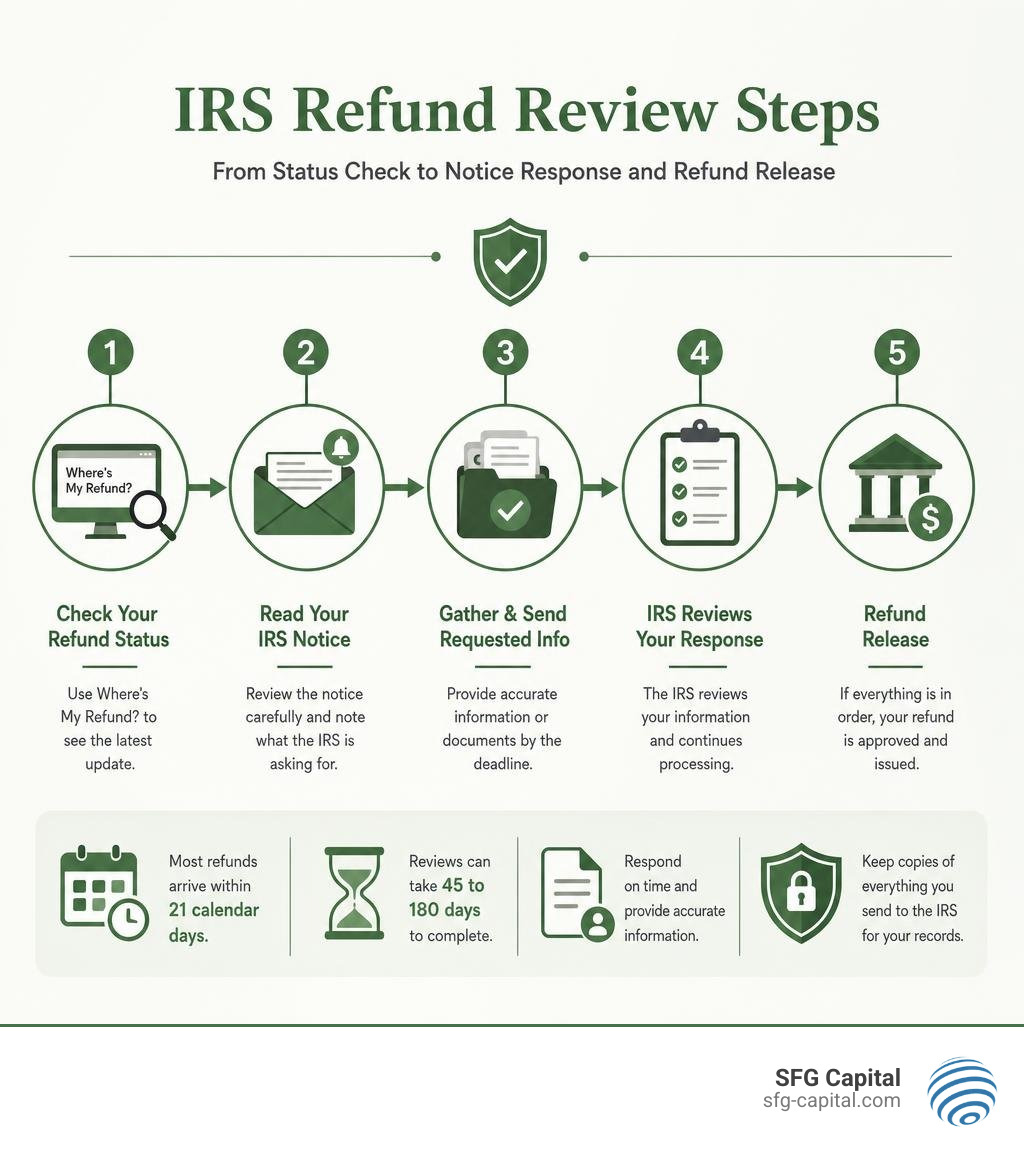
Key terms for the irs is holding my refund for review:
- average time for irs to approve refund
- how come my federal refund is taking so long
- irs time to process tax return
Why the IRS Is Holding My Refund for Review
When the automated systems flag an anomaly, your tax return shifts from automated pipeline processing into manual examination. Understanding the common reasons for slow tax refunds can demystify why an expected payment suddenly stops. Most electronically filed returns glide through automated approval in under 21 calendar days. However, when algorithms identify math inconsistencies, mismatched withholdings, or unusual credit claims, your return enters the IRS Error Resolution System (ERS).
Once routed to the ERS or manual review queues, an IRS human examiner must physically audit the figures against third-party reporting documents. According to official Internal Revenue Manual refund hold procedures, the agency institutes a formal hold—often flagged internally with Transaction Code 971 or reason code “RF”—to prevent erroneous payments. This hold freezes the entire payout until each questioned line item is substantiated.

Triggers Explaining Why the IRS Is Holding My Refund for Review
A wide variety of discrepancies can halt processing. The most frequent triggers that cause examiners to freeze a disbursement include:
- Wage and Income Discrepancies: If the wage income or federal income tax withholding reported on your Form 1040 does not match the W-2 or 1099 records submitted by your employer or payer, the automated screening system pauses the return.
- Unreported 1099 Income: Independent contractor earnings, dividend statements, or digital asset transactions that appear on third-party reporting forms but are omitted from your return trigger an immediate verification hold.
- Unfiled Prior-Year Returns: Under the IRS Refund Hold Program, if you have an unfiled tax return from any of the prior five tax years and a potential liability exists, the agency can freeze your current-year refund for up to six months while seeking compliance.
- Injured Spouse Allocation Requests: Filing Form 8379 to protect your share of a joint refund requires manual calculation by IRS personnel, lengthening processing windows beyond the typical three weeks.
- Treasury Offset Program (TOP) Interceptions: If you owe past-due federal agency debts, state income taxes, child support, or delinquent student loans, the Bureau of the Fiscal Service may hold and divert your funds to satisfy those obligations.
PATH Act Mandates and Anti-Fraud Verification Filters
Federal legislation also dictates mandatory refund holds regardless of how early you submit your return. Under the Protecting Americans from Tax Hikes (PATH) Act, the IRS cannot legally release a refund on any return claiming the Earned Income Tax Credit (EITC) or the Additional Child Tax Credit (ACTC) before mid-February.
The PATH Act mandate applies to your entire refund amount—not just the portion generated by the refundable credits. This window provides the IRS necessary runway to complete pre-refund wage verification by comparing employer-submitted Form W-2 data against individual returns. Enhanced anti-fraud filters also scan for identity theft signatures, screening out fraudulent filings before funds leave the U.S. Treasury.
IRS Review Timelines and the Error Resolution System
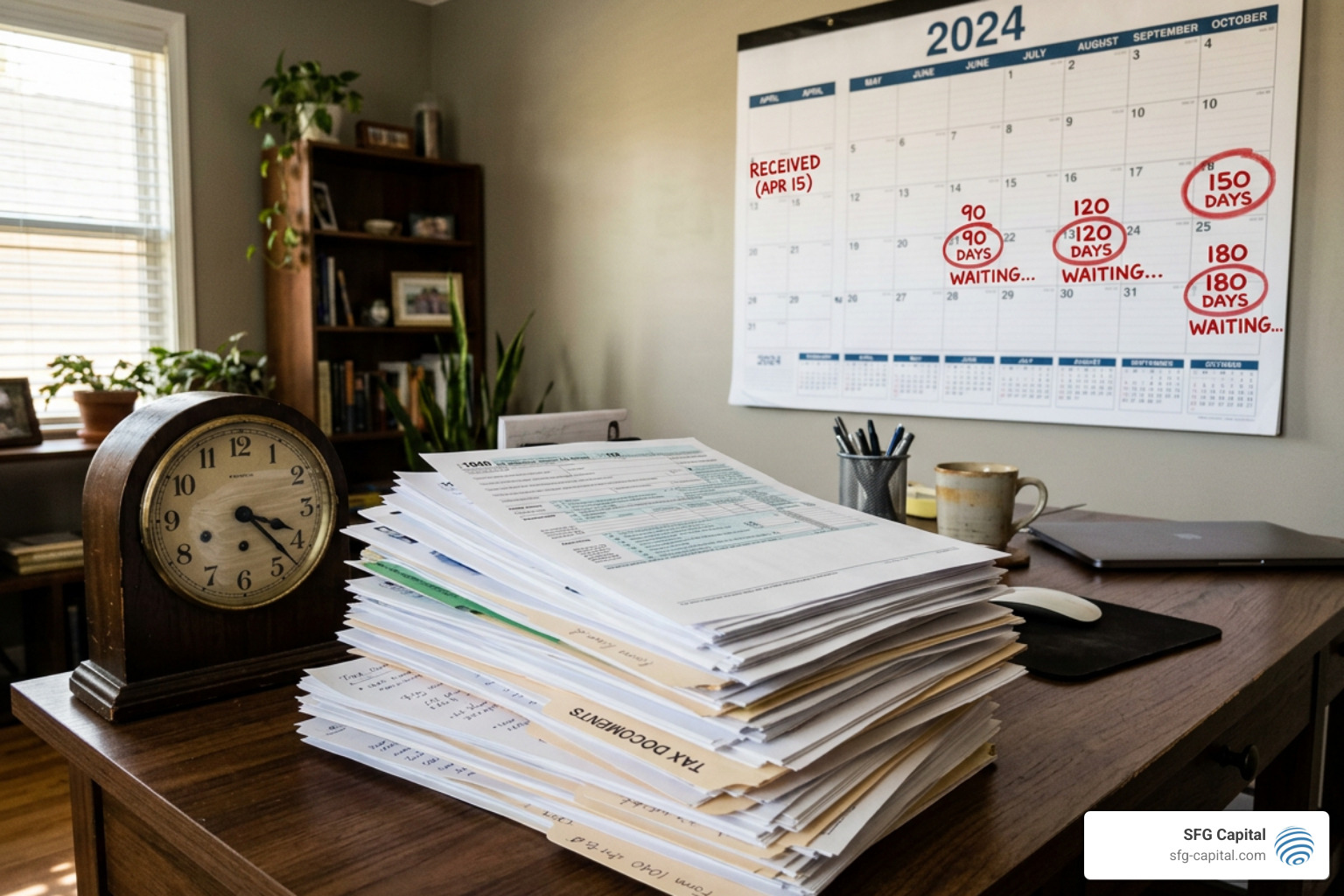
When an issue cannot be corrected systematically, taxpayers discover why their federal refund is taking so long as their return languishes inside internal inventory queues. Historically, returns diverted into the Error Resolution System holding queue have sat for an average of 75 days before reaching an examiner’s desk.
The overall duration of an IRS review varies based on the filing method and the complexity of the inquiry:
- Standard E-Filed Returns: Generally processed within 21 calendar days when no errors occur.
- Mailed Paper Returns: Typically require 6 or more weeks to process due to manual data entry.
- Formal IRS Review Pipeline: Commonly spans 45 to 180 days, depending on whether simple documentation or a comprehensive correspondence audit is required.
- Amended Returns (Form 1040-X): Routinely require 120 days or more for full processing and disbursement.
- Delinquent Return Compliance: Resolving an unfiled prior-year return to unlock a held refund typically takes up to 90 days after receipt.
What to Expect When the IRS Is Holding My Refund for Review for 60 Days or More
Discovering that your tax refund is stuck in processing limbo for two months or more usually indicates that your file requires manual third-party cross-referencing or identity authentication. The IRS instructs taxpayers who receive review notices to wait at least 60 days before calling, as phone representatives cannot accelerate returns undergoing standard document verification.
If your delay involves suspected identity theft, resolution timelines extend significantly. Resolving complex identity theft cases has averaged roughly 240 days. When documentation is requested via mail or the IRS online document portal, submitting comprehensive records promptly generally allows examiners to close the review within 60 days of receiving your file.
Overpayment Interest and the 45-Day Rule
There is a silver lining when the IRS delays your payout. Under federal statute, the IRS is subject to the “45-day rule.” If the agency fails to issue your refund within 45 calendar days of the tax filing deadline (typically April 15) or the date you filed your return (whichever is later), the government must pay you overpayment interest.
Interest on delayed refunds compounds daily. Overpayment interest rates for individual taxpayers are adjusted quarterly based on federal short-term rates. For individual overpayments, rates stood at 7% in the first quarter of 2026 and 6% in the second quarter of 2026. This interest is added automatically to your final check or direct deposit, though you must report that interest as taxable income on the following year’s return.
Understanding Your IRS Notices: CP05, CP05A, and CP05B
When your return is stopped, the IRS mails a formal notice detailing why your funds are on hold. The following matrix outlines the most common review notices:
| Notice / Letter | Primary Reason | Taxpayer Action Required | Expected Resolution Window |
|---|---|---|---|
| Notice CP05 | General review of income, withholdings, or credit eligibility | None immediately; review return for accuracy and wait 60 days | Up to 60 days from notice date |
| Notice CP05A | Verification of wage income and tax withholding | Submit copies of paystubs, employer letters, or Form W-2s | 30 to 60 days after records received |
| Notice CP05B | Third-party reporting mismatch on income or credits | Submit supporting wage documentation along with the notice voucher | 60 days post-submission |
| Letter 5071C | Return flagged by automated identity theft filters | Verify identity online at IRS.gov or via telephone | Up to 9 weeks after authentication |
Review the IRS guidelines on CP05 notices to understand how examiners authenticate reported earnings and tax credits before releasing funds.
Actionable Steps for CP05 Notice Variants
Receiving a CP05 notice series requires careful attention to instructions:
- Handling a Notice CP05: This notice informs you that the IRS is reviewing your return to verify reported income, withholding, or credits. No immediate action is required unless the notice explicitly asks for records. If you discover a mistake on your filed Form 1040, prepare an amended return (Form 1040-X), but do not submit it until the current review finishes.
- Responding to Notice CP05A: The IRS requires written proof of wages and withholdings. Gather your last three paystubs prior to the end of the tax year, an official letter from your employer on company letterhead confirming gross earnings and federal withholding, or Form W-2/1099 duplicates. Upload these files via the IRS Document Upload Tool using the access code provided on your letter.
- Addressing Notice CP05B: The IRS could not corroborate the information on your return with payer files. Respond prior to the stated deadline by mailing or uploading the requested 1099 or W-2 records alongside the response voucher. If you did not file the return in question, complete and submit Form 14039 (Identity Theft Affidavit) immediately.
Responding to Identity Verification Letters
If the IRS suspends your return under anti-fraud filters, you will receive Letter 5071C or Letter 6331C. This communication directs you to authenticate your identity before processing can continue.
You can verify your identity online using the official Identity and Tax Return Verification Service at IRS.gov. You will need your prior-year tax return, your current-year filing, supporting W-2s and 1099s, and your mobile phone or photo identification. If you cannot verify online, call the dedicated toll-free number listed on the letter, or make an appointment at your local IRS Taxpayer Assistance Center. Once identity verification is finalized, the IRS typically issues your refund within nine weeks.
How to Track, Expedite, or Escalate a Frozen Refund

When waiting for your funds, consult the Taxpayer Advocate Service guidance on held refunds to understand your legal rights and options for escalation.
If your direct deposit never arrived or a paper check went missing, file Form 3911 (Taxpayer Statement Regarding Refund) to initiate an official refund trace. The IRS will research the banking transit details or cancel the lost check and issue a replacement if the original remained uncashed.
Checking Status via Where’s My Refund and Online Accounts
The fastest way to monitor your return’s progress is through the official IRS refund tracking tool or the IRS2Go mobile application. Status data updates once every 24 hours, typically overnight:
- Access the Tool: Visit IRS.gov or open IRS2Go.
- Enter Information: Input your Social Security Number (or ITIN), your filing status, and the exact whole-dollar refund amount shown on your return.
- Interpret Status Bars: The tracker displays three stages: Return Received, Refund Approved, and Refund Sent. If your return is held, the tool will display a status message indicating that processing has been delayed.
For deeper insights, log into your personal IRS Online Account to inspect your tax transcripts. Review the Account Transcript for Cycle Codes and Transaction Codes (such as TC 570 for additional liability holds or TC 971 for notice issuance).
Taxpayer Advocate Service and Financial Hardship Relief
If an extended refund delay causes severe economic harm, you can escalate your case through the Taxpayer Advocate Service (TAS), an independent organization within the IRS.
To request TAS intervention, complete and submit Form 911 (Request for Taxpayer Advocate Service Assistance) or call 1-877-777-4778. To qualify for expedited processing under hardship criteria, you must demonstrate immediate financial distress, such as:
- Pending eviction or mortgage foreclosure notices.
- Utility disconnection notices.
- Inability to pay for essential medical treatments or prescription drugs.
- Impending business insolvency or payroll failure.
TAS advocates possess direct channels into IRS processing units to release manual holds when financial hardship criteria are satisfied, provided the underlying return documentation is verified.
Frequently Asked Questions About Refund Delays
What should I do if the IRS holds my refund past 60 days without an update?
If 60 calendar days have passed since the date printed on your CP05 or review notice and your online account status has not changed, call the IRS individual assistance hotline at 800-829-1040. Before calling, have your filed tax return, supporting tax documents (W-2s, 1099s), and all IRS notices in hand. If the telephone representative cannot provide a definitive processing timeline or your delay exceeds normal processing windows, submit Form 911 to the Taxpayer Advocate Service for formal case escalation.
Will the IRS pay interest on my held refund in 2026?
Yes. If the IRS takes longer than 45 days past the April 15 filing deadline (or 45 days after the date you filed, if filed after the deadline) to issue your payment, the government must pay daily compounding interest on your overpayment. In 2026, overpayment interest rates were set at 7% for the first quarter and 6% for the second quarter for individual returns. This interest is calculated automatically and added directly to your refund check or direct deposit.
How do business refund holds differ from individual review holds?
Business refund holds—particularly those involving Form 941-X claims for payroll tax credits—involve distinct verification pipelines compared to individual Form 1040 filings. Business owners dealing with ERC refund delays encounter enhanced compliance checks, moratorium backlogs, and detailed eligibility audits. Because business tax credit holds involve substantial capital sums, they often cause acute cash-flow strains that require dedicated commercial liquidity strategies.
Conclusion
A notification that the IRS is holding your refund for review can be unsettling, but most holds stem from routine automated cross-checks, identity verification procedures, or document discrepancies. By monitoring your status on Where’s My Refund?, responding swiftly to CP05 notices, and supplying thorough documentation, you can navigate the review process and secure your funds.
For business owners in Travis County and across the United States facing prolonged working-capital freezes due to delayed payroll tax credits, waiting months for IRS examiners is not always an option. At SFG Capital, we provide specialized funding solutions—including advance and buyout options on qualified claims—to bridge the gap caused by federal backlogs. Explore our services to discover how we help businesses bypass lengthy IRS review queues and regain control of their cash flow.
See what your business may qualify for.
60 seconds. No documents. No upfront cost.
General information only, not legal or tax advice. Eligibility and estimates are fact-specific and subject to review.