
Blog / Insights
InsightsThe Revenue Drop Guide to ERC Eligibility
October 14, 2026 · 9 min read · By the SFG Capital team
How the ERC Eligibility Revenue Drop Works
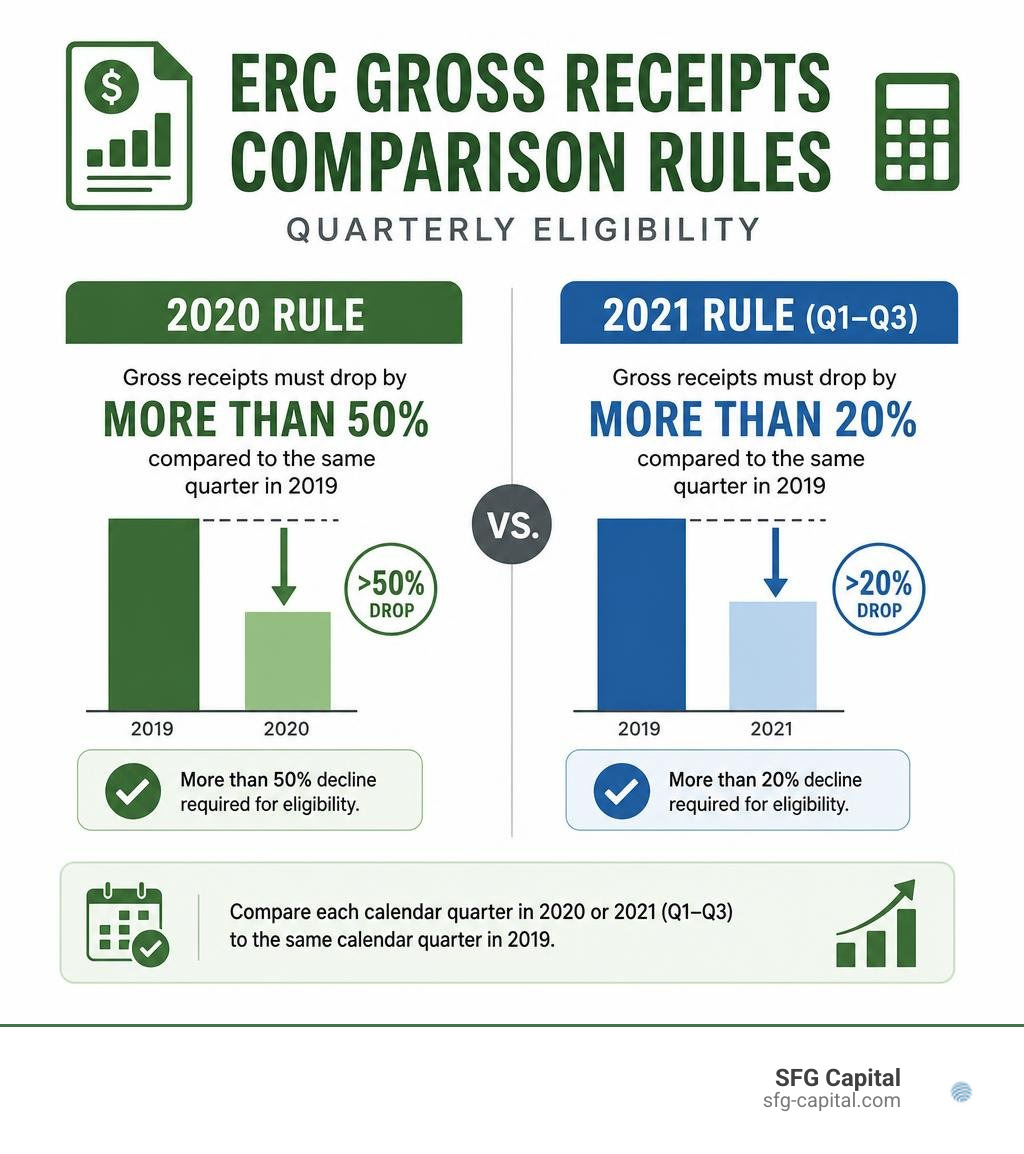
To qualify for the Employee Retention Credit through revenue decline, your business must meet specific gross receipts reduction thresholds when comparing pandemic quarters to the same calendar quarter in 2019:
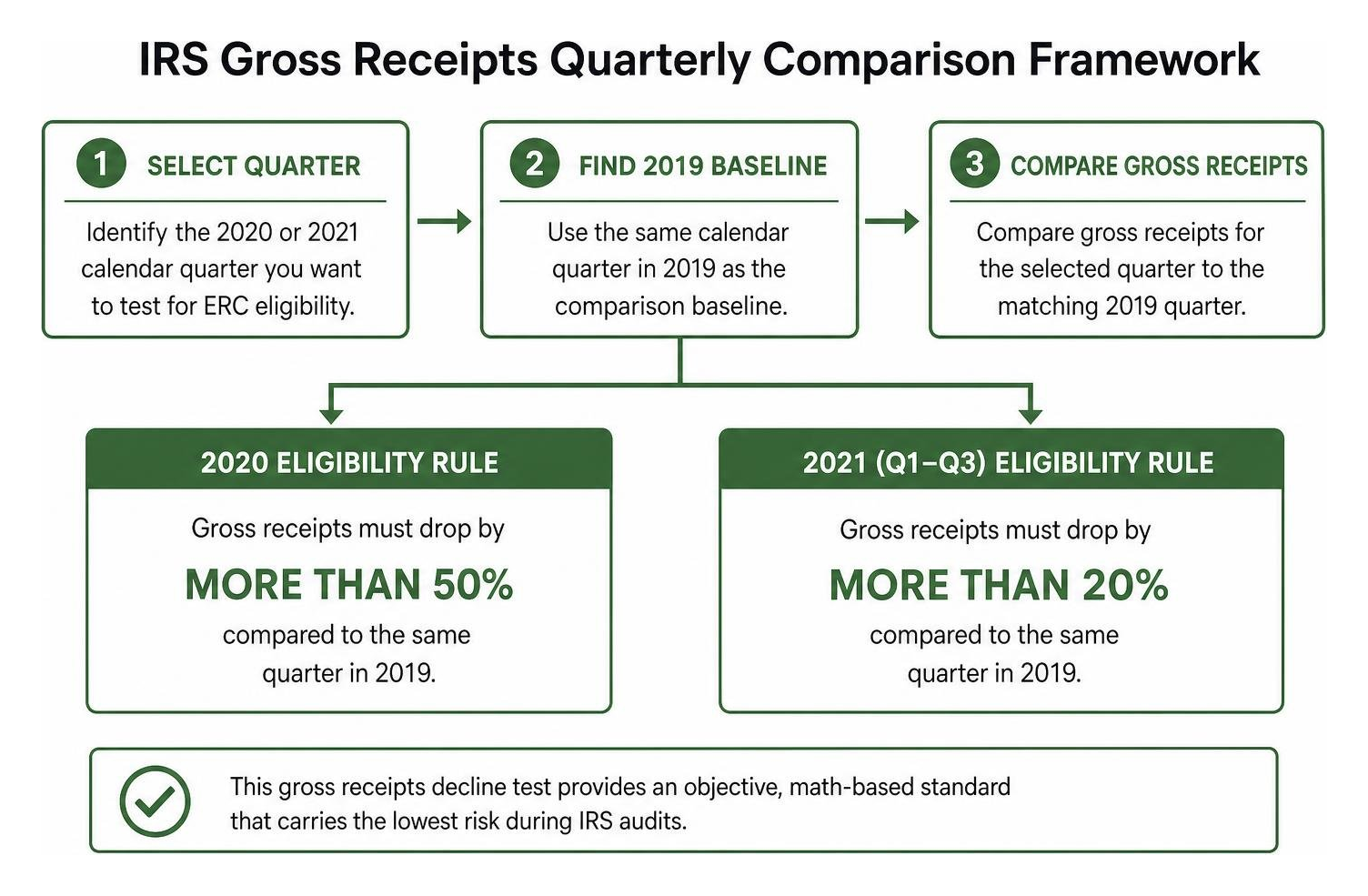
- For 2020: Gross receipts must drop by more than 50% compared to the matching 2019 quarter.
- For 2021 (Q1–Q3): Gross receipts must drop by more than 20% compared to the matching 2019 quarter.
Unlike subjective shutdown claims, the gross receipts decline provides an objective, math-based standard that carries the lowest risk during IRS audits.
I’m Santino Battaglieri, founder of SFG Capital, where we have funded over $500 million in claims and helped hundreds of business owners navigate complex erc eligibility revenue drop requirements. Below, I break down exactly how to measure your quarterly revenue, use lookback safe harbors, and build an audit-proof file.
Understanding the Gross Receipts Test and How It Works
The gross receipts test is the cleanest, most defensible pathway to claiming the Employee Retention Credit. While other pathways rely on executive mandates or supply chain interpretations that draw intense IRS scrutiny, the revenue decline method is anchored entirely in concrete financial data.
To determine what is ERC? eligibility under this method, the IRS directs employers to the statutory definition of gross receipts under Internal Revenue Code (IRC) Section 448(c) (and IRC Section 6033 for tax-exempt organizations). IRS Notice 2021-20 sets forth the precise rules for measuring revenue declines, establishing the pre-pandemic calendar year of 2019 as the universal baseline for comparison.
Gross Receipts Definitions for For-Profit and Tax-Exempt Entities
For for-profit businesses, gross receipts under IRC Section 448(c) encompass the total amount received or accrued from all sales of goods or services, net capital gains, interest, dividends, rents, and royalties, before deducting costs of goods sold or operational expenses.
For non-profit organizations, the definition is governed by IRC Section 6033. Non-profits must include total gross receipts from all sources:
- Contributions, gifts, and grants (both restricted and unrestricted)
- Program service fees and dues
- Gross investment income (dividends, interest, rents)
- Gross sales of inventory items or assets
A critical point for both business types: under IRS Revenue Procedure 2021-33, proceeds from Paycheck Protection Program (PPP) loan forgiveness, Shuttered Venue Operators Grants (SVOG), and Restaurant Revitalization Grants (RRG) are explicitly excluded from gross receipts when calculating ERC eligibility. This ensures that federal relief does not artificially inflate revenue and inadvertently disqualify an employer from claiming the Employee Retention Tax Credit.
Establishing the 2019 Baseline Quarter for New and Existing Businesses
Determining quarterly declines requires establishing an accurate 2019 benchmark. For existing businesses that operated throughout 2019, each calendar quarter in 2020 and 2021 is compared directly against the corresponding quarter of 2019 (e.g., Q2 2020 vs. Q2 2019, or Q1 2021 vs. Q1 2019).
For businesses that began operations in 2019, the IRS provides specific adaptation rules detailed in The Essential Guide to ERC Eligibility Requirements:
- If an employer started business in the middle of 2019 (e.g., Q3 2019), they use that quarter as the baseline for earlier quarters (such as Q1 or Q2) or utilize an annualized quarterly calculation.
- Businesses that launched operations after February 15, 2020, cannot establish a 2019 baseline under the standard gross receipts test, but may qualify separately as a Recovery Startup Business.
Calculating the ERC Eligibility Revenue Drop: 2020 vs 2021 Rules
The revenue decline thresholds and credit calculations differ significantly between the 2020 and 2021 tax years, reflecting legislative changes enacted under the CARES Act, the Relief Act, and the American Rescue Plan Act. Meeting ERC Qualifications requires evaluating each quarter against its specific statutory benchmark.
| Metric | 2020 Tax Year | 2021 Tax Year (Q1–Q3) |
|---|---|---|
| Gross Receipts Drop Required | > 50% decline vs. 2019 | > 20% decline vs. 2019 |
| Recovery / Exit Benchmark | Gross receipts exceed 80% of 2019 | Evaluated quarter-by-quarter |
| Credit Percentage | 50% of qualified wages | 70% of qualified wages |
| Qualified Wage Cap | $10,000 per employee per year | $10,000 per employee per quarter |
| Maximum Credit Per Employee | $5,000 annually | $7,000 per quarter ($21,000 max) |
| Small Employer FTE Threshold | 100 or fewer full-time employees | 500 or fewer full-time employees |
Applying the ERC Eligibility Revenue Drop in 2020: The 50% Threshold
Under the original CARES Act provisions outlined by the Employee Retention Credit guidance, an employer entered an eligible period beginning on the first day of the first calendar quarter in 2020 in which its gross receipts were less than 50% of its gross receipts for the same calendar quarter in 2019.
The 2020 rules feature an automatic continuation provision: once an employer enters an eligible quarter, eligibility continues through the end of the calendar quarter following the quarter in which gross receipts recover to more than 80% of the corresponding 2019 quarter.
For 2020, the credit equals 50% of up to $10,000 in qualified wages paid to each employee for all quarters combined, resulting in a maximum credit of $5,000 per employee for the year.
Determining the ERC Eligibility Revenue Drop in 2021: The 20% Rule
The Relief Act and subsequent legislation expanded access in 2021, lowering the required gross receipts decline from 50% to more than 20% compared to the matching 2019 quarter.
The credit value increased dramatically for 2021 to 70% of up to $10,000 in qualified wages per employee per quarter. Employers could claim up to $7,000 per employee for Q1, Q2, and Q3 of 2021, for a total potential credit of $21,000 per worker. Reviewing The ERC Eligibility Checklist: Don’t Miss Out helps verify that quarterly payroll figures are paired accurately with the 20% threshold.
Leveraging the Alternative Quarter Election in 2021
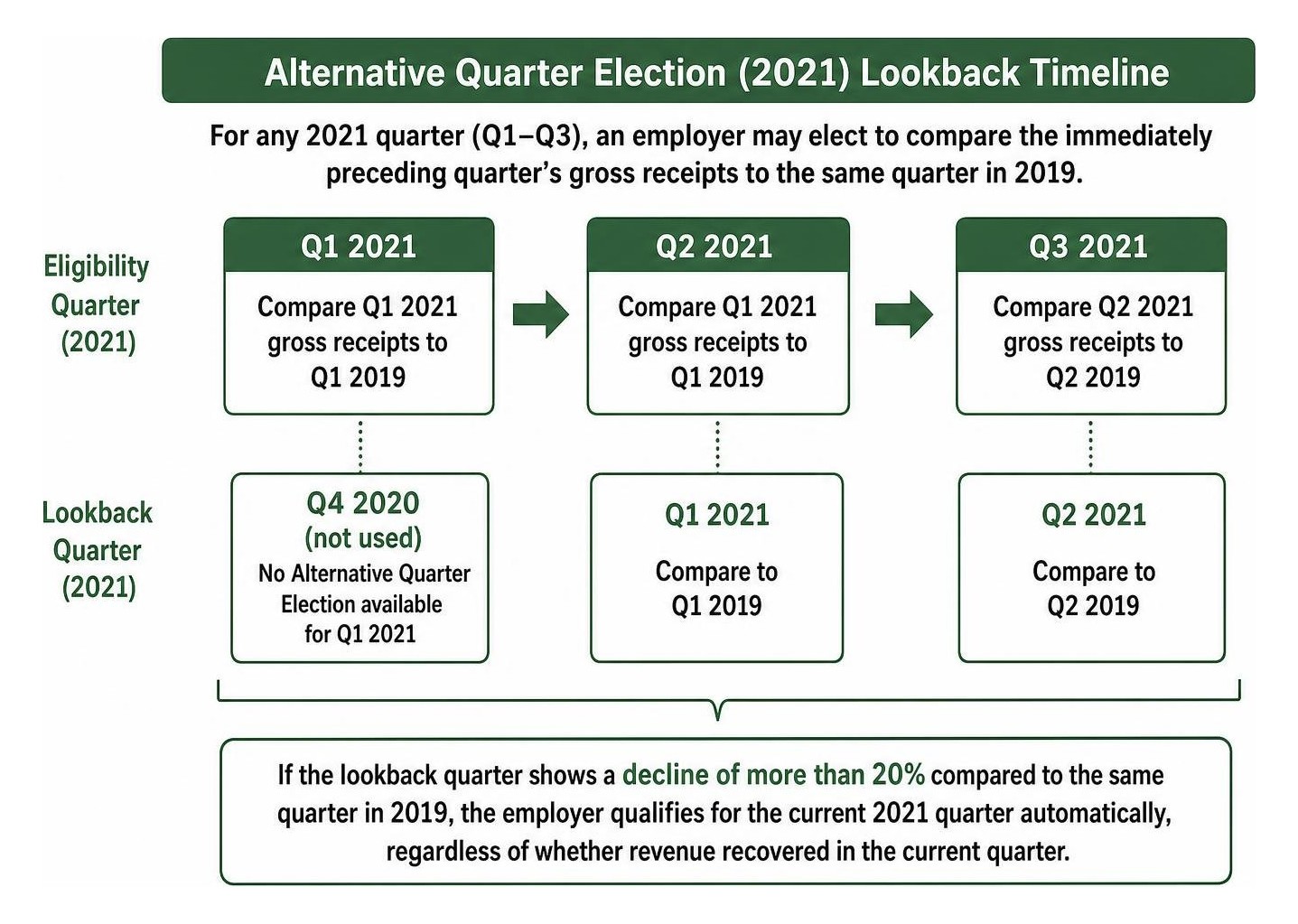
To provide flexibility, IRS Notice 2021-23 introduced the Alternative Quarter Election for 2021. This safe harbor allows an employer to determine eligibility for a 2021 calendar quarter by comparing the gross receipts of the immediately preceding calendar quarter with the corresponding quarter in 2019.
For example, an employer testing eligibility for Q2 2021 can elect to compare its Q1 2021 gross receipts against Q1 2019 gross receipts. If Q1 2021 experienced a 20% decline relative to Q1 2019, the employer qualifies for Q2 2021 automatically, regardless of whether Q2 2021 revenue recovered.
Revenue Drop vs Other ERC Eligibility Pathways and Wage Coordination
While revenue reduction is the cleanest method to claim the credit, it exists alongside other eligibility paths outlined in The ERC Explained: Everything You Need to Know About This Tax Credit.

Gross Receipts Decline vs Government Shutdown Orders
The IRS evaluates ERC claims across four distinct pillars:
- Gross Receipts Decline: Clean, objective, verified through bank and tax records.
- Full Suspension of Operations: Narrow; requires an explicit government order shutting down all business activity.
- Partial Suspension of Operations: Heavily audited; requires demonstrating that a specific government mandate caused a “more-than-nominal” disruption (at least 10% of revenue or service hours) to operations.
- Recovery Startup Business: Applicable only to Q3 and Q4 2021 for businesses launched after February 15, 2020, with annual receipts under $1 million (capped at $50,000 per quarter).
Because partial suspension claims require extensive legal and operational proof—and generic supply chain claims frequently fail IRS review as highlighted in the Employee Retention Credit Eligibility Checklist: Help understanding this complex credit—qualifying through a verifiable gross receipts drop remains the safest strategy.
Coordinating ERC Wages with PPP Loan Forgiveness
Employers that received Paycheck Protection Program loans are fully permitted to claim the ERC, but they cannot “double-dip” by claiming the exact same payroll dollars for both programs.
To maintain compliance when calculating ERC Funding Requirements:
- Review your PPP loan forgiveness application (Form 3508/3508S/3508EZ) to identify the specific payroll dollars allocated toward forgiveness.
- Utilize non-payroll expenses (rent, utilities, covered supplier costs) on the PPP forgiveness application up to the allowable 40% cap to free up maximum payroll for ERC.
- Retain detailed wage allocation schedules demonstrating that wages claimed for ERC were paid outside of or in excess of the payroll used for PPP forgiveness.
Audit Substantiation, IRS Scrutiny, and Avoiding Claim Pitfalls
The IRS continues to scrutinize retroactive ERC claims filed on Form 941-X. Claims for 2020 and early 2021 carry standard assessment windows, while late 2021 quarters carry an extended statutory audit window under federal law. Understanding your compliance standing is critical, as detailed in Are You Eligible? Decoding ERC Refund Requirements.
Essential Documentation for Proving Revenue Declines
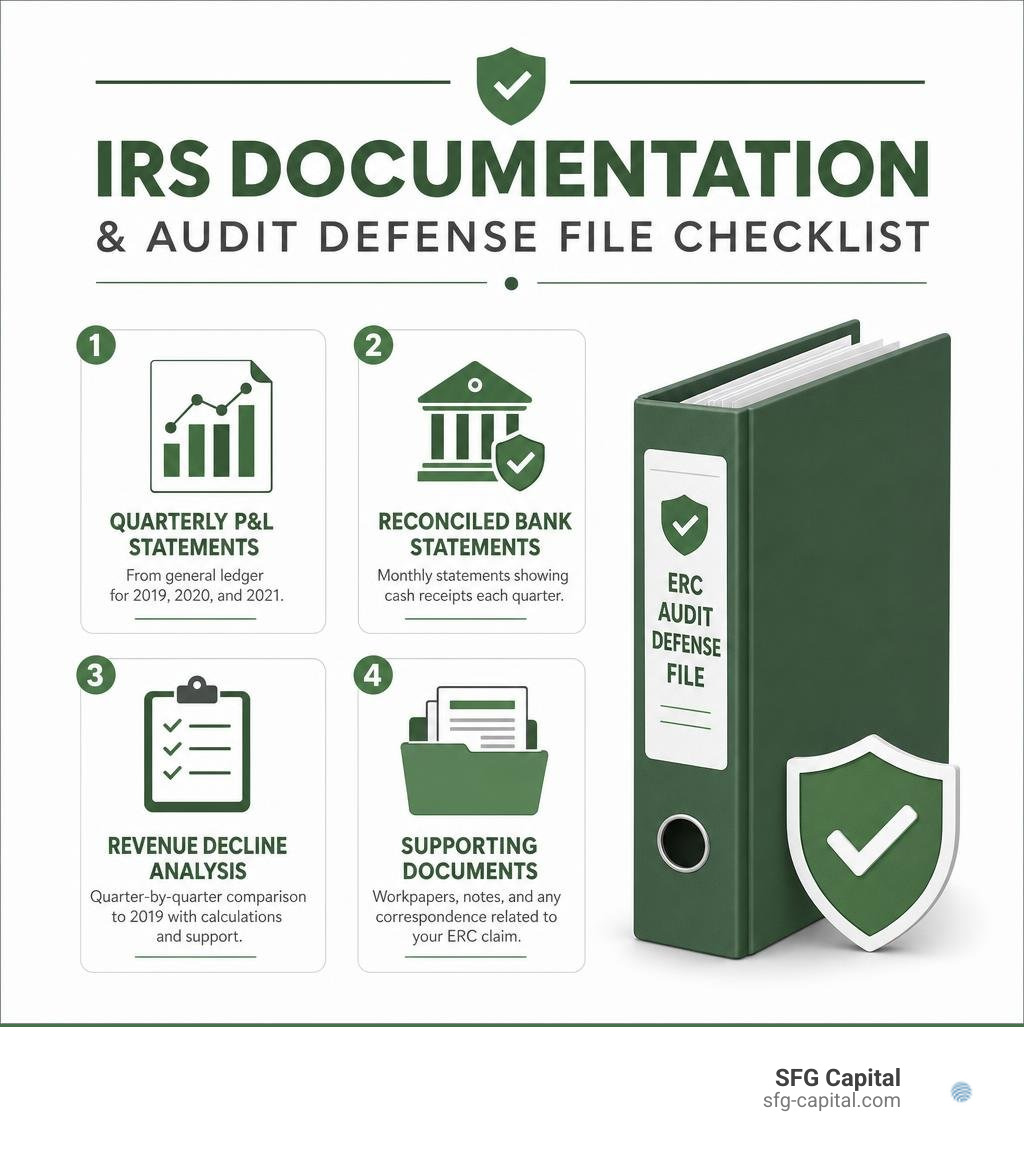
To defend a gross receipts claim against IRS inquiries (such as Letter 6612 or an audit request), compile a contemporaneous defense file containing:
- Quarterly profit and loss statements generated directly from your general ledger for 2019, 2020, and 2021.
- Reconciled monthly bank statements demonstrating actual cash receipts for each quarter.
- Federal income tax returns (Form 1120, 1120-S, 1065, or 990) for 2019 through 2021.
- Workpapers documenting the exclusion of PPP, SVOG, or RRG funds per Rev. Proc. 2021-33.
- Controlled group analysis under IRC Sections 52 and 414 if your business shares common ownership with other entities.
Red Flags and Aggressive ERC Promoter Schemes
The IRS has issued repeated warnings against aggressive third-party promoters and “ERC mills.” Businesses should be wary of common warning signs:
- Promoters charging percentage-based contingency fees rather than fixed professional rates.
- Claims asserting that every business qualifies under vague supply chain disruptions without identifying specific government orders.
- Advisors who fail to inform you that claiming the ERC requires reducing your federal income tax wage deduction under IRC Section 280C, necessitating amended income tax returns.
Employers who filed improper claims can utilize the IRS claim withdrawal program or file an adjusted return to rectify errors before receiving a formal disallowance via Letter 105-C.
Frequently Asked Questions About the ERC Gross Receipts Test
How does an employer calculate gross receipts to determine ERC eligibility?
Under IRC Section 448(c), for-profit employers calculate gross receipts by totaling all revenues received or accrued during the calendar quarter, including sales of products or services, net capital gains, interest, dividends, rents, and royalties, using the company’s established tax accounting method (cash or accrual). Non-profits follow IRC Section 6033, including all gross receipts from contributions, program revenue, dues, and investments.
Does PPP loan forgiveness count toward the gross receipts revenue drop test?
No. Under IRS Revenue Procedure 2021-33, proceeds from forgiven PPP loans, Shuttered Venue Operators Grants, and Restaurant Revitalization Grants are excluded from the definition of gross receipts when evaluating ERC eligibility.
What happens if a business met the revenue drop in one quarter but recovered in the next?
For 2020, an employer that qualified with a >50% decline remains eligible until the end of the quarter following the quarter in which gross receipts exceed 80% of the 2019 baseline. For 2021, each quarter is evaluated independently against 2019, but an employer can use the Alternative Quarter Election to qualify for the current quarter if the immediately preceding quarter experienced a >20% decline.
Conclusion: Navigating ERC Revenue Requirements and Funding Delays
The gross receipts test offers employers a clear, objective standard to claim substantial pandemic tax credits without the audit exposure of subjective shutdown theories. By maintaining comprehensive quarterly financials, segregating PPP wages, and adhering to IRS safe harbor guidelines, businesses in Travis County, Austin, and across the nation can confidently defend their credits.
However, prolonged IRS backlogs and processing delays have left many businesses waiting extended periods for legitimate refund checks. At SFG Capital, we help businesses navigate these delays through specialized advance funding and refund buyout solutions, providing immediate liquidity backed by performance-based terms.
To learn more about optimizing your claim and accessing immediate capital, visit our services page to explore your funding options today.
See what your business may qualify for.
60 seconds. No documents. No upfront cost.
General information only, not legal or tax advice. Eligibility and estimates are fact-specific and subject to review.