
Blog / Insights
InsightsThe Step-by-Step Guide to Getting Your Payroll Tax Refund
October 15, 2026 · 9 min read · By the SFG Capital team
How to Get a Payroll Tax Refund
To get a payroll tax refund, compare your payroll records with the returns and payments you filed, identify an overpayment or eligible credit, and check the filing deadline. If you can still make a claim, use the form for the tax period, such as Form 941-X for a corrected quarterly return.
Looking for an Employee Retention Credit (ERC) refund? The standard deadlines for new 2020 and 2021 ERC claims have passed. If you filed on time and are still waiting, keep your claim records together and check its status. A funding offer may help with cash flow, but it does not speed up IRS approval.
I’m Santino battaglieri, founder of SFG Capital, where we help businesses get payroll tax refund claims reviewed with care before they consider funding. I have more than nine years of experience in financial services, and SFG Capital has purchased and funded over $500 million in ERC claims.
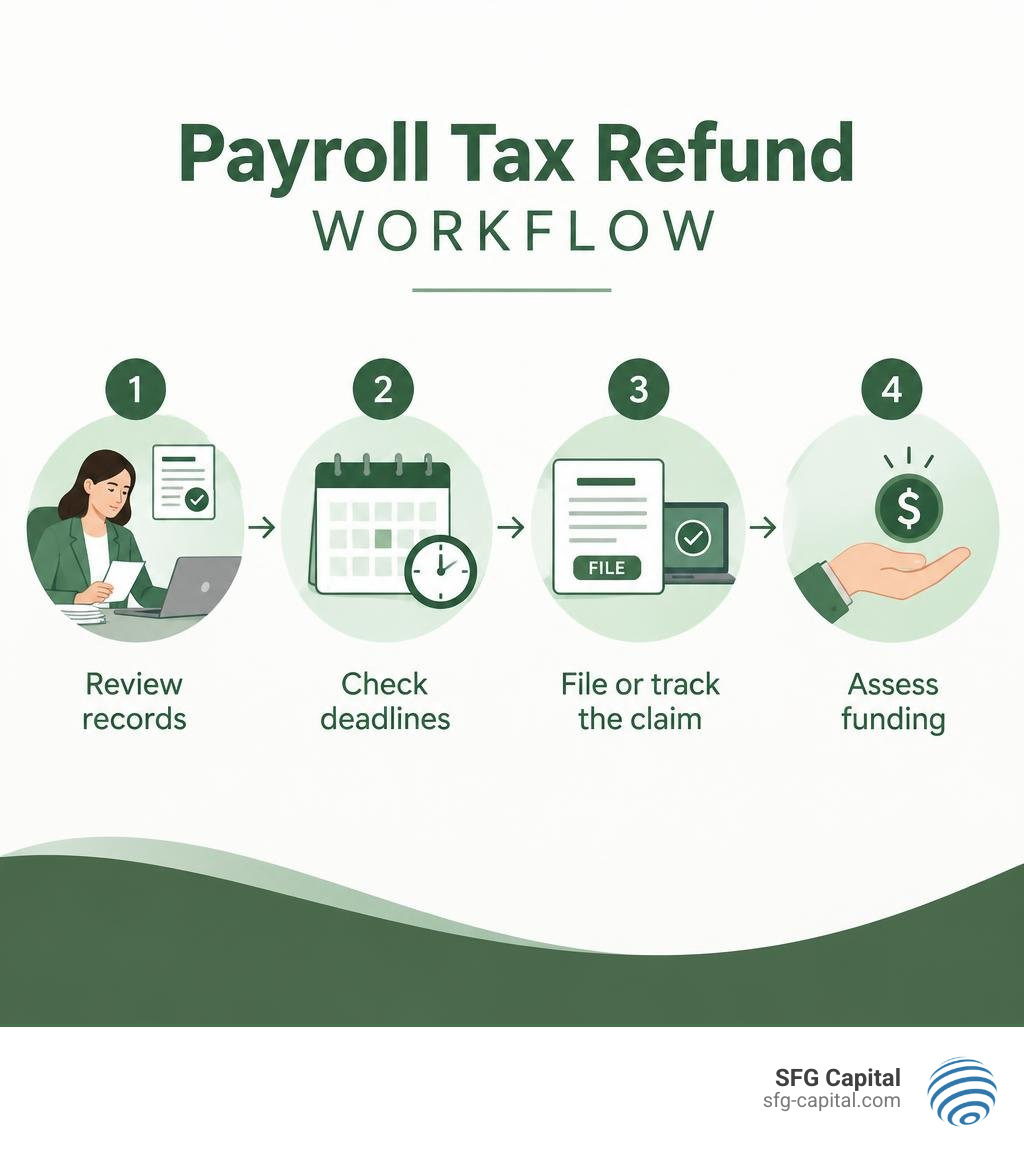
Understanding Payroll Tax Refunds: Eligibility and Core Mechanisms
A payroll tax refund occurs when an employer overpays statutory employment taxes or claims refundable tax credits against their employment tax obligations. Many business owners assume business tax recovery revolves exclusively around income tax returns, but payroll taxes operate under completely separate statutory mechanisms, filing forms, and reconciliation cycles.
Employment taxes primarily consist of the Federal Insurance Contributions Act (FICA)—which includes Social Security tax (6.2%) and Medicare tax (1.45%) for both the employer and employee—along with federal income tax withholding (FITW) and Federal Unemployment Tax Act (FUTA) liabilities. When an organization deposits excess funds via the Electronic Federal Tax Payment System (EFTPS) or miscalculates statutory wage bases, an overpayment occurs. Exploring our payroll tax credit complete guide provides deeper context on how these credits interact with your quarterly returns.
| Feature | Income Tax Refund | Payroll Tax Refund |
|---|---|---|
| Primary Forms Used | Form 1120 (C-Corp), 1120-S, 1065, or 1040 | Form 941-X, Form 940, Form 944-X |
| Filing Frequency | Annual return | Quarterly or annual adjustments |
| Tax Base | Net taxable business income / profit | Gross employee wages & statutory wage bases |
| Employee Share Impact | None (entity/owner level only) | Requires employee notification or consent |
| Correction Windows | 3 years from filing or 2 years from payment | 3 years from April 15 of succeeding filing year |
Business Restructuring and Federal Successorship Rules
One common scenario leading to massive payroll overpayments involves mergers, acquisitions, and corporate restructurings. When a business acquires another entity or division mid-year, payroll systems frequently restart year-to-date wage accumulators at zero for transferred workers. This mistake leads to double-withholding Social Security tax beyond the statutory taxable wage base cap and overpaying FUTA taxes.
Under federal rules outlined in Revenue Procedure 2004-53 and established Treasury guidance (such as Part I rulings), an acquiring entity can qualify as a “successor employer” if it acquires substantially all the property used in a trade or business (or a separate unit of a trade or business) and immediately employs the predecessor’s workers in the same calendar year. Establishing statutory successorship allows the successor to combine predecessor wages, preventing excess deposits and enabling the recovery of overpaid FICA and FUTA taxes.
State Unemployment Insurance (SUI) Successorship vs. Federal Requirements
While federal statutory successorship focuses on wage caps, State Unemployment Insurance (SUI) introduces a separate set of rules governed by state workforce authorities. In Texas, the Texas Workforce Commission (TWC) regulates the transfer of compensation experience and tax rate determinations.
State guidelines dictate whether an experience rating must, may, or cannot be transferred from a predecessor to a successor entity. Under state tax provisions, such as those detailed in the STAR: State Automated Tax Research for the State of Texas database, failing to properly structure an asset purchase or miscalculating workforce continuity can trigger non-compliance penalties or inflated SUI rates. Organizations operating across state lines must carefully distinguish between federal wage credits and state unemployment account transfers to avoid costly mistakes.
How to Get Payroll Tax Refund Claims Processed with the IRS

Claiming a payroll tax overpayment from the IRS requires formal correction instruments rather than simply adjusting current payroll runs off the books. The primary vehicle for correcting quarterly employment taxes is Form 941-X (Rev. April 2026), used in tandem with Form 940 for annual FUTA reconciliations.
The statutory lookback period for federal employment taxes runs three years from the date the original Form 941 was filed (with all on-time quarterly returns considered filed on April 15 of the following calendar year) or two years from the date tax was paid, whichever is later. Implementing proven strategies to speed up your tax refund helps avoid common administrative hurdles during submission.
Adjustment Process vs. Claim Process: Choosing the Right Filing Track
When filing Form 941-X, you must select one of two procedural tracks: the Adjustment Process (Line 1) or the Claim Process (Line 2). Each track serves a distinct administrative purpose governed by Treasury regulations.
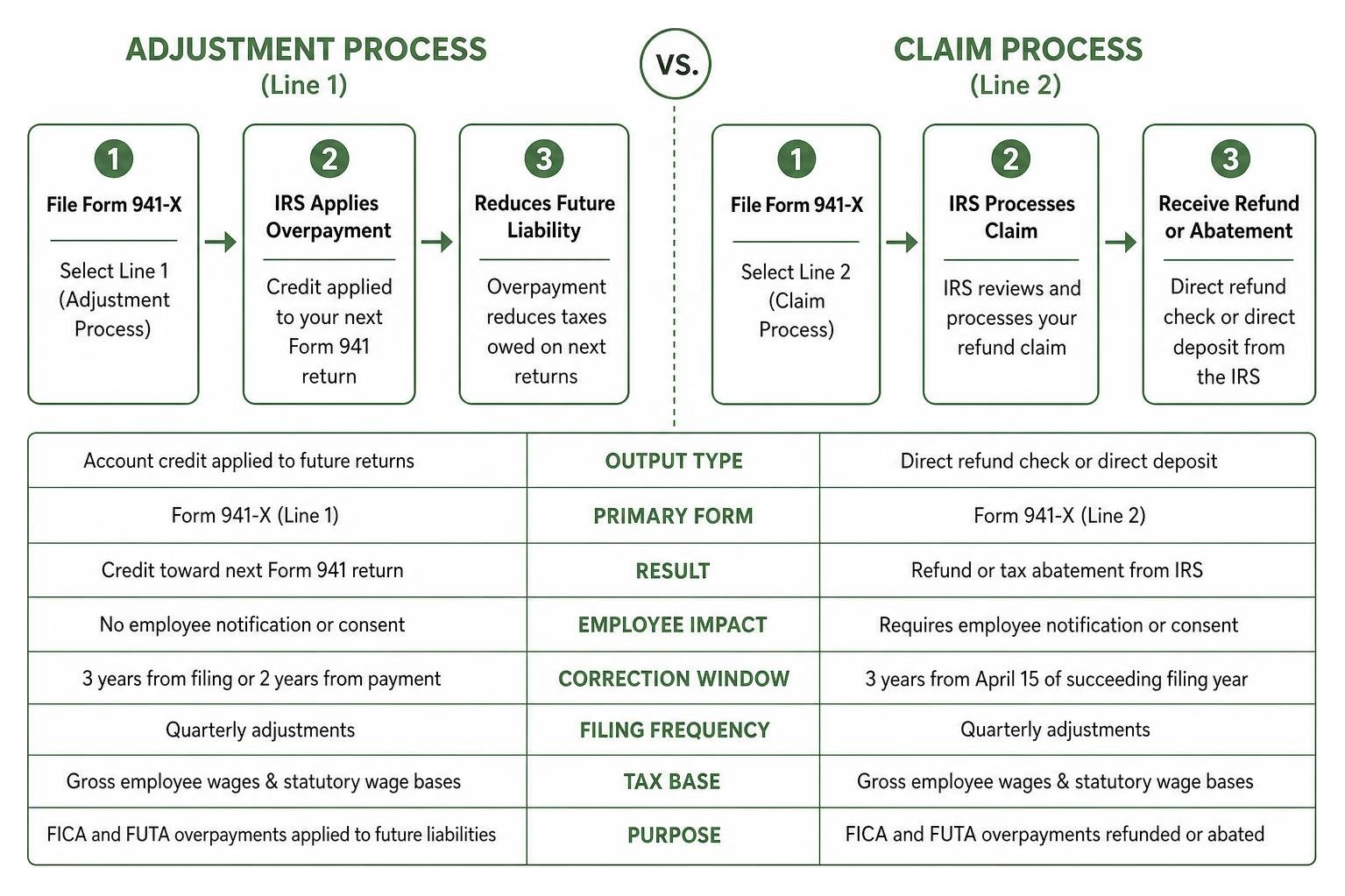
According to the official Instructions for Form 941-X (Rev. April 2026), the adjustment process applies an overpayment as a credit toward your next Form 941 return, while the claim process requests a direct refund or tax abatement from the IRS.
| Evaluation Metric | Adjustment Process (Line 1) | Claim Process (Line 2) |
|---|---|---|
| Output Type | Account credit applied to future returns | Direct refund check or direct deposit |
| Statutory Deadline | Must file at least 90 days before statute expires | Can file up to the final day of limitations period |
| Interest Treatment | Interest-free adjustment mechanism | May accrue statutory IRS overpayment interest |
| Employee FICA Rule | Overcollections must be repaid before filing | Can file for employer share if employee consent fails |
Employee Consent and Certification Requirements for Over-Withheld Taxes
When an overpayment involves over-withheld employee Social Security and Medicare taxes, employers cannot simply pocket the refund. To claim both the employer and employee shares of overpaid FICA taxes, the business must obtain written employee consent and certify that it has reimbursed or credited the funds back to the workers.
Under IRS Revenue Procedure 2017-28 (which governs procedures under § 6402 and the Railroad Retirement Tax Act (RRTA) pursuant to § 6402 of the Internal Revenue Code), employers must give employees a minimum 45-day window to respond to an initial consent request. If an employee fails to respond, a second request can provide a 21-day window. If the employee still cannot be reached or refuses consent, the employer is legally restricted to claiming only the employer’s portion of the overpaid tax, while maintaining detailed audit records of all good-faith contact attempts.
Maximizing Pandemic and Research Tax Credits (ERC & Beyond)
Government relief initiatives significantly expanded refundable payroll tax opportunities. The most notable was the Employee Retention Credit (ERC) under the CARES Act, designed to reward employers that retained staff during government-mandated shutdowns or gross receipts reductions. Understanding the mechanics of how the ERC tax credit works remains essential for understanding how pandemic-era credits are evaluated by IRS compliance teams.

How Small Businesses and Startups Can Get Payroll Tax Refund Benefits
Beyond legacy pandemic credits, modern small businesses and early-stage startups can leverage statutory payroll tax offsets. For example, qualifying small businesses engaged in technological or scientific development can elect to apply up to $250,000 (and up to $500,000 for certain tax years) of their Section 41 Research and Development (R&D) credit against their employer Social Security and Medicare liability using Form 8974.
Sole proprietors and independent contractors pay a self-employment (SE) tax rate of 15.3% on net earnings (12.4% for Social Security up to the wage cap and 2.9% for Medicare). While unincorporated entities do not file Form 941 for themselves, they can secure refunds for overpaid estimated self-employment taxes via Form 1040 Schedule SE. Reviewing key insights to ensure you don’t leave money on the table with payroll tax credits can safeguard your balance sheet.
Overcoming Long Processing Timelines and Funding Delays
Because of unprecedented processing backlogs and intensified IRS compliance scrutiny, businesses awaiting significant payroll tax refunds frequently experience delays extending over many months. For leadership teams depending on these receivables to fund operations, capital investments, or payroll, these delays create operational friction.
To bridge this gap, specialty financial solutions have emerged. Understanding the mechanics of ERC funding options can help leadership teams evaluate bridge liquidity. Reviewing the complete guide to funding your ERC claim early provides clarity on converting pending IRS claims into immediate working capital without waiting out IRS processing queues.
Strategic Roadmap: Working with Tax Advisors and Expediting Claims
Recovering payroll taxes requires meticulous financial documentation. The IRS evaluates payroll adjustments against original wage ledgers, W-2 records, and bank settlement statements. Utilizing an expedited tax refund roadmap ensures your internal team gathers all necessary substantiation before submission.
Practical Steps to Get Payroll Tax Refund Approval Without IRS Delays
To submit an unassailable payroll tax refund claim, follow this rigorous, quarter-by-quarter reconciliation process:
- Conduct a Line-by-Line Ledger Audit: Extract your raw payroll journal summaries and compare total gross compensation, exempt wages, and tax withholdings against your filed quarterly Forms 941.
- Verify All EFTPS Deposits: Confirm every federal tax deposit settlement date and dollar amount via bank transaction records and official IRS account transcripts.
- Execute Employee Consent Notices: If recovering over-withheld employee FICA taxes, mail formal consent packages meeting Revenue Procedure 2017-28 standards and log all delivery confirmations.
- Complete the Latest Form 941-X: Fill out all five pages of the April 2026 revision, noting specific quarter dates, correct column calculations, and detailed Part 4 explanations.
- Attach Required Support Documents: Include all relevant worksheets, Schedule R (if filing as an aggregate filer/PEO), and wage adjustment summaries.
- Ensure Authorized Officer Execution: Have the return signed by an authorized corporate officer or partner; missing or unauthorized signatures trigger automatic rejections.
Reviewing IRS procedural memoranda, including guidance on whether there is an expedited process to refund excess deposits before Form 941 is filed, underscores that early refunds require exact statutory adherence.
When to Request Expedited Handling and Hardship Relief
If an unresolved payroll tax overpayment creates an existential financial crisis—such as an inability to meet ongoing payroll, impending bankruptcy, or sudden equipment repossession—businesses can seek expedited administrative relief. In these extreme situations, an employer can submit IRS Form 911 (Application for Taxpayer Assistance Order) to engage the Taxpayer Advocate Service (TAS).
For routine deposit errors, statutory Automated Clearing House (ACH) reversal rules permit financial institutions to reverse erroneous electronic deposits within a narrow five-banking-day window from the settlement date. Outside this narrow window, employers must follow standard Form 941-X refund procedures.
Frequently Asked Questions About Payroll Tax Refunds
What is the deadline to file a claim for past-due payroll tax refunds?
The standard statute of limitations for filing a payroll tax refund claim via Form 941-X is three years from the date the original Form 941 was filed or two years from the date the tax was paid, whichever is later. For statutory purposes, all Forms 941 filed on time for a calendar year are considered filed on April 15 of the following year.
Annual FUTA claims submitted on Form 940 are subject to a three-year deadline running from the January 31 filing due date.
Can a self-employed individual receive a refund on payroll taxes?
Self-employed individuals and sole proprietors pay their equivalent employment contributions through self-employment (SE) tax on Form 1040 (Schedule SE). If you overpay quarterly estimated tax installments or experience an unexpected reduction in net annual business earnings, you can claim a refund for overpaid self-employment taxes directly on your annual individual tax return.
What should an employer do if former employees do not respond to consent requests?
If former employees do not respond to your written consent requests after you have satisfied the required notice timelines (an initial 45-day window followed by a secondary 21-day notice), you can still claim the employer share of the overpaid FICA taxes. You must check the specific certification boxes in Part 2 of Form 941-X confirming that you made reasonable, documented efforts to secure consent, and you must retain these records in your audit file for at least four years.
Conclusion
Securing a payroll tax refund requires precise calculation, diligent record-keeping, and strict compliance with IRS procedural rules. Whether correcting inadvertent wage base overpayments following an acquisition, leveraging statutory R&D offsets, or navigating complex federal successorship criteria, recovering overpaid employment taxes can provide a significant boost to your company’s cash flow.
Navigating these filings alongside changing IRS guidelines calls for careful documentation. To optimize your capital strategy and turn pending claims into actionable working capital, explore comprehensive tax advance and refund solutions designed to support your business’s financial health.
See what your business may qualify for.
60 seconds. No documents. No upfront cost.
General information only, not legal or tax advice. Eligibility and estimates are fact-specific and subject to review.