
Blog / Insights
InsightsThe Ultimate Small Business Guide to ERC Refund Success
October 22, 2026 · 13 min read · By the SFG Capital team
ERC Small Business Refunds: Start With Official Records
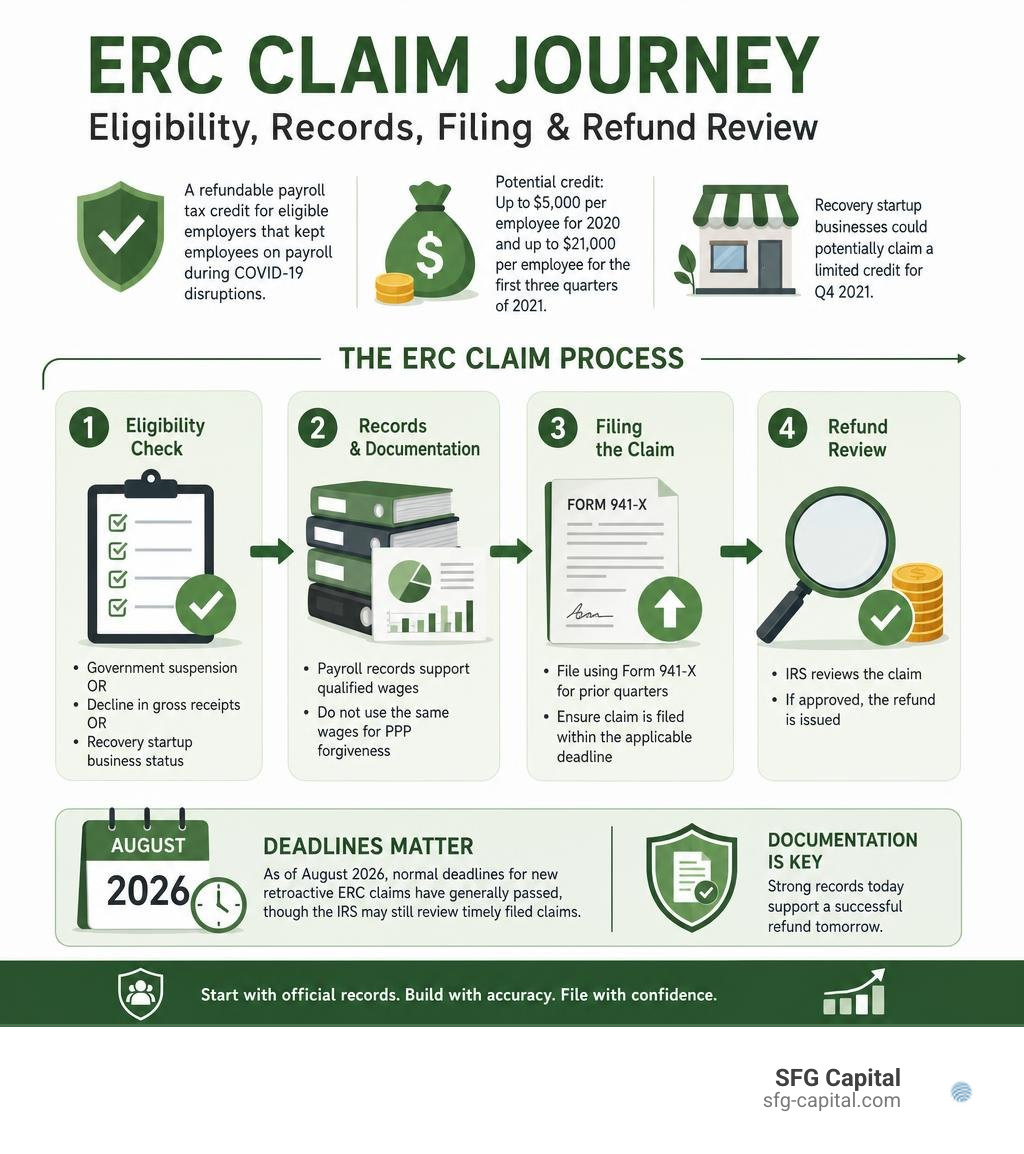
For an ERC small business claim, begin with the IRS Employee Retention Credit page and its eligibility checklist. Then verify three things before relying on a refund:
- You had a qualifying COVID-19 government suspension, required decline in gross receipts, or recovery startup business status.
- Your payroll records support the qualified wages claimed, without using the same wages for PPP forgiveness.
- The claim was filed within the applicable deadline. As of August 2026, normal deadlines for new retroactive ERC claims have generally passed, though the IRS may still review timely filed claims.
The ERC was a refundable payroll tax credit for eligible employers and tax-exempt organizations that kept employees on payroll during COVID-19 disruptions. It could be worth up to $5,000 per employee for 2020 and up to $21,000 per employee for the first three quarters of 2021. Recovery startup businesses could potentially claim a limited credit for Q4 2021.
I am Santino Battaglieri, and I work with SFG Capital on compliance-focused ERC advisory and funding solutions. Our ERC small business experience includes evaluating claims, supporting documentation discipline, and managing more than $500 million in ERC claim purchases and funding transactions.
Introduction
Navigating the Employee Retention Credit (ERC) requires a balance of technical tax accounting, precise legal interpretation, and realistic patience. Born out of the Coronavirus Aid, Relief, and Economic Security (CARES) Act in March 2020, this refundable payroll tax credit was created by Congress to encourage private employers and non-profit organizations to keep staff on their payrolls during unprecedented global market upheavals.
While the Paycheck Protection Program (PPP) initially grabbed the headlines, the ERC quietly became one of the most substantial federal relief measures ever offered. Unlike traditional tax deductions that merely reduce your taxable income, the ERC provides a direct, dollar-for-dollar refundable payroll tax credit against employment taxes paid, with any excess refunded directly to the employer via check.
However, the journey from understanding the employee retention credit overview to securing legitimate cash in your bank account has been anything but simple. Between shifting legislative deadlines, evolving Treasury guidelines, aggressive third-party promoters, and unprecedented IRS processing moratoriums, small business owners need a reliable, grounded roadmap to protect their balance sheets and maintain strict compliance.
Complete ERC Small Business Eligibility Requirements

To qualify for the ERC, an entity had to operate an active trade or business during the 2020 or 2021 calendar years and pay qualified W-2 wages to full-time or part-time employees. Eligible employers include private taxable businesses, 501(c) tax-exempt entities, and certain agricultural organizations. Household employers and governmental bodies were generally excluded from eligibility.
According to official IRS employee retention credit guidance, an employer could establish qualification for any given calendar quarter through one of three distinct gateways:
- Full or Partial Government Suspension: Operations were suspended due to orders from an appropriate governmental authority limiting commerce, travel, or group meetings due to COVID-19.
- Gross Receipts Reduction: The business experienced a qualifying statutory decline in quarterly gross revenue compared to pre-pandemic benchmarks.
- Recovery Startup Business: A qualifying business was launched after February 15, 2020, meeting specific annual revenue caps.
Meeting any one of these criteria during an eligible quarter satisfies the threshold to claim qualified wages, subject to aggregation rules and full-time employee headcounts.
Qualifying Through Full or Partial Government Suspensions
A primary pathway for qualification involves demonstrating that a federal, state, or local governmental authority imposed a mandatory order that directly curtailed your business operations. Voluntary modifications or mere public health recommendations (such as general CDC guidance) do not satisfy statutory requirements; the directive had to be a legally binding government shutdown order.
To qualify under a partial suspension, the government order must have had a more than nominal impact on operational capacity. Under IRS standards, a portion of business operations is considered more than nominal if the suspended segment accounted for at least 10% of total gross receipts or 10% of employee service hours in the corresponding 2019 baseline period. Examples include:
- A full-service restaurant forced to close indoor dining rooms, operating exclusively via carryout.
- A retail establishment subjected to mandatory capacity limits that directly restricted customer volume.
- A manufacturing facility prohibited from operating full shifts due to mandatory social distancing directives.
Importantly, claiming eligibility based solely on general supply chain disruptions requires meeting strict parameters outlined in IRS legal memorandums: you must prove your direct supplier was forced to suspend operations because of a specific government order, which in turn prevented you from obtaining critical goods. To examine specific operational rules, review the essential guide to erc eligibility requirements.
Gross Receipts Reduction Benchmarks and Recovery Startups
The financial gateway relies on objective accounting data. An employer qualifies based on gross receipts by comparing revenue in a specific calendar quarter against the identical quarter in baseline year 2019:
- 2020 Rules: A severe drop requiring a 50% decline in gross receipts compared to the same calendar quarter in 2019. Eligibility began in the quarter revenue dropped below 50% and continued until the quarter following the quarter in which receipts recovered above 80% of baseline levels.
- 2021 Rules: A significantly lower disruption threshold requiring only a 20% decline in gross receipts during Q1, Q2, or Q3 of 2021 compared to the corresponding quarter in 2019. Alternatively, businesses could use an alternative quarter election, comparing the immediately preceding calendar quarter to the matching 2019 quarter.
For newer businesses, Congress introduced the Recovery Startup Business (RSB) provisions under the American Rescue Plan Act (ARPA). An enterprise qualifies as an RSB if:
- It began active trade or business operations after February 15, 2020.
- Its average annual gross receipts for the three-year period preceding the tax year did not exceed $1,000,000.
- It did not otherwise qualify under the full/partial suspension or gross receipts decline tests.
Recovery startups could claim up to a statutory cap of $50,000 per quarter in credits for Q3 and Q4 of 2021. For a detailed breakdown of thresholds, check the erc eligibility checklist.
Calculating Qualified Wages and Maximum Credit Amounts
Calculating your credit requires isolating qualified wages and allocable qualified health plan expenses paid to employees during eligible periods. The definition of qualified wages depends heavily on whether your business was classified as a small or large employer:
- 2020 Employer Sizing: Businesses with 100 or fewer full-time employees in 2019 could claim wages paid to all employees (whether working or not). Businesses with more than 100 full-time workers could only claim wages paid to employees who were not providing services.
- 2021 Employer Sizing: The threshold expanded dramatically to 500 or fewer full-time employees in 2019, allowing mid-sized employers to claim qualified wages for working staff members.
Qualified wages include gross compensation subject to FICA taxes plus pre-tax employer health insurance contributions.
| ERC Parameter | 2020 Tax Year | 2021 Tax Year (Q1–Q3) | Recovery Startup (Q3–Q4 2021) |
|---|---|---|---|
| Credit Percentage | 50% of qualified wages | 70% of qualified wages | 70% of qualified wages |
| Wage Cap per Employee | $10,000 per year | $10,000 per quarter | $10,000 per quarter |
| Max Credit per Employee | $5,000 per year | $7,000 per quarter ($21k max) | $7,000 per quarter |
| Gross Receipts Test | 50% decline vs 2019 | 20% decline vs 2019 | Under $1M avg annual revenue |
| Small Employer Cap | 100 full-time employees | 500 full-time employees | 500 full-time employees |
| Entity Dollar Cap | None (wages capped) | None (wages capped) | $50,000 per quarter maximum |
How the ERC Small Business Rules Differ Between 2020 and 2021
Understanding the structural differences between the two years is critical for evaluating historical claims and maintaining accurate records. The Relief Act and ARPA transformed a relatively conservative 2020 credit into an aggressive relief program for 2021.
In 2020, the credit was limited to 50% on up to $10,000 in qualified wages across the entire year—capping the benefit at $5,000 per employee. For 2021, the credit surged to 70% of up to $10,000 in qualified wages per quarter. Thus, an employer retaining a worker through the first three quarters of 2021 could claim up to $21,000 ($7,000 × 3) for that single employee.
While early 2021 statutory drafts suggested theoretical four-quarter potential benefits reaching $28,000 per worker (or up to $33,000 across both years), the Infrastructure Investment and Jobs Act (IIJA) retroactively terminated the standard ERC on September 30, 2021, restricting Q4 2021 exclusively to Recovery Startup Businesses. If you are reviewing foundational concepts, explore what is erc.
Coordinating Qualified Wages with PPP Loan Forgiveness
When the CARES Act was first enacted, businesses were forced to make a binary choice: apply for a Paycheck Protection Program (PPP) forgivable loan or claim the ERC. The Taxpayer Certainty and Disaster Tax Relief Act of 2020 retroactively eliminated this restriction, allowing businesses to leverage both programs simultaneously.
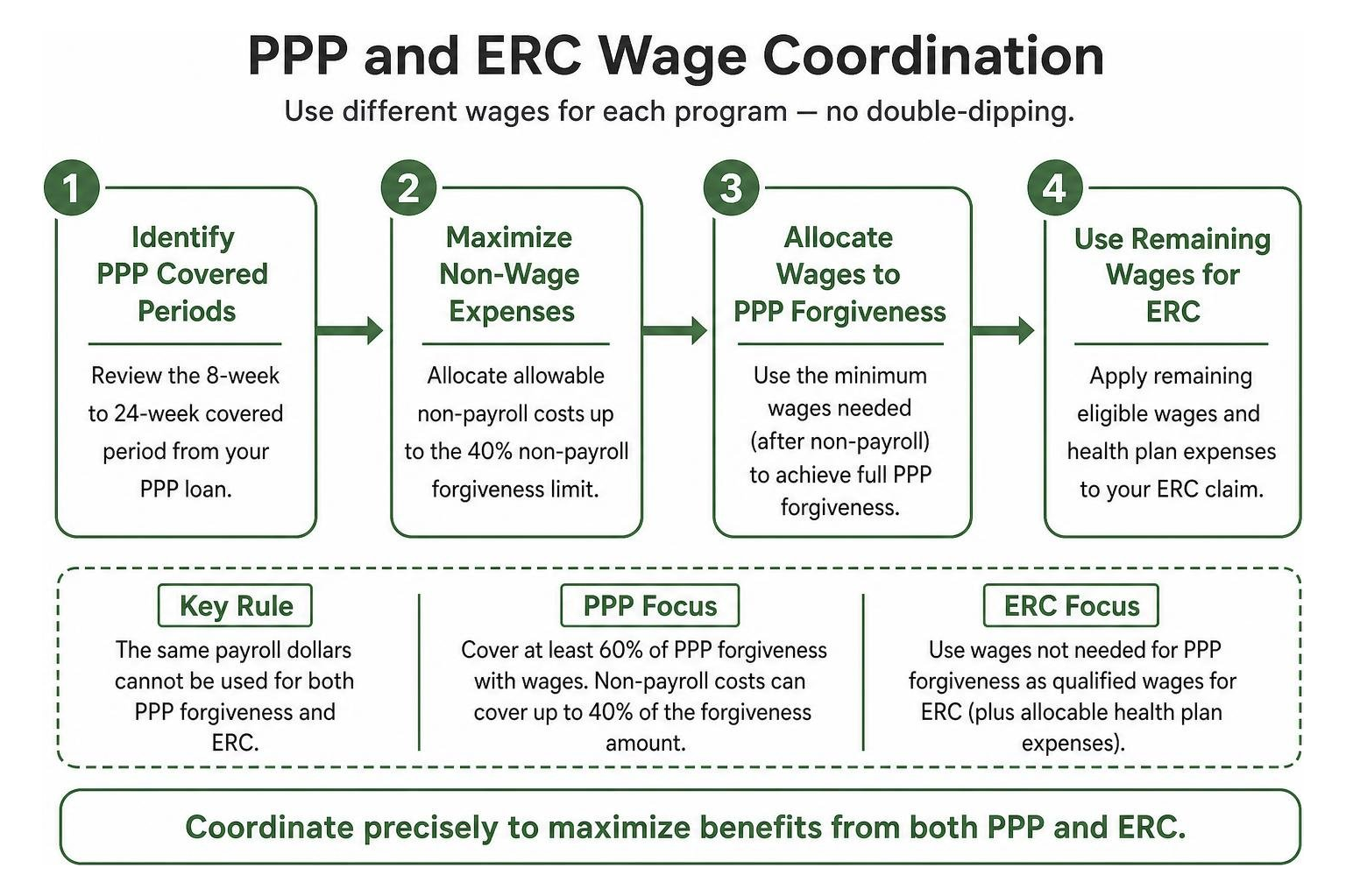
However, federal law strictly prohibits double-dipping: the exact same payroll dollars cannot be counted toward both PPP loan forgiveness and qualified ERC wages.
To maximize your combined benefit, employers must implement precise payroll cost segregation:
- Identify PPP Covered Periods: Review the 8-week to 24-week covered period established during your First or Second Draw PPP loan.
- Maximize Non-Wage Expenses: Allocate allowable non-payroll costs (such as mortgage interest, business rent, utilities, and covered operations expenditures) up to the statutory 40% non-payroll forgiveness limit on your PPP application.
- Segregate Wage Dollars: Apply the minimum required payroll costs (typically 60%) to satisfy full PPP forgiveness. The remaining payroll expenses outside of that forgiveness allocation can be utilized as qualified wages for the ERC.
- Coordinate Other Federal Grants: Ensure wages are not duplicated across the Restaurant Revitalization Fund (RRF), Shuttered Venue Operators Grant (SVOG), or Work Opportunity Tax Credits (WOTC).
For additional step-by-step guidance on structural tax credit integration, consult the US Chamber guide to claiming the employee retention tax credit.
Step-by-Step Process for Retroactive Filing and Documentation

Claiming the credit retroactively requires filing amended employment tax returns using IRS Form 941-X (Adjusted Employer’s Quarterly Federal Tax Return or Claim for Refund). Because the ERC directly modifies payroll tax liability, it cannot be claimed on standard annual corporate income tax forms.
A bulletproof retroactive filing package relies on extensive contemporaneous documentation:
- Detailed Payroll Journals: Employee-by-employee breakdowns showing gross wages, paid leave, pre-tax deductions, and qualified health plan expenses.
- PPP Forgiveness Records: Official SBA forgiveness letters and Schedule A worksheets proving zero wage overlap.
- Gross Receipts Ledgers: Quarterly income statements and revenue ledgers for 2019, 2020, and 2021 establishing the statutory reduction.
- Government Orders Repository: Exact copies of county, state, or federal executive orders outlining mandatory restrictions, dates of enforcement, and specific business impacts.
Required Payroll Tax Forms and Income Tax Adjustments
Adjusting your payroll filings triggers mandatory downstream income tax adjustments under Internal Revenue Code (IRC) Section 280C. When an employer receives an ERC refund, the business must reduce its deductible wage expense on its federal income tax return by the exact dollar amount of the credit claimed for that matching tax period.
For example, if an S-Corporation filed a Form 941-X claiming $100,000 in ERC for wages paid in the second quarter of 2021, the business cannot deduct that $100,000 as a standard payroll wage expense on its 2021 Form 1120-S. This requires filing an amended business income tax return (Form 1120, Form 1120-S, or Form 1065) to reflect the reduced deduction, resulting in an adjustment to taxable income.
Failing to amend corporate income tax returns while claiming employment tax refunds is one of the most common red flags flagged during IRS automated compliance checks. You can read more about avoiding structural audit errors by reviewing our guide on navigating erc irs guidelines.
Avoiding Predatory Scams Targeting ERC Small Business Owners
The massive financial scale of the ERC led to an influx of aggressive third-party marketing firms—commonly referred to as “ERC mills.” These promoters targeted small business owners with unsolicited calls, aggressive radio ads, and misleading promises that every business automatically qualified for maximum relief.
To protect your business against audit liabilities, penalties, and interest, review the official IRS checklist for avoiding ERC scams.
If your business was misled into submitting an improper or aggressive filing, the IRS provides an administrative ERC Claim Withdrawal Process. This allows employers whose claims have not yet been processed—or who received a refund check but have not cashed or deposited it—to formally withdraw the submission. The IRS treats withdrawn claims as though they were never filed, eliminating civil penalties, audit scrutiny, and repayment interest.
Managing IRS Processing Backlogs and Refund Delays
Over the past several years, the IRS experienced unprecedented surges in fraudulent and improper filings. In response, the agency implemented a processing moratorium on new claims to establish rigorous audit protocols, deploy automated fraud filters, and systematically review backlogged filings.
The agency’s operational data illustrates the scale of this compliance effort:
- The IRS has processed approximately 400,000 legitimate claims representing more than $10 billion in direct relief.
- As of August 2026 reporting, approximately 17,300 complex remaining claims are actively working through specialized review stages across the IRS inventory (including 2,300 claims under field review, 2,900 pending final payment or disallowance, 4,400 assigned to active audit examination, 6,100 under post-disallowance response review, and 1,600 with the Independent Office of Appeals).
This extensive scrutiny has stretched processing timelines for paper Form 941-X returns, leaving legitimate businesses waiting extended periods for their capital.
IRS Review Status and Dispute Resolution via Letter 105-C
When the IRS reviews an amended payroll return, it either approves the refund, requests additional documentation through an Information Document Request (IDR), or disallows the claim.
If an ERC claim is disallowed, the IRS issues a formal Letter 105-C (Notice of Claim Disallowance). Receiving this notice does not necessarily mean the end of the road. If your claim is legitimate and backed by concrete documentation:
- Analyze the Disallowance Rationale: Determine whether the rejection was due to missing forms, mathematical discrepancies, or a disagreement over government suspension eligibility.
- File an Administrative Appeal: You have 30 days from the date of Letter 105-C to file a formal written protest requesting an administrative review with the IRS Independent Office of Appeals.
- Submit Rebuttal Evidence: Provide comprehensive payroll journals, copies of active executive orders, and gross revenue ledgers proving statutory compliance.
To understand how these administrative mechanics work, see our resource where the erc explained breaks down formal compliance responses.
Accelerating Liquidity with ERC Advance Solutions
For many businesses in Travis County and across the country, waiting indefinitely for IRS processing creates severe cash flow constraints. Capital that was earmarked for equipment purchases, payroll stability, or expansion remains locked in government queues.
To bypass these delays, business owners can utilize private non-dilutive liquidity solutions:
- ERC Refund Advances: Short-term bridge financing secured by your verified, pending Form 941-X claim.
- ERC Claim Buyouts: A transaction where a specialized financial institution purchases your ERC claim rights, delivering immediate upfront cash while assuming the processing wait time.
At SFG Capital, we provide Travis County businesses with streamlined advances and buyout structures. Operating on performance-based fee arrangements, we verify your claim’s underlying tax compliance and deliver immediate working capital without waiting on federal disbursement backlogs. Learn more about unlocking your capital with erc advance funding.
Frequently Asked Questions About the Employee Retention Credit
Can our company claim the ERC if we already received PPP forgiveness?
Yes. Under the Taxpayer Certainty and Disaster Tax Relief Act, businesses can claim both PPP loan forgiveness and the ERC for the same tax periods. However, you cannot use the same wages for both programs. Employers must isolate the specific payroll dollars allocated to PPP forgiveness and claim the ERC exclusively on the remaining qualified wages paid to employees during eligible quarters.
What is the deadline to file retroactive ERC claims?
Under standard tax law statutes of limitations (IRC Section 6511), employers had three years from the date their original Form 941 was filed or two years from the date tax was paid to submit Form 941-X. For the 2020 tax year, the standard statutory deadline was April 15, 2024. For 2021 tax quarters, the standard statutory deadline was April 15, 2025. While normal deadlines for new retroactive claims have generally passed, the IRS continues to review, process, and disburse timely filed claims that remain pending in its active inventory.
How does claiming the ERC impact our business income tax returns?
Claiming the ERC reduces your business’s allowable wage deduction under IRC Section 280C. You must reduce your deductible wage expense on your federal income tax return (Form 1120, Form 1120-S, or Form 1065) by the exact dollar amount of the ERC claimed in that corresponding tax year. If you previously filed your corporate income taxes without accounting for the credit, you must file an amended income tax return to correct your deduction and pay any resulting tax adjustment.
Conclusion
The Employee Retention Credit remains one of the most powerful liquidity programs ever created for American enterprise, but claiming it successfully demands strict compliance and bulletproof documentation. As the IRS continues to audit claims and process remaining backlogs, business owners must ensure their calculations are supported by contemporaneous payroll journals, accurate gross receipts testing, and valid government suspension records.
If you operate a business in Travis County, Austin, or across the United States and have a pending, verified ERC filing trapped in federal processing delays, you do not have to let frozen capital stall your operational growth. SFG Capital provides specialized bridge advances and claim buyout options designed to deliver immediate, non-dilutive liquidity. Explore our tailored funding options today to bypass IRS wait times and put your hard-earned capital back to work.
See what your business may qualify for.
60 seconds. No documents. No upfront cost.
General information only, not legal or tax advice. Eligibility and estimates are fact-specific and subject to review.