
Blog / Insights
InsightsUnderstanding ERC Buyout Performance Fees without Losing Your Mind
November 5, 2026 · 9 min read · By the SFG Capital team
What Business Owners Need to Know About ERC Refund Processing
ERC refund processing is taking far longer than most business owners expected — and if you’re still waiting, you’re not alone.
Here’s a quick overview of where things stand:
| Topic | Key Facts |
|---|---|
| Standard processing time | 6-8 weeks after filing (often much longer) |
| Current IRS backlog | ~511,000 unprocessed Forms 941-X as of mid-2023 |
| Claims under active review | ~400,000 claims worth ~$10 billion |
| Claims filed after Sept. 14, 2023 | Under IRS moratorium — not being processed |
| How to check your status | Call IRS at (800) 829-4933 or use a tax professional’s line at (877) 777-4778 |
| What to do if disallowed | Appeal, withdraw, or adjust wage deductions in the year of final disallowance |
The Employee Retention Credit (ERC) was created under the CARES Act to help businesses keep workers on payroll during the COVID-19 pandemic. Millions of businesses filed claims — and many are still waiting for their money years later. A flood of claims, a wave of promoter-driven fraud, and an IRS stretched thin have all combined to create one of the most frustrating refund backlogs in recent memory.
For business owners who need that capital now, the wait is more than an inconvenience. It’s a real operational problem.
I’m Santino Battaglieri, and through SFG Capital I’ve worked directly on ERC refund processing at scale — having purchased and funded over $500 million in ERC claims, I’ve seen what causes delays, what triggers audits, and what options businesses actually have. In the sections below, I’ll walk you through exactly what’s happening with ERC refunds in 2026, what your options are, and how to protect yourself along the way.
The Reality of ERC Refund Processing in 2026
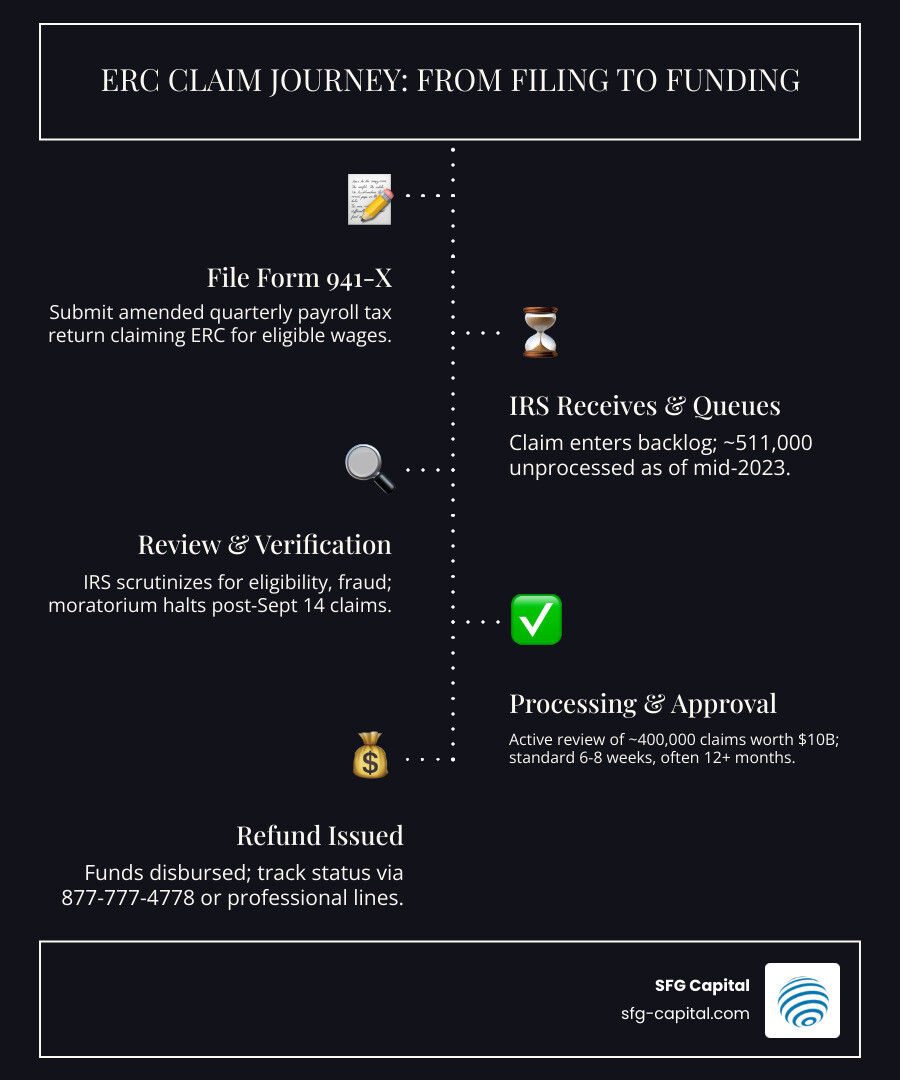
If you feel like you’ve been stuck in a digital waiting room for years, you aren’t imagining it. The IRS has been wading through a massive mountain of paperwork. As of August 2023, there were approximately 511,000 unprocessed Forms 941-X. While the agency has made strides, they are currently still processing roughly 400,000 claims worth about $10 billion.
The complexity of erc refund processing stems from how the credit evolved. Initially, the CARES Act provided a 50% credit on up to $10,000 in wages for 2020. Later, the Consolidated Authorizations Act, 2021 and the America Rescue Plan of 2021 expanded this significantly for 2021.
| Year | Credit Rate | Max Credit Per Employee |
|---|---|---|
| 2020 | 50% of qualified wages | $5,000 per year |
| 2021 | 70% of qualified wages | $7,000 per quarter (up to $21k or $28k total) |
Because these changes were retroactive, businesses had to file amended payroll tax returns (Form 941-X). Unlike original returns, these cannot be filed electronically; they must be mailed as paper forms, which contributes significantly to the backlog. If you’re feeling lost in the shuffle, you can learn more about tracking your refund to see where your business stands in the queue.
Why is my erc refund processing taking so long?
The biggest “speed bump” in the history of the ERC happened on September 14, 2023. To counter a flood of questionable claims driven by aggressive “ERC mills” or promoters, the IRS announced a moratorium on processing any new claims submitted after that date.
This moratorium was intended to give the agency time to digitize information and implement more robust fraud detection. The IRS has identified several “red flags” that trigger manual reviews, including:
- Identity verification issues.
- Claims from businesses that didn’t exist during the eligibility period.
- Discrepancies between payroll data and the credit amount claimed.
- Promoter scams that promised “instant eligibility” to businesses that didn’t actually qualify.
While the IRS shifted into a “new phase” of scrutiny in mid-2024, resuming processing for some claims filed between September 2023 and January 2024, the heightened verification means every claim is being looked at with a magnifying glass.
Understanding the 2025 Timeline
In a perfect world, erc refund processing takes 6 to 8 weeks. In the real world of 2026, many businesses in Travis County and across the U.S. have been waiting 12 months or longer.
The process is essentially a marathon through a series of checkpoints. First, the paper return must be received and manually entered into the IRS system. Then, it undergoes a risk assessment. Low-risk claims move toward payment, while high-risk claims are flagged for additional documentation or audit. You can find a more detailed breakdown by decoding the timeline for refunds to manage your expectations for the coming quarters.
Navigating IRS Scrutiny: Disallowances, Withdrawals, and Audits
The IRS isn’t just sitting on these claims; they are actively filtering them. The agency recently issued disallowance letters to about 28,000 businesses for claims filed during the moratorium period. Additionally, roughly 100,000 letters were sent to promoters and businesses specifying partial or full disallowance of claims deemed improper.
If you receive a notice, don’t panic, but do act quickly. Only about 2,000 taxpayers have responded to these disallowance letters so far, which suggests many owners are either overwhelmed or unsure of their next steps. Understanding the waiting game is key to staying calm while you navigate these official hurdles.

How to check your erc refund processing status
Waiting in silence is the hardest part. Fortunately, there are ways to peek behind the curtain. The most direct method is calling the IRS helpline at (800) 829-4933. However, be prepared for long wait times.
A more efficient “pro-tip” is to work with a tax professional who has access to the special IRS practitioner line at (877) 777-4778. This often yields faster results and more detailed information about whether your claim is “in suspense,” “under review,” or “approved for payment.” If you’ve hit a brick wall, you can also reach out to the Taxpayer Advocate Service, an independent organization within the IRS that helps taxpayers resolve persistent issues. For a step-by-step guide on what to say when you call, check your status here.
Options for Ineligible Claims
What if you realize—perhaps after reading a cautionary news report—that the promoter who helped you file might have played fast and loose with the rules? The IRS has provided a “get out of jail free” card (mostly) through the Withdrawal Program.
If you haven’t received your refund yet, or if you received a check but haven’t cashed it, you can withdraw the entire claim. This treats the claim as if it were never filed, which can protect you from future audits, penalties, and interest. You simply need to fax a signed request to (855) 738-7609 following the specific instructions at IRS.gov/withdrawmyERC. For more context on why someone might choose this path, read more on the ERC refund journey.
Tax Implications and Post-Refund Compliance
Receiving the check isn’t the end of the story. The ERC has significant income tax implications. Per Notice 2021-20, the credit is not considered taxable income, but it does reduce the wage expenses you can deduct on your income tax return.
This creates a “timing” headache. Under Section 2301(e) of the CARES Act, you are generally required to reduce your wage deductions for the year the wages were paid, not the year you received the refund. This often means you need to file an amended income tax return for 2020 or 2021.
However, because of the extreme delays in erc refund processing, some businesses are finding that the Statute of Limitations (SOL) for amending their 2020 or 2021 returns has already expired. In these cases, there are complex strategies involving the “tax benefit rule” that might allow you to account for the credit in the year of receipt. This is a technical area where understanding your delayed credit becomes vital for compliance.
Handling Disallowed Claims and Wage Deductions
What happens if you did the “right thing” and reduced your wage deductions in anticipation of a refund, but then the IRS disallowed your claim? You don’t want to lose out on those deductions.
The IRS has provided guidance suggesting that if your ERC is finaly disallowed, you can increase your wage expense on your income tax return in the year the disallowance becomes final. This avoids the need to go back and amend years-old returns and ensures you aren’t taxed on “phantom” income. It’s a relief mechanism designed to keep businesses from being penalized twice. To keep track of these moving parts, explore ways to track your credit.
Post-Refund Verification Steps
Once the funds hit your account, keep your records organized! The IRS can audit ERC claims for several years after they are paid. You should maintain:
- Documentation of how you met eligibility (gross receipts decline or government suspension).
- Detailed payroll records for the qualified wages.
- Records of any PPP loans received (to ensure no “double-dipping”).
- Proof of the refund amount and any interest paid by the IRS (usually at a rate of 15-16%).
Meticulous record-keeping is your best defense against future scrutiny. If you’re feeling overwhelmed by the paperwork, navigating the refund maze can provide the clarity you need to cross the finish line safely.
Frequently Asked Questions about erc refund processing
What is the Voluntary Disclosure Program (VDP)?
The VDP was designed for businesses that already received and cashed their ERC checks but later realized they weren’t actually eligible. The second VDP, which was open through late 2024, allowed businesses to repay 80% of the credit received. By paying back 80%, the IRS waived the remaining 20%, along with all interest and penalties, and promised not to audit the business for those periods. It was a “peace of mind” program for those caught up in promoter scams.
How do I avoid ERC scams and red flags?
Scammers love the ERC because the dollar amounts are high. Avoid anyone who:
- Charges an upfront contingency fee based on a percentage of the refund.
- Claims you can qualify in “minutes” without looking at your records.
- Uses aggressive marketing tactics like official-looking “urgent” mailers.
- Tells you that every business qualifies regardless of their actual impact from COVID-19.
Working with reputable, local professionals in Travis County is always safer than responding to a random ad. If you need the funds but want to avoid the risks of a bad provider, expediting your refund through a legitimate advance can be a viable alternative.
Can I withdraw an ERC claim if I think it’s ineligible?
Yes, as long as the IRS hasn’t paid it yet or you haven’t cashed the check. The IRS withdrawal instructions specify different procedures depending on your situation:
- Section A: No refund received and no audit notice.
- Section B: No refund received but you are currently under audit.
- Section C: You have the check in hand but haven’t deposited it.
Following these steps precisely ensures the IRS cancels the claim without triggering further investigation.
Conclusion
Navigating erc refund processing in 2026 requires a mix of patience, diligence, and expert guidance. With backlogs still hovering around half a million forms and the IRS maintaining a high level of scrutiny, the “waiting game” has become a significant burden for businesses in Austin and throughout Travis County.
At SFG Capital, we understand that “eventually” isn’t a helpful timeline for a business with payroll to meet or growth to fund. We specialize in helping businesses bypass the IRS backlog by providing ERC advances and buyouts. This allows you to access your capital now while we handle the complexities of the wait. Our performance-based fees mean we are as invested in the success of your claim as you are.
Don’t let your business’s future stay stuck in an IRS processing center. Expedite your refund today and get back to focusing on what you do best: running your business.
See what your business may qualify for.
60 seconds. No documents. No upfront cost.
General information only, not legal or tax advice. Eligibility and estimates are fact-specific and subject to review.