
Blog / Insights
InsightsWhen Will I Receive My Employee Retention Credit Refund
October 14, 2026 · 8 min read · By the SFG Capital team
The Honest Answer to “When Will I Get My ERC Refund?” in 2026
If you’re asking “when will I get my erc refund,” here is the short answer:
| Claim Type | Estimated Processing Time |
|---|---|
| Low-risk claims (pre-Sept 14, 2023) | Several months to 1+ year |
| High-risk or flagged claims | 1-3+ years (additional review required) |
| Claims filed Sept 14, 2023 – Jan 31, 2024 | Now being processed; timeline unclear |
| Claims filed after Jan 31, 2024 | Subject to OBBBA restrictions; some terminated |
The bottom line: Most businesses waiting on an ERC refund in 2026 are looking at a long wait. The IRS is currently processing roughly 400,000 claims worth about $10 billion, and the backlog has been a moving target for over two years.
The Employee Retention Credit (ERC) was created under the CARES Act to help businesses keep workers on payroll during the COVID-19 pandemic. It sounded simple enough. File an amended payroll return, wait for your refund.
But what followed was anything but simple.
The IRS has called the ERC the most complex credit it has ever managed. A flood of aggressive promoters pushed businesses — eligible or not — to file claims. The result: a backlog that hit 1.1 million unprocessed returns at its peak, a full moratorium on new claims, and millions of business owners still waiting with no clear end date in sight.
If you are one of them, you are not alone — and this guide will walk you through exactly where things stand, what is causing the delays, and what your options are right now.
I’m Santino Battaglieri, and through SFG Capital I’ve helped fund and evaluate over $500 million in ERC claims — giving me a ground-level view of the exact delays and bottlenecks that determine when you’ll get your ERC refund. That experience shapes everything in this guide, so you can make informed decisions rather than just wait.
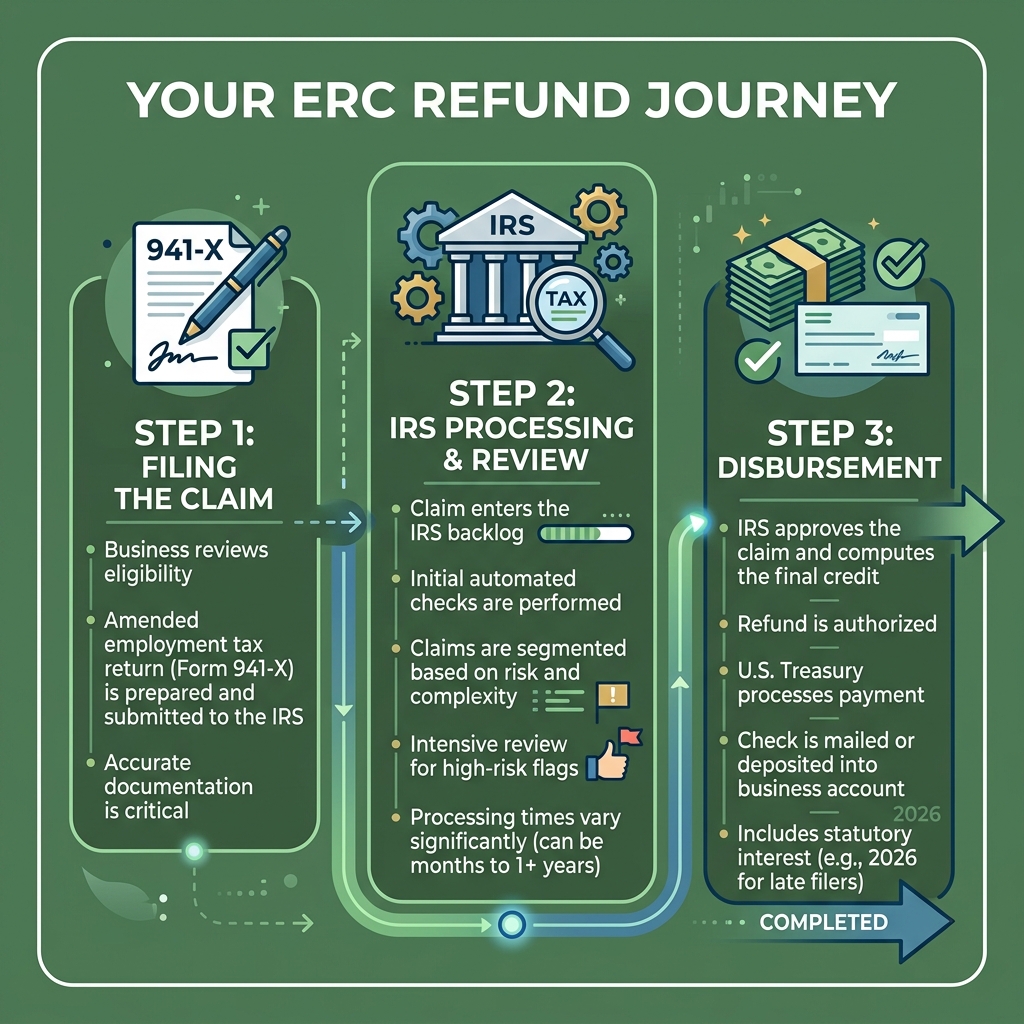
Current IRS Processing Times: When Will I Get My ERC Refund?

We know the silence from the IRS is deafening. As of late 2025 and heading into 2026, the IRS is currently navigating a massive inventory. While they are actively processing about 400,000 claims valued at approximately $10 billion, there is still a significant backlog of unprocessed amended employment tax returns. At one point in December 2023, that number sat at a staggering 983,000 returns.
The official Employee Retention Credit | Internal Revenue Service page notes that they are focusing on the “highest and lowest risk” claims first. If your claim is deemed “low-risk”—meaning it has clear documentation of a gross receipts decline and no red flags—you might see movement sooner. However, “sooner” in IRS terms still often means several months.
The reality is that these aren’t simple math problems for the IRS to solve. Unlike standard income tax returns, ERC claims (filed on Form 941-X) often require manual processing by highly trained staff. This hand-processing, combined with historical staffing shortages and the sheer volume of claims, has created a perfect storm of delays.
Understanding the IRS Moratorium and Legislative Delays
To understand when will I get my erc refund, we have to look back at September 14, 2023. On that day, the IRS implemented a sudden moratorium on processing new ERC claims. This was a drastic measure intended to protect small business owners from “ERC mills” and aggressive promoters who were filing fraudulent or ineligible claims.
During this moratorium, the IRS didn’t just stop working; they shifted their focus to fraud prevention and building better “filters.” The IRS Criminal Investigation (CI) unit has identified over 323 investigations involving more than $2.8 billion in potentially fraudulent claims. To combat this, they are now digitizing paper claims to run them through advanced identity theft and fraud detection sequences.
The moratorium has since shifted. The agency announced it would begin processing claims filed between September 14, 2023, and January 31, 2024. However, if you are in The Great ERC Wait, you should know that the IRS is being incredibly cautious. Any claim that looks even slightly complex is being diverted for additional manual review, which can add a year or more to the timeline.
How the OBBBA Affects When Will I Get My ERC Refund
The legislative landscape changed again with the proposed One Big Beautiful Bill Act (OBBBA). This act carries heavy implications for the future of the credit. Most notably, it sought to retroactively terminate 2021 Q3 and Q4 claims if they were filed after January 31, 2024, and the refund wasn’t received by July 4, 2025.
This legislation also extends the statute of limitations for IRS audits on all ERC claims to six years. This means even after you receive your check, the IRS has a much longer window to come back and verify your eligibility. For those still waiting in 2026, the OBBBA creates a “hard stop” for many claims, essentially shutting the door on late filers to help fund other tax priorities.
How to Track and Check Your ERC Refund Status
Checking your status isn’t as easy as checking a personal 1040 refund. There is no “Where’s My ERC Refund” online portal. Instead, you have to use more traditional—and often more frustrating—methods.
- The IRS Business Helpline: You can call the IRS at 800-829-4933. Be prepared for long hold times. When you get through, you’ll need your EIN, the tax periods you’re inquiring about, and the exact amount of the credit claimed.
- Tax Transcripts: Requesting an account transcript for the specific quarter (e.g., Q2 2021) can show if the IRS has even logged your Form 941-X. If you see a code “971” followed by “977,” it means they have received your amended return but haven’t processed it yet.
- Authorized Signers: Only an authorized officer of the company or someone with a valid Power of Attorney (Form 2848) can check the refund status.
Steps to Take if You Are Asking When Will I Get My ERC Refund
If you’ve been waiting more than six months, we recommend taking a proactive approach. First, verify that the IRS has your correct mailing address. Many ERC refunds are still issued as paper checks, and if you moved your office, that check could be sitting in a dead-letter office.
Second, consider a professional status check. Reputable tax professionals often have access to dedicated practitioner lines that can provide more detailed information than the general helpline. They can tell you if your claim is in “active” processing or if it has been suspended for “additional verification.”
Lastly, watch your mail for IRS correspondence. Sometimes the delay isn’t just a backlog; it’s because the IRS sent a letter (like a 6042C) asking you to verify your identity or business existence, and that letter got lost in the shuffle.
Options for Expediting Your ERC Refund
Let’s be blunt: You cannot “speed up” the IRS. No matter what a promoter tells you, there is no “fast lane” inside the government. However, you can expedite your access to the cash.
This is where we come in. At SFG Capital, we specialize in helping businesses in Travis County and throughout the U.S. bypass the IRS waiting game. We offer ERC advances and buyout options that provide immediate liquidity.
Instead of asking “when will I get my erc refund” and waiting for a check that might be years away, we provide the funds now. We take on the “IRS risk” and the wait time.
- Immediate Liquidity: Get cash in days, not years.
- Performance-Based Fees: Our interests are aligned with yours.
- Expert Assistance: We provide a deep-dive review of your claim to ensure it stands up to IRS scrutiny.
For many Austin-area businesses, this is the difference between expanding today or struggling with cash flow tomorrow. If you are tired of waiting for the IRS to move, a buyout might be your best path forward.
Frequently Asked Questions about ERC Refunds
What do IRS letters 105C, 106C, or 6577C mean for my timeline?
If you receive one of these letters, your timeline just changed significantly.
- Letter 105C: This is a full disallowance. The IRS has decided you aren’t eligible. You have 30 days to protest this to the Independent Office of Appeals.
- Letter 106C: This is a partial disallowance. They are paying some of your claim but denying other parts.
- Letter 6577C: This is often a “we need more time” letter, or it may indicate they are reviewing the claim for potential issues.
Understanding these status codes is vital. If you ignore a 105C, you lose your right to the credit entirely.
Should I withdraw my ERC claim if I am concerned about eligibility?
The IRS launched a Withdrawal Program specifically for businesses that realized their claim might be improper. If you were pushed into a claim by a “mill” and now realize you didn’t have a government order or a gross receipts decline, withdrawing is a smart move.
A successful withdrawal means the IRS treats the claim as if it never happened, which can save you from massive penalties, interest, and even potential criminal charges. You can withdraw as long as you haven’t cashed the check yet.
How does using a PEO affect my refund status and timeline?
If you use a Professional Employer Organization (PEO), your ERC journey is often more complex. Because the PEO files under their EIN, not yours, your credit is part of an “aggregate” filing on Schedule R.
This means your refund depends on the PEO’s processing speed and their compliance. If one business in the PEO’s aggregate filing has a red flag, it can delay the refunds for every other business in that batch. You must work closely with your PEO to get copies of the redacted Schedule R and verify they have actually received the funds from the IRS.
Conclusion
The question of “when will I get my erc refund” doesn’t have a single answer, but it does have a single theme: patience is required, but action is often better. Between the 400,000-claim backlog, the OBBBA legislative changes, and the IRS’s aggressive fraud filters, the “standard” 6-to-8-week window is a thing of the past.
You have two choices: you can continue to monitor the IRS helpline and wait for a paper check that may be months or years away, or you can take control of your capital. If your business needs that cash today to grow, hire, or stabilize, we are here to help.
Don’t let your pandemic relief stay stuck in a government backlog. Contact us today to learn more about our ERC buyout services and see how we can get your funds to you without the wait.
See what your business may qualify for.
60 seconds. No documents. No upfront cost.
General information only, not legal or tax advice. Eligibility and estimates are fact-specific and subject to review.