
Blog / Insights
InsightsWhy 2026 Tax Refunds Took Forever and How to Get Yours
October 14, 2026 · 8 min read · By the SFG Capital team
Why IRS Refund Delays in 2021 Still Matter in 2026
If you are still trying to resolve IRS refund delays 2021 in 2026, start by checking your IRS account transcript and the Where’s My Refund? tool. Then respond quickly to any IRS notice, file any missing prior-year returns, and seek Taxpayer Advocate Service help if the delay is causing serious financial hardship.
The delay was not usually one simple mistake. The IRS began 2021 with roughly 8 million returns left from the prior year, while COVID-19 disruptions, paper-return backlogs, staffing limits, stimulus payments, and new tax-credit rules created a much larger manual-review queue. By the end of the 2021 filing season, 35.3 million returns were awaiting manual processing.
For business owners awaiting payroll-tax or ERC-related refunds, the lesson is clear: verify every filing, preserve all support records, and do not assume a pending status means the IRS has all it needs. A delayed original payroll return could also hold up a related amended Form 941-X claim.
I am Santino Battaglieri, a financial-services professional with experience in ERC advisory, compliance support, and structured funding for large volumes of claims. My work around IRS refund delays 2021 has focused on helping businesses understand documentation, processing risk, and cash-flow options while keeping compliance first.
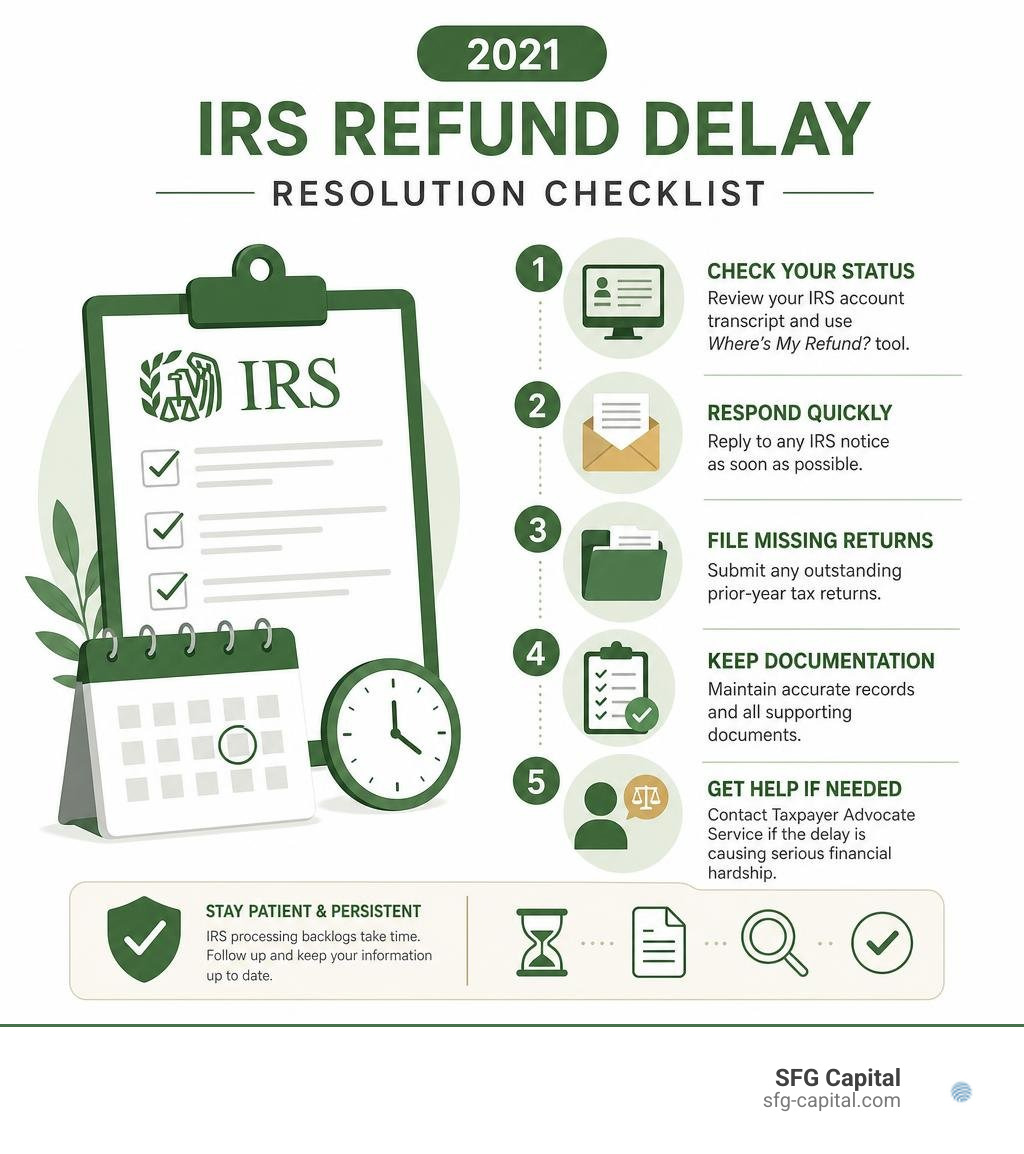
Simple guide to irs refund delays 2021:
Root Causes Behind the Historic IRS Refund Delays 2021
To understand why the backlog reached such staggering heights, we have to look under the hood of IRS operations. During normal filing cycles, the agency processes electronic returns seamlessly within 21 days. However, in 2021, an estimated 35 million returns were diverted into manual review queues within the Error Resolution System (ERS).

This operational logjam stemmed from several compounding factors:
- Massive Paper Return Inventory: Pandemic facility closures halted in-person paper processing. As revealed in the National Taxpayer Advocate Annual Report to Congress 2021, by mid-December 2021, the IRS held 6.2 million unprocessed individual returns (Form 1040), 2.8 million unprocessed business returns (Form 941), and 2.4 million unprocessed amended individual returns (Form 1040-X).
- Workforce Reductions: The agency’s overall staffing had declined by 17% since 2010, even as total filers surged by 19%. This left processing centers with over 4,400 unfilled vacancies.
- Facility Disruptions: The planned permanent closure of the Fresno paper-processing facility in late 2021 displaced critical workloads onto other already-strained centers.
- Hardware Bottlenecks: Physical infrastructure failed under the strain; at one major processing center, only three of ten copiers and printers were fully operational.
How Pandemic Stimulus Legislation Triggered IRS Refund Delays 2021
Congress passed several critical relief packages during the pandemic, but the late timing created immense friction for tax administration. As reported when Some Refunds Delayed as IRS Holds 29 Million Returns for Manual Processing, the passage of late-year legislation prevented the IRS from programming automated validation into its processing systems before filing season opened.
This dynamic caused millions of returns to trigger manual reviews due to specific relief provisions:
- Recovery Rebate Credit (RRC): Filers had to reconcile their third Economic Impact Payment using IRS Letter 6475. Any arithmetic discrepancy between taxpayer calculations and IRS internal records forced the return into manual ERS suspense.
- Advance Child Tax Credit (ACTC): Monthly advance payments issued in 2021 required year-end reconciliation via Letter 6419. Errors or missing dependent data immediately halted automatic refund issuance.
- 2019 Income Lookback Election: Filers were permitted to use 2019 earned income to calculate their Earned Income Tax Credit (EITC) and ACTC. Because systems could not automatically cross-reference 2019 records during intake, staff had to manually review each election.
Administrative and Statutory Bottlenecks
Beyond stimulus reconciliations, longstanding statutory mandates exacerbated processing delays. Understanding how come my federal refund is taking so long requires looking at strict legislative requirements:
- The PATH Act: The Protecting Americans from Tax Hikes Act legally prohibits the IRS from releasing refunds claiming the EITC or ACTC prior to February 15. Even in severe financial emergencies, the agency has no statutory authority to bypass this hold date.
- Prior-Year Non-Filing Holds: If a taxpayer had unfiled tax returns from prior years, the IRS automated system flagged the account, freezing refunds on current filings until the missing returns were processed (a workflow requiring up to 90 additional days).
- Paper Amended Returns (Form 1040-X): Amended returns required manual handling by Account Management staff, stretching average review timelines far beyond the standard 120-day baseline.
The Staggering Impact on Taxpayers and Customer Support
The volume of delayed returns triggered an unprecedented customer support collapse. According to GAO-22-104938, TAX FILING: 2021 Performance Underscores Need for IRS to Address Persistent Challenges, taxpayer phone inquiries surged by more than 180%. Customer service representatives were able to answer only 11% of incoming calls, leaving over 250 million phone calls unanswered while callers who broke through spent an average of 23 minutes on hold.
| Metric / Scenario | Standard IRS Baseline | 2021 Backlog Peak |
|---|---|---|
| Electronic Return Processing | Within 21 calendar days | 45 to 180+ days (if flagged) |
| Amended Returns (Form 1040-X) | Within 120 days | 6 to 12+ months |
| Customer Service Call Answer Rate | ~70%–80% | 11% (approx. 2% on 1040 lines) |
| Returns in Manual Review | < 2 million | 35.3 million |
| Statutory Refund Interest Paid | Routine operational cost | $3.3 Billion (FY 2021) |
Because the IRS exceeded the statutory 45-day processing window established under 26 U.S.C. § 6611, the federal government had to pay a staggering $3.3 billion in refund interest to delayed taxpayers in fiscal year 2021 alone.
Communication Failures and Tracking Tool Limitations
Taxpayers attempting to track their funds online encountered significant technological blind spots. The public-facing “Where’s My Refund?” tool offered generic, uninformative messages such as “Still Processing” without explaining whether a return was held for manual ERS verification, identity checks, or credit recalculations.
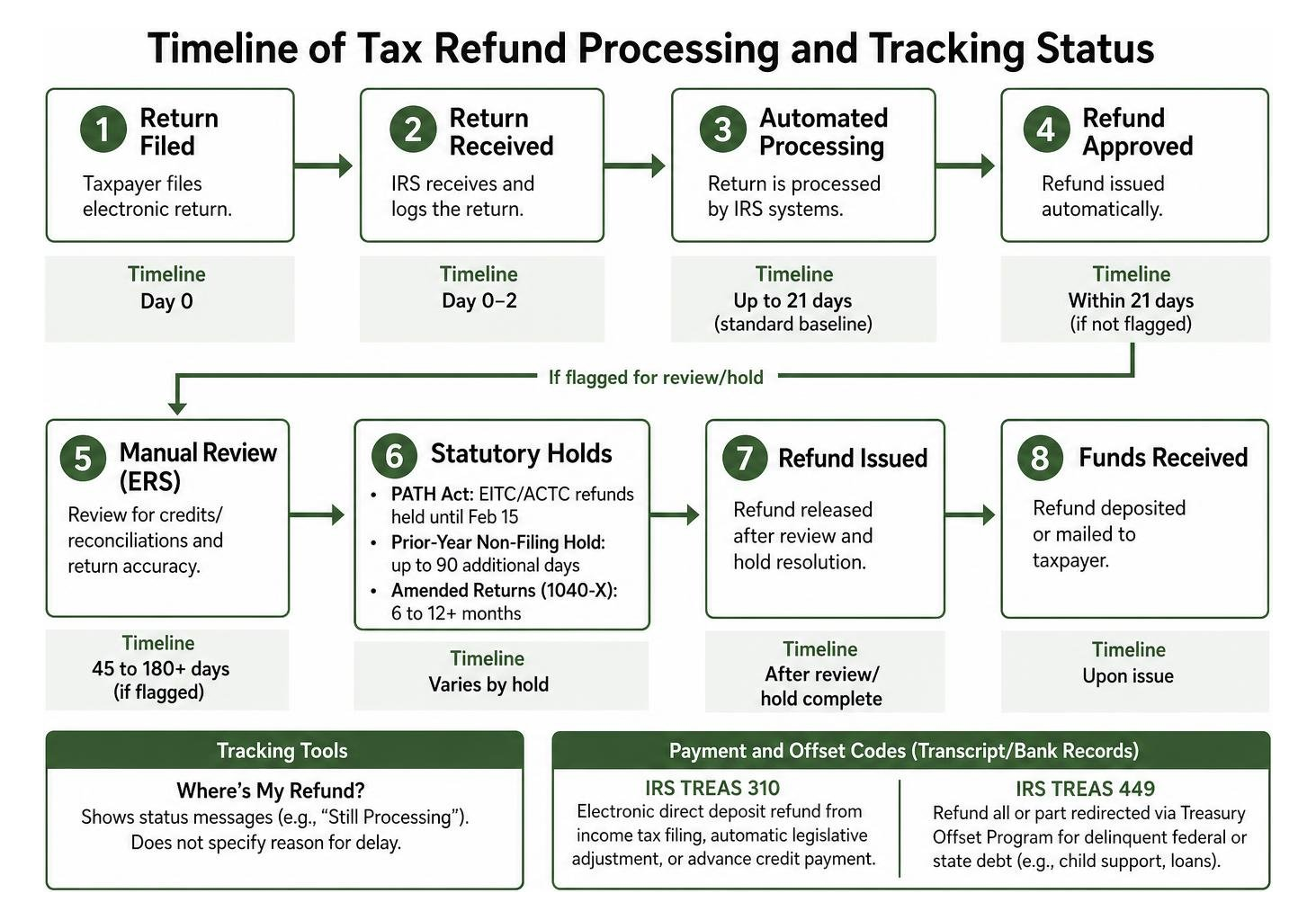
When reviewing bank records or transcript updates, taxpayers often encountered specific payment and offset codes:
- IRS TREAS 310: Indicates an electronic direct deposit refund originating from an income tax filing, automatic legislative adjustment (such as the 2020 unemployment compensation tax exclusion), or advance credit payment.
- IRS TREAS 449: Indicates that all or a portion of the refund was legally redirected through the Treasury Offset Program to satisfy a delinquent federal or state agency debt, such as past-due child support or student loans.
If you are dealing with a tax refund stuck in processing limbo, looking directly at your official tax account transcript remains the most transparent diagnostic method.
How to Claim and Expedite Overdue Prior-Year Tax Refunds

Resolving long-delayed returns requires structured documentation and persistence. When returns are held beyond standard timeframes, exploring strategies to expedite IRS processing can help break bureaucratic bottlenecks.
If an ongoing delay is causing acute financial harm—such as an inability to pay essential living expenses or impending foreclosure—taxpayers can apply for assistance through the independent Taxpayer Advocate Service (TAS). Outlined in the guidance on Held or Stopped Refunds – Taxpayer Advocate Service – IRS, filing Form 911 (Request for Taxpayer Advocate Service Assistance) allows eligible individuals and businesses to request case escalation.
Step-by-Step Guide to Resolving Unsettled IRS Refund Delays 2021
For taxpayers and business operators seeking to clear unsettled filings, follow this sequential resolution roadmap:
- Pull Official Tax Account Transcripts: Log into your IRS Online Account to inspect the exact line-item transaction codes on your Record of Account transcript. Look for Code 570 (additional liability pending/freeze) or Code 846 (refund issued).
- Verify All Supporting Credit Letters: Cross-check your original filing against IRS Letter 6475 (Economic Impact Payments) and Letter 6419 (Advance Child Tax Credit) to identify math errors.
- Submit Unfiled Prior-Year Returns: File any missing historical returns immediately; the IRS generally releases associated refund holds within 90 days of processing overdue prior-year filings.
- Complete Identity Verification: If your return was flagged by the Taxpayer Protection Program, complete online verification through ID.me or visit a local Taxpayer Assistance Center by appointment.
- Respond to Open IRS Notices: If you received Notice CP05, CP12, or Letter 12C, respond within the requested window with complete supporting documentation. Once received, the IRS typically resolves adjustments within 60 days.
- Seek Hardship Relief: If facing emergency hardship, utilize our comprehensive guide to getting a tax refund expedited alongside a formal TAS Form 911 submission.
Solutions for Business Filers and Payroll Tax Claims
Business filers experienced uniquely severe operational friction during the backlog era. Amended payroll tax filings submitted on Form 941-X—primarily for COVID-19 relief incentives like the Employee Retention Credit (ERC)—faced compounding administrative delays. Because the IRS requires the original Form 941 to be processed and posted before opening an amended Form 941-X claim, processing lags on initial filings created downstream freezes.
For businesses navigating liquidity challenges while waiting on claims, understanding and overcoming ERC refund delays is vital for maintaining healthy working capital. We at SFG Capital assist businesses across Travis County, Texas, by providing specialized claim analysis, compliance reviews, and structured ERC buyout and advance options that deliver immediate liquidity while claims navigate IRS queues.
Frequently Asked Questions About Prior-Year Refund Delays
Why did the IRS suspend so many returns during the 2021 filing season?
The IRS suspended over 35 million returns primarily because late-enacted pandemic legislation introduced new credits (such as the Recovery Rebate Credit and advance Child Tax Credit) and the 2019 income lookback election. Because agency IT systems could not automatically cross-verify these items at intake, any return with a calculation mismatch was routed into the Error Resolution System for manual examination.
Does the IRS pay interest on heavily delayed tax refunds?
Yes. Under Internal Revenue Code 26 U.S.C. § 6611, the IRS is statutorily required to pay overpayment interest on refunds delayed more than 45 days past the filing due date or actual return submission date, whichever is later. In fiscal year 2021, these processing backlogs resulted in $3.3 billion in statutory interest paid to taxpayers.
What should I do if my refund was held due to identity verification or missing returns?
If your refund is held under the Taxpayer Protection Program, complete the identity verification steps outlined in your IRS letter online or schedule an in-person appointment. If the hold stems from unfiled prior years, submit those completed returns immediately. For taxpayers experiencing extreme financial hardship due to held funds, review the official guidance at I Don’t Have My Refund – TAS – Taxpayer Advocate Service – IRS to request advocate intervention.
Conclusion
The historic processing bottlenecks of 2021 highlighted structural vulnerabilities within federal tax administration, demonstrating how a confluence of tax law changes, staffing constraints, and paper-based workflows can disrupt cash flow for millions of filers. For both individual taxpayers and commercial entities, resolving lingering prior-year issues requires proactive recordkeeping, careful transcript monitoring, and responsive communication with tax authorities.
For business owners in Austin and throughout Travis County navigating complex payroll credits or extended IRS processing queues, partnering with seasoned specialists provides financial certainty. Explore how our team at SFG Capital delivers dedicated Employee Retention Credit assistance and tailored advance solutions to keep your enterprise moving forward.
See what your business may qualify for.
60 seconds. No documents. No upfront cost.
General information only, not legal or tax advice. Eligibility and estimates are fact-specific and subject to review.