
Blog / Insights
InsightsWhy Your 2026 IRS Refund Might Be Taking Extra Time
October 14, 2026 · 9 min read · By the SFG Capital team
What to Do About IRS Refund Delays From 2023
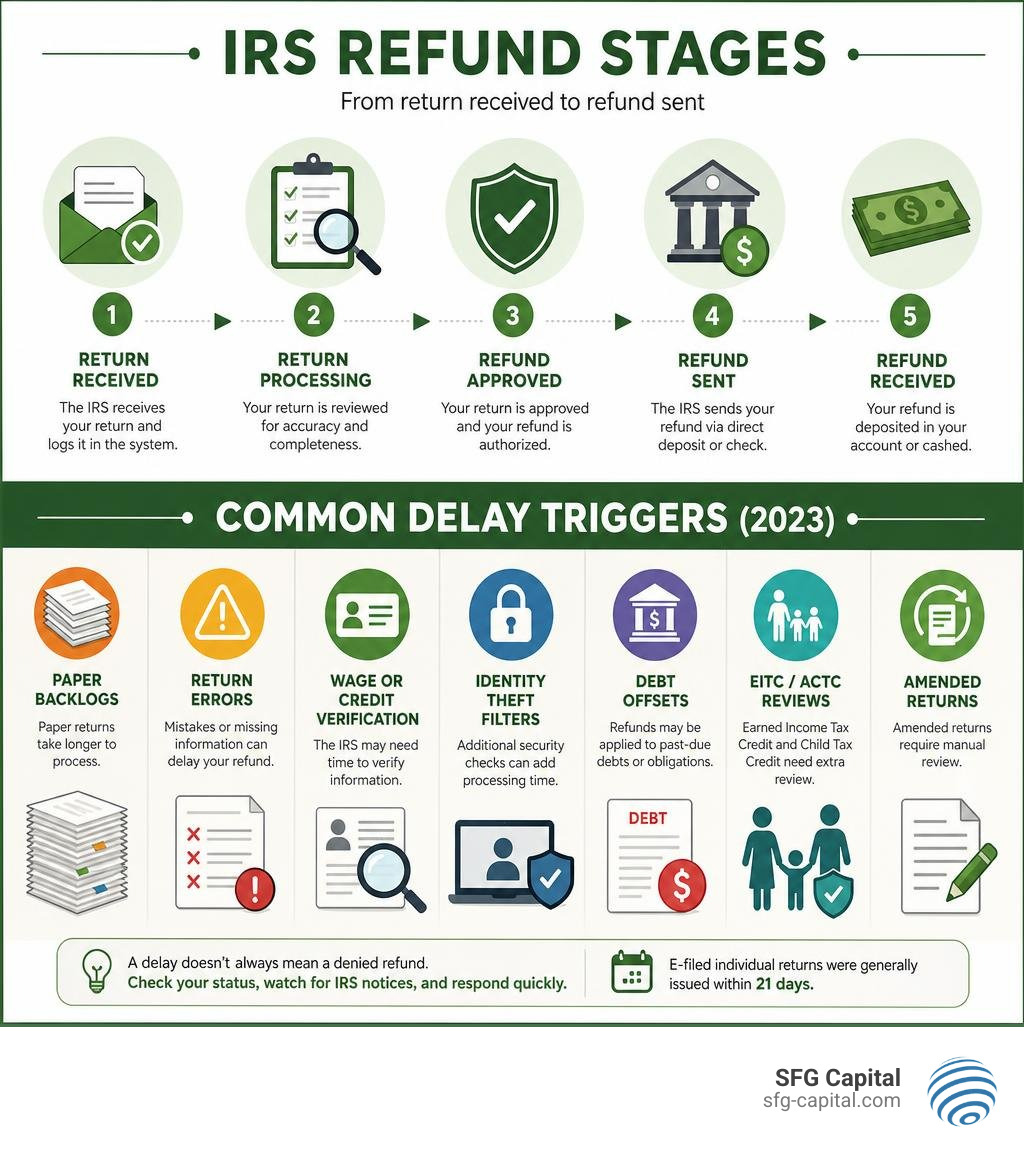
If you are still resolving a 2023 tax-year refund, start with Where’s My Refund?, then act on any IRS notice right away. E-filed individual returns were generally issued within 21 days, while paper returns and amended returns often took much longer because they needed manual work.
The most common reasons for IRS refund delays 2023 were paper-processing backlogs, return errors, wage or credit verification, identity-theft filters, debt offsets, and reviews of EITC, ACTC, or amended claims. For an ERC-related refund, keep your Form 941-X support organized and respond quickly if the IRS requests records.
In April 2023, the IRS still had 2.6 million original paper returns awaiting processing and 5.9 million returns suspended for issues such as error resolution or identity-theft review. That means a delayed refund did not always mean a denied refund, but it did require careful tracking and timely follow-up.
I am Santino battaglieri, founder of SFG Capital, with more than nine years of financial-services experience and extensive work supporting ERC claims and structured funding. My experience with IRS refund delays 2023 helps businesses understand the difference between a normal backlog, a compliance review, and a problem that needs action.
Quick irs refund delays 2023 terms:
- What to do when your tax refund is stuck in processing limbo
- The IRS waiting game: common reasons for slow tax refunds
- Employee Retention Credit delays
Understanding the Root Causes of IRS Refund Delays 2023
To understand why a tax refund might face multi-month holdups, it helps to examine how the IRS intake machinery operates. During the 2023 filing season, the IRS received over 137.1 million individual returns and successfully processed roughly 98% of standard submissions by late April. However, the journey looked drastically different depending on how the taxpayer filed and whether any automated verification flag was tripped.
| Filing Method & Condition | Standard Processing Window | Trigger for Extended Review | Typical Delayed Timeline |
|---|---|---|---|
| E-File with Direct Deposit | 10 to 21 Calendar Days | Math discrepancy, missing schedules | 45 to 180 Days |
| Paper-Filed Return | 6 to 8 Weeks | Manual data transcription, missing signature | 4 to 9 Months |
| Amended Return (1040-X / 941-X) | 16 to 20 Weeks | Manual agent assignment, credit verification | 5 to 12+ Months |
| Identity Protection Program Hold | Suspended until verified | Algorithmic fraud screen trigger | Up to 436 Days |
When a return is submitted electronically, it passes through automated screening algorithms within 24 to 48 hours. If an entry fails verification—such as an incorrect Social Security Number for a dependent, mismatched W-2 reporting, or computational math errors—the return is automatically pulled from the automated queue and funneled into the Error Resolution System (ERS).
Once an electronic or paper return enters ERS, automated processing stops completely. Returns routed into the ERS holding queue required manual intervention by IRS staff, averaging 75 days just sitting in the queue before a human examiner could review the flagged fields.
Over 5.1 million paper returns filed required manual transcription by agency clerks. When paper returns arrived without essential schedules, unsigned, or sent to the incorrect regional processing center, processing ground to a halt. As detailed in the National Taxpayer Advocate Mid-Year Report, paper returns remained the single largest processing vulnerability for the agency.

How Systemic Backlogs Triggered IRS Refund Delays 2023
While the IRS successfully improved its public telephone Level of Service (LOS) on customer service representative lines to 85% in 2023—drastically improving over the 15% rate recorded in 2022—this operational pivot required substantial trade-offs. The agency dedicated over 3.73 million staff hours to answering toll-free inquiries, pulling valuable personnel away from manual correspondence and paper return processing.
This reallocation of resources exacerbated delays for complex items. By late April 2023, the IRS still faced an overall inventory of 16.9 million items requiring manual processing, including:
- 2.6 million original paper returns
- 5.9 million returns suspended in error resolution and fraud detection queues
- 3.4 million amended returns (Form 1040-X and Form 941-X)
For individuals awaiting amended returns, the average wait stretched to 5.5 months, while amended business filings faced even longer delays. Taxpayers caught in The IRS Waiting Game: Common Reasons for Slow Tax Refunds experienced how shifting agency priorities created extended backlogs in correspondence departments.
Mandatory Review Windows: PATH Act, EITC, and ACTC Holds
Many taxpayers who filed early in the season were surprised to find their returns frozen despite error-free submissions. Under the Protecting Americans from Tax Hikes (PATH) Act, federal law strictly forbids the IRS from releasing any portion of a refund on returns that claim the Earned Income Tax Credit (EITC) or the Additional Child Tax Credit (ACTC) before February 15.
This statutory mandate provides the agency time to conduct pre-refund wage verification. The IRS matches wage figures reported on individual returns against Forms W-2 submitted by employers to the Social Security Administration. If an employer delays submitting wage records, the taxpayer’s refund is placed on hold until data reconciliation occurs. For more insight into these statutory rules, our review of Why are 2023 refunds delayed? highlights the regulatory framework governing these credits.
Identifying Fraud Flags, Debt Offsets, and Identity Theft Holds
Security screening filters represent another major source of prolonged refund holds. To combat tax fraud, the IRS deployed enhanced refund fraud filters and the Taxpayer Protection Program (TPP), which flagged over 2.3 million returns for potential identity theft during the 2023 cycle.
However, high fraud detection rates came with substantial friction:
- The false detection rate for identity theft filters reached 47%, leaving over 2.5 million legitimate returns temporarily frozen.
- Automated refund fraud filters selected 608,000 returns, recording a 66% false detection rate.
- As reported in the National Taxpayer Advocate mid-year review, the average resolution cycle time for identity theft victim assistance cases reached approximately 436 days (over 14 months).
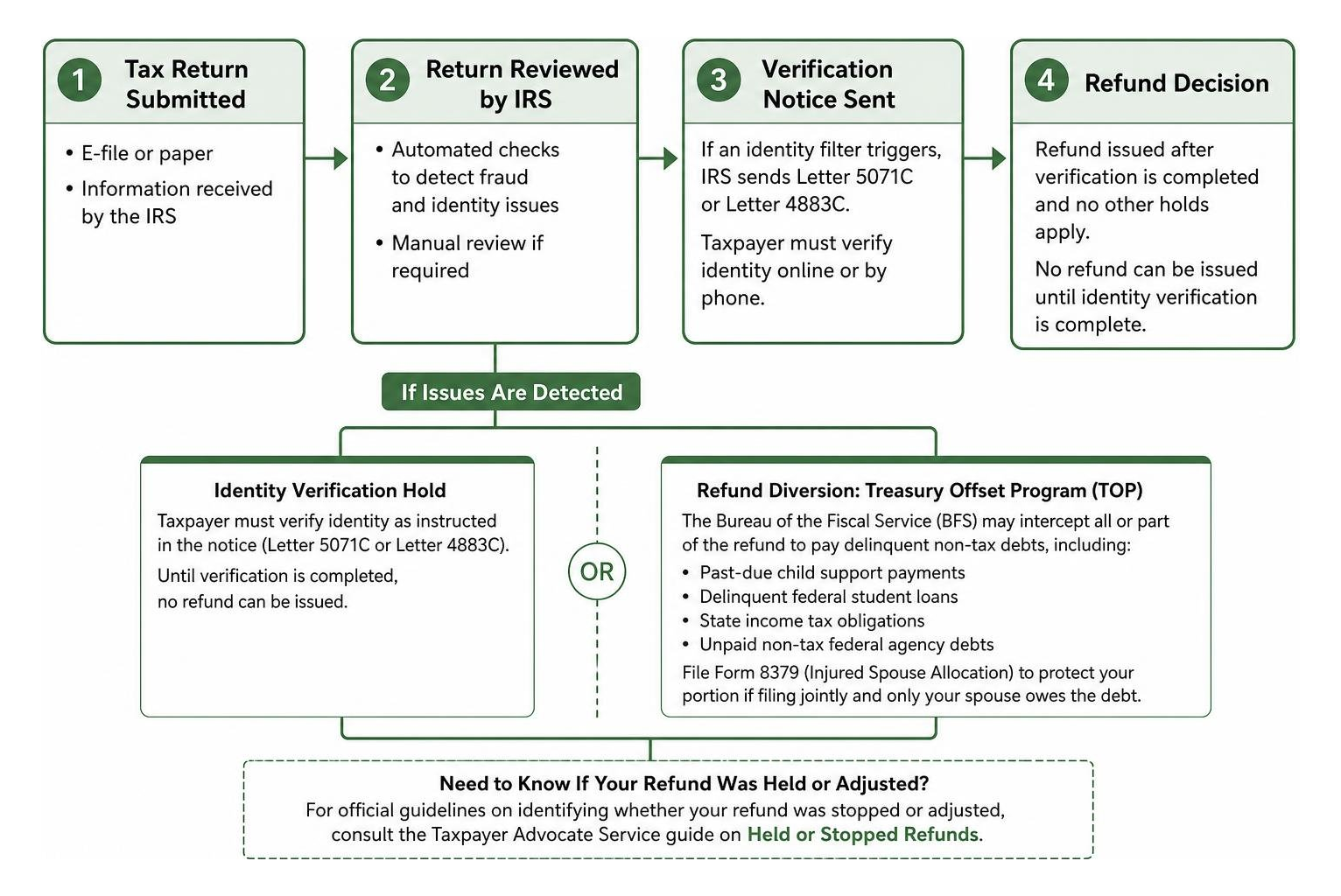
When an identity filter triggers, the IRS sends an identity verification notice (such as Letter 5071C or Letter 4883C) instructing the taxpayer to verify their identity online or by phone. Until this verification is completed, no refund can be issued.
Additionally, refunds can be diverted through the Treasury Offset Program (TOP), managed by the Bureau of the Fiscal Service (BFS). Under federal law, the BFS can intercept all or part of a tax refund to satisfy delinquent non-tax obligations, including:
- Past-due child support payments
- Delinquent federal student loans
- State income tax obligations
- Unpaid non-tax federal agency debts
If you file a joint return and only your spouse owes the qualifying debt, you can protect your portion of the overpayment by filing Form 8379 (Injured Spouse Allocation). For official guidelines on identifying whether your refund was stopped or adjusted, consult the Taxpayer Advocate Service guide on Held or Stopped Refunds.
Resolving Complex Claims Behind IRS Refund Delays 2023
Beyond individual income tax filings, business tax returns experienced significant delays due to payroll tax credit claims. In particular, claims filed via Form 941-X for the Employee Retention Credit (ERC) created massive manual review backlogs. The influx of claims prompted rigorous fraud audits, resulting in an inventory of hundreds of thousands of unprocessed amended payroll forms.
For business owners wondering What to Do When Your Tax Refund Is Stuck in Processing Limbo, addressing business-level holds requires organized substantiation, including detailed gross receipts worksheets and payroll records.
How to Track, Trace, and Troubleshoot Your Refund
The primary resource for monitoring refund progress is the official IRS Refunds | Internal Revenue Service online portal or the IRS2Go mobile app. The tracker updates once daily (usually overnight) and presents three primary status milestones:
- Return Received: The IRS has accepted your return into its system and initial processing has begun.
- Refund Approved: The IRS has finished processing your return, confirmed your calculations, and scheduled an exact direct deposit or check mailing date.
- Refund Sent: The funds have been transmitted to your financial institution or a physical check has been delivered to the United States Postal Service.

If your status shows “Refund Sent” but the direct deposit is missing from your account after 5 business days (or after 28 days for a mailed check), you can initiate an official refund trace.
To request a trace:
- Call the automated IRS Refund Hotline at (800) 829-1954, which recorded a 96% Level of Service and an average speed to answer of roughly one minute.
- Complete and mail Form 3911 (Taxpayer Statement Regarding Refund) to the IRS processing center corresponding to your state.
- If the refund check was uncashed, the IRS will cancel it and reissue a replacement. If the check was cashed fraudulently, the Bureau of the Fiscal Service provides a claim package containing a copy of the check for signature verification.
Actionable Steps to Expedite Processing and Request Taxpayer Assistance
When a held refund threatens basic household solvency, taxpayers have formal channels to request expedited processing. The IRS recognizes significant financial hardship criteria, including:
- Imminent eviction or foreclosure notices
- Utility disconnection notices
- Urgent medical emergencies with unpaid critical care bills
- Immediate inability to secure essential necessities (food, transportation to employment)
To pursue an expedited refund, gather formal documentation supporting your hardship claim and contact the IRS Individual Income Tax Services line at (800) 829-1040. When standard channels fail to resolve delayed cases, taxpayers can apply for intervention from the independent Taxpayer Advocate Service (TAS) by filing Form 911 (Request for Taxpayer Advocate Service Assistance). Low-income taxpayers can also seek free legal assistance through Low Income Taxpayer Clinics (LITCs) to dispute math errors or wage verification discrepancies.
For a step-by-step breakdown of hardship qualifications, read our detailed guide on the Need for Speed: Your Guide to Getting a Tax Refund Expedited.
Frequently Asked Questions About Delayed Tax Refunds
Why is my refund status stuck on ‘Return Received’ without moving to ‘Approved’?
When a return remains stuck on “Return Received” well past the standard 21-day timeline, it typically indicates that automated screening identified a discrepancy requiring manual review. Common triggers include missing wage data from an employer, inconsistent dependent information, or credit verification. If your return is flagged for review, the IRS will issue a CP05 notice or Letter 4464C stating that your return is under review for 45 to 60 days, though manual reviews can extend up to 180 days.
Can the IRS expedite my refund if my return claims the EITC or ACTC?
No. Under the statutory mandates of the PATH Act, the IRS cannot release refunds claiming the Earned Income Tax Credit or Additional Child Tax Credit prior to February 15 under any circumstances. Even if a taxpayer demonstrates severe financial hardship with documentation of eviction or utility shutoffs, the IRS lacks the statutory authority to override this date. Hardship expedite requests for EITC/ACTC returns can only be processed after the mandatory hold window expires.
What should I do if my refund check was mailed but never arrived?
If the “Where’s My Refund?” tool indicates that a physical check was mailed more than four weeks ago and you have not received it, you should contact the IRS Refund Hotline at (800) 829-1954 to initiate a check trace. Alternatively, submit Form 3911 by mail. The Bureau of the Fiscal Service will review bank records to determine if the check remains uncashed or was fraudulently endorsed, allowing the IRS to reissue the payment accordingly.
Conclusion
Resolving delayed tax refunds requires a clear understanding of IRS intake procedures, patience with statutory hold periods, and organized documentation. Whether your delay stems from an identity verification flag, wage matching issues, or a paper filing bottleneck, staying proactive with IRS correspondence ensures you reach a resolution.
For business owners dealing with prolonged holds on complex payroll tax credits, professional support can eliminate uncertainty. SFG Capital provides specialized Employee Retention Credit Help to assist businesses across Travis County, Austin, and throughout the United States. We offer liquidity solutions, claim buyouts, and advances to bypass administrative IRS processing delays with transparent, performance-based fee structures. Contact our team today to unlock the capital trapped in your pending tax credits.
See what your business may qualify for.
60 seconds. No documents. No upfront cost.
General information only, not legal or tax advice. Eligibility and estimates are fact-specific and subject to review.