
Blog / Insights
InsightsERC Advance No Credit Check: What Business Owners Should Expect
November 17, 2026 · 8 min read · By the SFG Capital team
ERC Advance No Credit Check: What to Know First
An ERC advance no credit check offer is private funding tied to a pending Employee Retention Credit refund, not an IRS program. A provider may skip a personal credit check but still review the claim and its supporting records. Before accepting an offer, ask about fees, whether a credit check is required, and what happens if the IRS reduces or denies the refund. Funding estimates depend on review; amounts and timing are not guaranteed.
The ERC is a tax credit for eligible employers affected by the COVID-19 pandemic. IRS processing can still take time: in early October 2026, the agency reported about 13,000 claims in review, audit, payment, or appeal stages. An advance may provide working capital while a valid claim is pending, but it does not speed up IRS approval.
I’m Santino Battaglieri, founder of SFG Capital, with more than nine years in financial services and experience funding and purchasing ERC claims. I help business owners assess ERC advance no credit check offers with careful attention to claim records, funding terms, and IRS risk.
How an ERC Advance No Credit Check Works for Delayed Claims
When you apply for advance financing against your Employee Retention Credit, the underlying asset is the tax credit itself rather than your personal FICO score. In traditional lending, a bank examines personal credit scores, historical debt-to-income ratios, and personal guarantees before releasing funds. In contrast, an ERC advance structures the pending refund as the primary collateral.
Underwriting focuses on whether your claim has been filed correctly, whether your business genuinely qualified under federal rules, and the likelihood of the IRS approving and paying the refund. While avoiding a hard credit pull provides breathing room for business owners who took on debt during the pandemic, it does not mean there is zero underwriting. A funder will carefully inspect payroll ledgers, quarterly 941 filings, and documentation demonstrating business impact.
If you are waiting on the IRS and want to explore liquidity, you can see if you qualify with our short form, no upfront cost, and no documents needed to start.

Eligibility Criteria for an ERC Advance No Credit Check
To qualify for advance funding against an ERC claim, your business must have filed the appropriate amended payroll tax returns, most commonly Form 941-X (or Form 943-X, 944-X, or CT-1X for agricultural, annual, or railroad employers).
The claim must adhere to the official Employee Retention Credit | Internal Revenue Service guidelines:
- Government Orders Suspension Test: Your operations were fully or partially suspended due to a government order limiting commerce, travel, or group meetings due to COVID-19 during 2020 or 2021.
- Gross Receipts Test: Your business experienced a significant decline in gross receipts (a 50% decline in 2020 compared to the same 2019 quarter, or a 20% decline in 2021 compared to the same 2019 quarter).
- Recovery Startup Business: Businesses started after February 15, 2020, with annual gross receipts under $1 million, claiming eligible wages paid in Q3 and Q4 of 2021.
Qualified wages cannot include amounts used for Paycheck Protection Program (PPP) loan forgiveness, Restaurant Revitalization Grants, or Shuttered Venue Operators Grants. Transparent documentation verifying these calculations is required to secure advance funding.
Claim Verification vs. Personal Credit Scoring
Private capital providers focus on claim validity rather than personal creditworthiness. If your personal score took a hit during lean quarters, your credit rating does not determine whether your ERC claim represents a real, legally sound receivable from the U.S. Treasury.
Underwriters examine:
- Filing Accuracy: Proper payroll allocations, wage caps ($10,000 per employee per year in 2020; $10,000 per employee per quarter in 2021), and correct Form 941-X line entries.
- Double-Dipping Prevention: Clean separation of PPP payroll costs from ERC qualified wages.
- IRS Status: Confirmation that the claim is currently pending and has not been disallowed or subjected to an unaddressed audit notice.
To learn more about how private bridge capital evaluates refund receivables, review our guide on commercial advance funding options.
Understanding IRS Claim Processing and Backlog Realities in Late 2026
IRS scrutiny on Employee Retention Credit filings remains rigorous. As of November 2026, processing speeds reflect careful manual compliance checks and anti-fraud filters implemented over recent years. Understanding where your claim stands within the IRS processing pipeline helps you determine whether private liquidity makes sense for your cash flow.
Current IRS ERC Inventory Breakdown
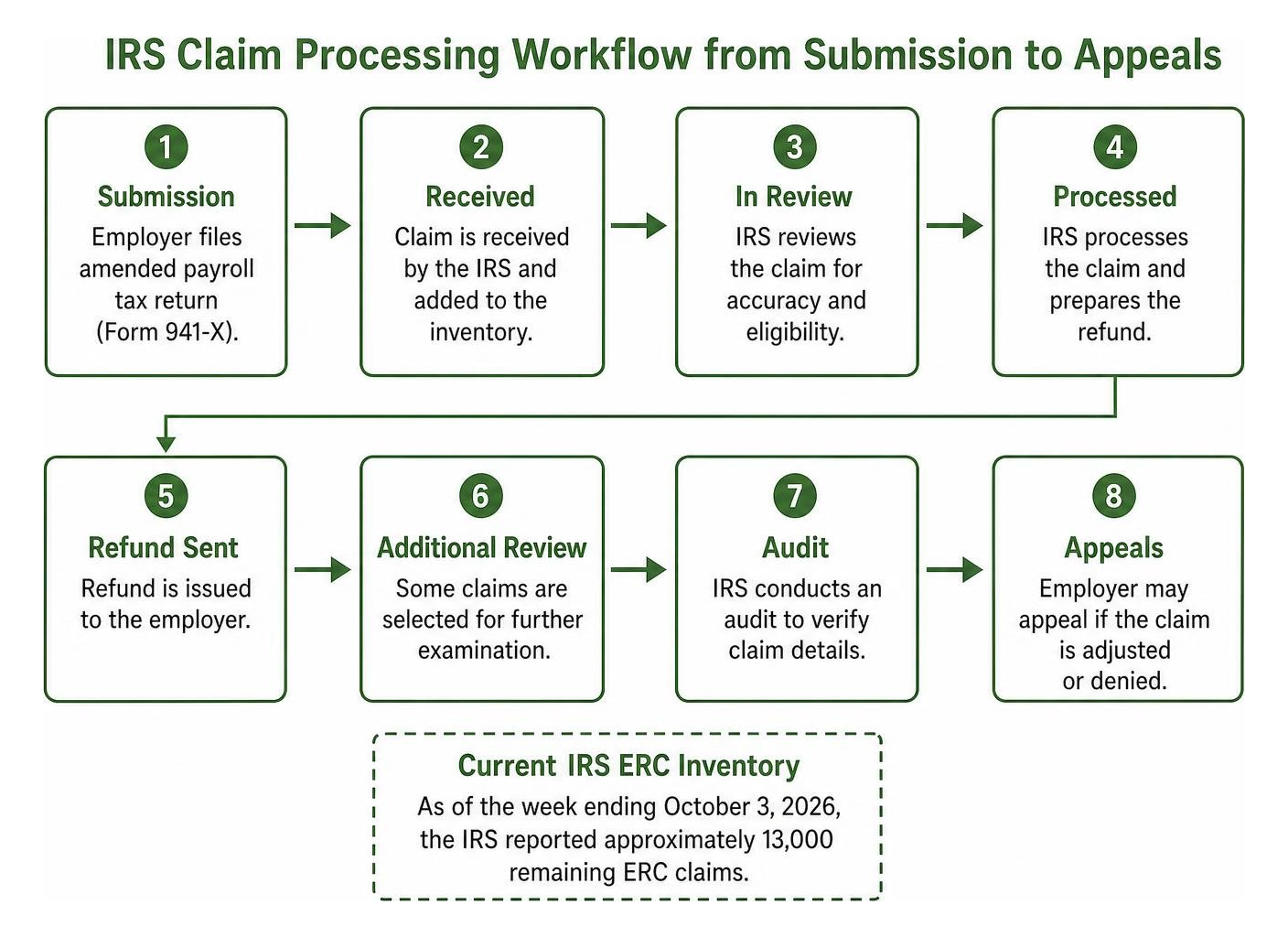
As of the week ending October 3, 2026, the IRS reported approximately 13,000 remaining ERC claims distributed across various processing stages:
| IRS Processing Stage | Number of Claims (as of Oct 3, 2026) | Description of Current Status |
|---|---|---|
| Under Initial Review | 750 | Claims undergoing primary clerical and technical validation |
| Pending Payment or Disallowance | 2,300 | Processed claims awaiting final disbursement approval or formal denial |
| Under Active Audit | 3,000 | Files flagged for detailed audit documentation and employer examination |
| Awaiting Review of Disallowance Responses | 5,400 | Cases where taxpayers submitted rebuttals following proposed denials |
| Independent Office of Appeals | 1,500 | Formally disputed disallowances under administrative appeals review |
These figures demonstrate that while the total volume has decreased, thousands of claims remain in administrative pipelines requiring extensive verification.
Resolving Ineligible Claims and Disallowances
If an employer realizes they were misled by an aggressive promoter into claiming an improper credit, the IRS maintains a formal claim withdrawal process. This program allows businesses that have not yet received or cashed an ERC refund check to withdraw their submission, avoiding future audits, penalties, and interest.
For employers who received a formal Letter 105-C disallowing their claim, administrative remedies are available. Taxpayers have the right to file a dispute with the IRS Independent Office of Appeals within the timeframe outlined in the letter, providing documentation supporting their eligibility.
Whenever an ERC refund is claimed, businesses must also remember to adjust their federal income tax returns (such as Form 1120 or Form 1065) by retroactively reducing wage deductions by the amount of the credit claimed.
Comparing Tax Credit Advances and Buyouts
When business owners look to bridge the gap while waiting on the IRS, they generally evaluate two main liquidity options: an advance loan or an outright claim buyout.

Ready to see how much working capital your business can unlock? See if you qualify by filling out our simple form with no upfront cost.
Advance Funding vs. Complete Claim Buyout
The core difference between an advance and a buyout comes down to structure, timing, and risk management:
- ERC Advance Funding: In an advance, you receive an upfront percentage of your anticipated refund as a financing arrangement. When the IRS releases the refund check, the financing balance and agreed fees are settled. For a comprehensive overview, review our breakdown of refund vs advance funding.
- ERC Claim Buyout: In a buyout, you sell the rights to your refund claim to a buyer at an agreed discount. The buyer takes over the claim receivable, transferring liquidity to you immediately. If you want a complete transfer of the waiting period and risk, explore our detailed analysis comparing ERC buyout vs advance options.
Avoiding Scams When Seeking an ERC Advance with No Credit Check
The Employee Retention Credit market has seen aggressive promoters charging high upfront contingency fees and claiming “every business qualifies.”
Watch out for these warning signs:
- Guaranteed Approvals Without Review: Legitimate providers will always state clearly that funding estimates depend on review and cannot be guaranteed upfront.
- Large Upfront Retainers: Promoters demanding thousands of dollars upfront before reviewing basic payroll documentation.
- Aggressive Marketing Solicitations: Mailers designed to mimic official government notices or threatening immediate loss of funds.
- Refusal to Calculate PPP Deductions: Promoters claiming you can maximize full wages without subtracting PPP loan forgiveness allocations.
At SFG Capital, we provide transparent, performance-based fee structures and thorough review protocols to ensure that every transaction complies with federal standards.
Frequently Asked Questions About ERC Advances
Is an ERC advance legitimate or an IRS program?
An ERC advance is a private capital financing solution provided by third-party funding firms; it is not a direct IRS program. The IRS does not provide advance cash loans on pending tax claims. Private advances allow business owners to unlock working capital from their pending refund asset while the IRS completes its review process.
How do amended income tax returns affect ERC funding?
Claiming an Employee Retention Credit reduces your allowable wage deduction by the exact amount of the credit for that tax year. Employers filing Form 941-X must file amended business income tax returns (such as Form 1120 or Form 1065) for 2020 or 2021 to reflect this change. Funders review these filings to ensure overall tax compliance.
What happens if the IRS audits or disallows the ERC claim?
If the IRS issues Letter 105-C or selects your claim for audit, your available remedies depend on your contract structure. In advance loans, employers retain responsibility for working through administrative appeals or audit defenses. In certain buyout structures, claim handling may be managed by the purchaser.
If you have questions about handling audit notices or resolving delayed filings, you can consult an ERC claim specialist to discuss your situation.
Conclusion
Waiting on the IRS to disburse Employee Retention Credit funds can place significant pressure on your working capital, payroll obligations, and growth plans. While the IRS works through its remaining inventory of claims, private bridge financing offers business owners a path to liquidity without relying on personal credit scores.
At SFG Capital, we serve business owners across the United States, including Austin and Travis County, providing transparent ERC advances and claim buyouts. We evaluate your claim based on underlying legal and payroll documentation, bypassing IRS wait times with fair, performance-based fee structures.
Please remember that all funding estimates depend on individual claim review; amounts and timelines are never guaranteed. Take control of your business cash flow today: see if you qualify with our short, no-obligation form with no documents required to start.
See what your business may qualify for.
60 seconds. No documents. No upfront cost.
General information only, not legal or tax advice. Eligibility and estimates are fact-specific and subject to review.