
Blog / Insights
InsightsNavigating the Maze of COVID Business Relief Programs
October 14, 2026 · 10 min read · By the SFG Capital team
Introduction
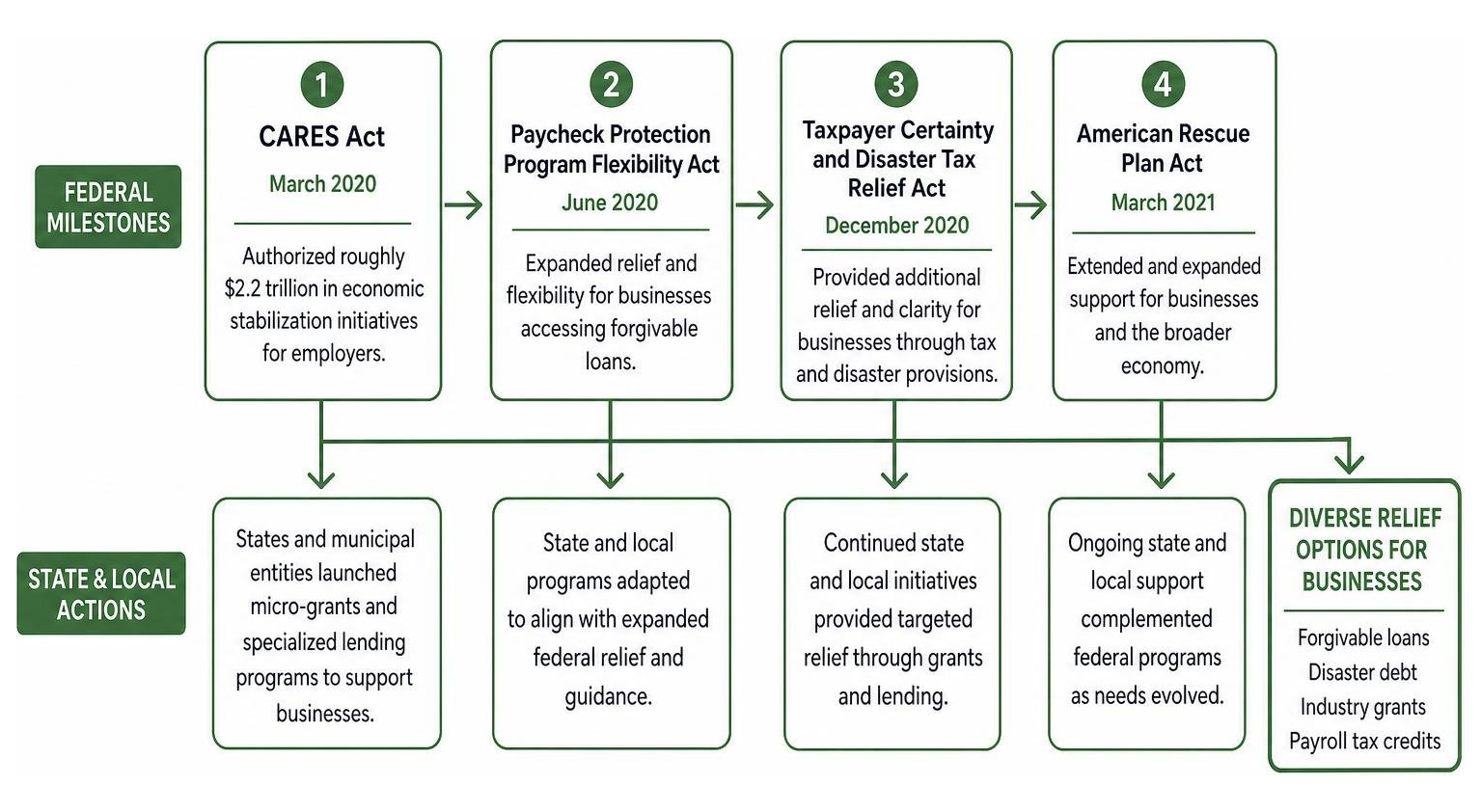
COVID business relief encompasses the major federal and state programs created to help employers survive pandemic-related disruptions, including forgivable Paycheck Protection Program loans, long-term COVID-19 Economic Injury Disaster Loans, sector grants such as the Restaurant Revitalization Fund and Shuttered Venue Operators Grant, and refundable payroll tax credits like the Employee Retention Credit. When the pandemic struck, the federal government responded with unprecedented legislative measures, starting with the Coronavirus Aid, Relief, and Economic Security (CARES) Act in 2020. This historic legislation authorized roughly $2.2 trillion in economic stabilization initiatives, establishing lifeboats for employers nationwide. As the economic shock evolved, Congress expanded these interventions through the Paycheck Protection Program Flexibility Act, the Taxpayer Certainty and Disaster Tax Relief Act, and the American Rescue Plan Act.
Together, these measures created a diverse web of support: forgivable commercial loans, long-term low-interest disaster debt, specialized industry grants, and refundable payroll tax credits. State governments and municipal entities mirrored these federal efforts with micro-grants and specialized lending vehicles. Understanding how each initiative operates is essential for maintaining tax compliance, optimizing capital structures, and resolving open claims.
Major Federal Aid Options for Small Businesses
The federal pandemic response relied on a mix of emergency debt, direct forgivable loans, and non-repayable grants. Comprehensive Congressional Research Service analysis on small business assistance highlights how the Small Business Administration (SBA) processed more loan volume in months than it had over preceding decades.
| Program | Max Award / Cap | Interest Rate | Maturity | Primary Purpose | Current Status |
|---|---|---|---|---|---|
| PPP (First & Second Draw) | Up to $10M (Draw 1) / $2M (Draw 2) | 1.00% fixed | 2 or 5 years | Payroll retention & basic overhead | Closed; forgiveness processing active |
| COVID-19 EIDL | Up to $2,000,000 | 3.75% (2.75% for Nonprofits) | 30 years | Working capital & operating expenses | Closed; loan servicing & repayment active |
| EIDL Advance Grants | Up to $10,000 | N/A (Direct Grant) | N/A | Immediate emergency working capital | Closed |
| Restaurant Revitalization Fund (RRF) | $10M per entity ($5M per location) | N/A (Direct Grant) | N/A | Food & beverage operating losses | Closed; compliance tracking active |
| Shuttered Venue Operators Grant (SVOG) | Up to $10,000,000 | N/A (Direct Grant) | N/A | Cultural venue overhead replacement | Closed; compliance tracking active |
| Employee Retention Credit (ERC) | Up to $26,000 per employee | N/A (Tax Refund) | N/A | Retaining payroll during disruptions | Processing existing amended returns |
Paycheck Protection Program (PPP) and Loan Forgiveness
The Paycheck Protection Program offered fully forgivable loans to help businesses maintain active payroll. The initial First Draw program allowed borrowing up to $10 million, calculated primarily at 2.5 times average monthly payroll costs. Later, Second Draw loans capped borrowing at $2 million for businesses with 300 or fewer employees that experienced at least a 25% drop in gross receipts. For hard-hit Accommodation and Food Services operators (NAICS 72), the Second Draw calculation increased to 3.5 times average monthly payroll.
All PPP loans featured a fixed 1% interest rate. Loans issued prior to June 5, 2020, carried a two-year maturity, while subsequent loans were structured with a five-year term. To qualify for 100% forgiveness, borrowers had to spend at least 60% of proceeds on payroll costs during a covered period spanning 8 to 24 weeks, with the remaining 40% allocated toward eligible mortgage interest, rent, utilities, and covered operational expenditures.
Borrowers can apply for forgiveness via the SBA Direct Forgiveness Portal using streamlined forms like Form 3508S (for loans up to $150,000) or Forms 3508 and 3508EZ. When filing tax credits, coordinate carefully: understanding how PPP interacts with ERC claims ensures you do not double-count payroll costs, and reviewing forgiveness rules and tax credit alignment protects you against IRS adjustments.
COVID-19 Economic Injury Disaster Loan (EIDL) and Advance Grants
The COVID-19 EIDL program provided direct federal working-capital loans designed to help businesses survive severe revenue disruptions. Unlike PPP, EIDL funds were direct loans administered by the SBA rather than private lenders. The lending ceiling rose from an initial cap of $150,000 to $500,000, and ultimately up to $2 million. Terms included a 3.75% fixed interest rate for commercial enterprises (2.75% for private non-profit entities) and an extended 30-year maturity schedule.
The SBA also distributed Emergency EIDL Advance grants of up to $10,000 ($1,000 per employee), which functioned as direct grants requiring no repayment. Standard EIDL terms included a mandatory 24-month initial payment deferment, although interest accrued during this window. Loans exceeding $25,000 required UCC lien collateral, and borrowing over $200,000 required personal guarantees. For active management, consult official SBA guidance on managing COVID-19 EIDL.
Specialized Sector Grants: RRF and SVOG
Targeted relief assisted specific entertainment and hospitality sectors through the Restaurant Revitalization Fund and the Shuttered Venue Operators Grant:
- Restaurant Revitalization Fund (RRF): Authorized under the American Rescue Plan, the RRF provided non-repayable grants up to $10 million per business ($5 million per physical location). Eligible entities included restaurants, bars, food trucks, and caterers. Bakeries, brewpubs, and wineries qualified if onsite food and beverage sales accounted for at least 33% of total gross receipts. Grant amounts equaled pandemic revenue loss (2019 gross receipts minus 2020 receipts) minus any PPP funds received.
- Shuttered Venue Operators Grant (SVOG): Tailored for live venue operators, theatrical producers, motion picture theater operators, and cultural institutions, the SVOG provided awards equal to 45% of 2019 gross earned revenue, with a maximum single grant award of $10 million.
Both programs required funds to be used on allowable expenses—including payroll, utilities, mortgage debt service, and maintenance—by statutory deadlines.
Tax Credits and Payroll Relief Measures

Federal relief also delivered substantial aid via the tax code. The Families First Coronavirus Response Act (FFCRA) introduced refundable tax credits for small and mid-sized employers (fewer than 500 employees) to reimburse 100% of qualified sick and family leave wages paid to staff affected by COVID-19. Additionally, net operating loss (NOL) carryback rules were temporarily modified under the CARES Act, allowing C corporations to carry back losses arising in 2018, 2019, and 2020 for up to five years, generating immediate liquidity. Comprehensive parameters are cataloged in the IRS coronavirus tax relief for businesses.
Employee Retention Credit (ERC) Overview and Qualifications
The Employee Retention Credit represents one of the largest payroll tax credit opportunities enacted. Under the CARES Act in 2020, eligible employers could claim a refundable credit equal to 50% of up to $10,000 in qualified wages per employee paid between March 12, 2020, and December 31, 2020 (a maximum credit of $5,000 per worker).
Legislative updates dramatically expanded the credit for 2021:
- The credit increased to 70% of up to $10,000 in qualified wages per employee per quarter for Q1, Q2, and Q3 of 2021.
- The maximum benefit reached $7,000 per employee per quarter ($21,000 total for 2021).
- Businesses qualified either by demonstrating a full or partial suspension of operations due to a government COVID-19 order or by meeting the gross receipts reduction test (a >50% decline in 2020 compared to the same 2019 quarter, or a >20% decline for 2021 quarters).
- Recovery Startup Businesses could claim credits for Q3 and Q4 of 2021 with capped limits.
To determine your business’s eligibility, review the essential guide to ERC eligibility requirements and our detailed breakdown on claiming qualified employee wages.
Key Eligibility Rules and Pitfalls for COVID Business Relief Tax Filing
Navigating tax relief requires rigorous compliance. The most common pitfall involves double-dipping payroll dollars: wages used to justify PPP loan forgiveness cannot be claimed as qualified wages for the ERC. Similarly, wages supported by FFCRA paid leave credits, RRF grants, or SVOG funds must be excluded from ERC calculations.
Another challenge involves IRS employer aggregation rules. Controlled groups and affiliated entities under common ownership must combine their employee counts and gross receipts when testing for size limits and revenue reductions. Claims submitted on Form 941-X are subject to heightened scrutiny. Protecting your organization requires evaluating complex IRS notices and audit clawbacks to ensure complete documentation, and regularly checking IRS refund statuses without delays.
State and Local Relief Programs

State and local jurisdictions established regional relief funds to complement federal initiatives. In Texas, local initiatives like the Travis County small business support programs and programs such as TCTX Thrive provided targeted operational assistance and technical recovery support to keep local employers afloat. Businesses in Austin and the surrounding areas can leverage specialized guidance through our Travis County regional funding solutions.
Similar targeted support appeared across the nation. For example, the California Rebuilding Fund offered working-capital loans of up to $100,000 for businesses with 50 or fewer employees and revenues below $2.5 million, while Sussex County, Virginia, utilized $973,580 in CARES Act Coronavirus Relief Funds to establish local business micro-grants.
Assistance for Sole Proprietors, Gig Workers, and Independent Contractors
Independent contractors, sole proprietors, and self-employed individuals were eligible for significant emergency aid:
- PPP for Schedule C Filers: Sole proprietors could establish loan amounts based on net profit (and later gross income) reported on IRS Form 1040 Schedule C, utilizing the funds as owner compensation replacement without needing formal W-2 payroll systems.
- EIDL and Emergency Advances: Independent workers qualified for direct SBA disaster loans and the initial $1,000 Advance grant based solely on verified business existence and operational costs.
- Pandemic Unemployment Assistance (PUA): Self-employed individuals excluded from standard state unemployment insurance could access temporary federal unemployment benefits.
- Targeted Micro-Lending: Community Development Financial Institutions (CDFIs) provided flexible micro-loans to solo practitioners lacking established commercial banking relationships.
To manage ongoing growth and overhead post-pandemic, explore our guide on working capital strategies for small business growth.
Managing Long-Term Debt and Expediting Pending COVID Business Relief Claims
While emergency grant windows have closed, managing remaining obligations and pending claims remains essential. Businesses carrying 30-year EIDL loans must monitor repayment terms and maintain collateral filings via the SBA MySBA Loan Portal. For employers awaiting pending payroll tax refunds, IRS processing queues and moratorium reviews continue to tie up critical capital.
To unlock liquidity trapped in government processing queues, many business owners turn to specialized financing mechanisms, such as securing early liquidity through ERC advance funding or utilizing an advance buyout for immediate working capital.
Practical Strategies to Unlock Lingering COVID Business Relief Funds
If your balance sheet is constrained by debt or delayed refunds, consider these actionable steps:
- EIDL Hardship Payment Relief: The SBA offers temporary Hardship Accommodation Plans for COVID-19 EIDL borrowers experiencing financial distress. Eligible borrowers can reduce monthly payments by 50% for six months, provided the loan is not over 90 days past due, the enterprise remains in active operation, and owners are not in bankruptcy. That interest accrues during reduced-payment periods, which increases the final balloon payment at loan maturity. Inquiries can be submitted through the SBA portal or via email to
CESC@sba.gov. - IRS Tax Transcript Verification: Ensure Form 4506-C or 4506-T verifications match IRS records exactly to prevent delayed processing of Form 941-X amended returns.
- Bridge Financing and Claim Buyouts: If IRS delays threaten daily operations, bridging long IRS waiting times with refund advances provides immediate liquidity. At SFG Capital, we offer non-recourse advances and purchase agreements, allowing you to optimize cash flow based on an objective assessment of evaluating performance-based claim buyout models.
Frequently Asked Questions About Pandemic Aid
Can businesses still receive loan forgiveness or servicing assistance for PPP and EIDL?
Yes. While both programs are closed to new applicants, forgiveness and loan management remain open. Borrowers with outstanding PPP loans can apply for direct forgiveness through the SBA Direct Forgiveness Portal or their primary lending institution using Form 3508S or Form 3508EZ.
For COVID-19 EIDL borrowers, full management functions are accessible via the MySBA Loan Portal. Borrowers facing cash flow challenges can request temporary hardship payment reductions of up to 50% for a six-month window by contacting the SBA Servicing Center. You can review current servicing rules via the official SBA overview of COVID-era programs.
How does PPP forgiveness interact with claiming the Employee Retention Credit?
You can claim both PPP forgiveness and the ERC, but you cannot use the same wages for both programs. To optimize both benefits:
- Apply non-payroll expenses (rent, utilities, software costs, mortgage interest) toward up to 40% of your PPP loan forgiveness requirement.
- Allocate only the minimum necessary payroll expenses (at least 60%) to satisfy full PPP loan forgiveness.
- Dedicate remaining qualified wages paid during eligible calendar quarters toward the Employee Retention Credit calculation.
Careful wage allocation prevents double-dipping and withstands IRS audit reviews. For step-by-step guidance, see our guide on coordinating PPP and ERC claims.
What should a business do if faced with extensive IRS refund delays on tax relief credits?
Extended review cycles and processing backlogs have delayed payroll tax refunds for many employers. If your business is waiting on an amended Form 941-X claim:
- Request an account transcript from the IRS to confirm your return was logged and assigned to a processing queue.
- Ensure your tax professional has full documentation substantiating your qualification—whether based on government shutdown orders or gross receipts tests.
- If waiting for IRS disbursements strains your working capital, consider assessing early refund buyout solutions to fix cash flow to access your funds without ongoing delays.
Conclusion
The pandemic relief landscape provided essential support during a historic economic disruption. Today, business owners must focus on prudent long-term debt servicing, audit-ready compliance, and unlocking capital tied up in processing queues.
At SFG Capital, we help businesses across Austin, Travis County, and nationwide bypass administrative delays. Our team provides non-recourse funding advances and claim buyout solutions under a transparent, performance-based fee structure—ensuring you secure immediate liquidity without waiting on IRS processing queues.
To turn your pending tax refunds into actionable working capital, access comprehensive business funding and relief services from SFG Capital today.
See what your business may qualify for.
60 seconds. No documents. No upfront cost.
General information only, not legal or tax advice. Eligibility and estimates are fact-specific and subject to review.