
Blog / Insights
InsightsThe Form for Employee Retention Credit Treasure Map
October 20, 2026 · 7 min read · By the SFG Capital team
Which Form Do You Need for the Employee Retention Credit?
Most employers who missed the Employee Retention Credit (ERC) on an original quarterly payroll tax return use Form 941-X to amend it. Agricultural employers use Form 943-X, annual filers use Form 944-X, and railroad employers use Form CT-1X. Match the form to the return you originally filed, then check the filing deadline for each tax period before making a claim.
If you already filed, your next step may be to track the claim, correct it, or respond to an IRS notice. As of October 3, 2026, the IRS reported about 13,000 ERC claims still in various stages of processing.
I’m Santino Battaglieri, founder of SFG Capital. For more than nine years, I’ve worked in financial services, and my team works with tax professionals to help businesses review eligibility and choose the right form for employee retention credit claims.
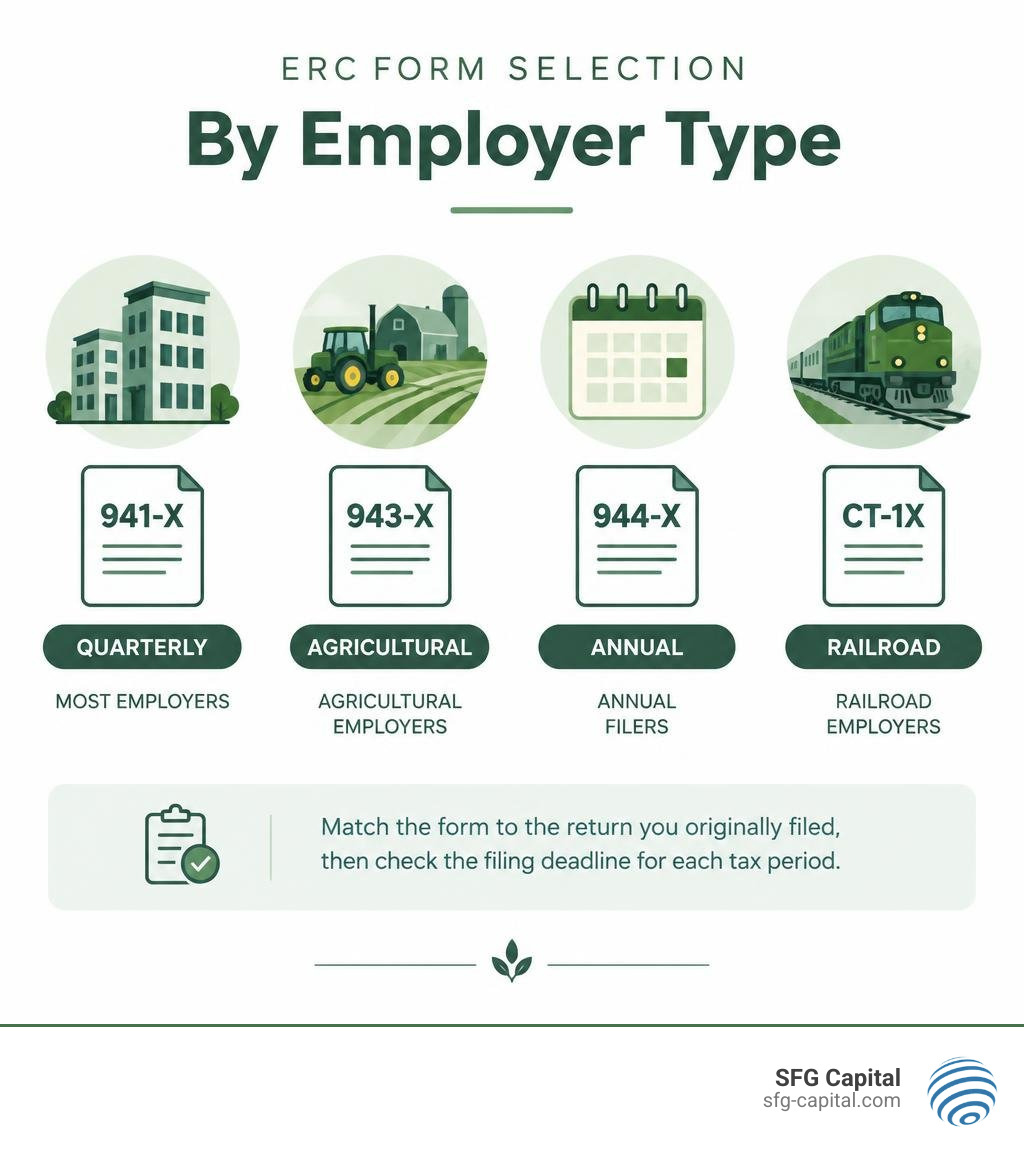
Common form for employee retention credit vocab:
Primary Form for Employee Retention Credit Filings by Employer Type
Navigating pandemic relief paperwork often feels like deciphering an ancient map. To claim refundable relief under the Employee Retention Credit | Internal Revenue Service guidelines, you must use the specific adjusted employment tax return that corresponds to your regular payroll filing schedule.
Filing the wrong document causes automatic rejections and months of administrative headaches. The IRS processes employment tax adjustments through dedicated “-X” series returns.
| Employer Type | Original Return | Adjustment Form | Primary Filing Frequency | Applicable Wage Periods |
|---|---|---|---|---|
| Standard Commercial | Form 941 | Form 941-X | Quarterly | March 13, 2020 – Dec 31, 2021 |
| Agricultural Employers | Form 943 | Form 943-X | Annual | March 13, 2020 – Dec 31, 2021 |
| Small Annual Filers | Form 944 | Form 944-X | Annual | March 13, 2020 – Dec 31, 2021 |
| Railroad Employers | Form CT-1 | Form CT-1X | Annual | March 13, 2020 – Dec 31, 2021 |
Form 941-X for Quarterly Employers
For the vast majority of commercial businesses in the United States, Form 941-X (Adjusted Employer’s QUARTERLY Federal Tax Return or Claim for Refund) is the required instrument. When completing this form, you must separate the credit into its nonrefundable and refundable portions across the appropriate lines.
Under federal rules, you must also reduce your wage deductions on your corresponding federal income tax return by the amount of the credit claimed. Reviewing a detailed step-by-step guide to the ERC application process helps ensure your payroll figures reconcile smoothly across lines 18a, 26a, and 31a.
Specialized Forms for Agricultural, Annual, and Railroad Filers
Not every company files quarterly on Form 941:
- Form 943-X: Dedicated exclusively to agricultural employers who report farm wages annually on Form 943.
- Form 944-X: Designed for small employers whose annual employment tax liability is $1,000 or less and who receive IRS notification to file Form 944 annually.
- Form CT-1X: Reserved for railroad employers adjusting compensation subject to the Railroad Retirement Tax Act under Section 3134.
When third-party payers or Professional Employer Organizations handle your payroll, they aggregate claims using specialized schedules; review how Schedule R ERC claims function to trace your underlying credit allocation.
Choosing the Correct Form for Employee Retention Credit Retroactive Claims
When retroactively correcting returns for wages paid between March 12, 2020, and January 1, 2022, matching each quarter to its distinct Form 941-X is essential. You cannot combine multiple quarters onto a single adjustment return. Keep statutory limitation periods in mind by checking 2026 ERC statutory deadlines to confirm how pending claims are treated under current IRS guidance.
Essential Qualifications and Calculation Rules for ERC Filers
Before you complete any adjustment document, your business must establish documented eligibility under statutory standards. You cannot simply claim the credit because business conditions were difficult; you must satisfy specific legal tests outlined in our essential guide to ERC eligibility requirements.
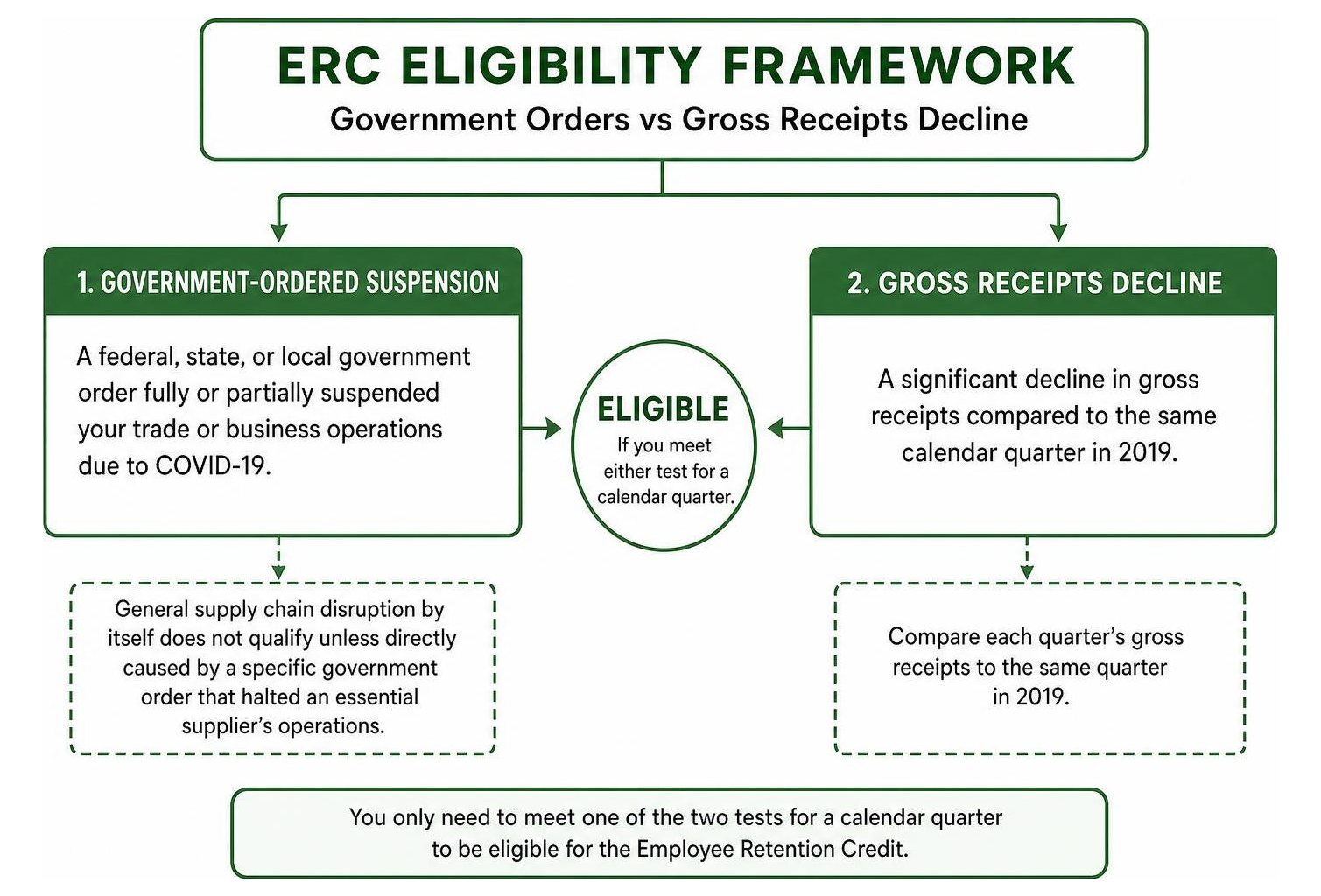
Government Orders vs Gross Receipts Reductions
Eligibility rests primarily on two distinct tests:
- Government-Ordered Suspension: A federal, state, or local government order fully or partially suspended your trade or business operations due to COVID-19. As clarified in Publication 5887, general supply chain disruption by itself does not qualify an employer unless directly caused by a specific government order that halted an essential supplier’s operations.
- Significant Decline in Gross Receipts:
- 2020 Rules: A calendar quarter where gross receipts fell below 50% of receipts for the same calendar quarter in 2019. Eligibility continued until gross receipts recovered above 80% compared to the 2019 baseline.
- 2021 Rules: A calendar quarter where gross receipts dropped by more than 20% compared to the same calendar quarter in 2019 (an alternative quarter lookback rule was also permitted).
Recovery Startup Businesses and Qualified Wage Limitations
The American Rescue Plan Act introduced Recovery Startup Businesses (RSBs). These are companies that began operations after February 15, 2020, maintained average annual gross receipts under $1,000,000, and did not otherwise meet the standard shutdown or gross receipts tests.
- RSBs are limited to a maximum credit of $50,000 per quarter.
- RSBs can claim the credit only for the third and fourth quarters of 2021.
- No Double-Dipping: Qualified wages counted toward Paycheck Protection Program (PPP) loan forgiveness cannot be claimed as ERC wages. You must coordinate payroll allocations as explained in our guide on PPP and ERC wage interaction.
Correcting Claims, Withdrawals, and the Voluntary Disclosure Program

If you discovered an error after submitting paperwork, the IRS established administrative relief paths to help businesses correct non-compliant filings without incurring substantial penalties.
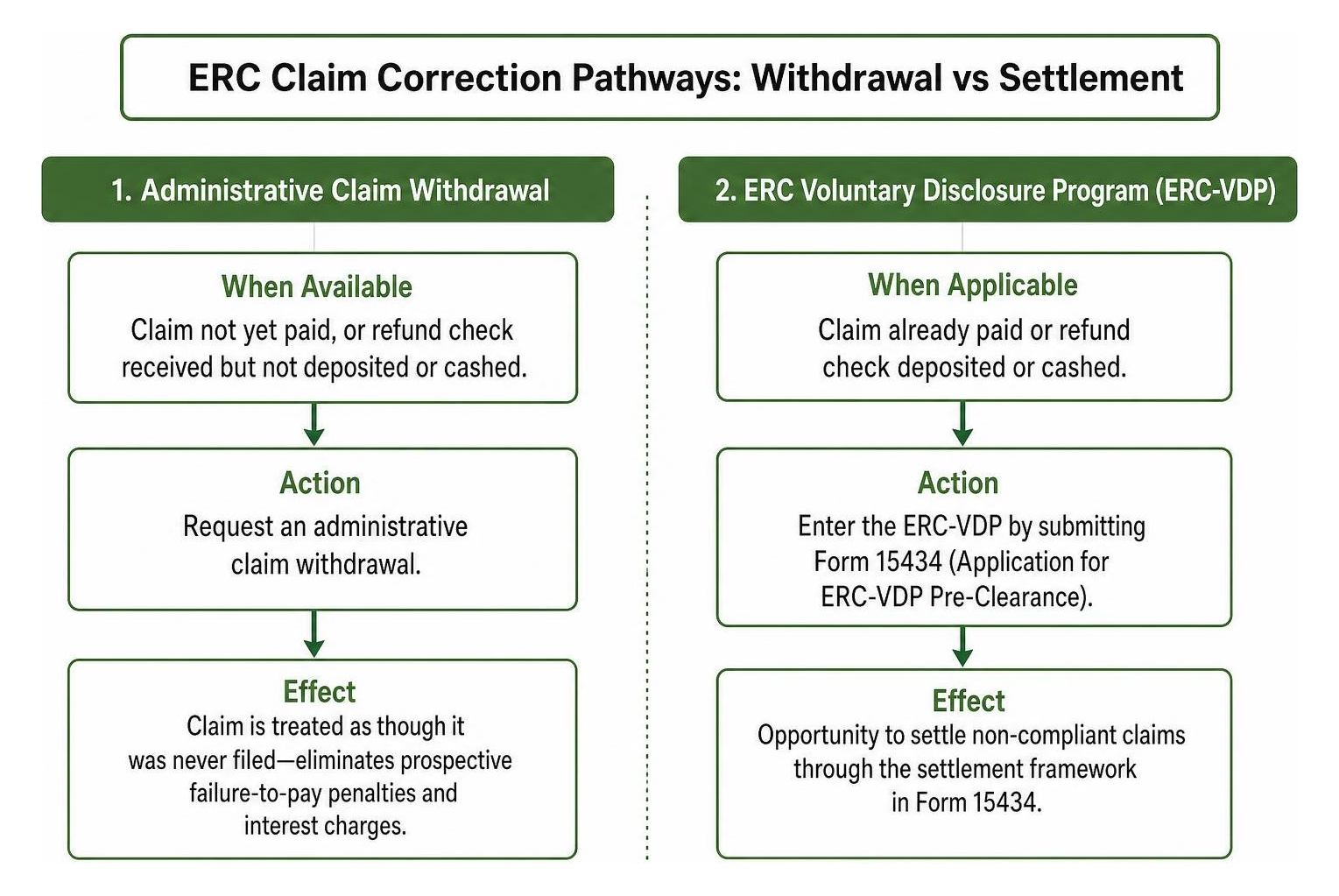
Administrative Claim Withdrawal Procedures
If you filed a claim that has not yet been paid—or if you received a refund check but have not yet deposited or cashed it—you can request an administrative claim withdrawal. Withdrawing an improper claim treats it as though it was never filed, eliminating prospective failure-to-pay penalties and interest charges.
The ERC-VDP and Form 15434 Settlement Framework
For taxpayers who already received and cashed ineligible refund checks, the IRS instituted specialized settlement programs:
- First ERC-VDP: Ran from December 22, 2023, through March 22, 2024.
- Second ERC-VDP: Ran from August 15, 2024, through November 22, 2024.
According to IRS guidance on frequently asked questions about the second Employee Retention Credit Voluntary Disclosure Program, participants in the second round received a 15% discount, repaying 85% of the credit received while avoiding civil penalties and income tax adjustments on wages.
Key Schedules and Form for Employee Retention Credit Disclosures
Participating in resolution programs required key supplemental paperwork:
- Form 15434: Application for Employee Retention Credit Voluntary Disclosure Program.
- Form SS-10 / Form 2750: Consents to extend statutory assessment windows for employment tax periods.
- Form 433-B: Collection Information Statement for businesses seeking installment agreements.
For employers caught in processing backlogs from prior years, reviewing protocols for old and long pending claims helps clarify your current procedural standing.
Navigating Disallowances, Audits, and Promoter Scams
As of October 2026, IRS inventory metrics show approximately 13,000 remaining claims moving through various verification phases:
- 750 claims under initial review
- 2,300 pending payment or formal disallowance
- 3,000 under active audit
- 5,400 awaiting review of disallowance responses
- 1,500 pending with the Independent Office of Appeals
This represents steady progress compared to August 2026, when roughly 17,300 claims were pending across these stages.
Handling IRS Letter 105-C Disallowance and Appeals
If the IRS denies your submission, you will receive Letter 105-C (Claim Disallowed). You have 30 days from the date of the letter to file a formal administrative appeal with the IRS Independent Office of Appeals. You also retain the right to challenge the determination in federal district court or the U.S. Court of Federal Claims. For strategic next steps, consult our breakdown of IRS notices, audits, and clawbacks.
Warning Signs of Fraudulent Promoters and Reporting Misconduct
The IRS has repeatedly warned businesses against aggressive third-party promoters who charged exorbitant contingency fees (often 15% to 30% of the gross credit) while misrepresenting eligibility criteria.
- Promoters promising immediate qualification without reviewing payroll records.
- Claims that generic supply chain delays automatically qualify a business.
- Refusal to sign the return as a paid preparer.
- Requiring large upfront non-refundable deposits.
To report abusive tax schemes or predatory promoters, submit Form 14242 (Report Suspected Abusive Tax Promotions or Preparers) directly to the IRS Lead Development Center.
Frequently Asked Questions About ERC Forms and Deadlines
What is the primary form used to claim the Employee Retention Credit retroactively?
The primary return is Form 941-X, which amends your original quarterly payroll tax return. Agricultural employers use Form 943-X, annual employers file Form 944-X, and railroad filers use Form CT-1X.
Can an employer withdraw an incorrect ERC form before receiving payment?
Yes. If your claim is currently pending or if you received an uncashed check, you can follow the IRS special withdrawal process. This avoids potential accuracy-related penalties and statutory interest charges.
What happens if an ERC claim is disallowed after filing Form 941-X?
You will receive IRS Letter 105-C explaining the basis for disallowance. You have 30 days to appeal the finding to the IRS Independent Office of Appeals or pursue judicial review in federal court.
Accelerate Your Liquidity with SFG Capital
Navigating federal payroll tax forms and enduring prolonged IRS processing cycles can tie up vital capital. If your business is located in Austin, Travis County, or anywhere across the United States and you are tired of waiting on IRS backlogs, we can help.
At SFG Capital, we provide claim advances and buyout solutions that give you immediate access to capital using a transparent, performance-based structure. Explore our dedicated SFG Capital ERC refund solutions and services today to secure your capital and bypass processing delays.
See what your business may qualify for.
60 seconds. No documents. No upfront cost.
General information only, not legal or tax advice. Eligibility and estimates are fact-specific and subject to review.