
Blog / Insights
InsightsUnderstanding the Process Behind Your ERC Tax Credit Cash Payout
November 19, 2026 · 10 min read · By the SFG Capital team
How ERC Tax Credit Cash Reaches Your Business
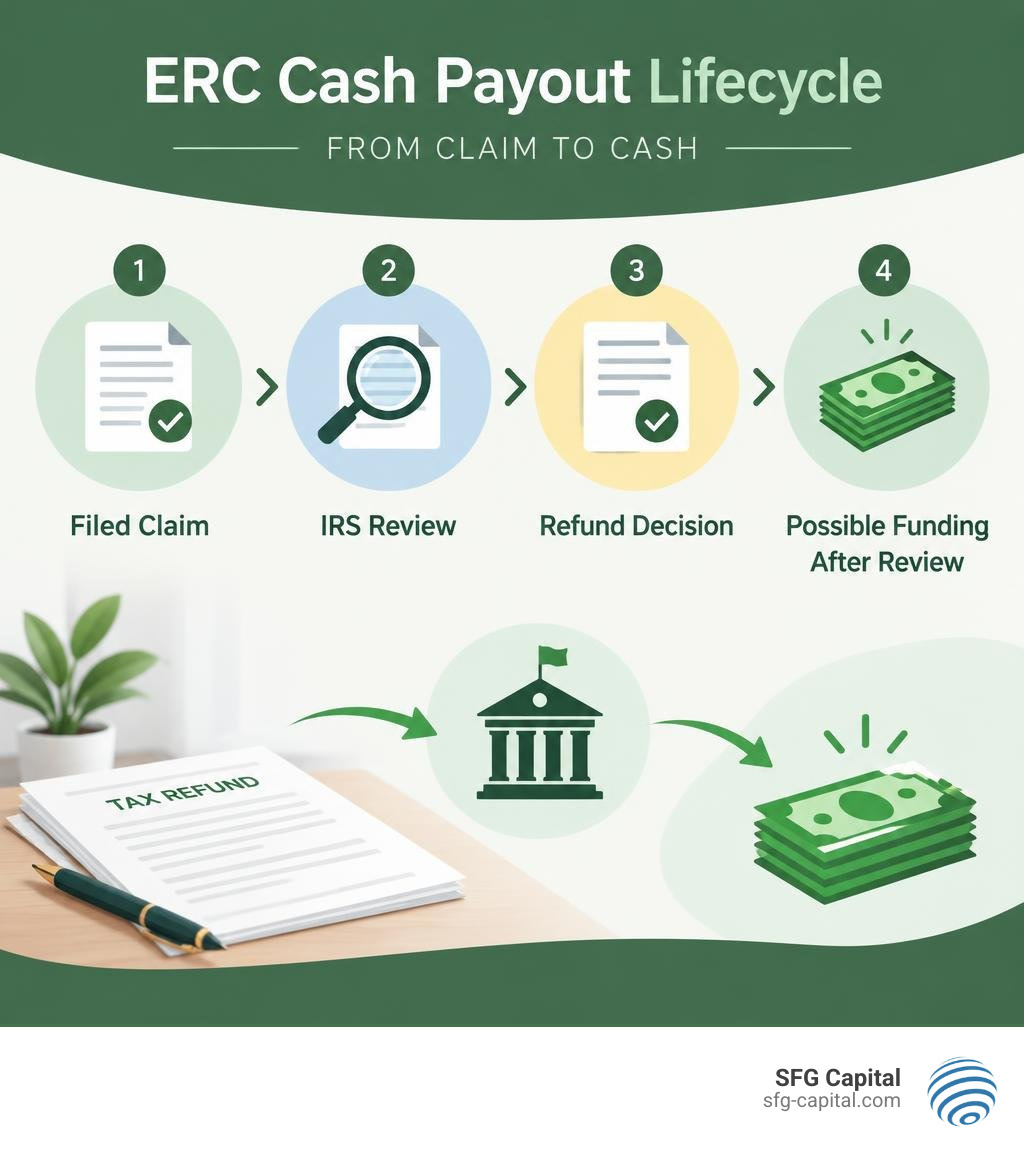
ERC tax credit cash comes from a refundable payroll tax credit. If your business already filed an eligible claim, the IRS reviews its adjusted employment tax return and issues a refund if it allows the credit. To understand where your cash stands, check your claim status and keep the payroll records, wage calculations, and eligibility documents that support it. A pending claim may also qualify for an advance or buyout through SFG Capital, but funding and payout estimates depend on review.
I’m Santino Battaglieri, founder of SFG Capital. I have more than nine years of experience in financial services, and my team has purchased and funded over $500 million in ERC claims, giving me a close view of what it takes to turn a pending claim into ERC tax credit cash.
What Is the Employee Retention Credit and How Is ERC Tax Credit Cash Calculated?
The Employee Retention Credit (ERC) was established under the Coronavirus Aid, Relief, and Economic Security (CARES) Act to encourage employers to keep workers on payroll during severe economic disruptions. Unlike standard tax deductions that merely reduce your taxable income, the ERC is a fully refundable tax credit applied directly against an employer’s share of federal payroll taxes. When the credit exceeds your payroll tax liability for a given calendar quarter, the IRS treats the excess as an overpayment, sending the remaining amount directly to your business as a cash refund check.
To claim the credit retroactively, employers submit adjusted quarterly federal employment tax returns using Form 941-X (or Forms 943-X, 944-X, or CT-1X for agricultural, annual, and railroad employers). The actual refund calculation depends on qualified wages paid to W-2 employees—including allocable qualified health plan expenses—during periods of government-ordered disruption or significant revenue decline.
If you want to determine where your business stands without upfront friction, you can See if you qualify by filling out a short form with no initial documents required and no upfront cost.
Eligibility Criteria and Key Differences Between 2020 and 2021
Congress modified the ERC several times, creating two distinct regulatory environments for tax years 2020 and 2021. For both years, employers could qualify through one of two primary pathways:
- The Governmental Order Test: Business operations were fully or partially suspended due to orders from an appropriate governmental authority limiting commerce, travel, or group meetings due to COVID-19. Under IRS guidance, a partial suspension requires showing that a government order had more than a “nominal impact” (typically considered at least 10% of gross receipts or employee service hours in the comparable baseline quarter).
- The Gross Receipts Test: The business experienced a statutory decline in quarterly gross receipts compared to the corresponding calendar quarter in 2019.
| Feature / Requirement | 2020 ERC Rules | 2021 ERC Rules (Q1–Q3) |
|---|---|---|
| Credit Percentage | 50% of qualified wages | 70% of qualified wages |
| Qualified Wage Cap | Up to $10,000 per employee per year | Up to $10,000 per employee per quarter |
| Maximum Credit Per Employee | Up to $5,000 per employee | Up to $7,000 per quarter ($21,000 total across Q1–Q3) |
| Gross Receipts Decline Required | More than 50% drop compared to 2019 | More than 20% drop compared to 2019 (or prior quarter) |
| Small Employer FTE Threshold | 100 or fewer full-time employees in 2019 | 500 or fewer full-time employees in 2019 |
| Large Employer Restrictions | Wages paid only for time not working | Wages paid only for time not working |
Special Rules for Recovery Startup Businesses and Relief Program Coordination
The American Rescue Plan Act introduced a third pathway: the Recovery Startup Business (RSB) provision. Businesses that began operations after February 15, 2020, with average annual gross receipts of $1 million or less, could claim the ERC for the third and fourth quarters of 2021 without needing to prove a revenue decline or government shutdown. RSB claims are capped at a maximum of $50,000 per quarter ($100,000 total).
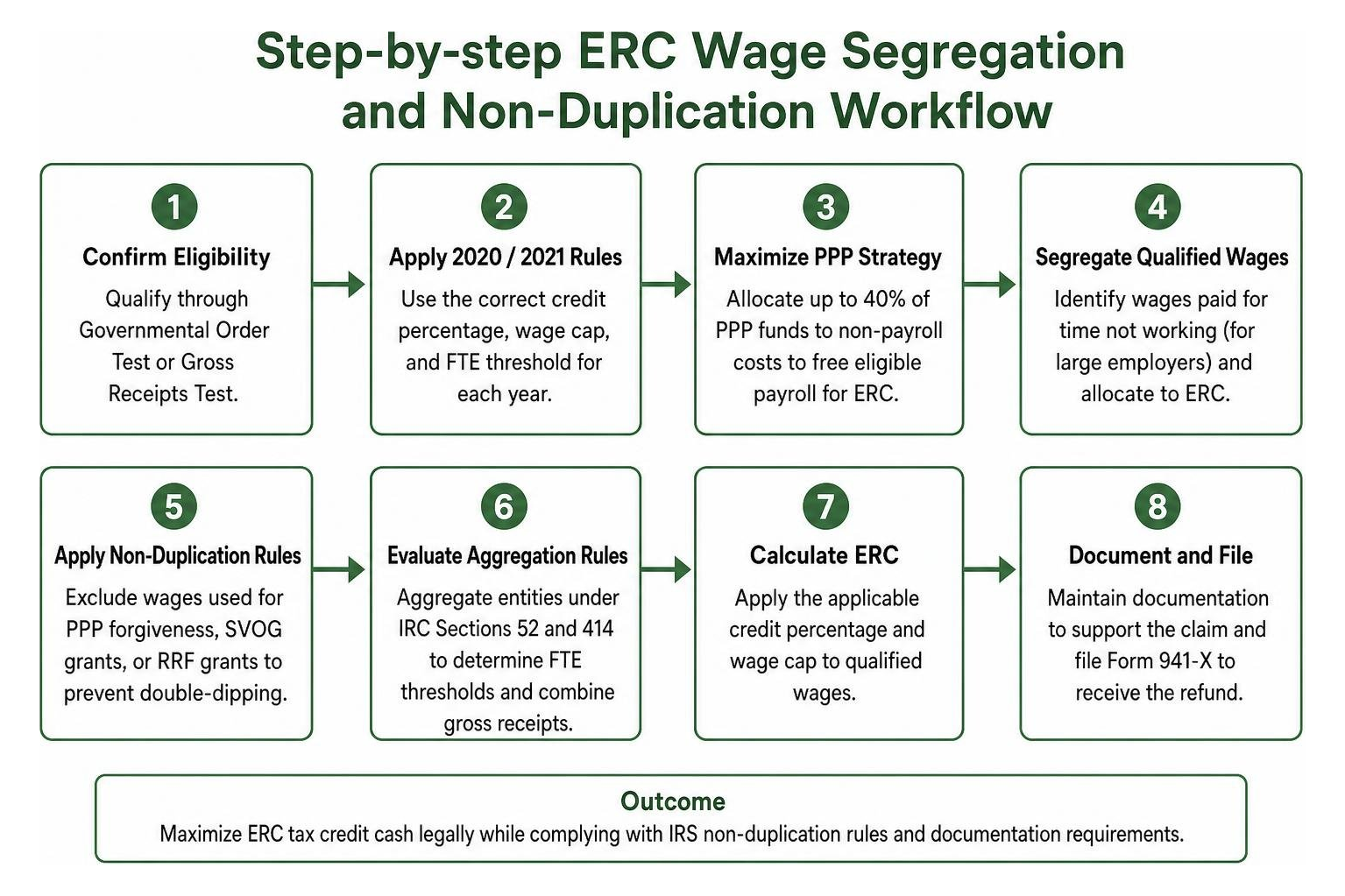
When calculating qualified wages, businesses must adhere strictly to non-duplication rules outlined in official IRS Employee Retention Credit Guidance. Wages paid using forgiven Paycheck Protection Program (PPP) loan funds cannot be counted toward the ERC. Employers must also exclude payroll expenses covered by Shuttered Venue Operators Grants (SVOG) or Restaurant Revitalization Fund (RRF) grants to prevent prohibited double-dipping.
How Employers Qualify for Maximum ERC Tax Credit Cash Payouts

Maximizing your credit legally requires careful wage segregation. Employers who received PPP loans can optimize their net benefit by allocating the maximum allowable non-payroll costs (up to 40%) toward PPP loan forgiveness, freeing up eligible payroll expenses for the ERC.
Additionally, companies operating under common ownership must evaluate IRS aggregation rules under Internal Revenue Code (IRC) Sections 52 and 414. Related entities treated as a single employer must aggregate their headcount to evaluate the 100- or 500-employee thresholds and combine gross receipts across entities. Navigating these layered payroll rules is much smoother when working alongside dedicated ERC claims support.
Navigating IRS Processing Stages, Audits, and Refund Backlogs
The journey of an amended payroll tax return through the IRS processing pipeline has faced unprecedented delays. Following an influx of non-compliant claims in the marketplace, the IRS announced a processing moratorium on new claims in September 2023. Backed by funding from the Inflation Reduction Act, the agency trained approximately 400 dedicated revenue agents to audit and scrutinize existing filings.

The Current Lifecycle of Claims in the IRS Inventory
As of late 2026, the IRS has approximately 13,000 remaining ERC claims moving through various administrative stages:
- Under Review: ~750 claims actively evaluated by examiners.
- Pending Payment or Disallowance: ~2,300 claims awaiting final check generation or formal rejection.
- Under Active Audit: ~3,000 claims subject to comprehensive Information Document Requests (IDRs).
- Awaiting Review of Disallowance Responses: ~5,400 claims where employers submitted rebuttals to preliminary disallowances.
- Independent Office of Appeals: ~1,500 claims undergoing administrative dispute resolution.
For claimants facing long processing windows, reviewing the Taxpayer Advocate Service Refund Advisory provides helpful perspective on why compliance reviews extend timelines beyond standard processing goals.
Statute of Limitations and Assessment Risks Under 26 U.S.C. § 3134
The statutory framework governing the credit gives the IRS extended authority to audit claims. Under 26 U.S.C. § 3134: Employee retention credit for employers subject to closure due to COVID–19, the statute of limitations for IRS assessment on third-quarter 2021 claims was extended to 5 years, with broader provisions extending the audit window to 6 years for assessments initiated after July 4, 2025. Employers must retain detailed contemporaneous payroll journals, executive shutdown orders, and gross receipts records throughout this multi-year exposure window.
Resolving Ineligible Filings Through the Claim Withdrawal Program
To protect business owners who fell victim to aggressive marketing promoters pushing dubious claims, the IRS introduced the ERC claim withdrawal program. If your business filed a Form 941-X but has not yet received payment—or received a paper Treasury refund check but has not cashed or deposited it—you can request a withdrawal to treat the claim as if it were never filed.
Using the Publication 5887 Checklist, business owners can verify their compliance. If an employer receives a formal Letter 105-C claim disallowance, they retain the legal right to submit an administrative appeal or pursue judicial review in federal court. Tax professionals handling these claims are held to strict standards under Treasury Department Circular 230 to prevent improper filings.
Accounting Frameworks and Federal Tax Rules for ERC Tax Credit Cash
Receiving cash from the ERC tax credit carries significant financial statement reporting and tax accounting responsibilities under U.S. GAAP and federal tax code regulations.
U.S. GAAP Recognition Thresholds Under IAS 20, ASC 958-605, and ASC 450-30
Because U.S. GAAP does not contain explicit accounting standards for commercial businesses receiving government grants, entities must apply one of three analogized frameworks:
- IAS 20 (Accounting for Government Grants): Recognizes grant income systematically over the periods in which the entity recognizes the related payroll costs, provided there is reasonable assurance the conditions will be met and the grant will be received.
- ASC 958-605 (Conditional Contributions): Recognizes income only when the conditions of the grant are substantially met (i.e., when eligibility barriers are overcome).
- ASC 450-30 (Gain Contingencies): A conservative approach where proceeds are recognized only when the cash is realized or realizable and all contingencies (such as audit risks) are fully resolved.
Under ASC 832, commercial entities receiving government assistance must include clear financial statement footnote disclosures describing the nature of the assistance, accounting policies elected, and impacted line items. Under ASC 740, uncertain tax positions must be analyzed carefully when audit exposure exists.
Section 280C Wage Deduction Reductions and State Tax Conformity
Under Internal Revenue Code Section 280C(a), employers are prohibited from taking a double tax benefit: you must reduce your federal wage expense deductions by the exact amount of the ERC claimed.
This adjustment applies to the tax year in which the qualified wages were paid, not the tax year in which the IRS eventually deposits the cash into your account. As a result, businesses must file amended federal income tax returns (such as Form 1120 or Form 1065) for 2020 or 2021. This often creates a tax liability before the IRS refund check arrives. If this timing gap triggers an IRS penalty, taxpayers can request administrative relief via First Time Penalty Abatement or by establishing reasonable cause.
Managing Cash Flow Delays: IRS Direct Payouts vs. Alternative Funding Options
Navigating multi-year IRS backlogs creates severe working capital hurdles for growing enterprises. If waiting on federal processing leaves your business in a cash crunch, See if you qualify for private liquidity options via our short form, requiring no upfront cost or initial paperwork.
The Challenges of Extended IRS Processing and Audit Timelines
Relying entirely on Treasury check disbursement leaves your business vulnerable to review bottlenecks, administrative freezes, and manual compliance checks. For an in-depth breakdown of practical cash solutions, review our guide to fast employee credit payouts.
Bridging the Liquidity Gap with Advance Funding and Buyouts
At SFG Capital, we help businesses across the United States—including Austin and Travis County—bypass IRS processing delays. Rather than staring at the mailbox, business owners can access our advance funding solutions or full claim buyouts:
- ERC Advance Loans: Access working capital secured against your pending Form 941-X claim.
- ERC Claim Buyouts: Sell your claim outright, transferring IRS collection waiting periods and administrative follow-up entirely.
| Factor | IRS Direct Payout | SFG Capital Advance / Buyout |
|---|---|---|
| Payout Timeline | Months to years depending on IRS backlogs | Rapid access upon completed underwriting review |
| Capital Certainty | Subject to administrative freezes and review pauses | Immediate, predictable liquidity for business operations |
| Fee Structure | None (standard Treasury refund) | Performance-based fee; no upfront out-of-pocket costs |
| Administrative Burden | Taxpayer manages IRS inquiries and status tracking | SFG Capital provides comprehensive claim support |
Note: All estimates, advance amounts, and approval timelines depend strictly on thorough underwriting review and claim verification.
Frequently Asked Questions About ERC Cash Payouts
How long does the IRS take to issue refund checks for approved claims?
IRS processing timelines vary widely based on the complexity of the filing, the quarter claimed, and whether the return is flagged for audit or manual compliance checks. While original estimates targeted 90 to 180 days, claims caught in inventory backlogs frequently take substantially longer.
Can an employer claim the credit if they received a Paycheck Protection Program loan?
Yes. Under the Relief Act of 2020, employers who received PPP loans are fully eligible to claim the ERC. However, the same wages cannot be double-counted. Payroll expenses allocated toward PPP loan forgiveness must be excluded from ERC qualified wage calculations.
What happens if the IRS issues a Letter 105-C disallowance?
Receiving Letter 105-C means the IRS has formally proposed to disallow your ERC claim. Employers have the right to challenge this determination by requesting an administrative appeal with the IRS Independent Office of Appeals within the timeframe specified in the letter or filing suit in federal district court.
Conclusion
The Employee Retention Credit represents a powerful financial recovery mechanism for American businesses. However, managing the multi-layered rules, Section 280C wage adjustments, extended audit statutes, and IRS processing queues requires clear planning and diligence.
At SFG Capital, we are dedicated to helping businesses across the country, including Austin and Travis County, optimize their capital. In addition to ERC liquidity solutions, our team assists organizations with tariff and government refund options and provides educational business tax guides to help you navigate federal programs.
If you are ready to evaluate your options, schedule a consultation with a specialist or See if you qualify today through our simple questionnaire—with no upfront fees and no initial documentation required. All advance funding and buyout amounts depend upon full underwriting review.
See what your business may qualify for.
60 seconds. No documents. No upfront cost.
General information only, not legal or tax advice. Eligibility and estimates are fact-specific and subject to review.