
Blog / Insights
InsightsWhat a Delay in Refund Really Means for Your Return
November 27, 2026 · 11 min read · By the SFG Capital team
What a Delay in Refund Means for Your Return
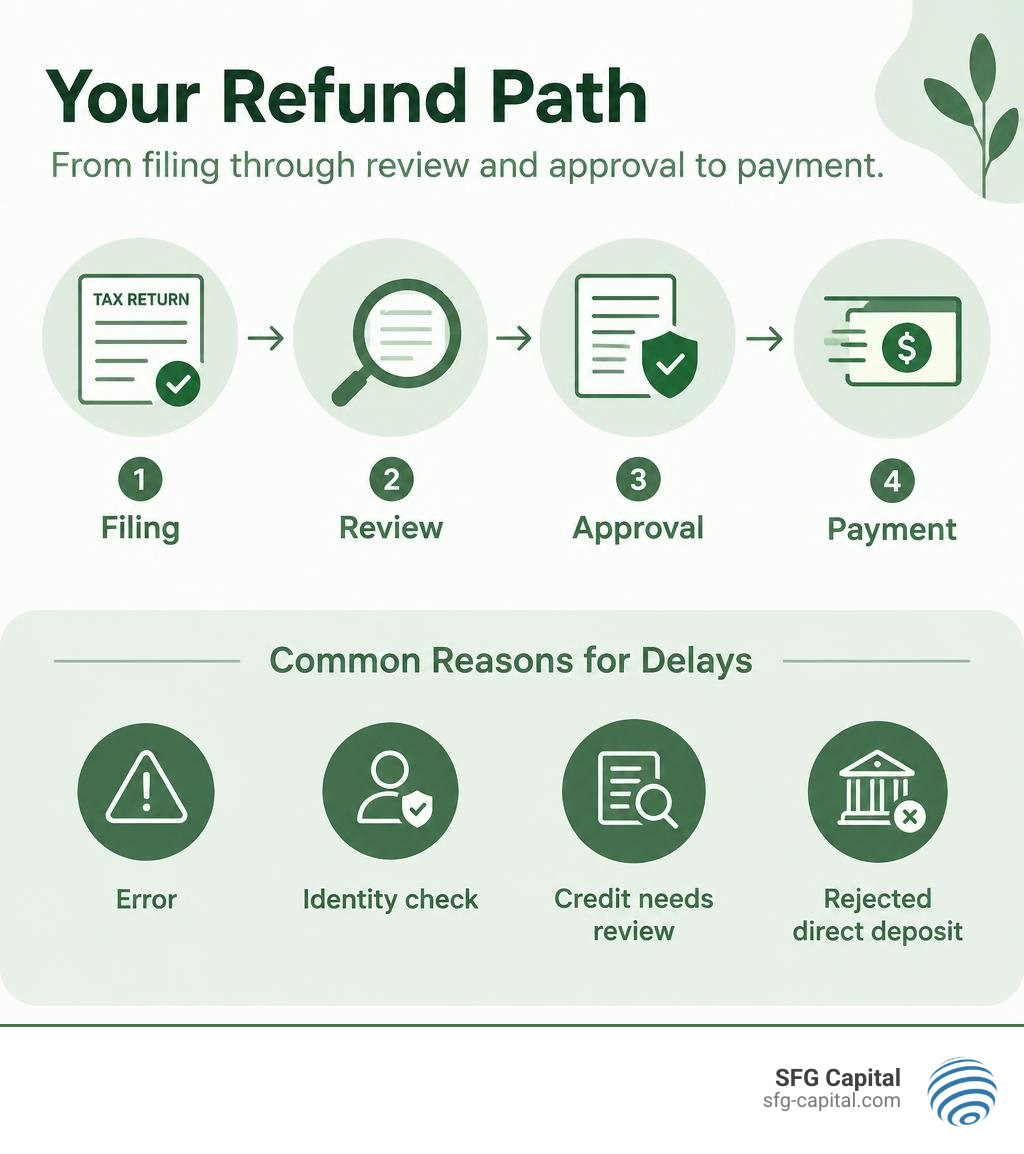
A delay in refund processing means your return or claim has not reached payment yet. Common reasons include an error, an identity check, a credit that needs review, or a rejected direct deposit. It does not, by itself, mean your claim was denied. Check the IRS refund tracker, read any IRS notice, and respond if the agency asks for information.
Most individual tax refunds arrive within 21 days of e-filing; paper returns can take six weeks or longer. Business credits such as the ERC follow different timelines. If you need cash while an eligible claim is pending, SFG Capital offers ERC advances and buyouts. Funding amounts and timing are estimates that depend on review, not guarantees.
I’m Santino Battaglieri, founder of SFG Capital, with over nine years of experience in financial services. I help businesses facing a delay in refund processing assess their ERC claims and funding options.
How long a tax refund usually takes—and how to check its status
The IRS issues most individual refunds within 21 days after accepting an electronically filed return. Mailed returns can take six weeks or longer after the IRS receives them. These are typical processing estimates, not promised payment dates; reviews, corrections, and bank processing can add time.
| Filing method | When refund status is generally available | Typical processing estimate |
|---|---|---|
| E-file, current-year return | 24 hours after filing | Most refunds within 21 days |
| E-file, prior-year return | About 3 days after filing | May take longer if additional review is needed |
| Paper return | About 4 weeks after mailing | Six weeks or longer |
Check the official IRS refund tracker and processing guidance. You can also use an IRS Online Account or the IRS2Go mobile app. The tracker updates once a day, usually overnight, so checking repeatedly during the same day is unlikely to reveal anything new. Our guide to typical tax refund timing explains how filing method and review can affect the wait.
When a delay in refund processing is still within the normal window
Count from when the IRS receives or accepts your return, not when you first sent it to tax software or put it in the mail. The IRS may take longer than the usual estimate if it needs to correct an error or review information. Even after the IRS issues a refund, your bank may need time to post a direct deposit, and a mailed payment takes time to arrive.
The tracker may not show a payment date until the IRS approves the refund. A missing date does not necessarily mean something is wrong. The IRS explains that its status tool is the best source for updates and that a displayed date is not a guarantee. See its guidance on common refund-date myths.
What information you need to check your refund
To check without signing in, have your tax return available. You will need the Social Security number or ITIN on the return, your filing status, the tax year, and the exact refund amount claimed. An IRS Online Account can also show refund status and tax records.
If you cannot find your return, you may be able to access a tax transcript through your account or request one by mail. A transcript is useful for tax information, but it does not provide a secret or more accurate refund date than the status tracker.
For automated phone information, call the IRS refund hotline at 800-829-1954. It generally provides the same status information as the online tracker.
E-file versus paper filing: how the method affects timing
E-filing is usually faster because the return reaches the IRS electronically and tax software can flag some common errors before submission. Paper returns have to travel by mail and may require manual data entry, increasing the time before processing is complete. Using direct deposit can also avoid the additional wait for a mailed check.
Before filing, double-check names, Social Security numbers, dependent information, calculations, and bank details. If you have an eligible pending government refund or credit and need to explore funding, see if you qualify through a short form. No documents are needed to start, and there is no upfront cost.
Why a delay in refund processing happens
A refund can be delayed because the IRS needs to correct or verify information, compare your return with records from employers or other agencies, or complete a review. Some delays are routine safeguards; others require you to respond to a notice. A delay alone does not tell you which situation applies.

Common reasons for a delay in refund processing
Common causes include:
- Missing information or an incomplete return: A missing signature, form, or required detail can prevent processing from moving forward.
- Math or data errors: The IRS may correct a calculation or ask for information when amounts do not match its records.
- Name or identification mismatch: A name or Social Security number that does not match official records can trigger additional review.
- Wage verification: The IRS may compare wages and withholding on your return with information reported by employers. A mismatch or missing employer report can hold up a refund.
- Identity verification: If the IRS needs to confirm that you filed the return, it may pause processing until you complete the requested verification.
- An amended return or prior-year issue: Amended returns require review of both the original and corrected returns. They can take eight to 12 weeks or longer. An unfiled prior-year return, open audit, or balance on another account may also affect processing.
- An injured spouse request: A request to protect one spouse’s share of a joint refund involves additional processing.
- A federal balance review: A CP44 notice means the IRS is checking whether you owe another federal tax balance. The IRS says this review can take up to eight weeks. Usually, you do not need to take action while waiting; the IRS will send a follow-up notice or any remaining refund. Read the IRS explanation of a CP44 notice.
Historical data illustrates how long manual reviews can take: in 2021, returns in the IRS Error Resolution System holding queue averaged 75 days, while identity-theft cases took an average of 240 days to work. These figures describe that year and are not current processing estimates or predictions for an individual return.
EITC and ACTC refund holds: what the mid-February rule means
By law, the IRS cannot issue refunds that include the Earned Income Tax Credit (EITC) or Additional Child Tax Credit (ACTC) before mid-February. This hold applies even if you file early. It gives the IRS time to compare income information and help prevent improper payments. If there are no other issues, many eligible refunds become available later, but a specific payment date is not guaranteed.
About 27 million people claim the EITC each year. A Federal Reserve analysis found that recipients spent about 15 cents of each refundable-credit dollar at retail stores and restaurants within two weeks. The delay can therefore matter for household cash flow, not just the date on a tracker.
What a CP53A notice means for a direct deposit delay
A CP53A notice means the IRS attempted to send your refund by direct deposit, but the financial institution rejected it. Possible causes include a closed account or a mismatch in the account holder’s name, Social Security number, routing number, or account number.
The IRS may need to review your account and then issue a paper check. Its guidance says this process can take up to 10 weeks after the notice. Check the instructions on your notice and wait for the stated period before contacting the IRS; calling early will not speed up the payment. See the IRS instructions for a CP53A notice.
What to do when a delay in refund processing persists
Start with the IRS status tool and any letters you have received. Save copies of notices and documents you send, note when you contacted the IRS, and record any deadlines. If you speak with an IRS representative, keep notes about the conversation. Respond to requests promptly and follow the notice instructions.

If your refund is past the normal processing time
Compare your wait with the typical estimate for your filing method: about 21 days for most e-filed returns or six weeks or more for paper returns. Then:
- Check the IRS tracker or your online account for a new status or request.
- Read any IRS letter carefully and provide the requested information by its deadline.
- Contact the IRS if the tracker tells you to, or if the normal processing period has passed and you still need help.
- Avoid sending a second return for the same tax year unless the IRS specifically instructs you to. Duplicate filings can create more confusion.
If the IRS needs additional information, it will generally contact you by mail. For a complicated or prolonged issue, free assistance may be available through the Taxpayer Advocate Service or a Low Income Taxpayer Clinic, depending on your circumstances.
If you are a business owner waiting on a pending government refund or credit, see if you qualify using our short form. No documents are needed to start, and there is no upfront cost. Any funding estimates depend on review.
If your refund was reduced, adjusted, or unexpectedly increased
Your refund may be reduced to cover past-due federal taxes, child support, certain federal agency debts, or state income tax. The Treasury Department’s Bureau of the Fiscal Service administers many offsets and generally sends a notice explaining how the refund was applied. For federal tax debt, the IRS may also issue a CP49 notice.
If the IRS changes your return, it should send an explanation. Compare the notice with your filed return and follow its instructions if you disagree or need to provide information. The IRS may also increase a refund after correcting a return. If you receive money you are not entitled to, do not spend it; contact the IRS and follow its instructions to return it. Be cautious with unexpected emails or messages claiming to be about a refund. Verify notices through official IRS channels.
If your direct deposit information is wrong or the account is closed
A bank may reject a deposit when the account is closed or the account details do not match. The funds are returned to the IRS, which may issue a paper check after processing the returned payment. This can add up to 10 weeks.
For future returns, confirm the routing and account numbers directly with your financial institution. The account should be in your name, or your spouse’s name for a jointly filed return. Do not close the account you listed until the refund has arrived.
How to request a trace for a lost or stolen refund check
First, check the tracker or your IRS account to confirm the refund was issued and note the issue date. Allow four weeks from that date for the check to arrive before requesting a trace.
For eligible filing statuses, you can start a trace through the IRS refund tracker or IRS2Go, or call 800-829-1954. If you filed jointly, call 800-829-1040 or submit Form 3911, Taxpayer Statement Regarding Refund. Have your return available when you contact the IRS.
If the check was not cashed, the IRS can cancel it and issue a replacement. If records show that it was cashed, the Bureau of the Fiscal Service will send a claim package for you to complete. Its review can take up to six weeks. Follow the package instructions and return it promptly.
Business tax refunds and funding while an IRS claim is pending
Business refund timelines vary by claim type and may differ substantially from individual income tax refunds. The 21-day benchmark for most individual returns does not apply to every business credit or government refund. Claims may need documentation and review before the government issues payment.
Businesses may be waiting on an Employee Retention Credit (ERC) claim, payroll tax credit, tariff or IEEPA refund, or grant. We help businesses and individuals across the United States, including Austin and Travis County, assess eligible pending claims and funding options. Explore our ERC claim assistance, advance funding options, and tariff refund information.
How ERC advances and buyouts may help bridge a wait
For an eligible business with a pending ERC claim, an advance or buyout may provide access to funds before the IRS completes processing. These options are different arrangements and depend on review of the claim, supporting documentation, and other factors. Our fees are performance-based, and funding amounts and timing are estimates, not guarantees.
How to evaluate funding against waiting for the IRS
Before choosing a funding option, consider your cash-flow needs, the claim’s status, the fees and terms, the documents required, and how the arrangement handles repayment or transfer of the claim. Compare the expected cost with the value of having funds sooner, and make sure you understand the terms before proceeding.
To begin, see if you qualify through a short form. No documents are needed to start, and there is no upfront cost. Any eligibility or funding estimate depends on review.
Frequently Asked Questions about a Delay in Refund
Does a refund delay mean my return is being audited?
No. A delay may result from routine error screening, identity verification, a wage mismatch, or a processing backlog. An audit is a separate review, and the IRS will generally send a notice if it needs records or an explanation. Read and respond to any notice rather than assuming the cause from the status alone.
Should I call the IRS if the tracker has not changed?
Not necessarily. The tracker updates once a day, and most e-filed refunds are issued within 21 days. For paper returns, allow six weeks or longer. Check the tool’s instructions and contact the IRS if it directs you to call or the normal processing estimate has passed. The automated refund hotline is 800-829-1954.
Can the IRS pay interest on a delayed refund?
Interest may apply in some circumstances, but it depends on the facts and applicable tax rules. Do not assume interest will be added to every delayed refund. Check your IRS notice or account for information specific to your return.
Conclusion
A delayed refund can mean your return is still being processed, needs correction, or requires verification. Check the status using the official tracker, allow time for your filing method, protect your bank details, and respond promptly to IRS requests. A business credit such as the ERC follows a different process from an individual income tax refund.
For eligible businesses and individuals waiting on a government tax refund or credit, SFG Capital can review funding options, including ERC advances and buyouts. Funding is not guaranteed, and estimates depend on review. See if you qualify through a short form, with no documents to start and no upfront cost.
See what your business may qualify for.
60 seconds. No documents. No upfront cost.
General information only, not legal or tax advice. Eligibility and estimates are fact-specific and subject to review.