
Blog / Insights
InsightsFiling for an Austin ERC Claim Advance without the Stress
November 3, 2026 · 7 min read · By the SFG Capital team
How to Get an Austin ERC Claim Advance
To seek an Austin ERC claim advance, gather your filed Form 941-X, payroll records, and proof that your business qualifies for the Employee Retention Credit. Then ask a funding provider to review the claim and show you the cash you would receive, its fee, and what you would owe if the IRS reduces or denies the refund. Read those terms before you sign.
For Travis County businesses waiting on an IRS refund, an advance or claim buyout can provide working capital sooner. It does not speed up the IRS or guarantee that the claim will be approved.
I’m Santino Battaglieri, founder of SFG Capital. I have more than nine years of financial services experience, and my team has purchased and funded over $500 million in ERC claims, including transactions relevant to businesses seeking an Austin ERC claim advance.

Simple guide to austin erc claim advance terms:
- average time for irs to approve refund
- irs time to process tax return
- the irs is holding my refund for review
How an Austin ERC Claim Advance Unlocks Immediate Working Capital
Operating a business in Central Texas means balancing rapid expansion with high overhead costs. Between rising commercial rents along South Congress and competitive payroll demands across the Silicon Hills, waiting indefinitely on federal tax refunds creates unnecessary operational drag. An advance against your pending payroll tax credit transforms an illiquid government receivable into immediate cash you can deploy today.

Why Travis County Employers Prioritize an Austin ERC Claim Advance
Federal refund queues have caused severe cash flow strain for employers throughout the region. With persistent IRS processing delays and claim moratoriums stretching into October 2026, many business owners cannot afford to let their capital sit idle in an administrative queue.
Securing liquidity allows local companies to cover bi-weekly payroll, invest in inventory, or execute expansion plans without taking on traditional, restrictive bank debt. Understanding how these advances fit into broader Texas business cash flow strategies helps owners protect their working capital during prolonged federal review cycles.
Distinguishing Federal Tax Relief from Texas Research and Legal Entities
When evaluating relief options, it is critical to distinguish the federal Employee Retention Credit | Internal Revenue Service program from other entities and acronyms in Texas. The CARES Act payroll relief mechanism is an IRS-administered tax credit designed to reward business owners who retained employees during 2020 and 2021 disruptions.
In Texas public records and administrative filings, the abbreviation “ERC” frequently appears in other contexts, such as the Texas Education Research Center or localized court filings. For example, business owners researching Travis County administrative matters might encounter justice court proceedings related to Civil Suits | Travis County, Texas. Ensuring your financial documentation aligns strictly with federal payroll tax filings prevents confusion and keeps your credit monetization on track.
Funding Structures: Bridge Advance Loans vs. Complete Claim Buyouts
Businesses seeking early liquidity generally choose between two primary mechanisms: a commercial loan secured by the tax credit or a complete asset buyout. Each structure handles balance-sheet liabilities, interest charges, and risk allocation differently.

Bridge Advance Loans and Commercial Credit Facilities
A bridge loan operates as a traditional credit facility. A lender advances a percentage of your expected refund, and the loan accrues interest over time until the IRS releases your funds.
- Balance-Sheet Impact: The advance is recorded as short-term debt on your balance sheet.
- Repayment Obligation: You remain liable for regular debt service or interest charges until the IRS pays out the refund.
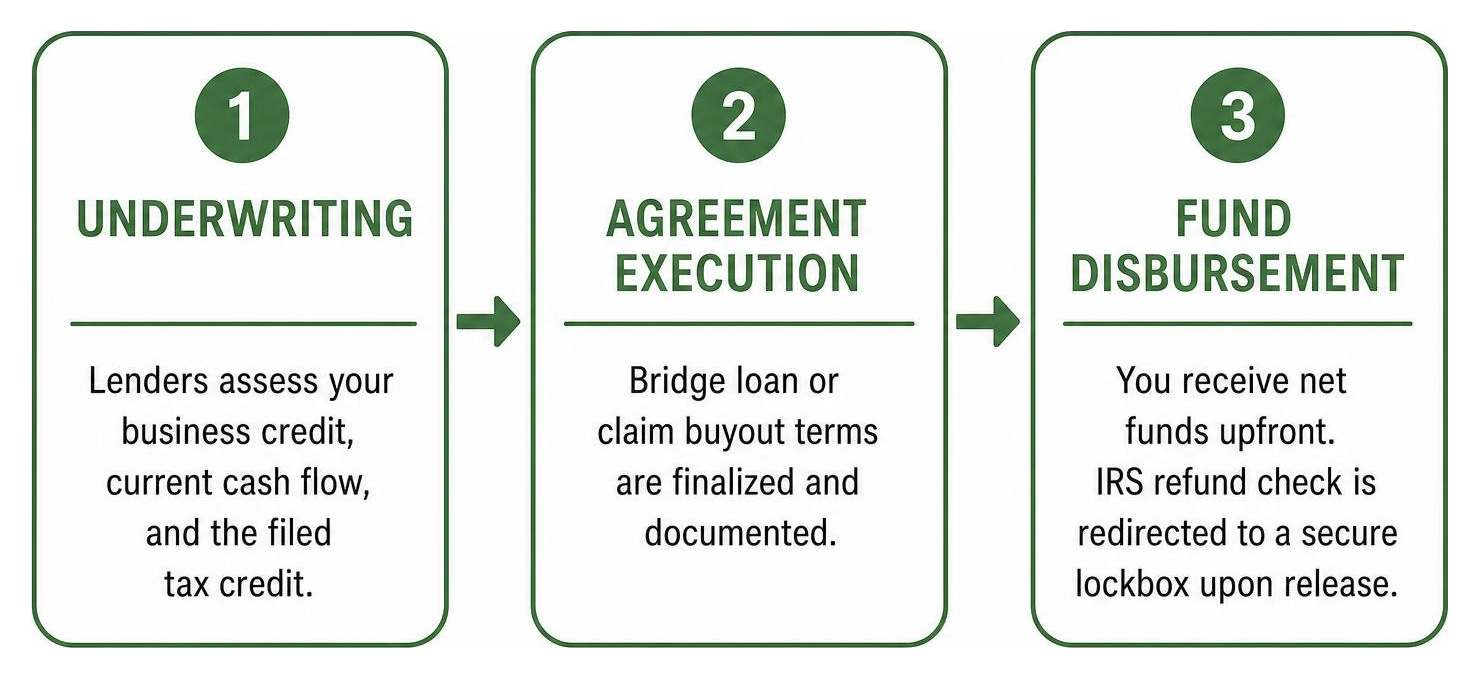
- Underwriting Focus: Lenders assess your business credit, current cash flow, and the filed tax credit.
To understand how short-term financing structures work in practice, explore our detailed guide on bridge financing solutions for ERC claims.
Complete Claim Buyouts, Discount Fees, and Check Redirection
A claim buyout is an outright asset purchase rather than a borrowing arrangement. In this structure, we purchase your rights to the pending credit at a predetermined discount fee, typically around 15% for qualified claims.
- Debt-Free Liquidity: Because the transaction is structured as an asset sale, it does not add debt to your balance sheet.
- One-Time Discount: There are no compounding monthly interest rates; you receive a net lump sum upfront.
- Lockbox Redirection: The IRS refund check is redirected to a designated secure lockbox upon release.
- Partial Claim Sales: You can choose to sell only a specific quarter or portion of your claim while retaining the remainder.
When evaluating your capital options, comparing ERC buyout vs advance structures allows you to choose the right balance between cost, risk transfer, and balance-sheet impact.
| Feature | Bridge Advance Loan | Complete Claim Buyout |
|---|---|---|
| Financial Structure | Debt / Commercial credit facility | Direct asset purchase agreement |
| Balance-Sheet Impact | Adds short-term liability | Off-balance-sheet cash |
| Fee Structure | Ongoing interest rates & origination fees | Flat, one-time discount fee (typically ~15%) |
| IRS Check Routing | Borrower repays lender after IRS check clears | Check redirected to secure lockbox |
| Claim Risk | Borrower carries ongoing debt liability | Risk is managed via purchase agreement terms |
Underwriting Criteria and Rapid Travis County Timelines
Accessing capital quickly requires clear documentation that substantiates both your original credit calculation and your business eligibility under CARES Act guidelines.
Steps to Qualify for an Austin ERC Claim Advance
To qualify for an advance or buyout, your claim must be audit-ready and fully documented. Funding providers verify several key records:
- Filed Form 941-X Returns: Stamped copies of your adjusted quarterly federal tax returns showing the credit amounts claimed.
- Detailed Payroll Journals: Line-item wage and health insurance records for each retained employee during eligible quarters in 2020 and 2021.
- Gross Receipts Substantiation: Quarterly revenue records demonstrating significant gross receipts declines (more than 50% decline in 2020 compared to 2019, or more than 20% decline in 2021).
- Government Shutdown Orders: Official federal, state, or local emergency orders from Travis County or the City of Austin that caused a full or partial suspension of operations.
Review our comprehensive overview of underwriting guidelines for ERC advances to ensure your file meets all compliance thresholds.
Verification and Fast-Track Disbursement Timelines
Once your complete documentation package is submitted, our team completes claim verification within 24 to 48 hours. Upon signing the purchase or credit agreement:
- Bridge advance funding typically distributes capital within 3 to 7 business days.
- Claim buyout funding distributes via direct wire or ACH shortly after document execution and lockbox setup.
For local business owners, selecting established Travis County ERC funding solutions ensures that underwriters understand regional operating conditions and local emergency orders.
Tax Compliance, Denial Risks, and Local Austin Incentives
Managing tax credits requires careful attention to evolving IRS regulations and local capital opportunities.
Managing Updated IRS Wage Deduction Rules and Claim Denials
Under federal rules, receiving an Employee Retention Credit requires an adjustment to your deductible wage expenses. Recent guidance published in IRS Releases New Guidance Concerning ERC Refunds clarifies how businesses handle tax reporting without unnecessary administrative burden:
- Current-Year Reporting: If an ERC refund is received and prior-year returns were not amended to reduce wage expenses, businesses may report the refund amount as gross income on their current-year return.
- Disallowance Adjustments: If an ERC claim is ultimately disallowed by the IRS, the business can increase its wage expense deduction in the year of disallowance rather than reopening prior tax returns.
- Recourse Provisions: In buyout agreements, contracts specify terms regarding claim disallowance. Thorough upfront underwriting significantly reduces the likelihood of IRS clawbacks or whipsaw adjustments.
Stacking Austin Municipal and Energy Incentives
To maximize overall balance-sheet health, Travis County employers can combine tax credit liquidity with local municipal incentives:
- City of Austin Business Expansion Incentive Program: Offers wage reimbursements up to 3% or $1,800 per qualifying job per year for companies expanding local operations.
- Austin Energy Commercial Rebates: Provides rebates up to $420 per kW of electric demand reduced through qualifying energy-efficiency equipment upgrades.
Stacking these local programs alongside your tax relief provides substantial, non-dilutive capital to fuel sustainable growth.
Frequently Asked Questions about Austin ERC Advances
Is an ERC buyout considered a loan?
No, an ERC buyout is structured as a direct asset purchase. We purchase your rights to the pending tax refund at a discounted rate. Because it is not borrowing, you do not make monthly principal and interest payments, and it does not appear as debt on your corporate credit profile. You can review all available options to sell an ERC claim before deciding on a structure.
Can a business sell only a portion of its pending ERC refund?
Yes. Business owners can choose to sell specific quarters of their filed claim while leaving remaining quarters in the standard IRS processing queue. When a partial buyout occurs, the entire refund check for that filing period routes through the funder’s secure lockbox, which then disburses the unadvanced portion directly to you once received.
How quickly can a business access funds through an advance provider?
Once all underwriting files—including Form 941-X, payroll journals, and revenue documentation—are submitted and verified, claim verification is typically completed within 24 to 48 hours. Direct disbursement occurs shortly after contract execution, providing fast-track ERC cash access to help you resolve immediate operational needs.
Conclusion
Navigating prolonged IRS review queues does not mean your business must operate with constrained cash flow. At SFG Capital, we have funded and purchased more than $500 million in Employee Retention Credit claims across the nation. By working with our team, Travis County business owners can bypass federal administrative bottlenecks and convert pending tax credits into usable working capital today.
To see how our team can help your business secure debt-free liquidity, explore comprehensive advance and buyout funding services today.
See what your business may qualify for.
60 seconds. No documents. No upfront cost.
General information only, not legal or tax advice. Eligibility and estimates are fact-specific and subject to review.