
Blog / Insights
InsightsThe Complete Guide to a Tax Refund Advance for Quick Cash
November 24, 2026 · 8 min read · By the SFG Capital team
What Is a Tax Refund Advance?
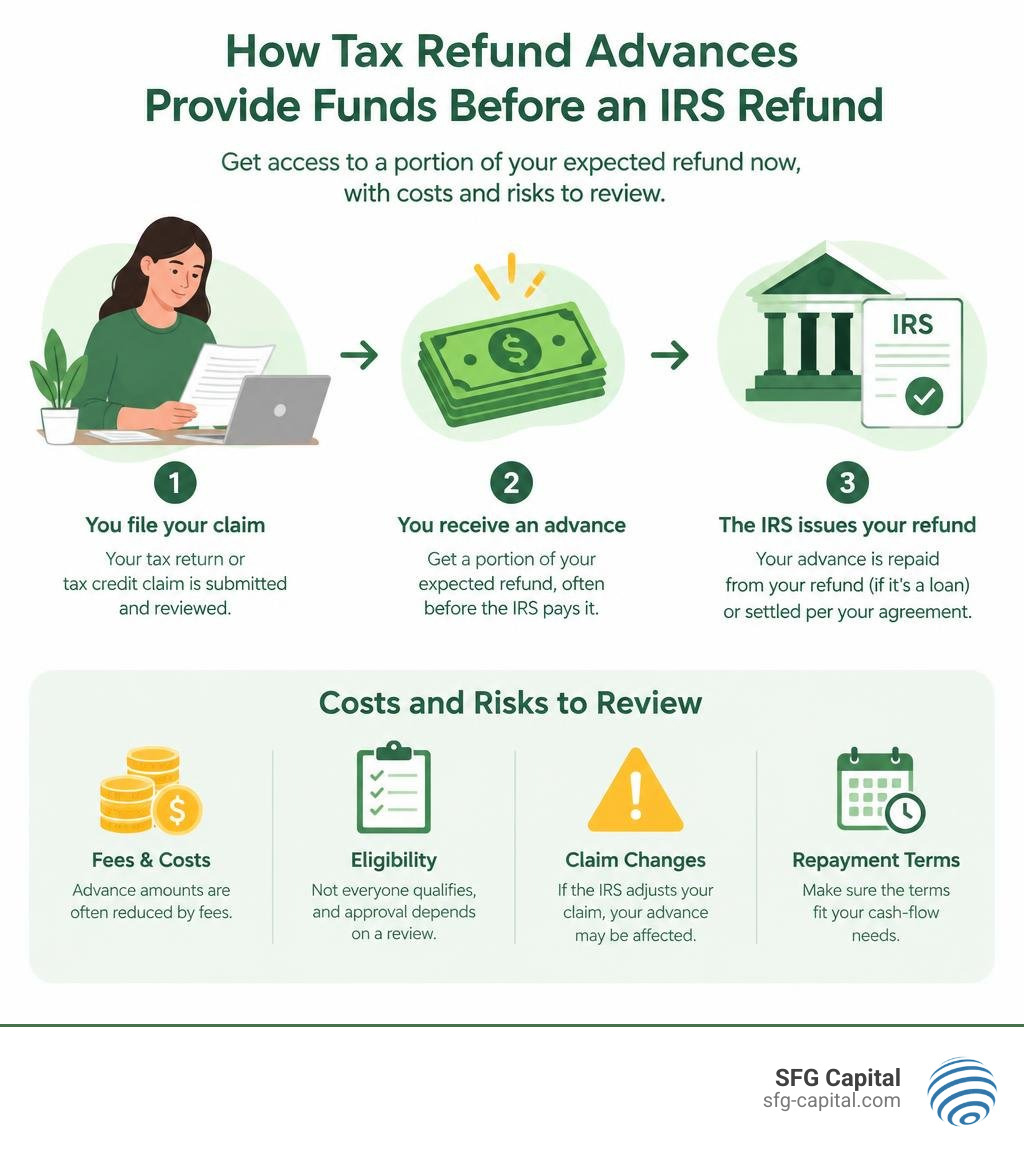
A tax refund advance gives you access to part of an expected refund before the IRS pays it. For an individual tax return, it is usually a short-term loan repaid from the refund. For a business waiting on a tax credit, funding may instead take the form of an advance or a claim buyout. Costs, eligibility, and funding estimates depend on a review of the claim and the agreement you choose.
If you are waiting on an Employee Retention Credit (ERC) refund, the key question is not just how soon you can get cash. It is how much you would receive after fees, what happens if the IRS changes your claim, and whether the terms fit your cash-flow needs.
I’m Santino Battaglieri, founder of SFG Capital, with more than nine years of experience in financial services. My work funding and purchasing ERC claims informs this guide to tax refund advance options and their risks.
Understanding the Tax Refund Advance and How It Works
Waiting on government agencies to release your hard-earned money can strain any budget. For individuals, personal tax refunds represent an essential financial milestone. The IRS issues more than nine out of ten electronic refunds via direct deposit in fewer than 21 days, but unexpected bills and seasonal obligations often require faster liquidity.
A tax refund advance is a financial arrangement structured around your expected payout. It is not an early payout sent directly by the IRS; rather, an underwriter advances funds based on your projected return. Once the IRS finishes processing and disburses the money, the principal balance and any associated fees are repaid directly from those government funds.
Federal guidelines outlined in the CFPB guide to filing taxes emphasize understanding the mechanics behind these products before signing an agreement. When you are ready to explore your options without upfront friction, you can see if you qualify through our simple short form with no initial documents required and no upfront cost.
How a Tax Refund Advance Operates
The tax advance process typically follows a clear sequence:
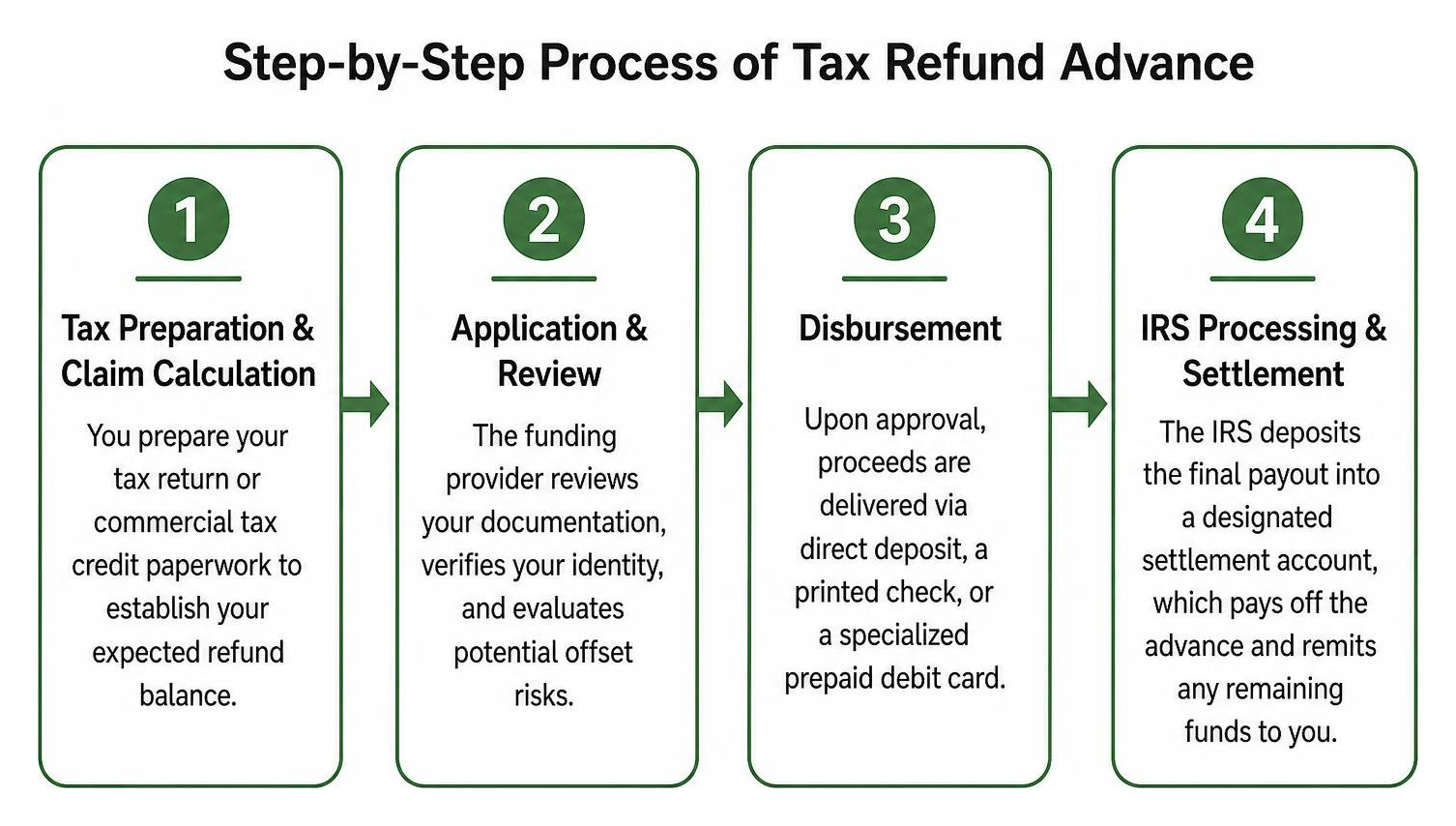
- Tax Preparation & Claim Calculation: You prepare your tax return or commercial tax credit paperwork to establish your expected refund balance.
- Application & Review: The funding provider reviews your documentation, verifies your identity, and evaluates potential offset risks.
- Disbursement: Upon approval, proceeds are delivered via direct deposit, a printed check, or a specialized prepaid debit card.
- IRS Processing & Settlement: The IRS deposits the final payout into a designated settlement account, which pays off the advance and remits any remaining funds directly to you.
| Feature | Refund Anticipation Loan (RAL) | Refund Anticipation Check (RAC) |
|---|---|---|
| Primary Purpose | Immediate cash liquidity before IRS payout | Deferring tax preparation fees without upfront cash |
| Speed of Access | Often within 24 to 48 hours of filing | Standard IRS timeline (10 to 21 days) |
| Typical Costs | 0% promotional APR or tiered interest rates | $30 to $50 administrative fee |
| Repayment Method | Deducted automatically from final IRS deposit | Deducted automatically from final IRS deposit |
Qualification Factors for a Tax Refund Advance
Underwriting standards for a tax refund advance are generally more flexible than standard unsecured personal loans because the funding is tied to an expected tax asset. Key evaluation factors include:
- Income Verification & Filing History: Valid W-2s, 1099s, pay stubs from the last 30 days, or payroll tax filings.
- Identity Verification: Valid government-issued photo identification and taxpayer identification numbers.
- Offset Checks: Screening for outstanding federal obligations, back taxes, or child support arrears that could cause the IRS to divert the refund.
- Credit Inquiries: Most consumer advance applications use soft credit inquiries that do not harm personal credit scores.
For organizations managing larger tax credit filings, specialized advance funding solutions provide tailored liquidity structures aligned with business cash-flow needs.
Cost Breakdown: Fees, Interest Rates, and Hidden Charges
Understanding the true cost of an advance requires looking beyond introductory marketing headlines. While some options advertise zero out-of-pocket costs, others involve significant interest charges, processing fees, or card maintenance deductions.

The Consumer Financial Protection Bureau provides helpful consumer guidance on refund advance loans detailing how ancillary fees impact overall payouts.
Zero-Fee Advances vs. High-Interest Refund Loans
In consumer tax preparation, smaller advances ranging from $250 to $3,500 often feature 0% APR with no direct loan fees. Providers utilize these zero-fee advances as loss-leaders to attract tax preparation business. However, larger consumer loan tiers (such as advances reaching $7,000) or third-party refund loans often carry interest rates near 35.9% APR.
Before entering an agreement, evaluate the transaction structure. Our guide on comparing purchases, advances, and loans breaks down the financial implications of each structure.
Refund Anticipation Checks and Ancillary Fees
A Refund Anticipation Check (RAC) is often confused with an advance loan. A RAC does not accelerate your funds; it simply creates a temporary settlement account allowing tax preparation fees to be deducted from your IRS payout. RAC services typically cost between $30 and $50.
Additionally, funds delivered via prepaid debit cards may carry ancillary charges, such as out-of-network ATM fees ($2.50 to $3.00), cash reload fees (up to $4.95), or monthly account maintenance charges. Exploring our comparison of refund payments versus advance funding clarifies how these fees impact net capital.
Comparing Tax Advance Options: Consumer Filings vs. Business Credit Buyouts
While consumer tax refund advances solve short-term personal cash needs, business tax credit advances address institutional working capital demands. Companies waiting on substantial government programs—such as the Employee Retention Credit (ERC) or tariff remedies—face complex IRS backlogs that require dedicated enterprise funding solutions.

Whether you operate in Austin, Travis County, or anywhere across the United States, we help businesses navigate these delays. You can see if you qualify for early liquidity on our short initial intake form with no documents to start and no upfront costs.
Consumer Refund Advance Structures
Consumer advances focus on individual Form 1040 returns. The average personal refund was approximately $3,000 in recent tax seasons. Mandatory statutory holds under federal law delay returns claiming the Earned Income Tax Credit (EITC)—which reaches up to $8,046 for families with three or more children—or the Child Tax Credit (CTC) until mid-to-late February. Consumer advances provide short-term liquidity during this hold period.
| Consideration | Consumer Refund Advance | Business Tax Credit Advance / Buyout |
|---|---|---|
| Typical Amount | $250 to $4,000 (up to $7,750 on high-tier loans) | $50,000 to $1,000,000+ |
| Underlying Filing | Individual Form 1040 (W-2, EITC, CTC) | Form 941-X (ERC), Payroll Credits, IEEPA |
| Turnaround | Minutes to 48 hours | Several business days following claim review |
| Risk Management | Automatic deduction from IRS deposit | Recourse advances or non-recourse buyouts |
Business Tax Credit Advances and Claim Buyouts
Commercial filers waiting on six-figure or seven-figure IRS refunds cannot rely on consumer retail tax products. Our team assists businesses waiting on ERC claims, offering performance-based structures that bridge the gap while claims remain in IRS queues.
For businesses seeking to eliminate repayment risk entirely, taking the fast lane to ERC funds with buyout programs provides an immediate purchase of the credit asset. We also assist importers eligible for tariff refund recovery under international trade provisions.
Risks and Alternatives to Early Refund Financing
Securing an early advance against a government receivable provides immediate cash flow, but applicants must weigh potential risks against standard filing alternatives.
Assessing the Risks of Refund Shortfalls
The primary risk in any refund-backed financing is a reduction in the final IRS payout. If the IRS adjusts your tax calculations or diverts funds to satisfy past-due federal debts, a balance discrepancy occurs:
- Recourse Agreements: If the IRS reduces your refund below the borrowed balance, you remain legally responsible for repaying the difference.
- Non-Recourse Buyouts: In a true claim purchase or buyout, the funding provider absorbs the timing risk, provided all initial representations were accurate and free of fraud.
- Review Dependence: All advance eligibility calculations, fee structures, and funding estimates depend strictly on a comprehensive underwriting review.
Smart Alternatives for Immediate Liquidity
If you decide an advance is not the best fit for your situation, consider these practical alternatives:
- Direct E-Filing with Direct Deposit: Filing electronically as early as possible remains the fastest free method to secure funds, with most IRS refunds issued in under 21 days.
- Form W-4 Withholding Adjustments: If you routinely receive a substantial individual refund, adjusting your Form W-4 withholdings increases monthly take-home pay throughout the year.
- Structured Commercial Buyouts: For business owners holding substantial ERC claims, reviewing our analysis on ERC buyout vs advance structures helps identify optimal liquidity paths without taking on unmanageable debt.
Frequently Asked Questions About Early Tax Funding
Does an advance impact my personal credit score?
In most cases, applying for a consumer tax refund advance involves a soft credit check conducted by the lending institution, which does not impact your credit score. Commercial tax credit evaluations focus on the validity and documentation of the underlying government tax claim.
What happens if my IRS refund is smaller than the advance amount?
If an individual IRS refund is smaller than the amount borrowed, the remaining liability depends on the agreement terms. In standard loan models, borrowers remain responsible for the outstanding balance. In commercial non-recourse claim buyouts, the purchasing institution manages the IRS shortfall risk. All final terms and advance estimates depend on a detailed claim review.
How fast can funds be deposited after applying?
Consumer advances delivered to digital accounts or prepaid cards can arrive within 24 to 48 hours of e-file acceptance. Commercial advances and claim buyouts require a document review period before funds are transferred via bank wire. Exact funding timelines and loan amounts are never guaranteed and depend entirely on claim verification.
Conclusion: Making the Right Funding Decision
Navigating tax refund timing does not have to stall your financial plans. Whether you are an individual balancing immediate household expenses or a business owner looking to deploy pending ERC or payroll tax credit funds, choosing the right liquidity option protects your bottom line.
At SFG Capital, we help businesses and filers across Austin, Travis County, and the wider United States unlock capital from pending government claims. All funding options, terms, and estimates depend on a complete file review.
Take the next step today: see if you qualify by completing our short initial intake form with no upfront documents and no initial costs, or contact our funding specialists to discuss your pending tax refund.
See what your business may qualify for.
60 seconds. No documents. No upfront cost.
General information only, not legal or tax advice. Eligibility and estimates are fact-specific and subject to review.