
Blog / Insights
InsightsYour Guide to Travis County Civil Suits
October 29, 2026 · 9 min read · By the SFG Capital team
How to File a Civil Claim in Travis County
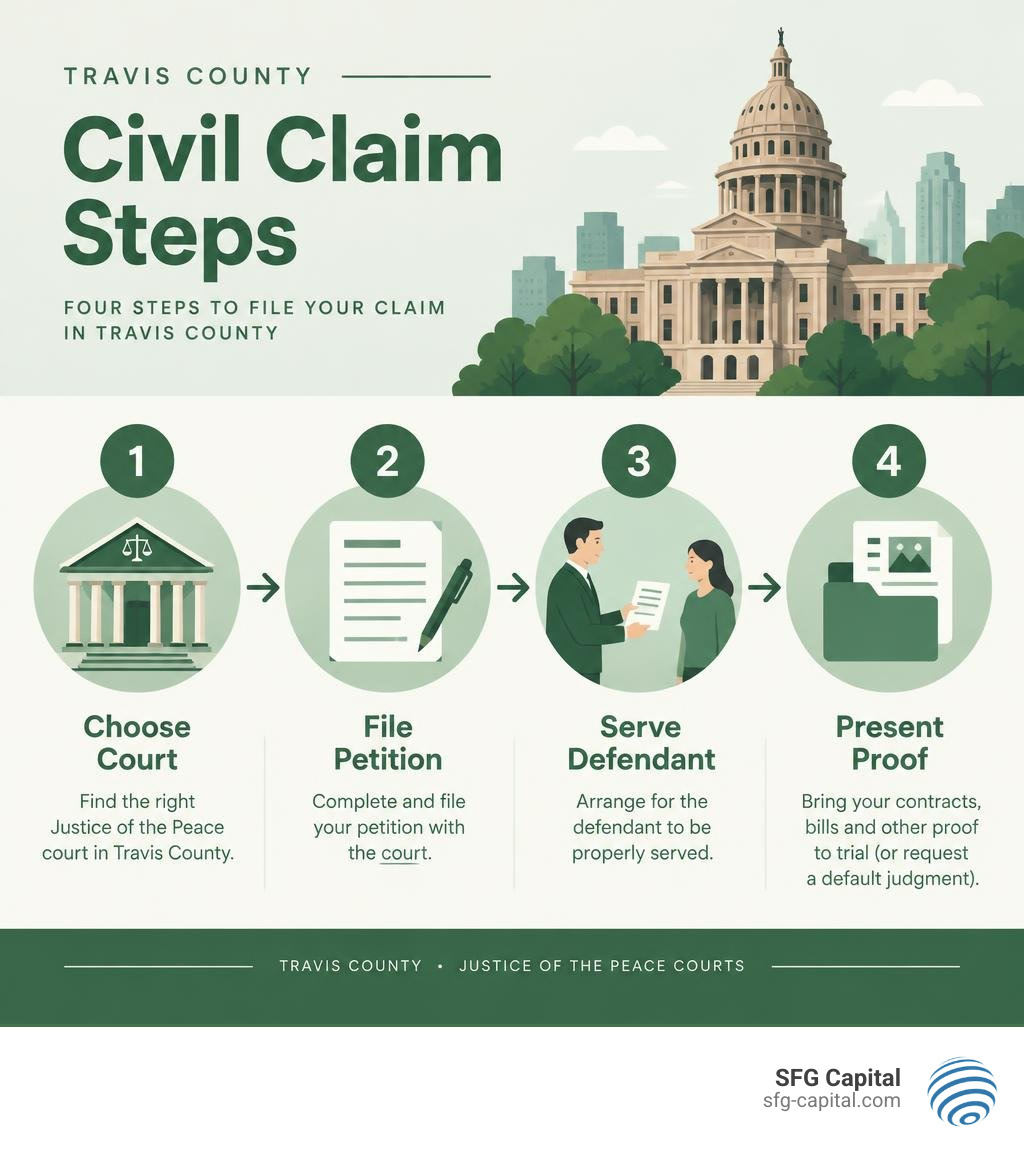
To file a debt or small claims case in Travis County, identify the correct Justice of the Peace court, complete a petition naming the defendant and stating what you seek, then file it with the court and arrange for the defendant to be served. You can file electronically through the Texas e-filing portal or check with the court about filing in person. Keep your contracts, bills, and other proof: you may need them at trial or to request a default judgment.
A credit claim in Justice Court is a lawsuit over an alleged debt. It is not the same as a tax credit claim filed with the IRS. This guide explains the court process first, then points you to other county resources when your issue is not a civil suit.
For Travis County businesses, the same attention to documentation and deadlines that supports a civil claim also matters when pursuing federal refunds. SFG Capital helps local companies accelerate Employee Retention Credit recovery through advances and buyouts, so they are not left waiting on IRS backlogs while managing other financial obligations.
Types of Civil Suits Handled in Travis County Justice Courts
Justice of the Peace (JP) courts in Travis County serve as the primary venue for resolving neighborhood disputes, minor financial disagreements, and landlord-tenant conflicts. Under Texas law, justice courts maintain jurisdiction over civil matters where the amount in controversy does not exceed $10,000, excluding statutory interest and standard court costs. Navigating the rules governing Civil Suits in Travis County ensures that your petition reaches the appropriate judge without unnecessary jurisdictional delays.
The Texas Rules of Civil Procedure govern how claims proceed through the county’s five JP precincts. These courts handle several distinct civil actions:
| Civil Suit Category | Statutory Limit | Primary Legal Remedy | Typical Filing Party |
|---|---|---|---|
| Small Claims | Up to $10,000 | Monetary recovery or return of personal property | Individuals, contractors, private citizens |
| Debt Claims | Up to $10,000 | Recovery of unpaid consumer loans, credit accounts | Institutional lenders, collection agencies |
| Evictions | Possession of property | Writ of Possession, unpaid back rent | Property managers, residential landlords |
| Repair & Remedy | Up to $10,000 | Court-ordered residential repairs, rent reduction | Residential tenants |
Small Claims Procedures and Texas Venue Requirements
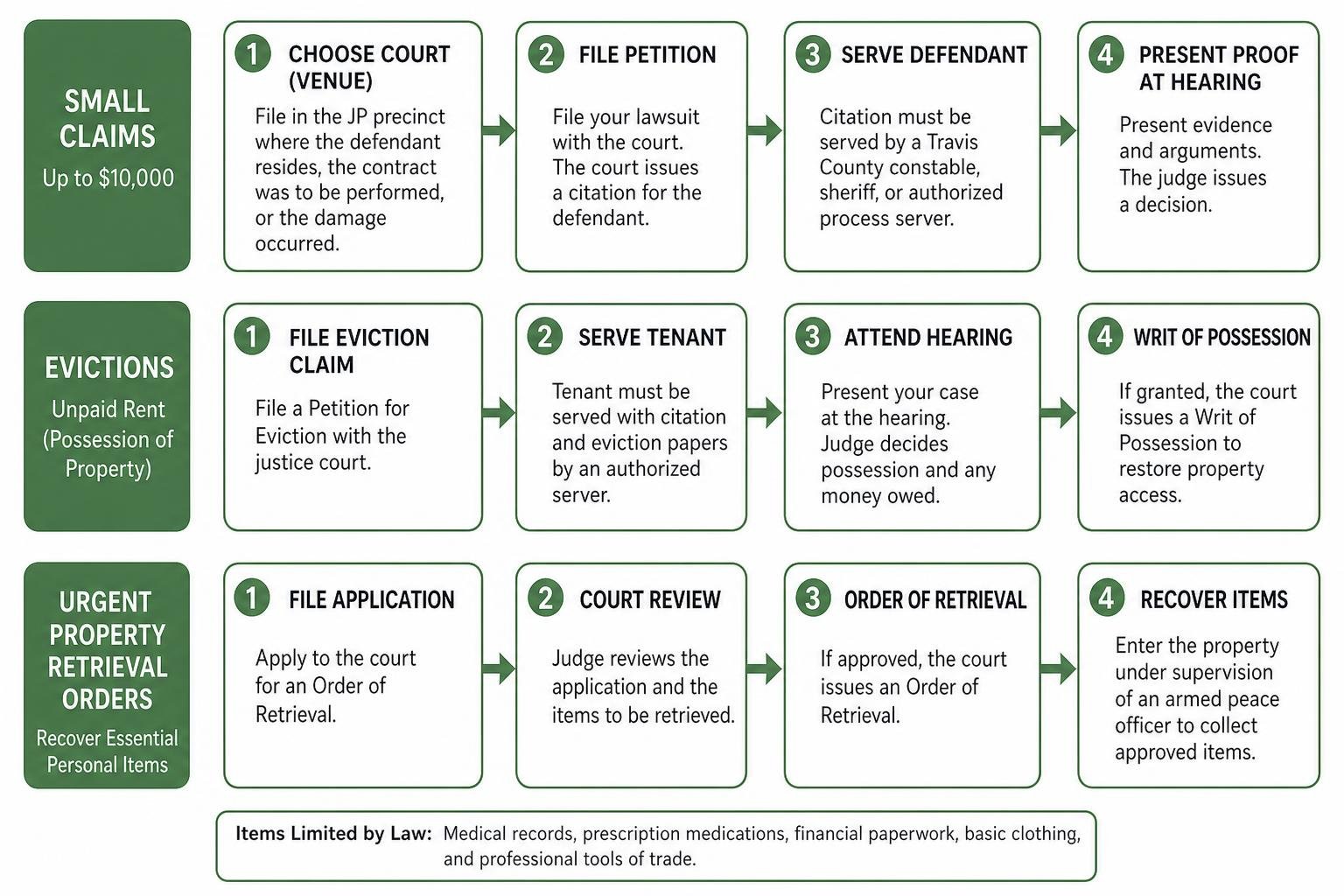
When you prepare to file a small claims lawsuit, understanding where to file is just as critical as the claim itself. The Self-Help Legal Information Packet provided by the Texas Justice Court Training Center outlines strict venue mandates. Generally, you must file your lawsuit in the Justice of the Peace precinct where the defendant resides, where the contract was to be performed, or where the property damage or personal injury occurred.
Filing in the wrong precinct exposes your petition to a Motion to Transfer Venue, adding months to your timeline. Once filed, the court issues a citation that must be officially served on the defendant. Service cannot be executed by you personally; it requires delivery by a Travis County constable, sheriff, or an authorized private process server. Keep the Texas statute of limitations in mind: you generally have four years to bring actions on breach of contract and debt disputes, but only two years for personal injury or property damage claims.
Evictions, Writs of Re-Entry, and Orders of Retrieval
Beyond straightforward monetary disputes, justice courts manage urgent residential access and property remedies. When an unlawful lockout occurs, a tenant can petition the court for an immediate Writ of Re-Entry to regain access to their leased home.
Similarly, if you have been locked out of a residence or business and need to recover vital personal items, you may apply for an Order of Retrieval. This order allows you to enter the property under the direct supervision of an armed peace officer to collect urgent necessities. Texas law strictly limits these retrieval items to medical records, prescription medications, financial paperwork, basic clothing, and professional tools of trade.
Navigating the Travis County Credit Claim and Debt Lawsuit Process
A debt claim lawsuit in justice court is formal litigation brought by a business, collection agency, or debt purchaser to recover unpaid debts arising under written contracts or credit agreements. Governed by Part V of the Texas Rules of Civil Procedure and the Texas Finance Code, these proceedings require precise documentation to establish the chain of title for any transferred debt.
How to File a Travis County Credit Claim in Justice Court
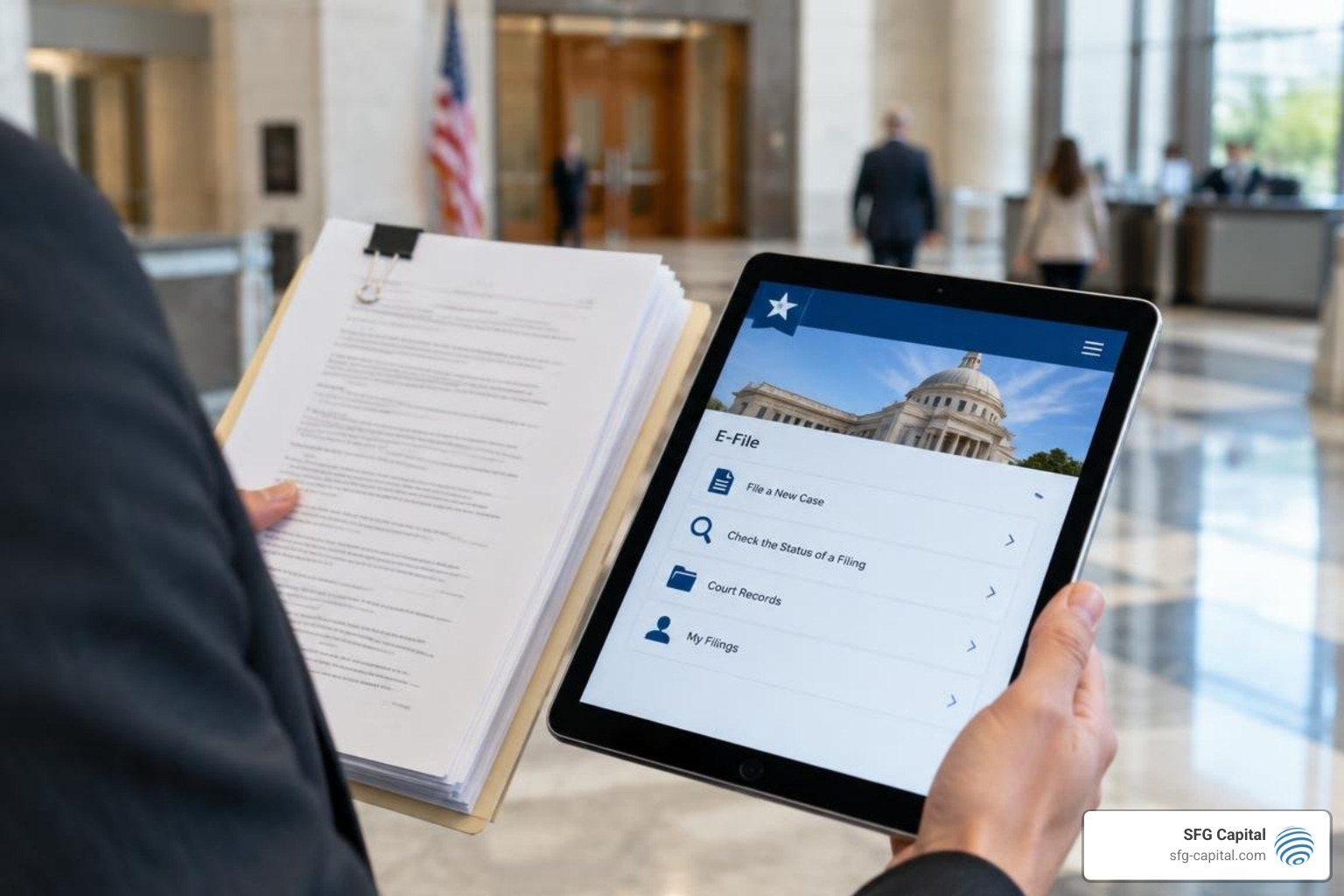
All formal petitions in Travis County JP courts are submitted electronically through the statewide E-File portal. Initiating the claim requires:
- Drafting an itemized original petition outlining the original creditor, current account holder, and exact balance.
- Completing a mandatory Civil Case Information Sheet specifying the dispute type.
- Paying the requisite court filing fee alongside the service fee for citation delivery.
Ensuring every contract exhibit, assignment document, and calculation matches the petition is vital. The same administrative precision applies when businesses manage complex tax credit documentation to establish legitimate claim validity with authorities.
Default Judgments and Mandatory Evidentiary Exhibits
If the defendant is properly served and fails to submit a written answer within the statutory deadline (by 10:00 a.m. on the Monday following the expiration of 14 days from service), the plaintiff can request a default judgment.
According to local Civil Court Guidelines, winning a default judgment is not automatic. The court requires specific evidentiary exhibits attached as separate files:
- Servicemembers Civil Relief Act (SCRA) Affidavit: A sworn statement verifying the defendant’s active-duty military status via the Defense Manpower Data Center.
- Certificate of Last Known Address: Sworn verification of where the defendant currently receives mail.
- Contractual Evidence: The original signed agreement or credit agreement terms.
- Custodian of Business Records Affidavit: An affidavit under Texas Rule of Evidence 902(10) authenticating accounting ledgers, itemized billing statements, and debt assignment records.
Resolving a Disputed Travis County Credit Claim and Judgment Enforcement
When a defendant files an answer contesting the credit claim, the court schedules a pre-trial conference or trial. If the parties do not settle, the judge evaluates the evidence and renders a final judgment.
Securing a favorable ruling is only half the battle; the court does not collect the money for you. Creditors use specific post-judgment enforcement mechanisms:
- Abstract of Judgment: Recorded in the Travis County deed records to place a lien on non-exempt real estate owned by the judgment debtor.
- Writ of Execution: Authorizes a county constable to seize non-exempt personal or commercial property to satisfy the balance through public auction.
- Writ of Garnishment: Directs third-party financial institutions holding the debtor’s bank accounts to freeze and remit eligible funds.
For Travis County companies, recovering what is owed—whether through a court judgment or a federal tax credit—often depends on having the right documentation and the patience to work through administrative delays. SFG Capital helps local businesses accelerate Employee Retention Credit refunds through advances and buyouts, providing faster access to working capital while IRS processing timelines remain uncertain.
County Financial Relief, Bond Refunds, and Consumer Protections

Aside from active litigation, county administrative offices provide essential relief mechanisms, statutory fee reimbursements, and identity protections for residents and businesses managing balance sheets.
Cash Bail Bond Release Procedures and LGC 117.055 Fees
Individuals who post a cash bail bond on behalf of a criminal defendant are entitled to recover those funds once the underlying criminal case concludes. To initiate the refund, the depositor submits a Cash Bail Bond Refund Motion directly to the County or District Clerk along with the original deposit receipt.
Under Texas Local Government Code Section 117.055, the clerk deducts an administrative fee equal to 5 percent of the withdrawal amount, capped at a maximum of $50, if the defendant is convicted. However, if the case is dismissed without a plea or the defendant is found not guilty, the statutory fee is entirely waived. If an administrative fee was deducted prior to a final dismissal, the clerk is legally required to issue a full reimbursement.
Delinquent Tax Installment Plans, SNAP Benefits, and Veterans Assistance
Taxpayers facing overdue local property obligations can utilize Delinquent Property Tax Installment Applications to avoid costly tax suits. The tax office provides 12-month payment agreements for residential real estate and up to 6-month plans for business personal property, provided the applicant has a working email and maintains good standing on other property accounts.
Emergency nutritional assistance is also coordinated at the county level. Under the HHSC Replacement SNAP Benefits Announcement, households that lose food during natural disasters or power disruptions can submit Form H1855 or dial 2-1-1 (Option 7) within designated emergency filing windows.
Additionally, local former service members can leverage the Travis County Veterans Services department for accredited assistance with VA disability claims, administrative appeals, and free local notary support. Maintaining overall financial health across these county channels mirrors the rigor needed for local enterprise financial qualification when accessing major capital recovery programs.
Travis County Credit Union Data Breach Response and Credit Monitoring
In 2026, cybersecurity protocols took center stage after Travis County Credit Union disclosed an unauthorized email access incident. The breach compromised personal identifiers including Social Security numbers, dates of birth, physical addresses, driver’s licenses, and government identification records. The incident affected 2,996 Texas residents alongside out-of-state accounts, totaling 3,315 impacted individuals nationwide.
In response, institutions enacted password resets, session token revocations, and enhanced multi-factor authentication. Through Travis County Credit Union Member Support, affected members were provided activation codes for 24 months of complimentary credit monitoring and identity restoration services via Experian IdentityWorks, with an enrollment cutoff date of October 31, 2026. Managing personal data integrity is fundamental to corporate resilience, particularly when understanding commercial liquidity and recovery solutions for enterprise balance sheets.
Frequently Asked Questions About Travis County Court Claims
What happens if a defendant fails to answer a Justice Court lawsuit?
If a defendant fails to file a written answer with the court by 10:00 a.m. on the Monday following the expiration of 14 days from the date of citation service, they enter default status. The plaintiff can submit a formal Motion for Default Judgment accompanied by a non-military status affidavit, an account statement, and a certificate of last known mailing address. If the submitted documentation establishes valid damages, the judge will render an enforceable default judgment without conducting an in-person trial.
How can I claim replacement SNAP benefits or property tax relief in Travis County?
To claim replacement SNAP food benefits after a storm or power outage, complete Texas Health and Human Services Form H1855 or call 2-1-1 within the county-designated filing window. Approved benefits are reloaded to Lone Star Cards within two business days. For delinquent property taxes, navigate to the Travis County Tax Office Account Search portal, locate your property ID, and select the payment plan button to establish a 6-to-12-month installment schedule.
What steps are required to release deposited cash bail bond funds?
To release deposited cash bail funds:
- Ensure the underlying criminal case has reached final disposition (dismissal, acquittal, or sentencing).
- Complete the Travis County Motion to Release Funds Deposited for Cash Bail Bond form.
- Attach the original cash bail receipt showing your depositor details.
- File the paperwork with the District or County Clerk. The clerk will process the payment, withholding an administrative fee of up to 5 percent (maximum $50) for convictions, or providing a 100 percent refund if the case was dismissed.
Conclusion
Whether you are preparing a small claims petition, seeking emergency county relief, or resolving a disputed civil balance, working through Travis County’s legal and administrative systems requires procedural accuracy and prompt filing. Securing court judgments and managing public records demands the same structured approach as managing corporate assets.
At SFG Capital, we understand the value of financial timing and thorough claims documentation. When IRS backlogs lock up vital capital, our team helps local business owners accelerate their Employee Retention Credit recovery through upfront advances and buyout programs. Explore our dedicated commercial refund services to bypass administrative bottlenecks and unlock the working capital your business needs to grow.
See what your business may qualify for.
60 seconds. No documents. No upfront cost.
General information only, not legal or tax advice. Eligibility and estimates are fact-specific and subject to review.