
Blog / Insights
InsightsOwner Wages and the ERC Explained
November 21, 2026 · 8 min read · By the SFG Capital team
Can Owner Wages Qualify for the Employee Retention Credit?
A majority owner’s W-2 wages can qualify for the Employee Retention Credit (ERC), but only if the related-party rules do not exclude them. A living sibling, ancestor, or descendant generally rules out the owner’s pay and often the spouse’s pay. If the owner has none of those relatives, both spouses’ employee wages may qualify, provided the employer meets the other ERC rules. A sole proprietor’s own self-employment income does not count.
These family rules can change the value of a pending ERC claim. Any credit or funding estimate depends on a review of the claim.
I’m Santino Battaglieri, founder of SFG Capital. My work on employee retention credit owner wages draws on more than nine years in financial services and SFG Capital’s experience purchasing and funding ERC claims.
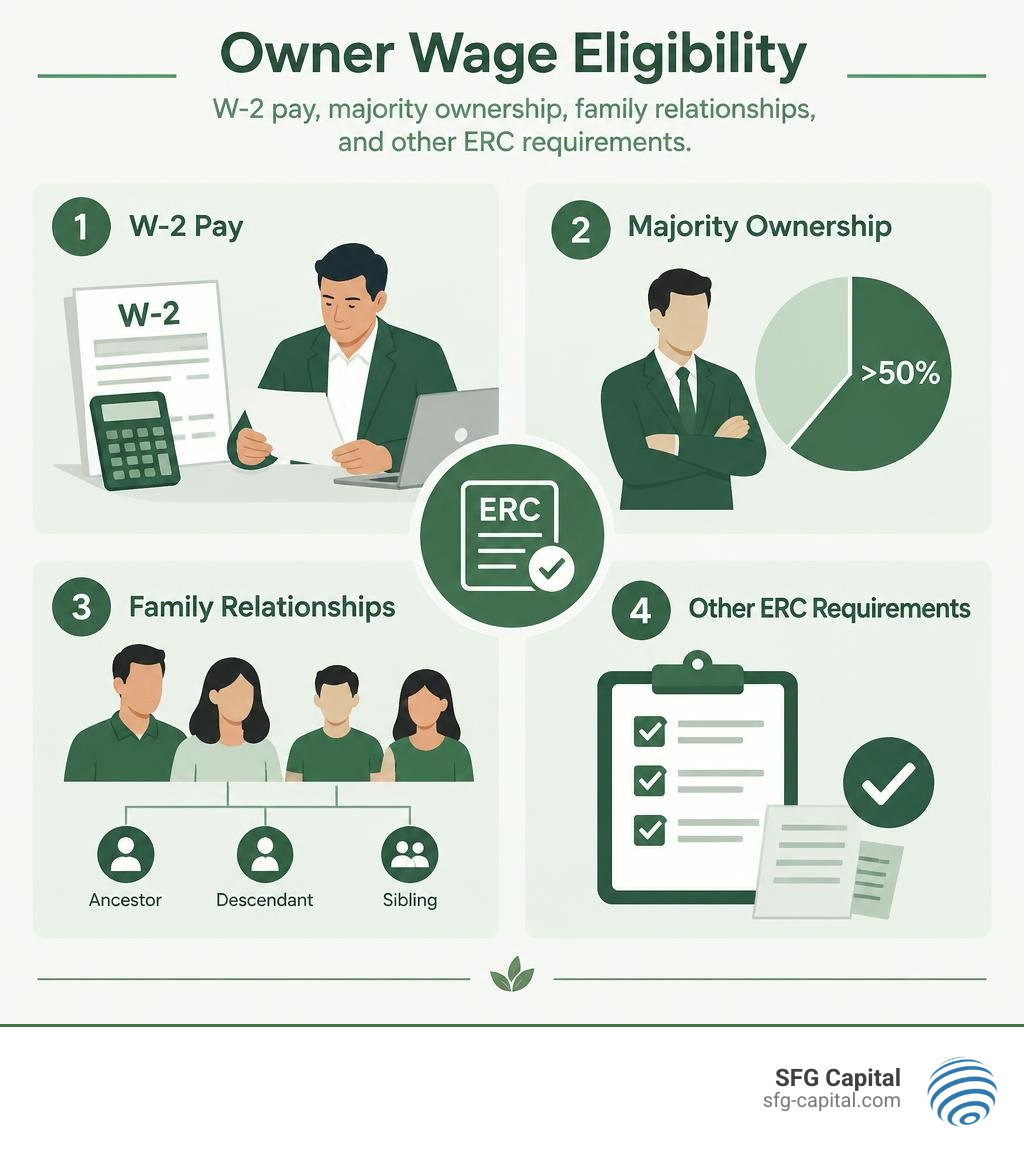
Important employee retention credit owner wages terms:
Rules Governing Employee Retention Credit Owner Wages Under IRS Guidance
The Employee Retention Credit originated under Section 2301 of the Coronavirus Aid, Relief, and Economic Security (CARES) Act and was later expanded by the Taxpayer Certainty and Disaster Tax Relief Act of 2020 and the American Rescue Plan Act. Designed to encourage businesses to keep staff on payroll during pandemic-related government shutdowns or gross receipts declines, the credit offers substantial relief:
- For 2020: The credit equals 50 percent of qualified wages paid to employees, capped at $10,000 in wages per employee for the year (a maximum credit of $5,000 per employee).
- For 2021: The credit equals 70 percent of qualified wages per employee per quarter, capped at $10,000 in wages per quarter across the first three calendar quarters (a maximum credit of $21,000 per employee, or up to $28,000 if qualifying as a recovery startup business across all four quarters).
Official guidance in IRS Notice 2021-20 and Notice 2021-49 laid out strict parameters for what constitutes eligible payroll. While non-owner employee salaries are straightforward, understanding ERTC qualified wages for business owners requires navigating complex constructive ownership and related-party statutes.
If you are waiting months for the IRS to resolve a payroll tax claim or want to verify that your compensation figures comply with current rules, See if you qualify for accelerated funding through a short form with no upfront cost and no initial documentation required.
Constructive Ownership and Employee Retention Credit Owner Wages
To evaluate owner pay, the IRS cross-references Internal Revenue Code (IRC) Section 51(i)(1) with the constructive ownership rules of IRC Section 267(c). Under IRC Section 51(i)(1), wages paid to an individual who owns—directly or indirectly—more than 50 percent in value of the outstanding stock of a corporation (or capital/profits interest in an unincorporated entity) are disqualified if that individual has certain familial ties.
The complexity arises through IRC Section 267(c) attribution:
- An individual is treated as owning the stock directly owned by their family members (defined as brothers, sisters, spouse, ancestors, and lineal descendants).
- When an owner’s relative is deemed to constructively own 100 percent of the business, the owner becomes a “related party” to their own relative under IRC Section 152(d)(2).
- Because the owner is now related to an indirect majority shareholder, their own wages are barred from qualifying.
This statutory loop means that an owner does not need to employ their family members to be disqualified. The mere legal existence of living relatives triggers constructive ownership, impacting core ERC qualifications.
The Rare Exception: Owners with No Living Relatives
The IRS clarified in Notice 2021-49 that a majority owner’s wages can qualify under one rare condition: the owner must have no living brother or sister (whole or half-blood), ancestor (parents, grandparents), or lineal descendant (children, grandchildren).
When no such relatives exist, there is no family member to whom the owner’s shares can be attributed. In that unique scenario:
- The majority owner is not considered a related individual under Section 51(i)(1).
- Wages paid to the majority owner qualify for the credit.
- Wages paid to the owner’s spouse also qualify (assuming the spouse has no disqualifying family relationships to other indirect owners).
The table below summarizes how living relative status controls whether you can claim qualifying 2020 wages and 2021 wages for owners:
| Ownership Structure | Living Relatives Present? | Owner Wages Eligible? | Spouse Wages Eligible? |
|---|---|---|---|
| >50% Majority Owner | Yes (Parents, Siblings, or Children) | No | No |
| >50% Majority Owner | No (No living ancestors, siblings, or descendants) | Yes | Yes |
| 50/50 Unrelated Partners | N/A (Each owns ≤50% directly/indirectly) | Yes | Yes |
| Sole Proprietorship (Schedule C) | N/A | No (Self-employment draw is not W-2 wage) | No |
Disqualifying Family Relationships Under IRC Sections 267(c) and 51(i)

The related-party rules outlined in IRC Section 152(d)(2) identify the specific relationships that bar wage eligibility. If an employee bears any of the following relationships to a direct or indirect majority owner, their wages cannot be claimed:
- Child, stepchild, or descendant of a child
- Brother, sister, stepbrother, or stepsister
- Father, mother, or ancestor of either
- Stepfather or stepmother
- Niece or nephew
- Aunt or uncle
- Son-in-law, daughter-in-law, father-in-law, mother-in-law, brother-in-law, or sister-in-law
Before preparing an amended payroll return, checking basic eligibility requirements ensures you do not inadvertently submit ineligible family compensation.
How Attribution Rules Impact Spouses and Children
Attribution can create double-traps for family-run businesses. Consider a corporate structure where a husband owns 100 percent of the business and employs his wife. If the couple has a child, the husband’s shares are attributed to the child under Section 267(c). The wife is the mother of that child, creating an immediate parent-child relationship with a constructive 100 percent owner. As a result, the wife’s wages are completely disqualified.
For single-member entities and founders, review solo entrepreneur application rules to confirm whether your business structure utilizes W-2 wages or self-employment draws, as only taxable W-2 wages are eligible for ERC consideration.
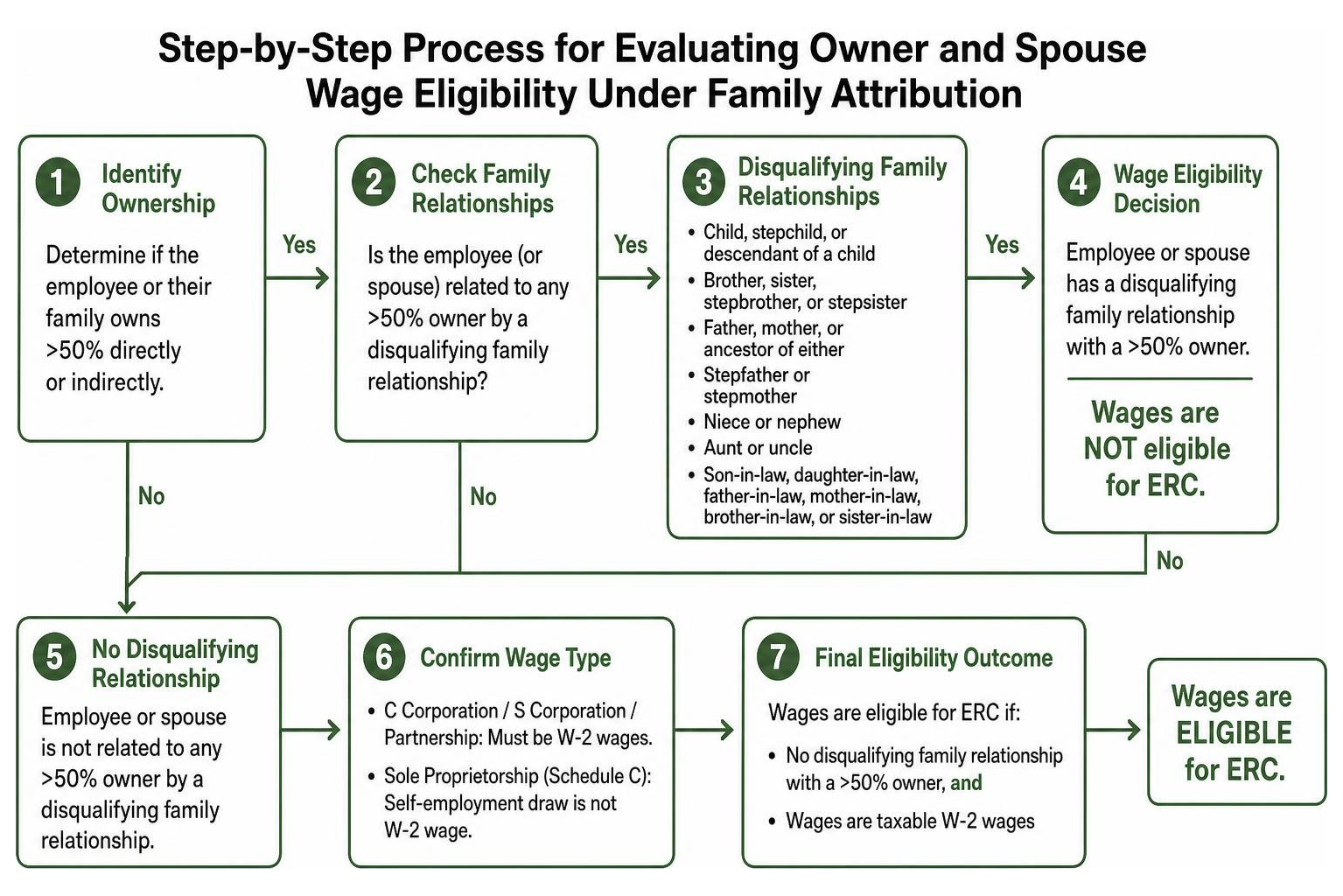
Impact of Direct vs Indirect Business Ownership
The method by which you hold equity in a C corporation, S corporation, or partnership influences the attribution analysis:
- S Corporations: Shareholder-employees who own more than 50 percent directly or through attribution cannot include their wages if disqualifying relatives exist.
- Partnerships: A partner holding greater than a 50 percent capital or profits interest is subject to similar restrictions on guaranteed payments and employee wages.
- Minority Ownership Groups: If two completely unrelated individuals each own 50 percent of a corporation and neither has family members employed by or owning stock in the company, neither person crosses the greater-than-50-percent threshold. In this scenario, both owners’ W-2 wages can qualify.
Review the guidelines on IRS ERC claims to understand how business entity classifications interact with relief programs. If you want to evaluate your potential claim value without sifting through complex tax law alone, See if you qualify through a preliminary review with no documents needed to start.
Income Tax Reporting and Wage Deduction Reductions

Claiming the ERC carries direct income tax consequences. Under IRC Section 280C(a), an employer cannot claim a business expense deduction for wages equal to the amount of the employment tax credit received.
This means businesses must reduce their wage expense deductions on their federal income tax return for the tax year in which the qualified wages were paid—not the year the credit check is deposited or processed. Correctly calculating credit math accurately ensures that you do not understate or overstate your business’s taxable income when properly amending Form 941.
Tax Deduction Adjustments for Employee Retention Credit Owner Wages
For pass-through entities such as S corporations and partnerships, the reduction in wage deductions increases ordinary business income, which flows through to the owners’ individual tax returns via Schedule K-1. This tax treatment is an important consideration when evaluating owner wages for the employee retention credit.
Key considerations include:
- Timing Discrepancies: If you claimed retroactive ERC for 2020 or 2021 wages in a later calendar year, you were technically required to amend the corresponding 2020 or 2021 corporate income tax returns to reduce deductible wage expenses.
- PPP Coordination: You must coordinate ERC wage allocations alongside Paycheck Protection Program (PPP) loan forgiveness. Wages utilized for PPP forgiveness cannot be double-counted as qualified ERC wages. Reviewing guidance on coordinating PPP forgiveness and ERC prevents overlapping payroll expense claims.
Navigating Recent IRS Updates on Amended Returns
In recent filing cycles, backlogs at the IRS created friction for businesses facing closed statute-of-limitations windows for 2020 and 2021 income tax amendments. In updated administrative guidance, the IRS discussed reporting alternatives—such as the tax benefit rule—allowing certain taxpayers to recognize the credit adjustment in the year of receipt if amending prior-year returns is barred by statutory deadlines.
Given rigorous audit procedures and penalty enforcement on payroll claims, maintaining full substantiation of ownership, family trees, and gross receipts records is essential. If you have questions about how these rules impact your pending refunds or want help evaluating your filing, speak directly with a specialist via the SFG Capital contact page.
Frequently Asked Questions About Owner Wages and the ERC
Can a majority business owner claim the ERC on their own salary?
Generally, no. If a majority owner (owning more than 50 percent of the business value or profits) has any living sibling, ancestor, or lineal descendant, their wages are excluded from qualified wages under the constructive ownership and related-party rules of IRC §§ 267(c) and 51(i)(1). The only exception occurs when the majority owner has absolutely no living siblings, ancestors, or descendants.
Under what circumstances are spousal wages eligible for the credit?
Spousal wages qualify only if the majority owner has no living ancestors, siblings, or descendants whose attribution would create a disqualified familial relationship under IRC § 152(d)(2). If the couple has children, the children are deemed 100 percent owners, which immediately disqualifies the spouse (as the parent of the constructive owner).
How does PPP loan forgiveness impact owner wage calculations for the credit?
Wages paid to owners or employees that were used to obtain PPP loan forgiveness cannot be counted as qualified wages for the ERC. Businesses must separate payroll dollars allocated toward PPP forgiveness from the payroll dollars submitted on Form 941-X.
Conclusion
Understanding the rules governing owner compensation is critical for compliant Employee Retention Credit filings. While non-owner employees often qualify under standard decline-in-gross-receipts or suspension tests, owner and spouse eligibility requires an analysis of family trees, constructive ownership percentages, and wage deduction adjustments.
At SFG Capital, we help businesses across the United States—including Austin and Travis County—navigate complex government programs. When dealing with extended IRS delays on pending payroll tax refunds, tariff refunds, or other credits, we provide ERC advances and claim buyouts so you can access capital without waiting years on the Treasury.
All funding estimates and advance approvals are subject to a detailed, case-by-case claim review. To explore your options, See if you qualify today through our simple questionnaire with no upfront fees.
See what your business may qualify for.
60 seconds. No documents. No upfront cost.
General information only, not legal or tax advice. Eligibility and estimates are fact-specific and subject to review.