
Blog / Insights
InsightsThe Ultimate ERC Qualification Checklist for Small Businesses
November 4, 2026 · 9 min read · By the SFG Capital team
How to Check Employee Retention Credit Criteria
To check employee retention credit criteria, start with the quarter when you paid employees. Your business may qualify if a COVID-19 government order fully or partly suspended its operations, its gross receipts fell enough compared with the required earlier period, or it met the special rules for a recovery startup business in late 2021. Then check which wages count. Receiving a PPP loan does not rule you out, but you cannot use the same wages for PPP forgiveness and the ERC.
The ERC was a refundable payroll tax credit meant to help employers keep staff during the pandemic. As of October 2026, the usual deadlines for new amended ERC refund claims have passed. If you already filed, your payroll records, receipts, and any government orders are still important for supporting the claim.
I’m Santino Battaglieri, founder of SFG Capital, with more than nine years of experience in financial services. My work with ERC claims has shown me why checking employee retention credit criteria carefully matters before relying on a refund.
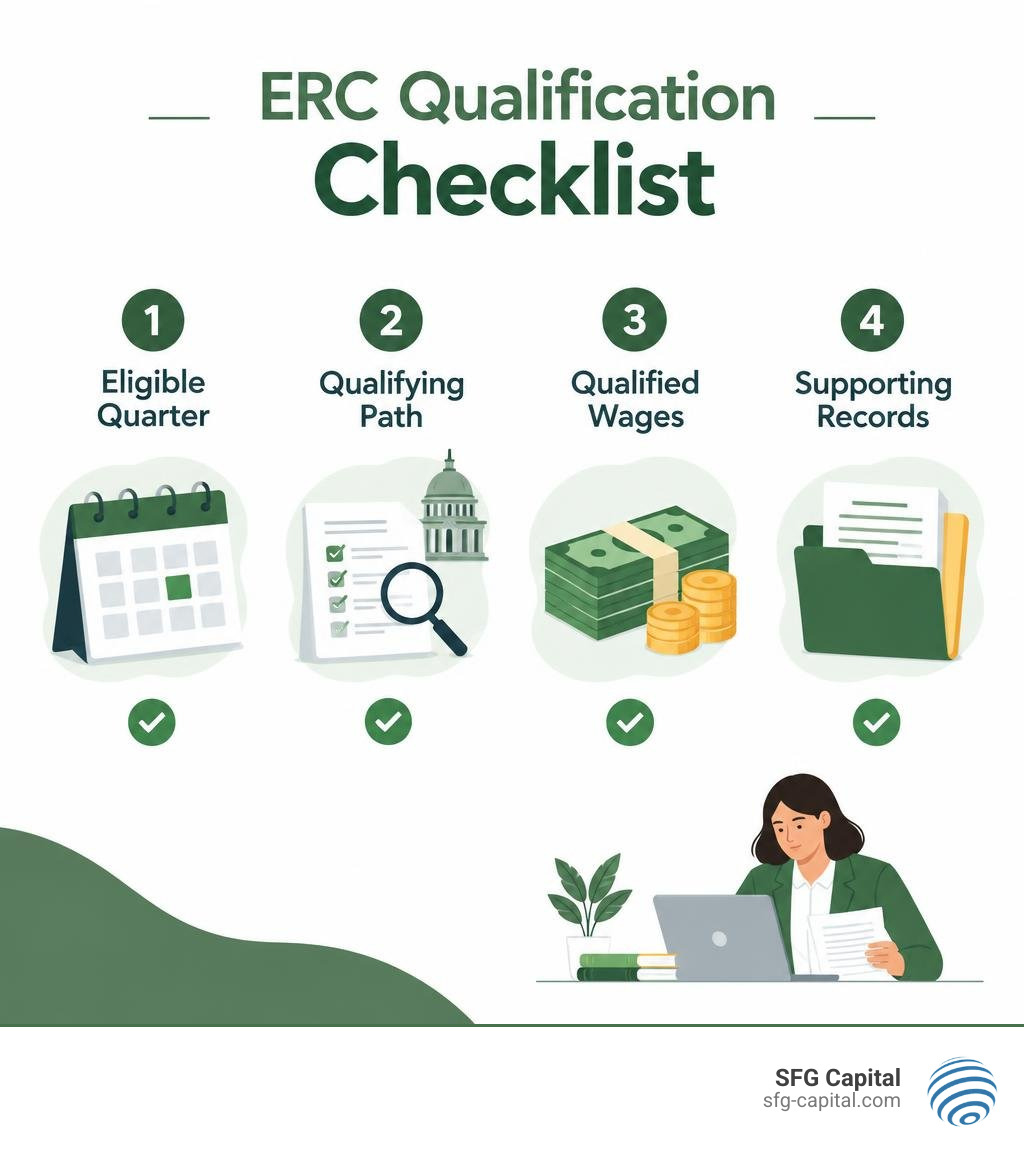
Employee retention credit criteria basics:
- employee retention credit guidelines
- calculating employee retention credit
- employee retention credit qualified wages 2026
Core Employee Retention Credit Criteria: The 3 Main Qualification Paths
To successfully substantiate a claim, an employer must satisfy clear, statutory criteria. The Employee Retention Credit was established under the CARES Act in 2020 and subsequently expanded by the Consolidated Appropriations Act and the American Rescue Plan Act (ARPA). Before diving into the numbers, understanding what the ERC program is requires looking at who the credit was built for: employers operating a trade, business, or tax-exempt organization that paid qualified wages between March 13, 2020, and December 31, 2021.
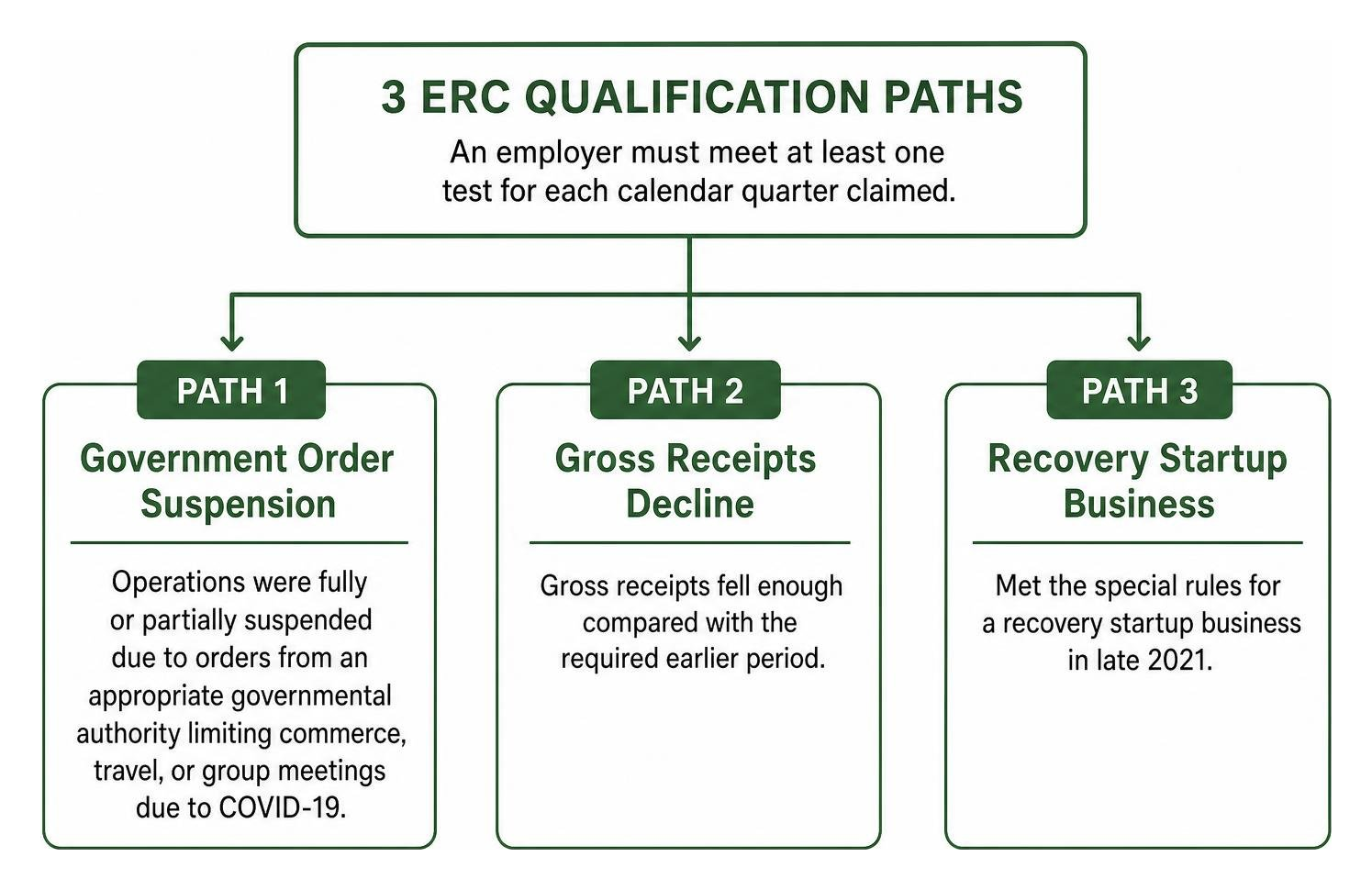
An employer must meet at least one of three distinct qualification tests for each calendar quarter claimed. You can review your baseline qualification with our practical ERC eligibility checklist.
Government Order Suspension and Employee Retention Credit Criteria
The first pathway allows an employer to qualify if their trade or business operations were fully or partially suspended due to orders from an appropriate governmental authority limiting commerce, travel, or group meetings due to COVID-19.
- Full Suspension: An operational shutdown where mandatory orders completely halted business activities (such as mandatory closures of non-essential storefronts).
- Partial Suspension: When governmental mandates forced operational adjustments, such as capacity restrictions, reduced operating hours, or the complete curtailment of specific service lines. If you adapted your operations under these limits, see our detailed breakdown on qualifying during a partial shutdown.
Under IRS guidance (such as Notice 2021-20), an employer’s operations are considered partially suspended if a government mandate had a “more than nominal” effect on business operations—generally defined as affecting at least 10% of total service capacity or gross revenue.
A critical point emphasized by the IRS: general supply chain disruptions do not automatically qualify your business unless you can prove that a specific governmental order shut down a direct supplier, making it impossible to obtain critical goods or materials. Detailed requirements can be referenced through the official IRS ERC portal.
Gross Receipts Test and Employee Retention Credit Criteria for 2020 vs. 2021
The second method is an objective financial test based on quarterly revenue drops compared to pre-pandemic baseline figures from 2019. The threshold rules differ significantly between the 2020 and 2021 tax years. For a comprehensive walkthrough, explore our revenue drop eligibility rules.
| Tax Year | Required Gross Receipts Reduction | Baseline Comparison Period | Exit Threshold Rule |
|---|---|---|---|
| 2020 | Decline of > 50% | Same calendar quarter in 2019 | Ends in the quarter following the quarter when gross receipts recover to > 80% of 2019 levels. |
| 2021 | Decline of > 20% | Same calendar quarter in 2019 (or alternative prior quarter) | Evaluated independently per quarter (Q1, Q2, and Q3 2021). |
For 2020, qualification begins in the first quarter where gross receipts are below 50% of the comparable 2019 quarter and continues until the quarter following the one in which gross receipts exceed 80% of the corresponding 2019 baseline.
For 2021, the threshold became significantly more accessible: a drop of more than 20% compared to the same quarter in 2019 was sufficient. Businesses could also elect an alternative quarter rule to compare the immediately preceding quarter to the corresponding 2019 period.
Recovery Startup Business (RSB) Rules
The American Rescue Plan Act introduced a third pathway for newer enterprises: the Recovery Startup Business (RSB) provision. This rule provided crucial support for companies launched during the pandemic that lacked pre-2019 historical revenue data.
According to IRS Notice 2021-49, an employer qualifies as a Recovery Startup Business if:
- The business began operations after February 15, 2020.
- Its average annual gross receipts for the preceding three-year period (or the period of existence) did not exceed $1,000,000.
- It does not otherwise qualify under the full/partial suspension test or the gross receipts decline test.
Special statutory limits apply exclusively to RSBs:
- Eligible claim periods are restricted strictly to Q3 2021 and Q4 2021.
- The maximum credit is capped at $50,000 per calendar quarter, giving an eligible startup a maximum potential refund of $100,000 across both quarters.
Calculating Qualified Wages and Interaction with PPP Loans
Calculating qualified wages requires distinguishing between small and large employer status, properly tabulating qualified healthcare expenses, and coordinating with other federal relief programs.

Small vs. Large Employer Thresholds
- 2020 Calculations: A business with 100 or fewer full-time employees (based on 2019 data) could treat all wages paid to employees during eligible periods as qualified wages. For employers with more than 100 employees, only wages paid to employees not providing services (furloughed or idle staff) counted.
- 2021 Calculations: The threshold expanded significantly. Businesses with 500 or fewer full-time employees in 2019 could claim all wages paid during the eligible quarter.
For a detailed breakdown on payroll components, read our resource on allocating ERTC qualified wages.
| Category | 2020 Guidelines | 2021 Guidelines |
|---|---|---|
| Credit Percentage | 50% of qualified wages | 70% of qualified wages |
| Wage Cap per Employee | $10,000 across the entire year | $10,000 per calendar quarter |
| Maximum Credit per Employee | $5,000 total for 2020 | Up to $7,000 per quarter ($21,000 total across Q1–Q3; $28,000 if eligible RSB in Q4) |
| Employer Size Cap for All Wages | Up to 100 full-time employees | Up to 500 full-time employees |
PPP Loan Coordination and Safe Harbor Rules
Under the original CARES Act, employers who took Paycheck Protection Program (PPP) loans were barred from claiming the ERC. However, the Taxpayer Certainty and Disaster Tax Relief Act of 2020 repealed this restriction retroactively.
Employers may claim both benefits, provided there is no double-dipping: the exact payroll dollars forgiven under PPP cannot be used as qualified wages for the ERC.
To avoid inadvertently failing the gross receipts test due to emergency funds, the IRS released IRS Revenue Procedure 2021-33. This safe harbor allows employers to exclude PPP loan forgiveness amounts, Restaurant Revitalization Grants, and Shuttered Venue Operators Grants from their gross receipts calculations solely when determining ERC eligibility.
Step-by-Step ERC Eligibility Checklist and Documentation
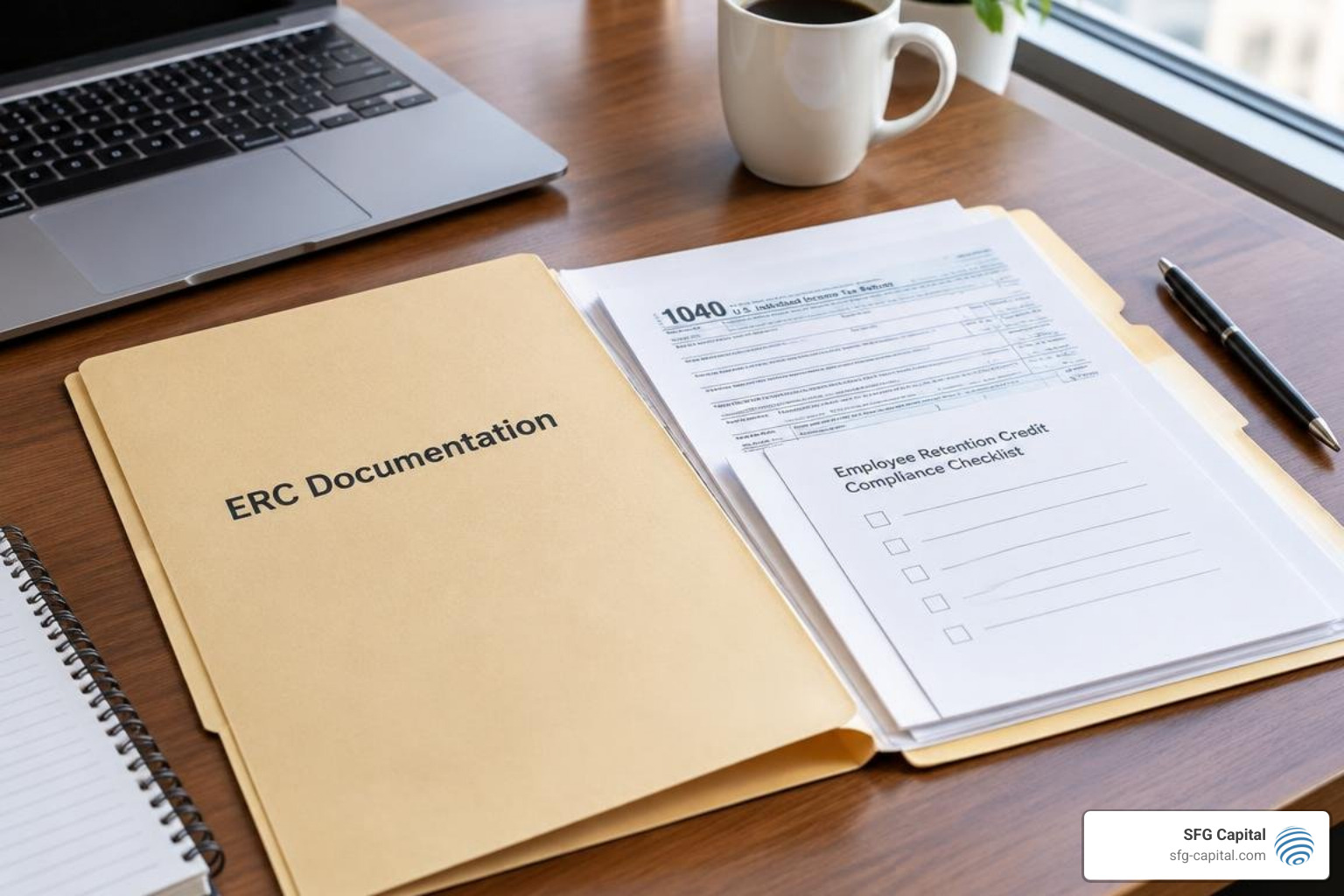
When the IRS audits an ERC claim, the burden of proof rests entirely on the employer. Maintaining an organized, audit-ready substantiation folder is essential.
- Quarterly Federal Tax Returns: Copies of original Form 941 filings and amended Form 941-X returns for all relevant quarters.
- Detailed Payroll Registers: Employee-by-employee wage breakdowns, demonstrating how qualified wages were calculated per pay period, with employer-paid health plan allocations.
- PPP Forgiveness Substantiation: Form 3508/3508EZ applications and SBA forgiveness letters, illustrating the distinct allocation of wages between PPP forgiveness and ERC claims.
- Government Orders File: Copies of specific municipal, county, or state executive orders mandating business closure, capacity caps, or operational restrictions, coupled with internal operational logs showing the exact dates impact began and ended.
- Gross Receipts Calculations: Financial statements, general ledgers, or sales tax returns comparing 2020/2021 quarterly revenues against 2019, including documentation of any safe harbor elections under Rev. Proc. 2021-33.
- Aggregation Group Records: Documentation showing whether your business shared common ownership with other entities under Internal Revenue Code Section 52 or 414, which requires aggregated employee counts and gross receipts.
Navigating IRS Audits, Scam Warnings, and Claim Resolutions
Over the past several years, the IRS placed heightened scrutiny on ERC claims following aggressive marketing by non-credentialed promoters. In October 2026, the IRS continues working through a substantial volume of filings.
As of the week ending October 3, 2026, the IRS reported approximately 13,000 remaining ERC claims moving through administrative review stages:
- 750 under active examination
- 2,300 pending payment or formal disallowance
- 3,000 under field or correspondence audit
- 5,400 awaiting review of responses to disallowance notices
- 1,500 pending before the IRS Independent Office of Appeals
Red Flags of Unscrupulous Promoters
If you utilized an outside third party to prepare your ERC claim, review their work against standard warning signs:
- Unsolicited calls or aggressive marketing promising instant qualification without reviewing detailed payroll or accounting books.
- Charging contingency fees based on a percentage of the total refund amount.
- Asserting qualification based on broad, nationwide supply chain issues without specific local government orders.
What to Do If You Filed an Improper Claim
If you discover that your business filed an erroneous or overstated claim, proactive remediation is critical to mitigate severe penalties:
- IRS Claim Withdrawal Program: If your claim has not been paid, or if you received a check but have not cashed or deposited it, you can request an administrative claim withdrawal. This treats the claim as though it was never filed, eliminating prospective penalties.
- Filing Corrected Returns: If you already deposited refund checks for an improper claim, work with an experienced tax specialist to submit corrected amended payroll returns (Form 941-X) to repay the funds with applicable penalty and interest abatement requests.
Frequently Asked Questions About Employee Retention Credit Criteria
Can I claim the ERC if my business received a PPP loan?
Yes. The Taxpayer Certainty and Disaster Tax Relief Act of 2020 removed the restriction that prohibited PPP recipients from claiming the ERC. However, you cannot allocate the same payroll dollars to both programs. Qualified wages claimed for the ERC must be separated from payroll reported to achieve PPP loan forgiveness.
What is the maximum credit amount per employee?
For calendar year 2020, the maximum credit is $5,000 per employee (50% of up to $10,000 in annual qualified wages). For 2021, the maximum credit is $7,000 per employee per quarter (70% of up to $10,000 in quarterly qualified wages) for Q1, Q2, and Q3, totaling up to $21,000 per employee (or up to $28,000 if eligible as a Recovery Startup Business in Q4).
How can an employer withdraw an incorrect or improper ERC claim?
Employers with pending, uncashed ERC claims can submit a formal withdrawal request directly to the IRS following special agency procedures. If the IRS accepts the withdrawal, the claim is treated as if it were never submitted, avoiding negligence or civil penalties.
Conclusion: Verifying Your ERC Status and Accessing Funding
Understanding the nuances of the Employee Retention Credit criteria is vital for maintaining compliance, defending an existing claim against an audit, or resolving processing delays.
For business owners in Travis County and the surrounding Austin, TX area facing ongoing processing delays or liquidity bottlenecks from pending IRS refunds, professional financial solutions can help bridge the gap. We specialize in providing reliable guidance and financial advance options designed to eliminate waiting periods with performance-based structures.
Explore SFG Capital’s funding and advisory services to review your refund status, ensure strict compliance with federal guidelines, and unlock the working capital your business needs.
See what your business may qualify for.
60 seconds. No documents. No upfront cost.
General information only, not legal or tax advice. Eligibility and estimates are fact-specific and subject to review.